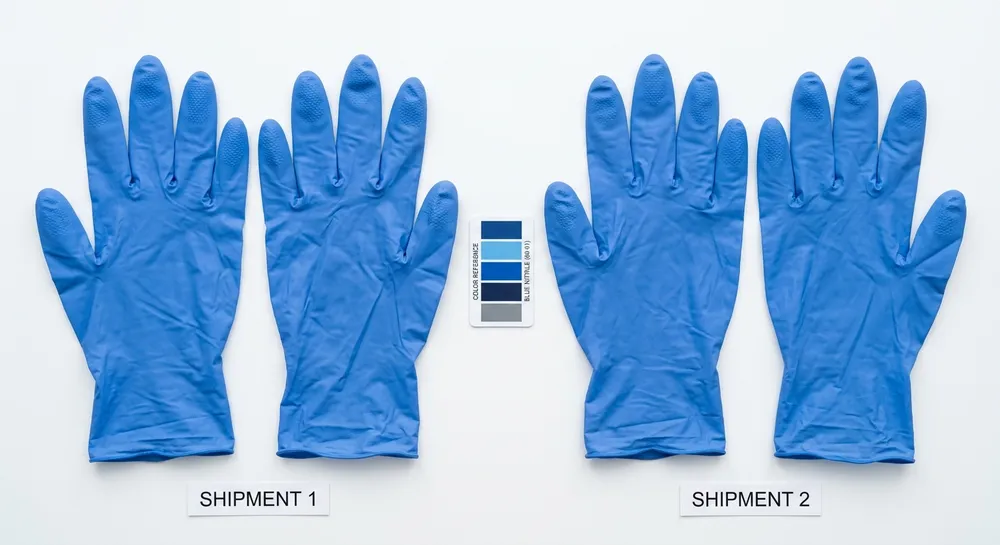
The first container looks right. The gloves match the sample. Your customer approves them. You reorder.
The second container arrives and something is off — the blue is slightly different, the fingertip texture feels thinner, or your customer's QC team flags a higher pinhole rate than the first shipment. You go back to the factory. They tell you the gloves meet spec. You're looking at the same spec sheet you approved six months ago, and you can't prove otherwise.
That's spec drift. It's one of the most common and expensive problems in nitrile glove sourcing, and it almost always starts before the container ships — not after.
This guide walks through how to structure a container order for Disposable Blue Nitrile Gloves so that what arrives in your warehouse on the fifth shipment is the same product you approved on the first.

Where spec drift actually starts
Most buyers assume spec drift is a production problem. It's usually a documentation problem.
When you place a first order, the factory works from a sample or a verbal brief. The production team hits the target. But if the spec was never formally locked — thickness tolerance, color reference, AQL level, packaging format — then the next production run starts from memory, not from a document. Small deviations accumulate. By the third or fourth container, the product has drifted enough to cause complaints.
The mechanism is straightforward: nitrile compound formulation affects both color and physical properties. A small shift in the nitrile-to-filler ratio changes tensile strength and elongation. A change in the pigment batch changes the blue. Neither change is intentional — it's what happens when a factory runs your SKU between other orders without a locked formulation record tied to your account.
We see this most often with buyers who approved a sample, placed a trial order, and then scaled up without ever issuing a formal product specification document. The factory has no anchor. Each run is a best-effort match to the previous one.
Step 1: Lock the spec before the first production run
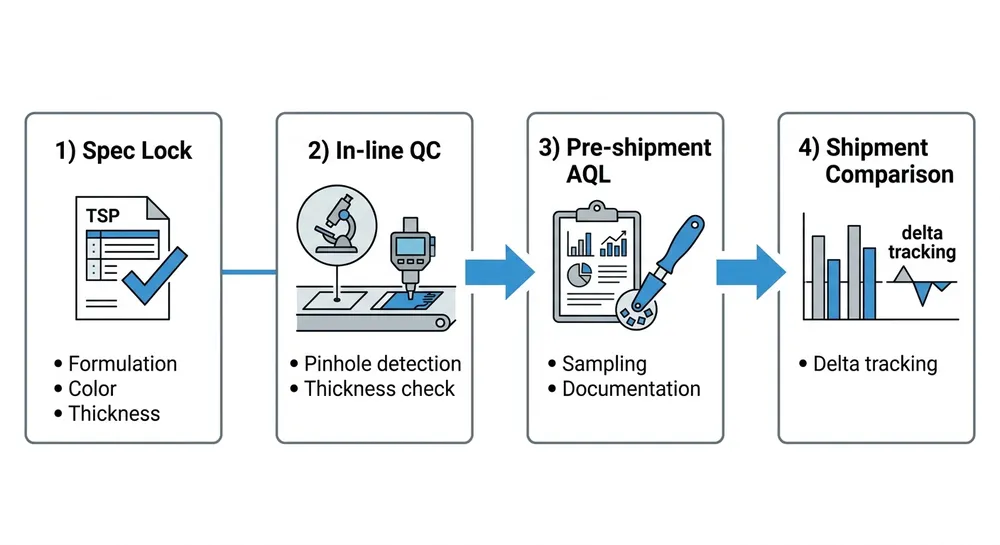
Before any production starts, issue a written product specification that covers at minimum:
- Color reference: Pantone number or physical color chip retained by both parties. "Blue" is not a spec. We use Pantone 2935 C as a standard reference for our mid-blue SKU — buyers who want a specific shade should provide a physical chip or agree on a Pantone code in writing before the first run.
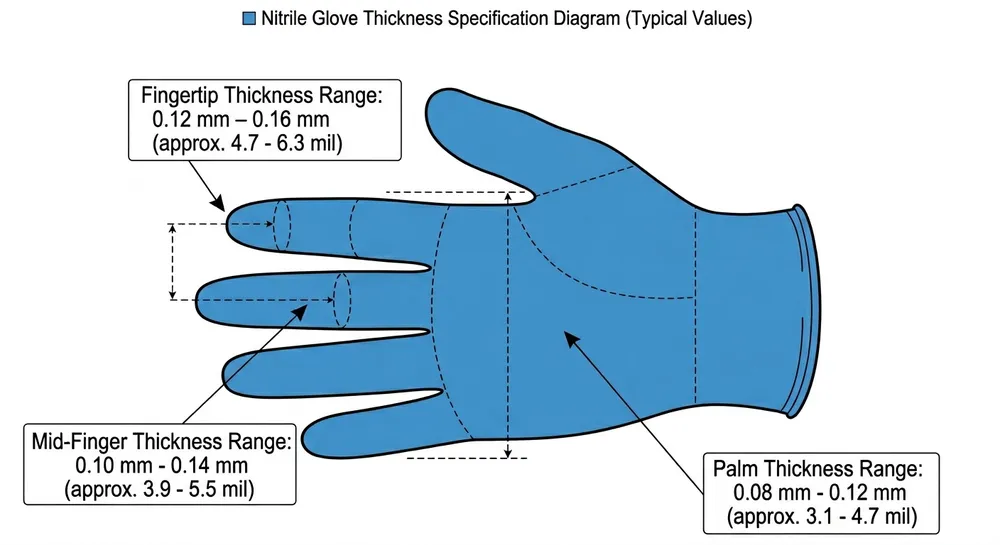
- Thickness range: Palm, finger, and cuff measurements with tolerance. For standard exam-grade disposable blue nitrile, 0.08–0.10mm at the palm is typical. If your market requires a heavier gauge, specify it — don't assume the factory will default to your preference.
- AQL level: State whether you require AQL 1.5 or AQL 2.5. These are not interchangeable. AQL 1.5 means a tighter sampling plan and a lower acceptable defect rate — it costs more to inspect but reduces the risk of a bad container reaching your customer.
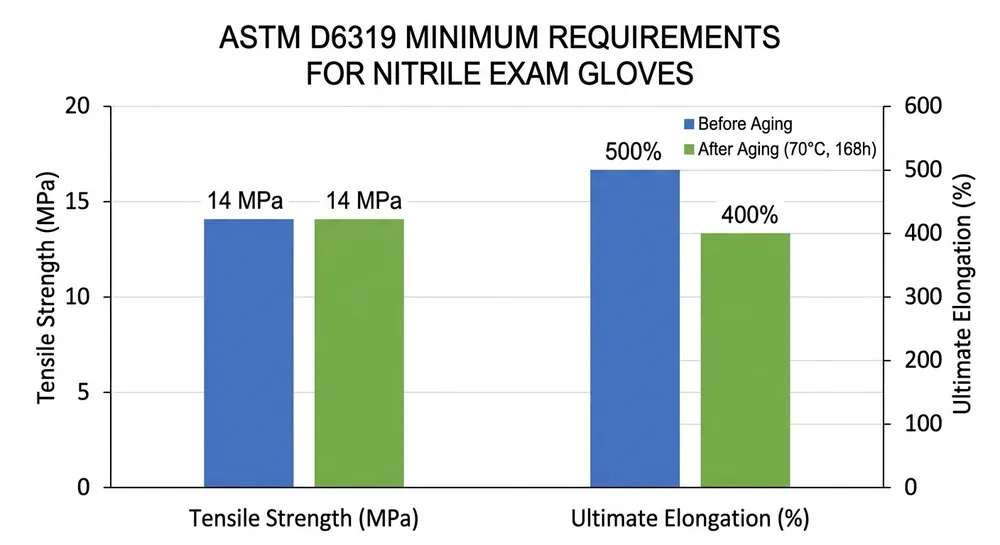
- Tensile strength and elongation: Reference ASTM D6319 or EN455 minimums. If you're selling into medical or food-service channels, your downstream customers may require these values on the CoA.
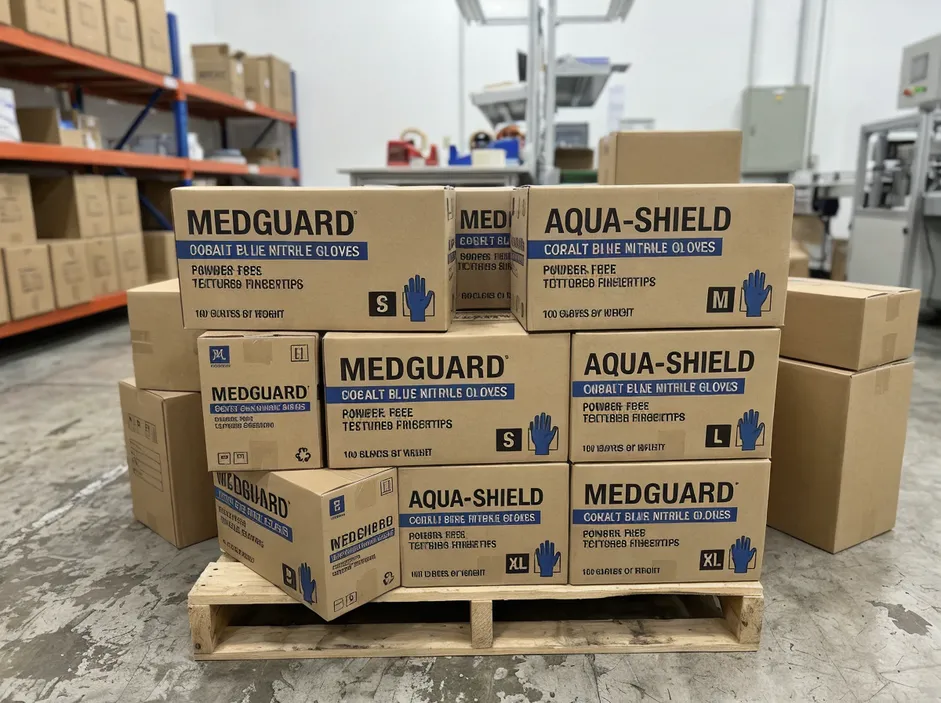
- Packaging format: Box count (typically 100 pcs/box for exam gloves), carton configuration, and labeling requirements. Packaging changes between shipments are a common source of customer complaints that get misattributed to product quality.
Get this document countersigned by the factory before production starts. A factory that won't sign a spec sheet is telling you something important.
Step 2: Require a retained production sample from every run
This is the single most effective tool for catching drift early, and most buyers don't ask for it.
For every production run tied to your account, the factory should retain a sealed sample set — typically 10–20 gloves from the run — with the production date, line number, and batch ID recorded. You should receive a duplicate set.
When the next container arrives, you compare the new production sample against the retained set from the previous shipment. If the color, texture, or physical feel has shifted, you have a documented baseline to reference. Without retained samples, every dispute becomes a he-said-she-said conversation about what the product "should" look like.
(We retain production samples for all active accounts for 24 months. If a buyer contacts us about a shipment from 18 months ago, we can pull the retained sample and compare it against the complaint sample in the same room.)
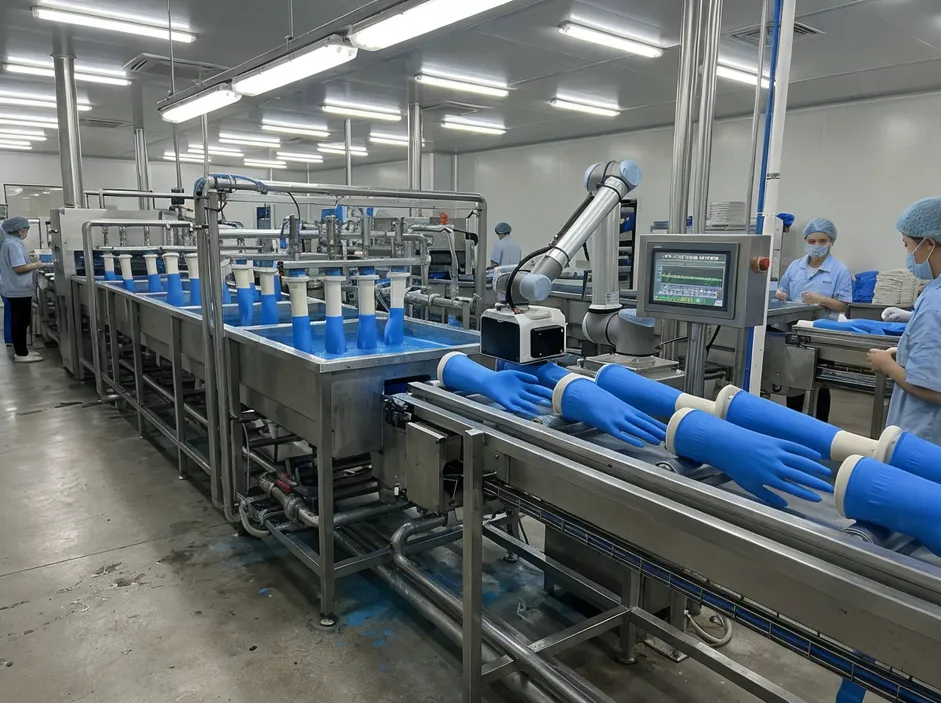
At our facility, each of the 8 production lines runs with a batch record that ties the compound lot, pigment lot, and dipping parameters to the finished goods. That record is available to buyers on request. If your current supplier can't provide batch-level traceability, that's a gap worth addressing before you scale the relationship.
Step 3: Understand what AQL 1.5 actually means for your order
AQL (Acceptable Quality Level) is the most misunderstood number in nitrile glove sourcing. Buyers often see "AQL 1.5" on a spec sheet and assume it means 1.5% of gloves are defective. That's not what it means.
AQL 1.5 defines the sampling plan and the rejection threshold. At AQL 1.5, a lot is accepted if the number of defects found in the sample falls below the critical number for that lot size. The actual defect rate in an accepted lot can be higher than 1.5% — the AQL number describes the risk tolerance of the inspection plan, not a guaranteed defect ceiling.
What this means practically:
- AQL 1.5 is the standard for medical-grade exam gloves under EN455 and ASTM D6319. It's the tighter plan. Use it if your customers are hospitals, clinics, or food processors with documented QC requirements.
- AQL 2.5 is common for industrial-grade nitrile. Acceptable for general-purpose distribution, but not appropriate if your downstream buyers have medical or food-contact compliance requirements.
- Online pinhole detection is a separate control from AQL sampling. We run 100% online pinhole detection on every glove before it reaches the packaging line. AQL sampling at the finished-goods stage is a second check, not the only check.
When you're comparing supplier quotes, ask specifically: is the AQL inspection done in-house by the factory's own QC team, or by a third-party inspector? Both are valid, but they have different implications. In-house inspection is faster and catches issues earlier in the process. Third-party inspection (SGS, Bureau Veritas, Intertek) gives you an independent record that's useful for import compliance and customer audits.
Step 4: Structure the purchase order to prevent substitution
Spec drift sometimes isn't drift at all — it's substitution. A factory running tight on capacity fills your order with product from a different line, a different compound batch, or in some cases a different sub-supplier. If your purchase order doesn't specify the production parameters, you have no contractual basis to reject the shipment.
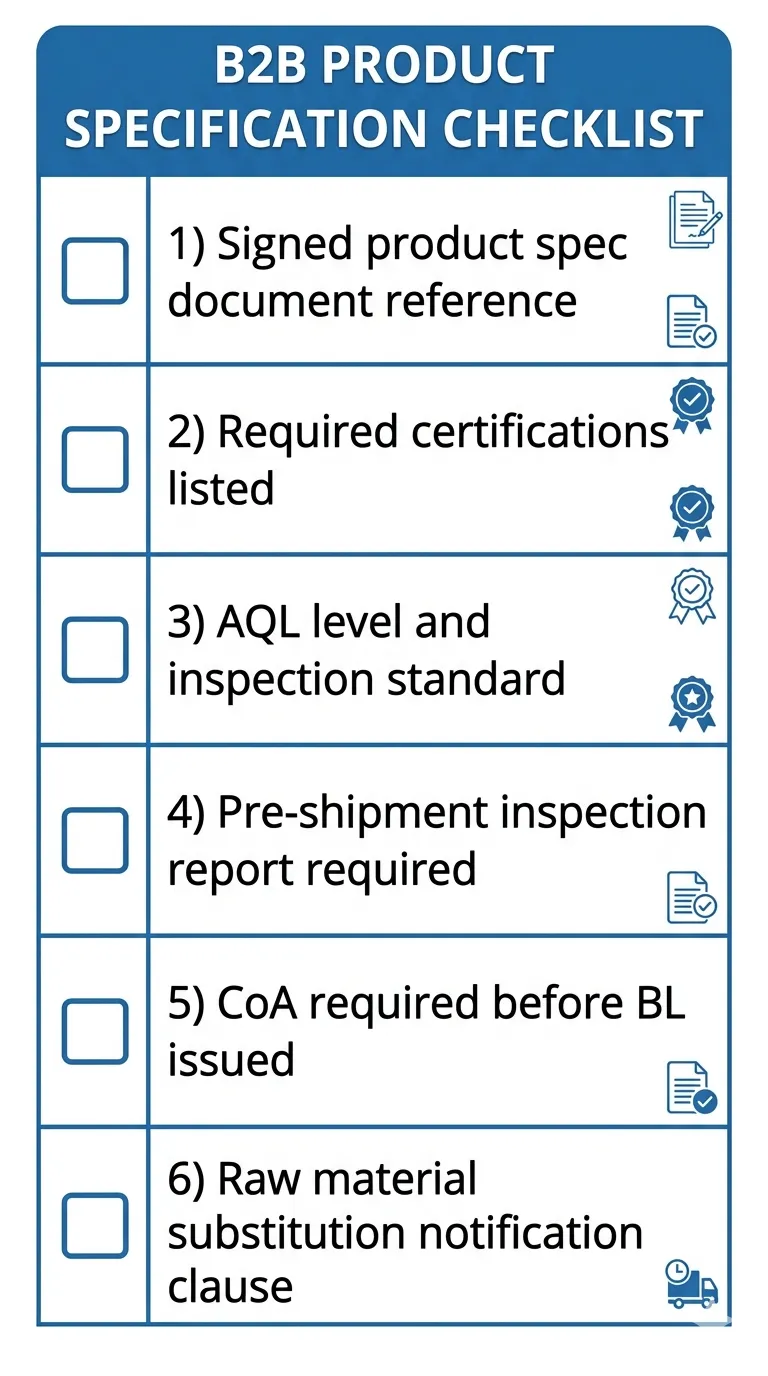
Your PO for a Blue Nitrile Gloves container order should reference:
- The signed product specification document (by document number and date)
- The required certifications (ISO 9001:2015, CE, FDA 510(k), or whichever apply to your market)
- The AQL level and inspection standard
- The requirement for a pre-shipment inspection report and CoA before the bill of lading is issued
- A clause requiring factory notification if any raw material substitution occurs
That last point matters more than most buyers realize. Nitrile compound is a commodity input — prices move, and factories sometimes switch compound suppliers without telling buyers. A compound change can shift tensile strength, elongation, and color even if the production process stays identical. Requiring notification of raw material changes gives you the option to request a re-qualification sample before the new compound goes into your production run.
Step 5: Run a pre-shipment inspection before the container is sealed
A pre-shipment inspection (PSI) is your last practical opportunity to catch a problem before it becomes a landed container you can't sell.
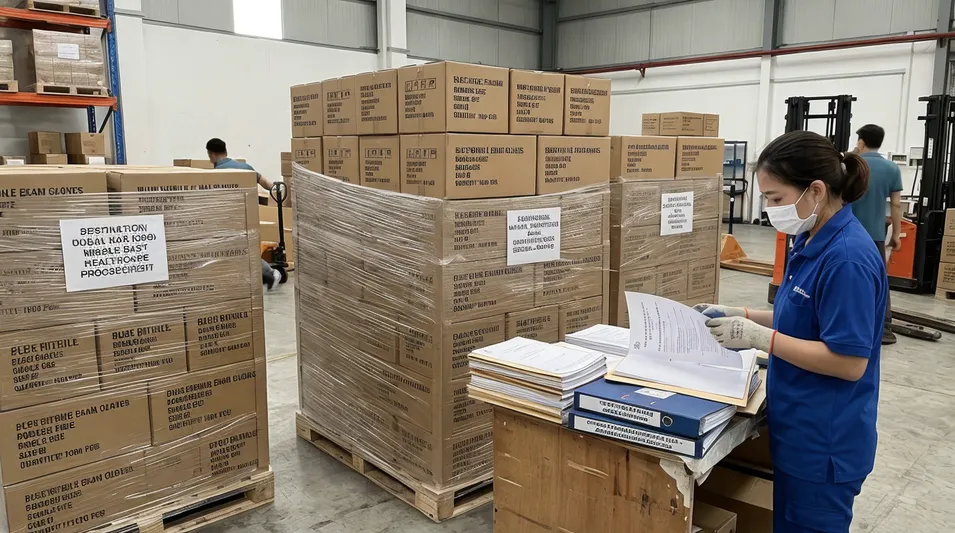
The PSI should happen after 100% of production is complete and at least 80% of the goods are packed. Inspecting before packing is complete means you're sampling from an incomplete lot — defects in the last 20% of production won't be captured.
What a PSI for disposable blue nitrile gloves should cover:
- Visual inspection: Color consistency across cartons from different production dates within the same shipment. If the factory ran your order across multiple days or multiple lines, color variation between cartons is a real risk.
- Physical dimensions: Glove length, width, and cuff thickness against the spec. Measure from multiple cartons, not just the top layer.
- Pinhole test: AQL sampling for pinholes per ASTM D5151 or EN455-1. Record the lot size, sample size, and number of defects found.
- Packaging check: Box count, labeling accuracy, carton marking. Mislabeled size or grade is a common cause of customer returns that has nothing to do with the glove itself.
- Documentation review: Confirm the CoA, test reports, and certifications are present and match the shipment lot numbers.
If you're using a third-party inspector, brief them specifically on your color reference and thickness spec. Generic inspection reports that just say "passed AQL 2.5" without recording the actual measurements against your spec are not useful for tracking drift over time.
Step 6: Build a shipment-to-shipment comparison record
This is the step most buyers skip, and it's the one that makes everything else work.
After each container arrives, record the key measurements from the PSI report in a simple tracking sheet: color reference match (pass/fail), palm thickness (measured value), AQL result (defects found / sample size), and any packaging discrepancies. Keep the retained production sample from that shipment.
When the next container arrives, compare the new PSI data against the previous shipment's record. A single data point tells you nothing. Three or four shipments of data tell you whether the factory is holding spec or drifting.
We've had buyers come to us after switching from another supplier specifically because they had this kind of tracking in place and could show us exactly where their previous supplier's product had drifted — thinner palm measurement on shipments 3 and 4, color shift starting on shipment 5. That documentation made the transition conversation straightforward. It also told us exactly what spec parameters they needed us to hold.
(If you're placing your first container order and don't have a tracking template, ask us — we can share the format we use internally for account management.)
The upstream control that most buyers miss
Everything above assumes the factory is running your compound correctly. But compound consistency starts with the raw material supplier, not the factory floor.
Nitrile compound quality varies by supplier and by batch. The key variables are acrylonitrile content (which affects chemical resistance and tensile strength) and the filler loading (which affects thickness and elongation). A factory that sources compound from a single approved supplier with incoming QC testing will hold spec more consistently than one that buys from the spot market based on price.
When you're evaluating a supplier for a long-term container relationship, ask:
- Do you have an approved compound supplier list, or do you buy on the spot market?
- What incoming QC tests do you run on each compound batch before it goes to the dipping line?
- How do you handle a compound batch that fails incoming QC?
A factory with an in-house compounding lab has a structural advantage here — they control the formulation directly rather than depending on a third-party compound supplier's consistency. We run our own compounding lab, which means we can adjust the formulation to compensate for raw material variation without changing the finished product spec. That's not something a factory that buys pre-mixed compound can do.
Practical FAQ
What's the minimum order for a container of disposable blue nitrile gloves?
A standard 20-foot container holds approximately 2,000 boxes (200,000 gloves for 100-count boxes). That's our standard MOQ for stock SKUs. A 40-foot container runs roughly 4,000–4,500 boxes depending on carton configuration and glove size. For OEM or custom-labeled orders, MOQ may be higher depending on the labeling setup.
How do I know if a factory's AQL 1.5 claim is real?
Ask for the inspection records from the last three shipments — not just a certificate that says "AQL 1.5 compliant." The records should show lot size, sample size, number of defects found, and the accept/reject decision. If the factory can't produce shipment-level inspection records, the AQL claim is a marketing statement, not a process.
Can I specify a custom blue shade for my private-label order?
Yes, with a physical color chip or Pantone reference provided before the first production run. Color matching requires a trial run to confirm the pigment formulation — plan for that in your lead time. We don't guarantee color match from a digital reference alone; the pigment behavior in the dipping process doesn't always translate directly from screen to glove.
What certifications should I require for selling into North American medical channels?
At minimum: FDA 510(k) clearance for the specific glove SKU, ASTM D6319 compliance, and AQL 1.5 inspection. If your buyers are in Canada, Health Canada device licensing applies separately. ISO 9001:2015 covers the quality management system but doesn't substitute for product-level regulatory clearance.
—
If you're ready to place a container order or want to discuss spec requirements for your market, Request Quote with your target grade, size range, and destination — we'll come back with a detailed quote and the spec documentation your compliance team will need.