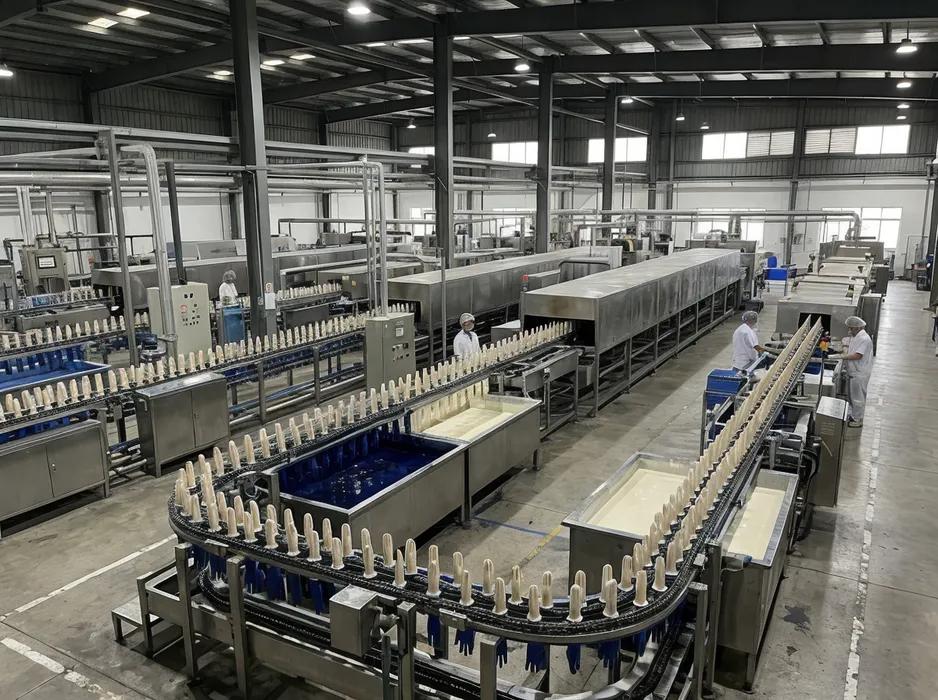
8 automated dipping lines, 1.2 billion pieces annual capacity, and an in-house compounding lab that controls the formulation from raw compound to finished glove. Every SKU ships with full certification documentation for North American and European markets.
One factory. One category. Disposable nitrile gloves across medical, industrial, and food-contact grades — manufactured and shipped direct.
We've been manufacturing disposable nitrile gloves since 2007 — nothing else. No latex, no vinyl, no mixed PPE catalog that treats gloves as one line item among fifty. The entire 18,000 m² facility in Weifang, all 220 people, and all 8 dipping lines exist for one product category. That focus compounds over time: every process refinement, every QC checkpoint, every formulation adjustment we've made in 18 years applies directly to your order.
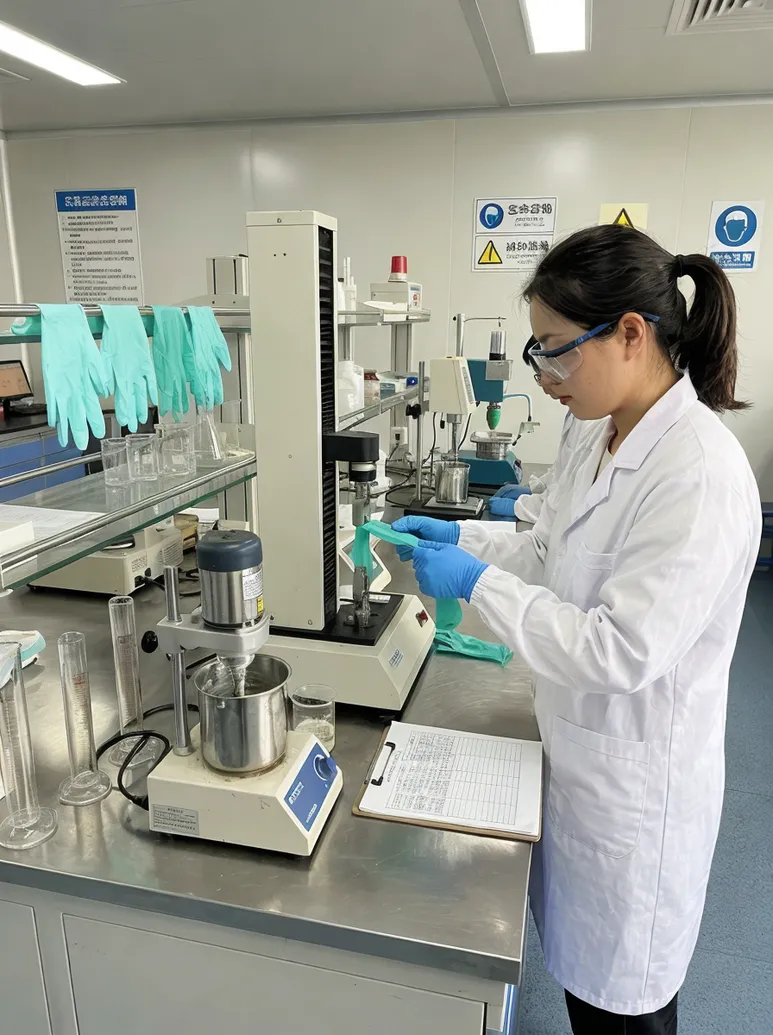
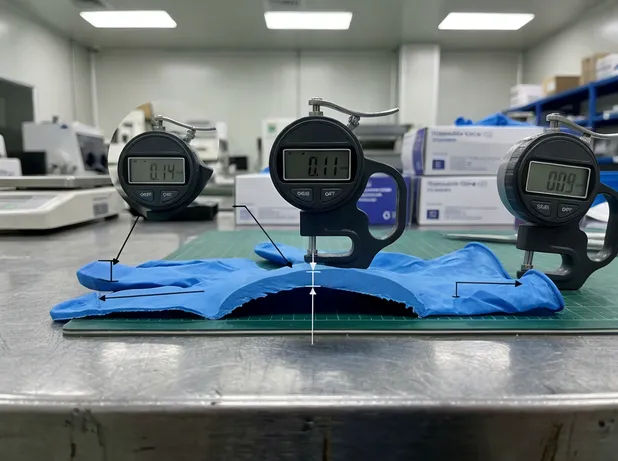
The practical consequence for your supply chain is consistency. The hardest thing to find in a disposable nitrile gloves supplier isn't a good first sample — it's a factory that ships the twelfth container to the same spec as the first. We built our compounding lab specifically to solve that problem. When you own the nitrile formulation in-house, you control the variable that causes most AQL failures: compound viscosity drift between batches. Our QC team pulls dimensional checks every two hours per line, and any line that drifts outside the 0.08–0.15mm thickness tolerance stops immediately. We don't run out-of-spec product and sort it later.
For distributors and importers, this translates directly to fewer destination-port rejections, fewer downstream complaints, and a supplier relationship you can actually plan around. Learn more about our manufacturing process and certifications.
Own the nitrile formulation — control compound viscosity drift, the #1 cause of AQL failures.
Dimensional checks every two hours per line. Lines drifting outside 0.08–0.15mm stop immediately.
The 12th container ships to the same spec as the first — fewer port rejections, fewer complaints.
The four SKU families under this category cover the main procurement segments your buyers operate in. Each is manufactured on the same 8 automated lines, with the same AQL 1.5 outgoing inspection standard — the differences are in formulation, thickness spec, and certification documentation.
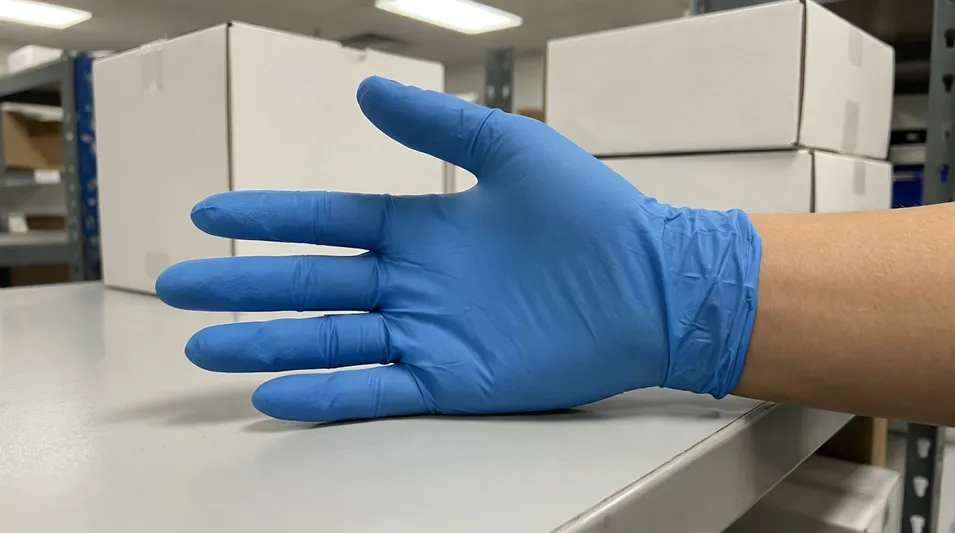
The core SKU. Powder-free, chlorinated inner surface for donning ease, available in standard examination thickness (0.08–0.10mm palm). This is the volume product for medical distribution, dental supply, and general industrial safety channels. If you're building a private-label line or need a high-volume replenishment SKU, this is where most buyers start.
The same powder-free formulation in the blue colorway that dominates medical and food-service procurement. Blue is the default specification for hospital group tenders, food processing facility contracts, and institutional supply programs — buyers in those channels often specify color as a contamination-control requirement, not a preference. We run blue as a standard color, not a custom order.
EN 455-compliant and FDA 510(k)-cleared examination gloves for healthcare distribution. These ship with the full documentation package: CE declaration of conformity, FDA 510(k) reference number, and our internal AQL test reports for the specific production lot. If your customer is a hospital group, a dental network, or a medical supply distributor, the compliance paperwork is already in order — you're not waiting on us to pull certifications together at the time of inquiry.
Heavier gauge (0.10–0.15mm palm) for industrial safety, chemical handling, and food processing applications. The thicker compound provides better puncture resistance and extended wear time for tasks where examination-weight gloves aren't sufficient. Available in 6-mil and 8-mil specifications depending on the protection level your market requires.
These are category-wide ranges. Individual product pages carry the exact specifications for each SKU.
| Parameter | Range / Options |
|---|---|
| Material | 100% nitrile rubber (acrylonitrile-butadiene) |
| Thickness — palm | 0.08–0.15 mm (examination to industrial grade) |
| Thickness — finger | 0.10–0.18 mm |
| Thickness — cuff | 0.06–0.10 mm |
| Length | 240 mm (standard) |
| Sizes | XS, S, M, L, XL |
| Surface finish | Smooth or textured fingertip |
| Inner surface | Chlorinated (powder-free) |
| Color | Blue (standard); black, white, purple, green available |
| Accelerator-free option | Available — sulfur-donor cure system, no thiuram/carbamate residue |
| AQL standard | 1.5 (outgoing inspection, 100% of lots) |
| Tensile strength (pre-aging) | ≥14 MPa (EN 455-2 / ASTM D6319) |
| Elongation at break (pre-aging) | ≥500% |
| Pinhole detection | Online electrical leak test, every glove, every line |
Accelerator-free compound runs on a dedicated line — it's not a reformulation of the standard SKU, it's a separate cure system.
If you're targeting European hospital procurement, ask us specifically about this variant.
Need exact SKU specs?
Individual product pages carry the exact specifications for each SKU in our line.
This is the capability that separates us from most disposable nitrile gloves factories, and it's worth explaining the mechanism rather than just stating the fact.
Most nitrile glove manufacturers buy pre-mixed compound from a third-party chemical supplier. That means their glove thickness and physical properties are only as consistent as their compound supplier's batch-to-batch variation — which they don't control and often don't even measure. When AQL failures happen at destination, the factory blames the dipping line. The actual cause is usually compound viscosity drift between batches.
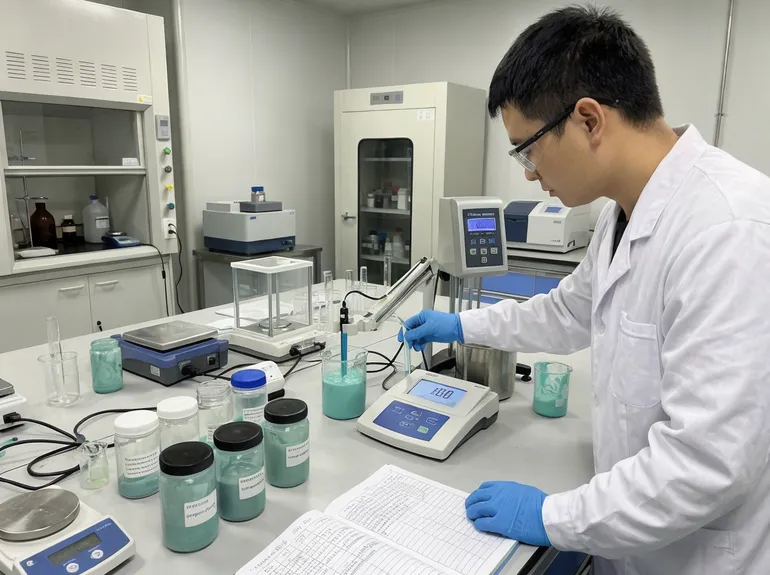
We built our own compounding lab in the early years specifically because we kept seeing this problem. Our formulation team mixes nitrile compound in-house, monitoring viscosity, pH, and acrylonitrile content on every batch before it goes to the line. Bath temperature on each dipping line is held to ±1°C. Dipping speed is controlled by the automated conveyor, not by an operator's judgment. The result is that a glove pulled from line 3 on a Tuesday and a glove pulled from line 7 on a Friday measure within tolerance of each other — not because we got lucky, but because we engineered the process to produce that outcome.
The sample you approved is representative of what ships in container 8, not just container 1. That's the consistency problem that most buyers have already been burned by before they find us.
We hear this regularly from new buyers — the first two containers were fine, then something changed. Usually it's a compound supplier switch the factory didn't disclose.
In-House Process Controls
Viscosity, pH & acrylonitrile content
Monitored on every compound batch before line release
Bath temperature held to ±1°C
Per dipping line, continuously regulated
Automated conveyor dipping speed
Operator-independent — removes human variability
Matched to Pantone references in production — not outsourced, handled by our formulation team.
Specific elongation-at-break targets engineered into the compound for your application requirements.
Dedicated line for sensitization-sensitive markets — a separate cure system, not a reformulation.
The lab also handles OEM formulation development: custom colors matched to Pantone references, specific elongation-at-break targets, accelerator-free compound for sensitization-sensitive markets. These are production capabilities, not special projects that require outsourcing.
Disposable nitrile gloves span a wide range of end-use applications, and the procurement requirements differ significantly by segment. Here's how we think about the grade selection decision:
Your buyers need EN 455 or ASTM D6319 compliance documentation at minimum. FDA 510(k) clearance is required for US healthcare channel sales. Specify our powder-free medical grade; the certification package ships with every lot.
Accelerator-free is worth adding to your SKU mix if you're supplying European hospital groups — Type IV allergy compliance is increasingly written into tender specifications.
Thickness is the primary spec decision. Standard examination weight (0.08–0.10mm) covers light-duty assembly and general handling. For chemical exposure, automotive, or manufacturing environments, the 6-mil (0.15mm) or 8-mil (0.20mm) industrial grade provides the puncture resistance and chemical barrier your buyers need.
Black is the dominant color in this channel — it hides grease and signals industrial-grade positioning to the end user.
Blue or white colorways for contamination visibility. Food-contact compliance documentation (FDA 21 CFR, EU 10/2011) is required for institutional food service contracts.
Our standard powder-free formulation meets food-contact requirements; we can provide the compliance documentation on request.
One container (approximately 2,000 boxes for standard examination SKUs) is the MOQ for standard SKUs. Custom formulation, color matching, and branded packaging are handled from the same facility — no subcontracting.
If you're building a house brand, we can develop the specification, produce a sample run, and supply the full technical file for your regulatory submission.
There are three failure modes that experienced disposable nitrile gloves buyers have already encountered. We address each one directly in our manufacturing process.
The Problem
A glove that measures 0.10mm at the palm and 0.07mm at the fingertip fails AQL at destination — and the failure shows up in your customer's hands, not in your incoming inspection.
The cause is almost always compound viscosity drift or inconsistent dipping speed.
Our Solution
In-house compounding and automated conveyor control eliminate both variables. Dimensional checks run every two hours per line; any drift triggers a line stop, not a sorting operation.
The Problem
Pinholes are the defect that matters most in medical and food-contact applications, and they're invisible to visual inspection.
Our Solution
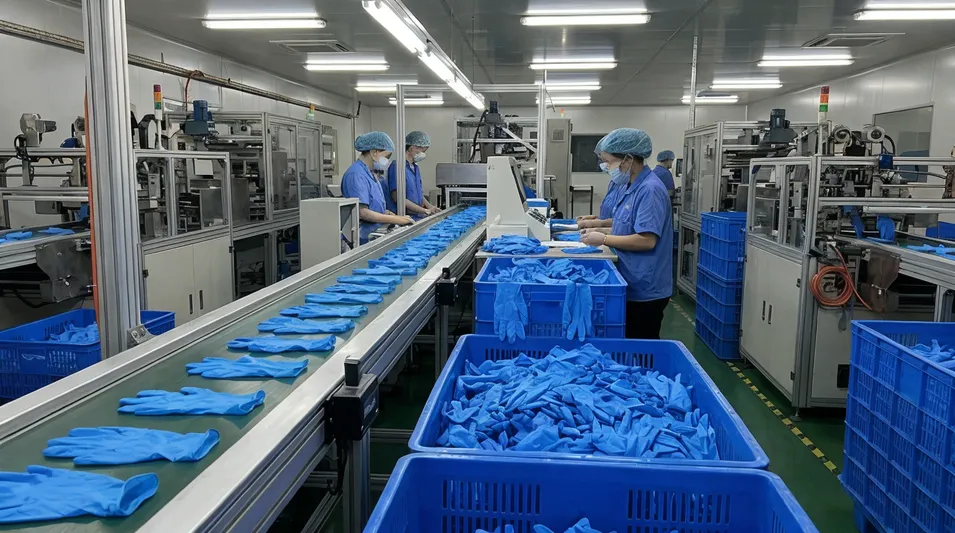
We run online electrical leak testing on every glove, on every line, before stripping. Gloves that fail the leak test are pulled automatically — they don't reach the counting stage. This is why our AQL 1.5 outgoing results hold at destination, not just at our factory gate.
The Problem
Thiuram and carbamate accelerators — standard in most nitrile vulcanization processes — are the primary cause of Type IV allergic reactions in healthcare workers.
European hospital procurement is increasingly specifying accelerator-free as a baseline requirement, not a premium option.
Our Solution
We run a dedicated accelerator-free line using a sulfur-donor cure system. The glove passes EN 455 with no detectable accelerator residue. If you're supplying European healthcare and you're not offering accelerator-free, you're losing tenders to suppliers who are.
We'll send the complete testing methodology, AQL documentation, and line-specific certifications.
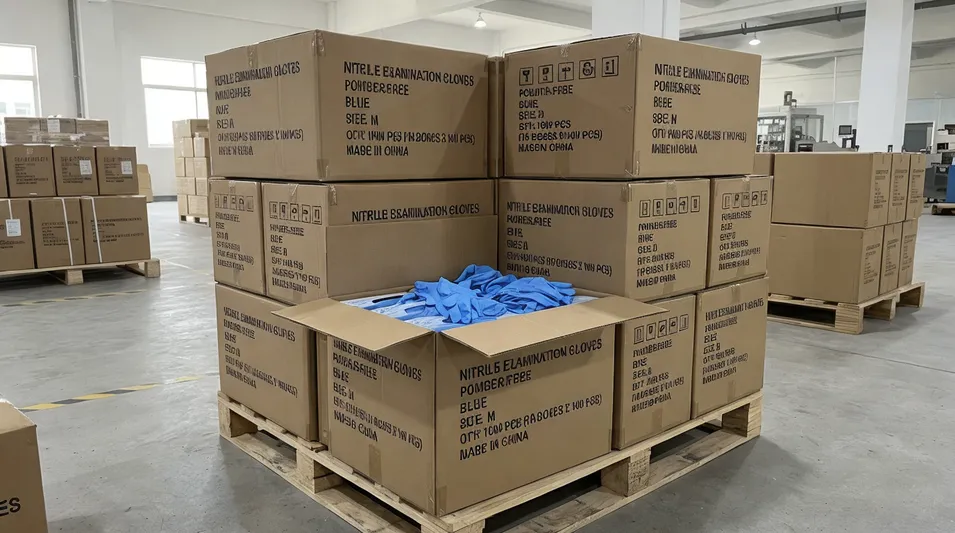
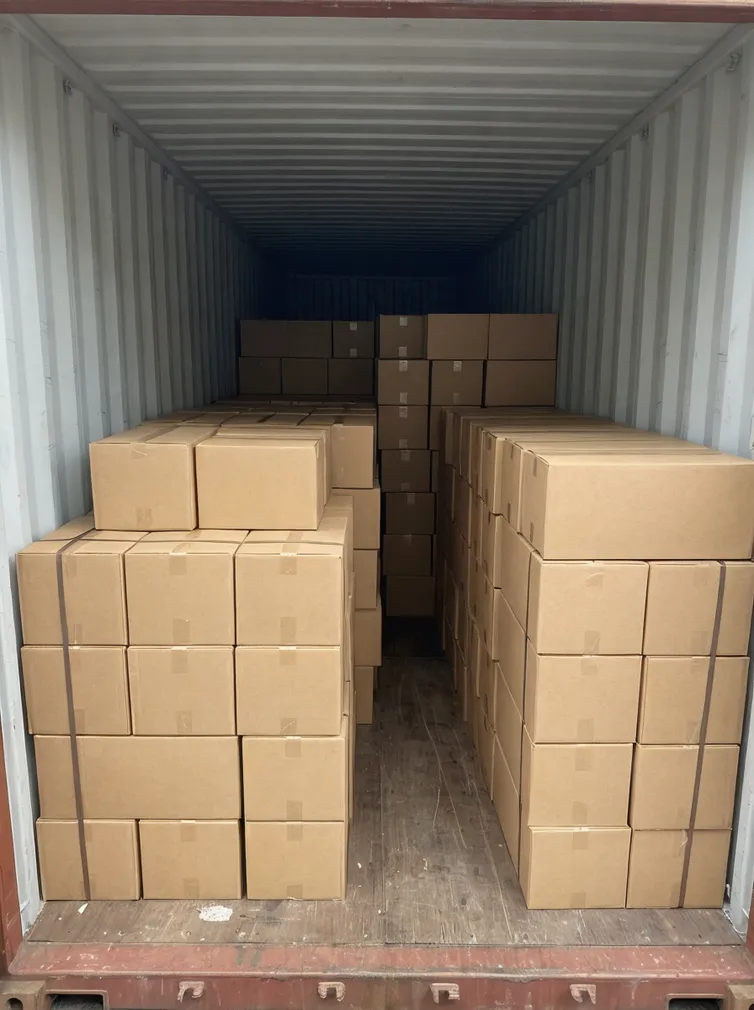
Standard examination gloves pack at 100 pieces per box, 10 boxes per carton. A properly loaded 40HQ container carries approximately 2,000 cartons — that's 200,000 boxes and 20 million pieces for standard examination-weight SKUs. Industrial-grade gloves at heavier gauge pack at slightly lower density, typically 1,600–1,800 cartons per 40HQ depending on thickness spec.
We worked out the pallet configuration years ago and it's optimized for 40HQ loading efficiency. Carton dimensions are standardized across the product line, so mixed-SKU container loads — multiple grades or colors in one shipment — don't create dead space. For buyers consolidating multiple SKUs into a single container, we can provide a loading plan with exact carton counts per SKU before you confirm the order.
Pre-shipment inspection coordination with SGS or Bureau Veritas is standard. If your procurement process requires third-party verification, we handle the scheduling and documentation.
Country-of-origin documentation, carton labeling to Amazon FBA or distributor DC requirements, and full export documentation are routine for us.
For repeat orders on established SKUs, we maintain a rolling production schedule that allows us to confirm ship dates at order time — no guesswork on delivery windows.
Tell us your SKU mix and we'll send a loading plan with exact carton counts per SKU before you confirm the order.
Request Loading PlanQuality management system
Global — required by most institutional procurement programs
Product conformity
European market entry
Medical gloves for single use
European healthcare distribution, hospital tenders
Nitrile examination gloves
North American healthcare and industrial distribution
Medical device clearance
US healthcare channel — required for hospital and clinical supply
All certifications are current and available for review. If your buyer requires specific test reports — AQL data for a production lot, tensile strength results, accelerator residue testing — we can provide the documentation for the specific lot you're ordering, not just a generic certificate.
If you're sourcing disposable nitrile gloves to sell under your own brand, the relevant question isn't whether we can do OEM — it's what the actual scope of customization looks like.
Matched to a Pantone reference from our compounding lab — no subcontracting, no third-party color houses.
Specific elongation targets, accelerator-free compound, higher acrylonitrile content for chemical resistance — developed in-house.
Your artwork on box and carton. No separate tooling fee — packaging artwork is included in the OEM project setup.
Complete documentation for your regulatory submission — ready for EN 455, FDA 510(k), or regional equivalents.
The QC team inspects to your AQL requirement. Production lines run your spec from the same facility — no subcontracting.
For distributors building a house brand in a new market, we suggest a starter SKU mix based on what's moving for existing customers in that region.
Your artwork on our standard formulation.
Approx. 2,000 boxes (200,000 gloves at examination weight)
Custom compound, custom color, or both — with a sample approval stage before full production.
Sample approval stage included. No separate tooling fee for packaging artwork.
Tell us your target market and volume expectations — we'll give you a practical recommendation, not a catalog.
Examination-grade gloves (typically 0.08–0.10mm palm thickness) are manufactured to medical device standards — EN 455 in Europe, ASTM D6319 and FDA 510(k) in North America. These certifications are required for healthcare channel sales.
Industrial-grade gloves (0.10–0.20mm, depending on mil spec) are manufactured to EN 374 or ASTM D6978 for chemical resistance applications — they don't carry medical device clearance and shouldn't be sold into clinical settings.
If you're distributing into both channels, you need separate SKUs with separate certification documentation. We supply both grades and can provide the appropriate documentation for each.
The most common cause is that the factory's outgoing inspection is sampling-based at AQL 2.5 or looser, which allows a higher defect rate through. A secondary cause is that pinholes — the defect that matters most for barrier protection — aren't caught by visual inspection and require electrical leak testing to detect.
We run 100% AQL 1.5 outgoing inspection with online electrical pinhole detection on every glove. The inspection standard is tighter, and the pinhole detection is automated rather than sample-based.
Standard nitrile vulcanization uses thiuram and carbamate chemical accelerators. These compounds are the primary trigger for Type IV (delayed) allergic reactions in healthcare workers — a growing compliance issue in European hospital procurement.
Accelerator-free nitrile uses an alternative cure system (sulfur-donor based) that produces a glove with no detectable accelerator residue. The glove still passes EN 455 for barrier performance.
If you're supplying European hospital groups, dental networks, or any buyer whose end users include sensitized healthcare workers, accelerator-free is increasingly a specification requirement, not a premium option.
Standard SKUs: one 40HQ container, approximately 2,000 boxes (200,000 gloves for examination weight). This is the MOQ for standard powder-free nitrile in our existing formulations and colors.
Custom formulation or custom color projects start at the same container MOQ for the production run, with a sample approval stage before full production.
We support sample orders before container commitment — samples ship within 5–7 business days with full certification documentation.
Every production lot ships with an internal test report covering AQL results, dimensional measurements (palm thickness, finger thickness, cuff thickness), tensile strength, and elongation at break for that specific lot.
If your procurement process requires third-party verification, we coordinate pre-shipment inspection with SGS or Bureau Veritas — you get an independent inspection report tied to the specific container before it ships. The lot number on the carton label traces back to the production record and test data.
Blue is our standard color and runs without MOQ premium. Black, white, purple, and green are available as standard color options at container MOQ.
Custom colors matched to a Pantone reference are available through our OEM program — the compounding lab handles the color matching, and the MOQ is one 40HQ container for the custom color run.
Two paths to get started — whether you're evaluating us for the first time or ready to lock in pricing on a known spec.
Most buyers start with a sample order to test the product with their own customers before committing to a container. Samples ship within 5–7 business days and include the full certification documentation package for the specific lot.
If you already know your spec — grade, thickness, color, certification requirements — send us the details and we'll turn around a quote with lead time and loading data within one business day.