Standard (0.10–0.12mm) and heavy-duty (0.13–0.15mm) wall thickness — powder-free, AQL 1.5, carbon-black color-stable across your full container order.
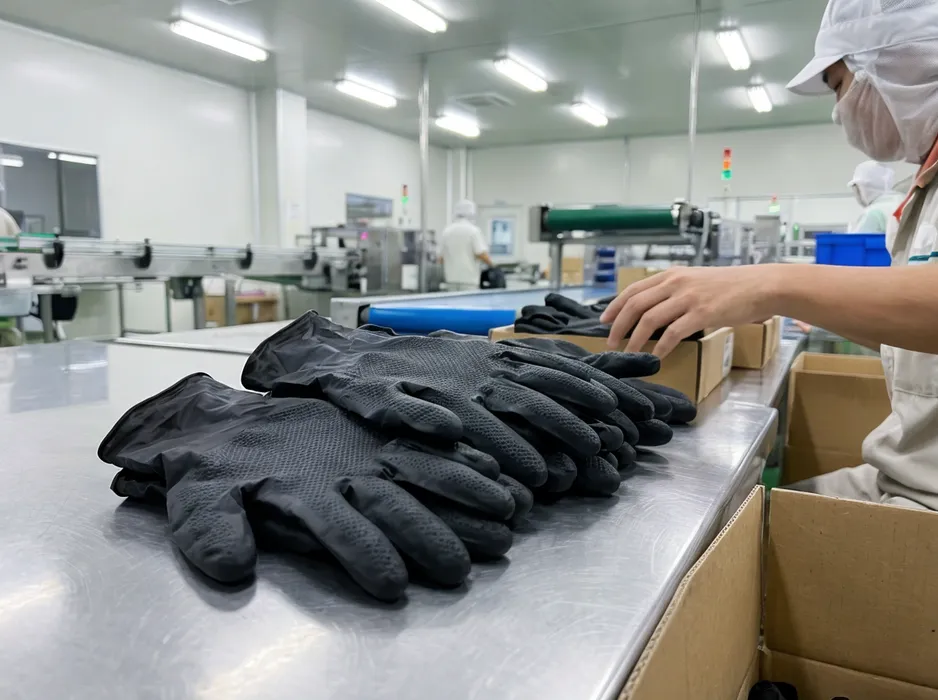
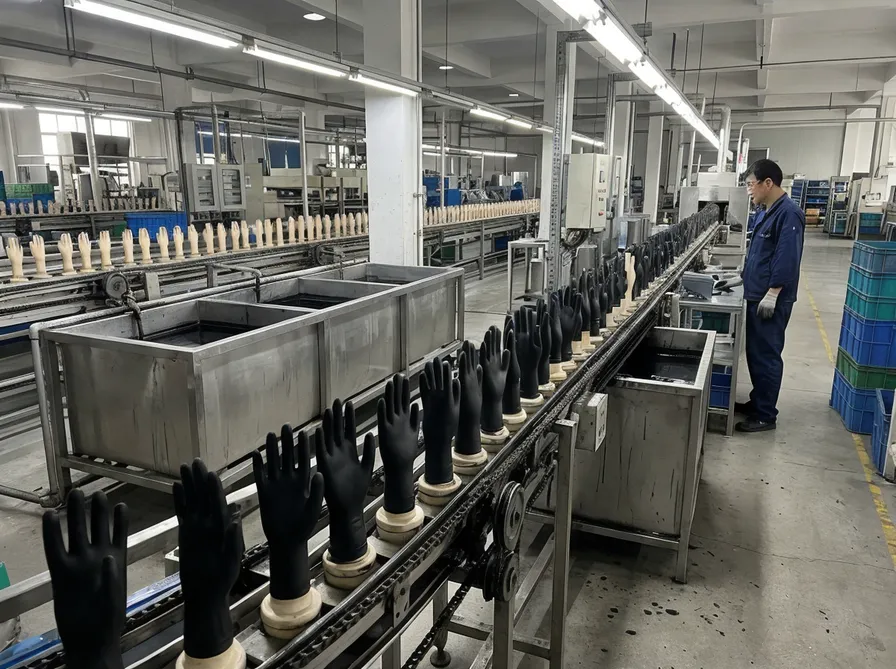
Built on the same 8 automated dipping lines and in-house compound as our full industrial range. Black colorway is a production constant here, not a special run — color consistency batch-to-batch is tracked as a process parameter.
Black nitrile gloves occupy a specific position in the industrial supply market. In automotive service, tattooing supply, and certain chemical handling environments, black isn't a cosmetic preference — it's what the end user expects, what the shop owner orders by default, and what your downstream customer will notice if it's wrong.
The practical consequence for sourcing: black gloves have a visible quality signal that blue or white gloves don't. Color inconsistency between boxes from the same order is an obvious defect. A batch that runs slightly gray, or that varies noticeably between cartons, generates end-user complaints that trace back to you as the distributor. We've seen this happen with factories that treat black as a standard colorway add-on — they disperse carbon black into whatever compound batch is running and don't track color stability as a separate parameter.
We do it differently. Black is a permanent part of our production rotation, not a special-run color. Our carbon-black dispersion protocol is built into the compounding process: dispersion ratio, mixing time, and viscosity targets are fixed parameters that our compounding lab monitors every batch. The result is color consistency that holds across cartons, across containers, and across reorders placed six months apart.
We started tracking this after a customer flagged visible color variation between two pallets from the same shipment — that was 2014, and we haven't had a color complaint since we formalized the protocol.
For your business, that consistency means your automotive or tattooing supply customers can reorder without worrying about whether the next container matches the last one. Predictable product = predictable reorders.
Why this matters for distributors: End users in automotive and tattoo supply notice color variation immediately. Consistent black across every carton in your container eliminates a common complaint vector and protects your brand with downstream accounts.
Both configurations are powder-free, run through 100% online pinhole detection, and ship with AQL 1.5 outgoing inspection records.
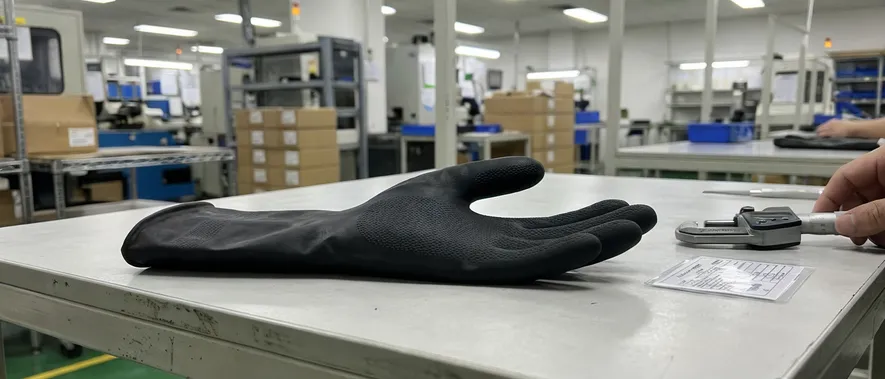
Specifications shown are standard production values. Tensile strength, elongation-at-break, and force-at-break test reports are available on request.
The choice between standard and heavy-duty wall thickness is a sourcing decision that affects both your landed cost and your downstream complaint rate. Getting it wrong in either direction costs margin.
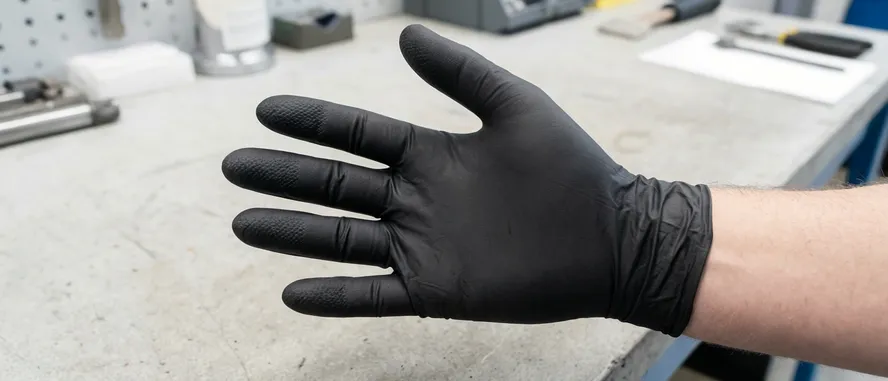
The right specification for automotive service, general assembly, janitorial supply, and tattooing. Fingertip micro-texture handles grip on oily or wet surfaces without sacrificing tactile sensitivity.
Best-fit accounts
Highest-volume configuration in black production — the default SKU for most automotive distributors and tattooing supply wholesalers.
Built for environments where puncture risk is higher and grip in wet or oily conditions is the primary performance requirement. Full-hand micro-texture pattern gives grip across the entire glove surface.
Best-fit accounts
Freight note: Heavier gauge adds roughly 12–15% to per-unit weight — factor into your margin model before speccing it across accounts that don't need the extra thickness.
Buyer Rule of Thumb
If your accounts are in automotive service or tattooing, start with standard black. If you're supplying industrial cleaning contractors or chemical handling operations, heavy-duty is the defensible specification. If you're covering both, carry both — the MOQ structure supports it.
Black industrial nitrile gloves concentrate in a few specific market segments. These aren't generic application descriptions — they're the segments where black is the default specification and where your buyers reorder predictably.
Auto shops, dealership service departments, and fleet maintenance operations specify black as a category standard — the color masks grease and oil, which matters to technicians who handle customer vehicles.
2–4
boxes/week, independent shop
10–20
boxes/week, dealership 10+ bays
High-frequency reorder item with low switching friction once you're in the spec. Standard 0.10–0.12mm covers the application; heavy-duty only needed for transmission or differential work.
Black is the only acceptable colorway. Tattoo artists specify black gloves for professional presentation and because the color doesn't show ink transfer during a session.
Account profile
A tattooing supply wholesaler covering 200–500 studios is a meaningful volume account — smaller quantities per account but at higher per-box margins than industrial distribution.
Standard wall thickness is the right spec. Tattoo artists need fingertip sensitivity for fine line work — the 0.10–0.12mm wall delivers that without sacrificing puncture protection from needles.
Cleaning contractors supplying commercial facilities, hospitals, and industrial sites specify heavier gauge for chemical exposure and puncture resistance. Black is preferred because it doesn't show soiling during use — relevant for contractors whose staff appearance is part of the service contract.
Contract dynamics
Facilities management contracts run on annual or multi-year terms. Once you're in the spec, the reorder pattern is predictable and the switching cost for your customer is high.
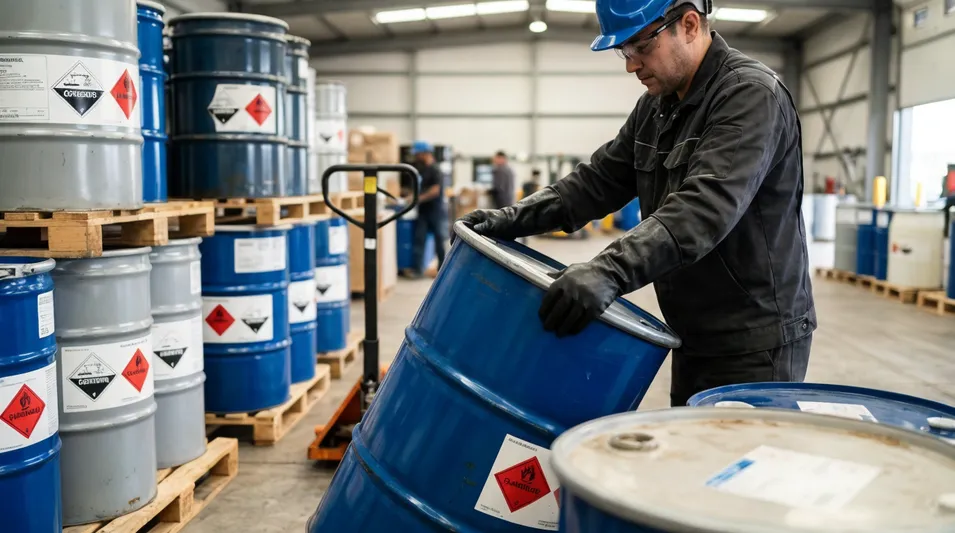
Black heavy-duty nitrile covers light-to-medium chemical exposure applications. The color is incidental here, but buyers in this segment often standardize on black across their PPE line for visual consistency.
Specification
The 0.13–0.15mm wall handles the puncture and chemical permeation requirements for most applications in this category.
Color consistency in black nitrile is a manufacturing process question, not a QC sampling question. By the time a color defect shows up in outgoing inspection, it's already in the production lot — the only way to prevent it is to control the dispersion process upstream.
Carbon black is dispersed into the nitrile compound during the compounding stage, before the batch goes to the dipping line. The dispersion ratio — how much carbon black per unit of nitrile compound — determines the final color depth. If the ratio drifts between batches, the color drifts. If the mixing time is inconsistent, you get uneven dispersion and visible variation within a single production run.
We run our compounding lab in-house, which means we control these variables directly. Each black compound batch is mixed to a fixed dispersion ratio with a fixed mixing protocol. Viscosity is checked before the batch goes to the line. If a batch is out of spec, it doesn't go to production — it goes back to the lab for adjustment. This is the checkpoint that prevents color variation from reaching your cartons.
The practical result: when you reorder black industrial nitrile six months after your first container, the color matches. Your automotive customers don't open a new box and notice it looks different from the last one. That's a small thing until it generates a complaint, at which point it becomes a supplier conversation you'd rather not have.
Direct control over carbon black dispersion ratio and mixing protocol. No third-party compounding variability.
Each batch mixed to a fixed carbon black ratio with a fixed protocol. Viscosity verified before the batch reaches the dipping line.
Batches that fail viscosity checks return to the lab for adjustment — they do not proceed to production.
Full documentation ships with every container. Third-party pre-shipment inspection is available on request.
Required by most institutional procurement processes. Covers the full manufacturing quality management system.
Covers EU import and distribution requirements. Declaration of conformity included with every container shipment.
North American industrial distribution standard. The reference standard for automotive, janitorial, and chemical handling buyers.
Available through SGS or Bureau Veritas if your procurement process requires it. Confirm at order placement and we coordinate scheduling without adding lead time.
For healthcare-adjacent industrial accounts requiring accelerator-free specification, that variant is available as a separate SKU — the black colorway is available on the accelerator-free line. See our full industrial nitrile range.
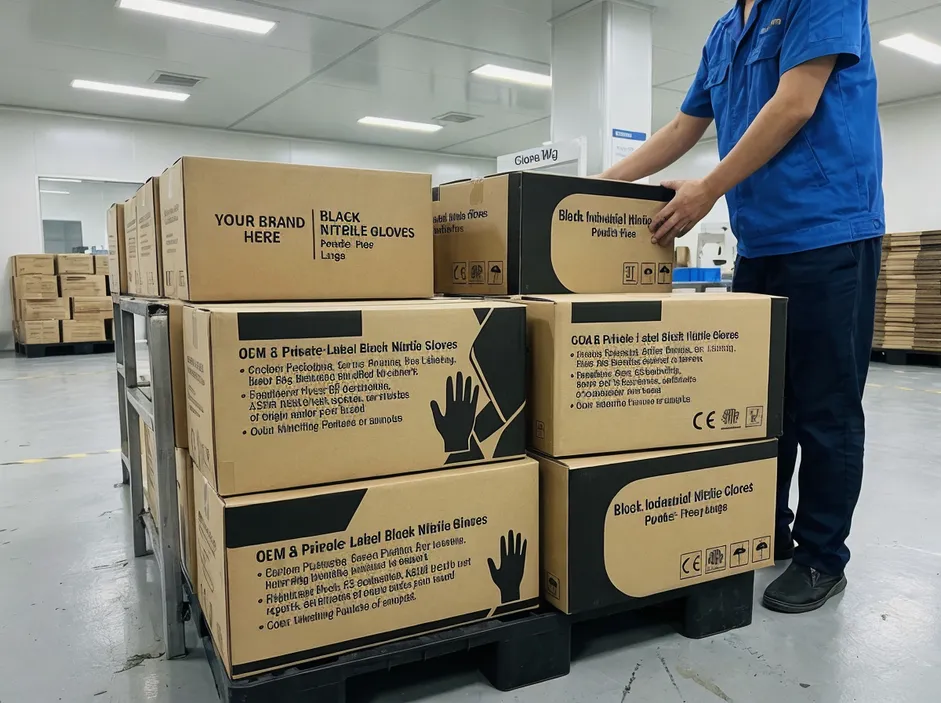
If you're building a private-label line in the automotive or tattooing supply channel, black industrial nitrile is one of the cleaner OEM projects we run — the specification is well-defined, the color is a fixed production parameter, and the packaging customization is straightforward.
Custom packaging covers carton printing, box labeling, and inner bag branding in your brand identity. We can match your existing packaging format or develop a new one from your artwork files. Regulatory documentation — CE declaration of conformity, ASTM D6319 test reports, country-of-origin certificates — is prepared under your brand name.
If you need a specific color shade — a deeper black, or a proprietary colorway that's close to black but distinct — our compounding lab can develop a color match from a Pantone reference or a physical sample. Color development adds one validation production run before the first commercial order; the timeline depends on how many iterations the match requires.
Minimum Order Quantity
MOQ for OEM projects is one 40HQ container, approximately 2,000 boxes. That's the threshold where line setup and documentation preparation cost makes sense for both sides. Below that, we'll tell you upfront rather than after you've committed to development work.
Custom Packaging
Carton printing, box labeling, inner bag branding — matched to your artwork files.
Regulatory Docs
CE declaration, ASTM D6319 test reports, country-of-origin certificates under your brand.
Color Matching
Pantone or physical sample reference. One validation run before first commercial order.
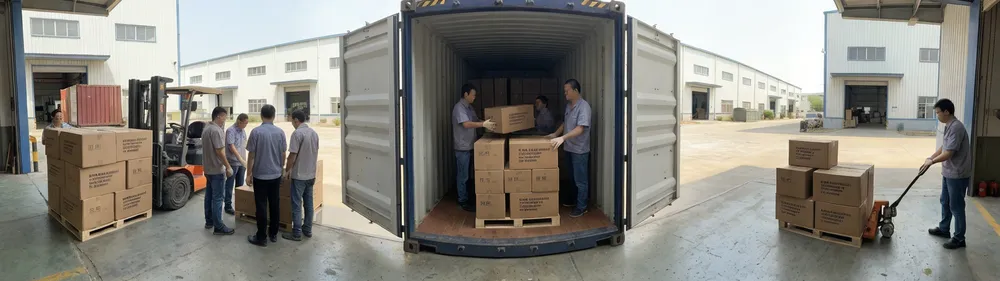
Standard black industrial nitrile packs at 10 boxes per carton, 100 gloves per box. A properly loaded 40HQ carries approximately 2,000 cartons — 200,000 boxes, 20 million gloves at full container load. Heavy-duty black runs the same carton configuration; the heavier gauge adds weight per carton but doesn't change the cubic loading.
10
Boxes / Carton
Standard pack configuration for black SKUs
100
Gloves / Box
Consistent count across standard and heavy-duty
2,000
Cartons / 40HQ
Full container load — 200,000 boxes
20M
Gloves / FCL
At full container load capacity
Carton labeling can be configured to Amazon FBA requirements, distributor DC barcode standards, or your own warehouse receiving format. We've set up enough label configurations that it's a checklist item at order placement, not a special request.
Lead time for standard black SKUs runs 25–35 days from order confirmation. Black is a permanent production rotation item, so there's no color-change setup delay. For repeat orders, we maintain a rolling production schedule that allows us to confirm ship dates at order placement — useful if you're managing inventory against predictable reorder cycles.
One 40HQ container for standard SKUs — approximately 2,000 boxes at 100 gloves per box. For buyers who want to test the product before committing to a full container, sample orders ship within 5–7 business days with full certification documentation included.
No performance difference — the colorway doesn't affect tensile strength, elongation, or chemical resistance. The difference is application convention: black is the default specification in automotive service and tattooing supply because the color masks grease and ink. Blue is more common in food processing, janitorial, and healthcare-adjacent applications where color-coding by task is a safety or hygiene protocol. If your accounts are in automotive or tattooing, black is the right colorway. If they're in food processing or healthcare-adjacent industrial, blue or white is typically the specified color.
Carbon-black dispersion ratio and mixing protocol are fixed parameters in our compounding process. Each batch is checked for viscosity before it goes to the dipping line. If a batch is out of spec, it's adjusted before production — color variation doesn't reach the line. This is why our black gloves match batch-to-batch and reorder-to-reorder, not just within a single production run.
For automotive service — standard 0.10–0.12mm palm thickness. It covers the puncture and grip requirements for automotive work without over-speccing. For chemical handling, metalworking, or waste management — heavy-duty 0.13–0.15mm with full-hand texture. The heavier gauge reduces puncture-related complaints in high-abuse environments. If you're supplying both types of accounts, carry both configurations; the MOQ structure supports it.
Yes. Carton labeling can be configured to Amazon FBA requirements at order placement. The standard 10-box carton format is compatible with FBA inbound shipment requirements. We can also configure for blind drop-shipping or white-label e-commerce if you're running a direct-to-business model. Packaging durability for mail-order is standard — the carton spec handles normal parcel handling without glove damage.
Yes. The accelerator-free variant is available in black colorway for buyers supplying healthcare-adjacent industrial accounts where Type IV sensitization compliance is a procurement requirement. Same carbon-black dispersion protocol, same color consistency standard, sulfur-donor cure system instead of thiuram/carbamate. Contact us for specifications and pricing on the accelerator-free black variant.
We've been producing black nitrile gloves since the colorway became a category standard in automotive supply — long enough to have the compounding protocol dialed in and the color consistency documented. If you're evaluating suppliers for your black nitrile line, the fastest way to verify the product is a sample order.
Send us your target volume, preferred wall thickness (standard or heavy-duty), and any packaging requirements. We'll respond with a detailed quote, the relevant certification documentation, and a sample shipment if you want to test before committing to a container.
South Side of the Road, 500 Meters West of Heng'er Road, Zhilan No. 3 Village, Gaomi Economic Development Zone, Gaomi, Weifang, Shandong, China