Factory Direct
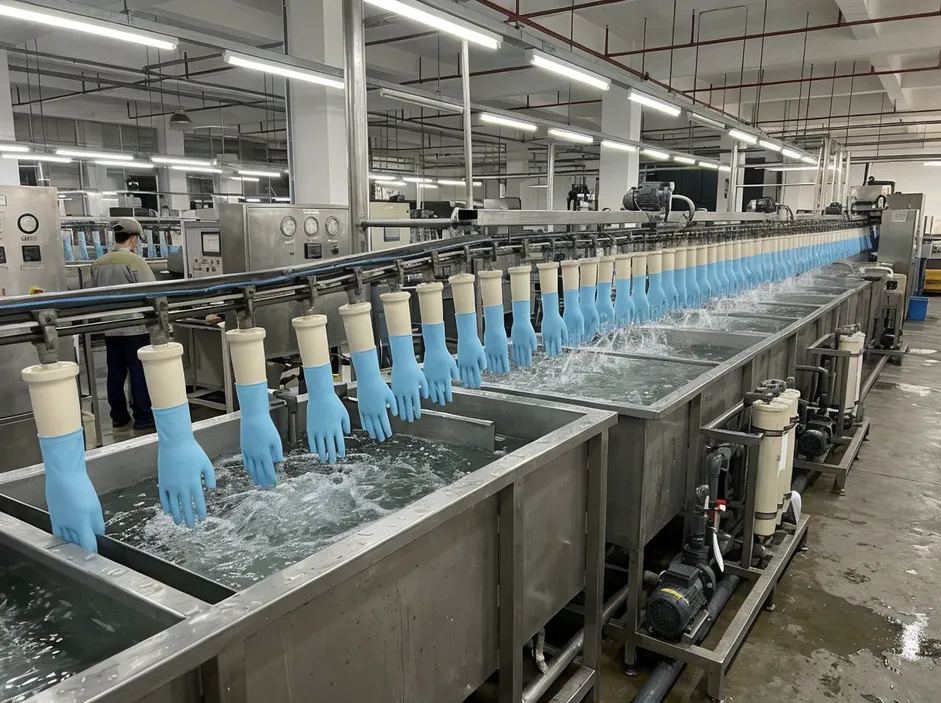
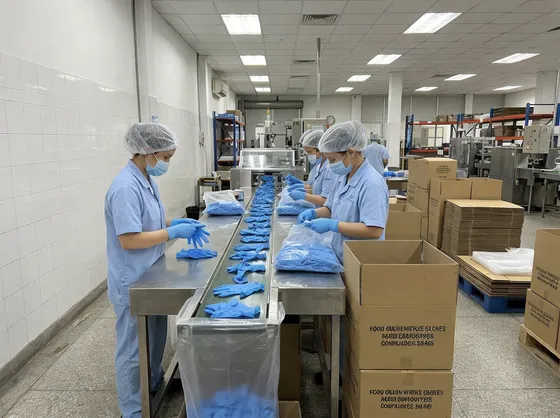
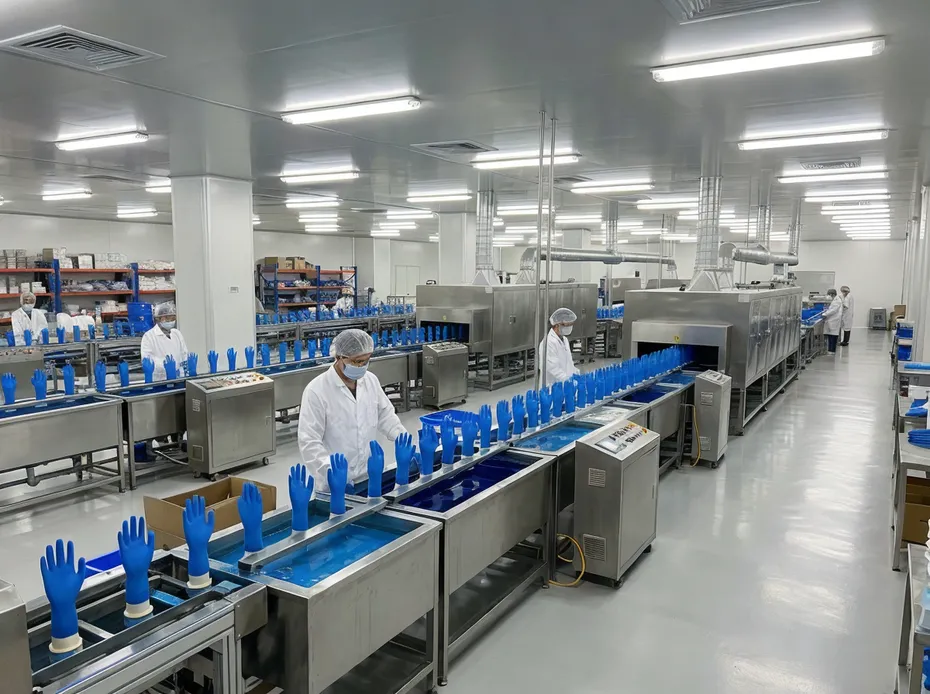
glovemfg has produced nitrile gloves exclusively since 2007. Food-contact grade runs on the same 8 automated dipping lines, same in-house compound, same AQL 1.5 outgoing inspection — your food processing accounts get consistent spec across every container.
Food nitrile gloves aren't a separate product category — they're a specification decision. The glove itself is the same nitrile construction your industrial accounts use, but the compliance documentation, the powder-free process verification, and the material safety data are what make it sellable into food processing facilities, commercial kitchens, and food service distribution.
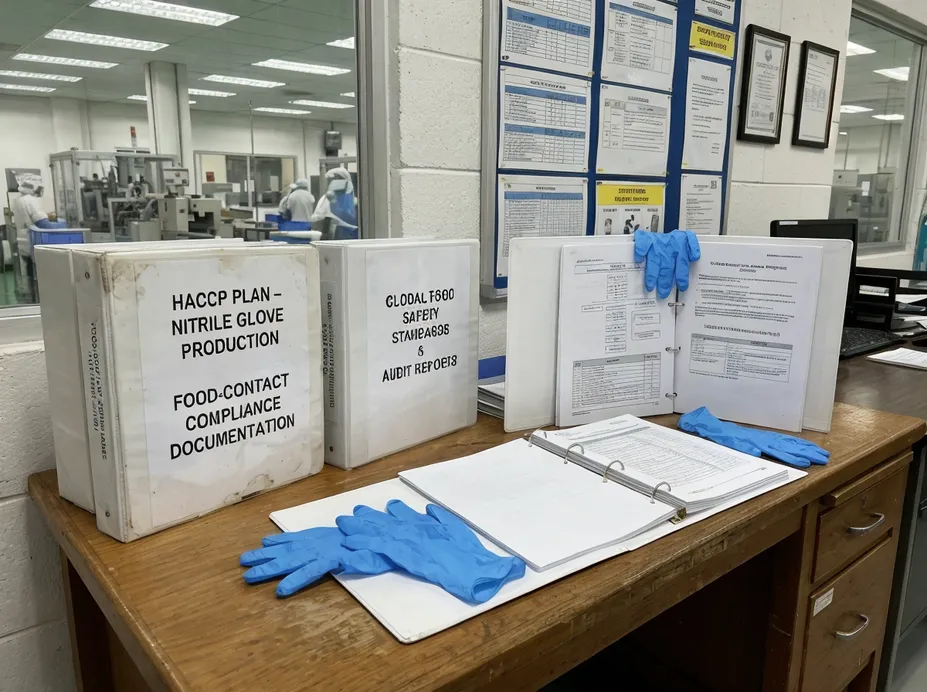
Your buyers in food processing procurement don't just need a glove that works on the line. They need documentation that satisfies their HACCP plan, their facility audit, and in some markets, their regulatory import requirements. A glove without the right paperwork is a liability, not a product — and that's the sourcing problem we solve.
We produce food-contact nitrile gloves at the same facility that holds FDA 510(k) clearance and EN 455 for our medical line. The process discipline that satisfies FDA import reviewers is the same process that produces your food-contact SKU.
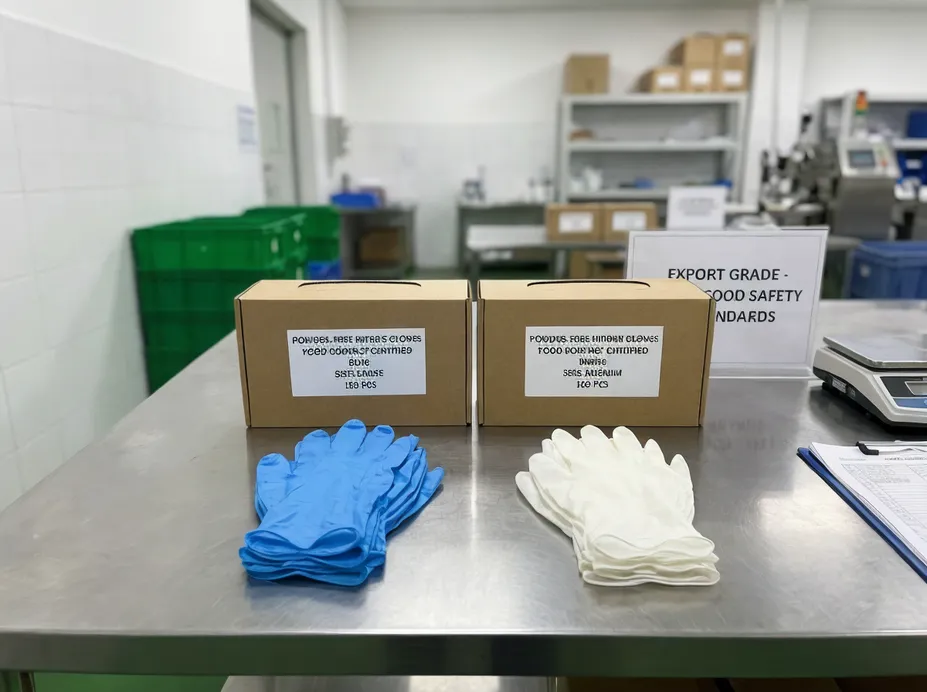
Powder-free is verified through post-stripping chlorination and a final rinse stage, with documentation available for buyers who need to demonstrate compliance to food-contact procurement standards. No latex, no powder, no accelerator residue on the accelerator-free variant — the material profile that food processing facilities require.
Compliance documentation satisfies facility audits and procurement standards.
Post-stripping chlorination and final rinse stage — verified powder-free process.
FDA 510(k) & EN 455 process discipline applied to every food-contact SKU.
Specifications shown are standard production values. Tensile strength, elongation-at-break, and force-at-break test reports are available on request.
Tensile strength, elongation-at-break, and force-at-break test reports available on request.
Powder-free is a claim every glove supplier makes. What it means in practice varies considerably, and food processing buyers — especially those supplying facilities under HACCP or BRC audit — need more than a label claim.
Our powder-free process runs in two stages after stripping. First, gloves go through an aqueous chlorination bath that neutralizes surface tack without leaving residue. Second, a final rinse stage removes chlorination byproducts before the gloves enter the drying and packing sequence. We run this as a controlled process with documented parameters — bath concentration, contact time, rinse volume — not as a variable step that operators manage by feel.
We've had buyers come to us after a facility audit flagged their previous supplier's powder-free documentation as insufficient. The audit didn't fail the glove — it failed the paperwork. That's a supply chain problem we can prevent on the front end.
Prepared as a standard part of the product package — not a special request that adds lead time.
For North American food processing distribution, FDA 510(k) is the certification your buyers reference when qualifying a new glove supplier. For European food processing accounts, CE marking covers the import requirement.
US food processing facilities and food service distributors — satisfies FDA import requirements and institutional procurement standards.
EU food processing and food service distribution — required for European import.
European medical and healthcare-adjacent procurement — applies to accelerator-free variant. Relevant for food processing facilities with healthcare-adjacent compliance requirements.
Universal quality management — required by most institutional and government procurement processes.
North American nitrile examination glove standard — referenced by US industrial and food processing distributors.
Third-party pre-shipment inspection through SGS or Bureau Veritas available if your procurement process requires it.
If your customers include food manufacturing facilities with pharmaceutical-adjacent compliance requirements, the accelerator-free variant with EN 455 documentation satisfies the more stringent procurement standards those facilities apply.
Food nitrile gloves distribute across several distinct segments, each with different volume patterns, specification requirements, and margin dynamics. The right SKU mix depends on which segments your buyers serve.
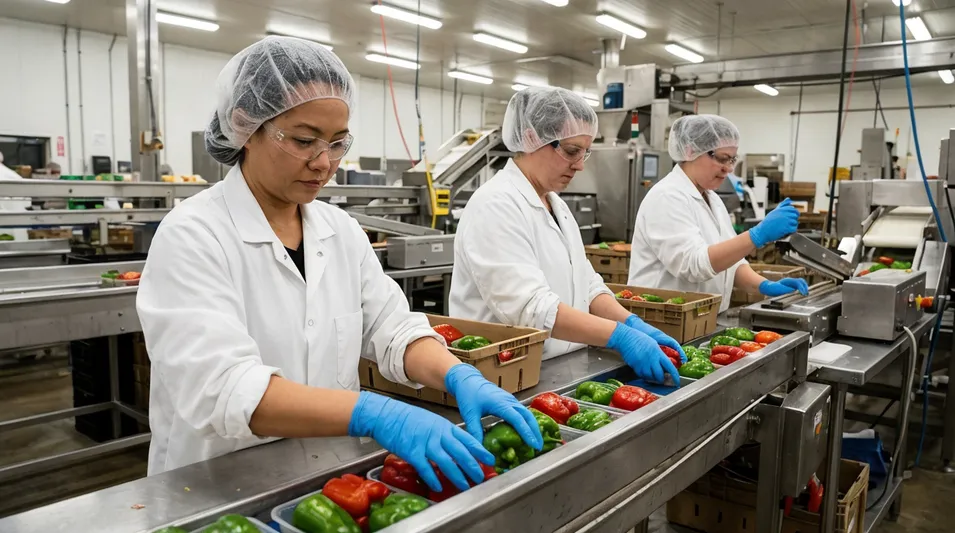
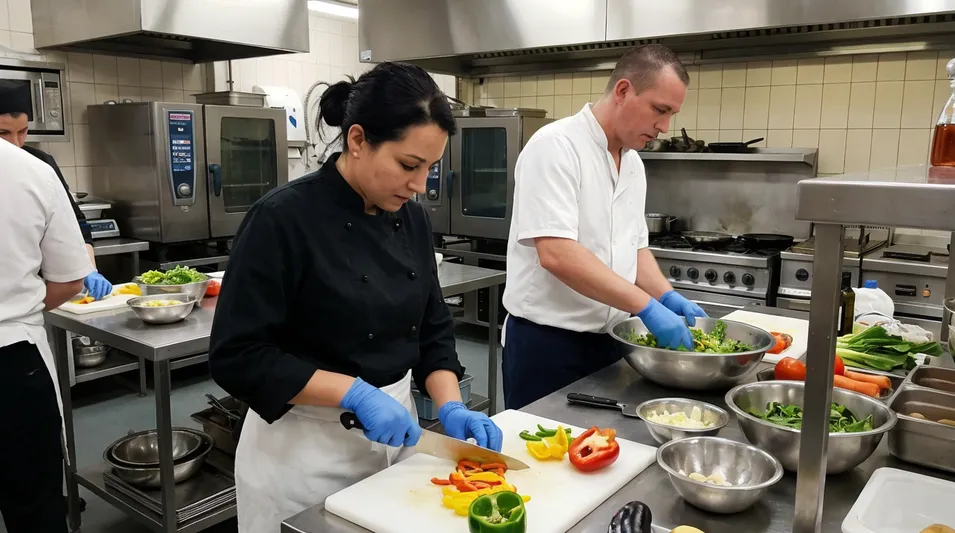
Meat processing, poultry, seafood, and produce packing lines consume nitrile gloves at high rates — shift changes, contamination protocols, and line hygiene requirements drive frequent glove changes.
Supply chain reliability matters more than price per box in this segment. Facilities run on approved supplier lists — getting on the list is the entry point.
Smaller facilities, more frequent smaller orders, higher SKU fragmentation across sizes. Restaurant groups, catering operations, and institutional food service (hospitals, schools, corporate cafeterias) require faster replenishment cycles.
Distribution model differs from processing — smaller order frequency, broader size coverage, and institutional account management are the operational requirements.
A growing segment for distributors who want to move up the value chain. Supermarket chains and food retail groups increasingly source private-label nitrile gloves for their deli, bakery, and prepared foods departments.
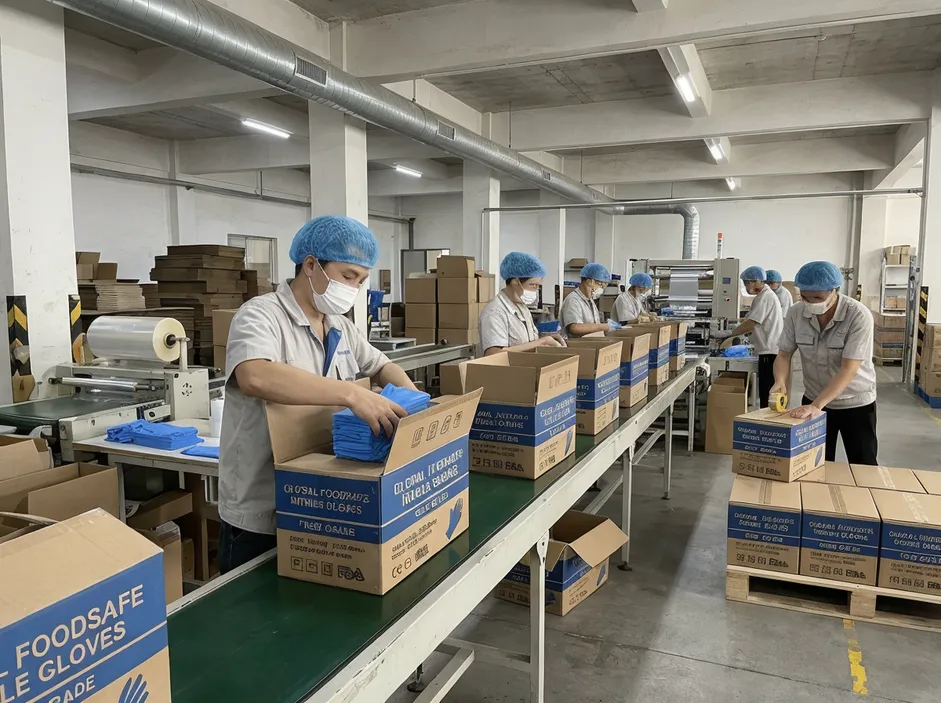
Packaging carries the retailer's brand. Our OEM capability covers custom carton printing, box labeling, and inner bag branding without subcontracting.
The segment where the accelerator-free variant earns its premium. Contract manufacturers producing dietary supplements, functional foods, and specialty ingredients often operate under pharmaceutical-adjacent GMP requirements that flag standard accelerator chemistry as a contamination risk.
This segment is smaller by volume but the margin structure reflects compliance-driven procurement. One factory, two specifications, broader market coverage.
The standard food-contact specification covers the majority of applications. But the choice between standard and accelerator-free, and between fingertip texture and full-hand texture, affects which accounts you can serve and at what margin.
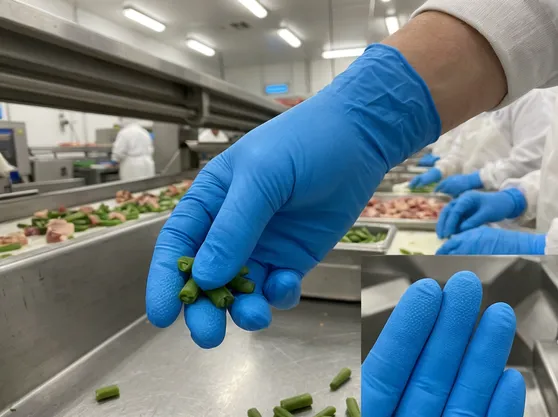
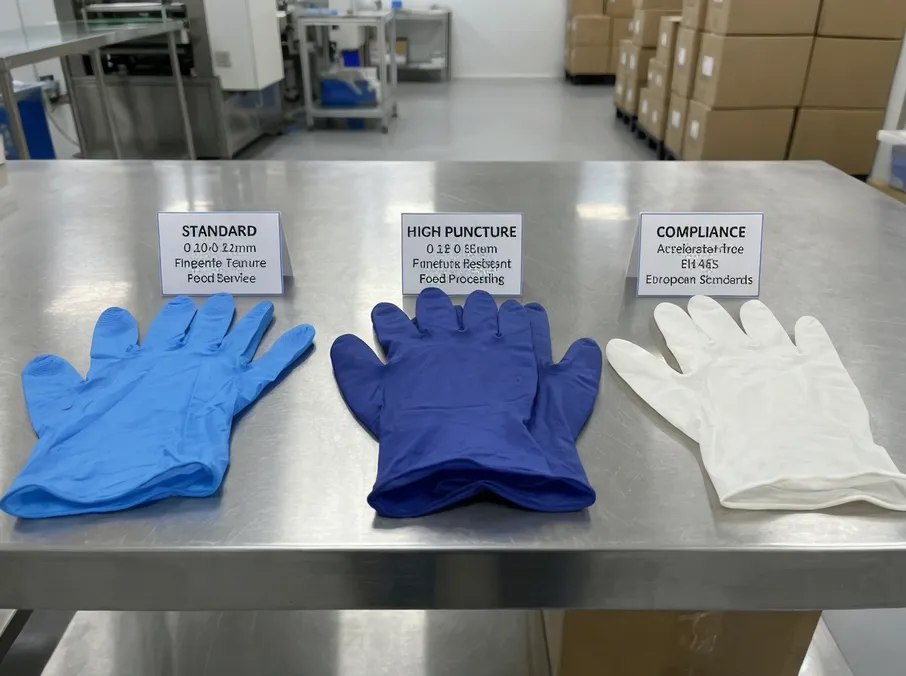
Meat packing, produce handling, food assembly — fingertip micro-texture at 0.10–0.12mm is the right specification. Provides enough grip for wet and slippery food surfaces without over-speccing wall thickness.
Blue colorway is the standard for food processing — visually detectable against most food products, a contamination control requirement in HACCP-compliant facilities.
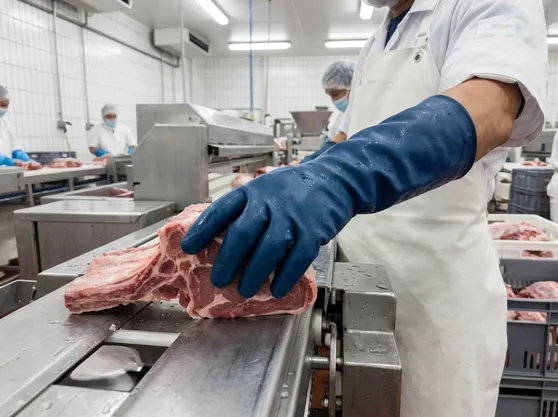
Bone handling in meat processing, shellfish processing, heavy packaging work — the heavier gauge from our industrial heavy-duty variant is worth considering. Available in food-contact documentation format on request.
Most food processing distributors don't carry the heavier gauge as a standard SKU, but it's worth having in your catalog for accounts that have had puncture-related complaints with standard spec.
Accelerator-free variant is the specification that opens these procurement doors. European food processing accounts with sensitization compliance requirements also fall here.
The alternative for your buyer is a separate supplier qualification process. One factory, two specifications, broader market coverage.
The right specification depends on the account type, not just the application. Here's how to map buyer requirements to the correct variant:
Standard food processing and food service
0.10–0.12mm, fingertip micro-texture, blue or white. Covers the majority of accounts. Price-competitive segment — supply reliability is the differentiator.
High-puncture food processing environments
0.13–0.15mm, food-contact documentation on request. Catalog item for accounts with puncture complaints on standard spec. Not a default SKU for most distributors.
Nutraceutical, pharmaceutical-adjacent, European compliance
Accelerator-free with EN 455 documentation. Higher per-unit cost, compliance-driven procurement, less price-competitive. One factory qualification covers both standard and accelerator-free.
If you're building a private-label food-contact glove line, the same manufacturing infrastructure that produces our standard SKUs handles OEM and ODM projects. We don't subcontract custom work — it runs on our lines, with our compound, under our QC process.
Custom packaging for food-contact SKUs covers carton printing, box labeling, and inner bag branding. Regulatory documentation — CE declaration of conformity, FDA 510(k) reference, food-contact compliance declaration, country-of-origin certificates — is prepared under your brand name for markets where you hold the import registration. If you're supplying a supermarket chain or food retail group that requires supplier-branded documentation, we prepare the full package.
Color customization is available for runs over one container. Blue and white are standard; other colors are available on request with a minimum run. We've done custom colors for food processing accounts that use color-coding to differentiate glove grades across departments — it's a straightforward compound adjustment, not a special process.
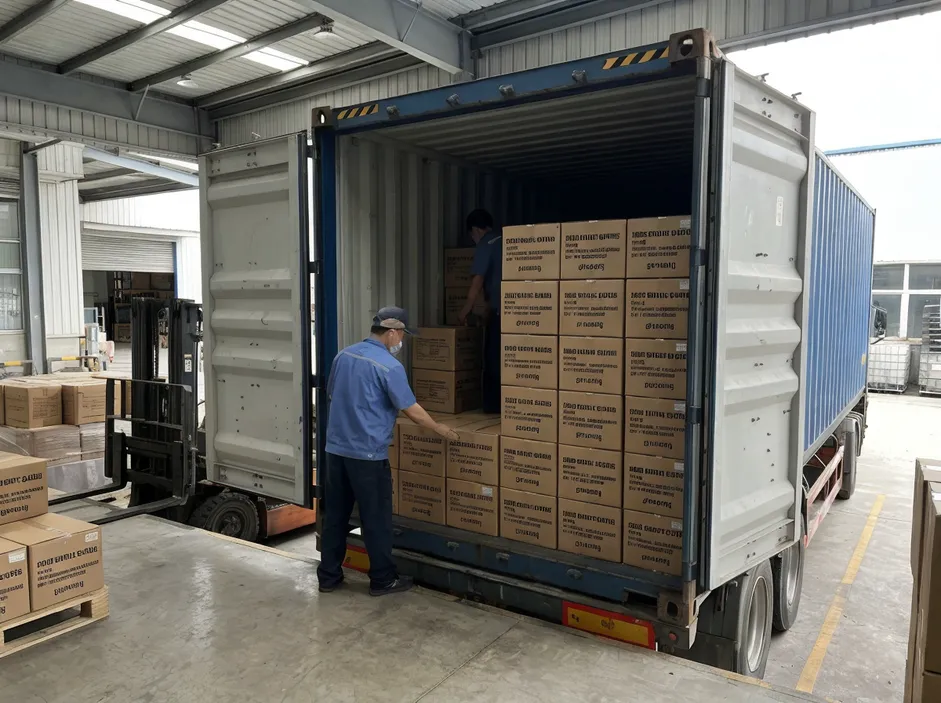
MOQ for standard food-contact SKUs starts at one 40HQ container — approximately 2,000 boxes at 100 gloves per box. Custom formulation or color projects carry the same MOQ. Below that threshold, the compound development and line setup cost doesn't make sense for either side; we'll tell you that upfront.
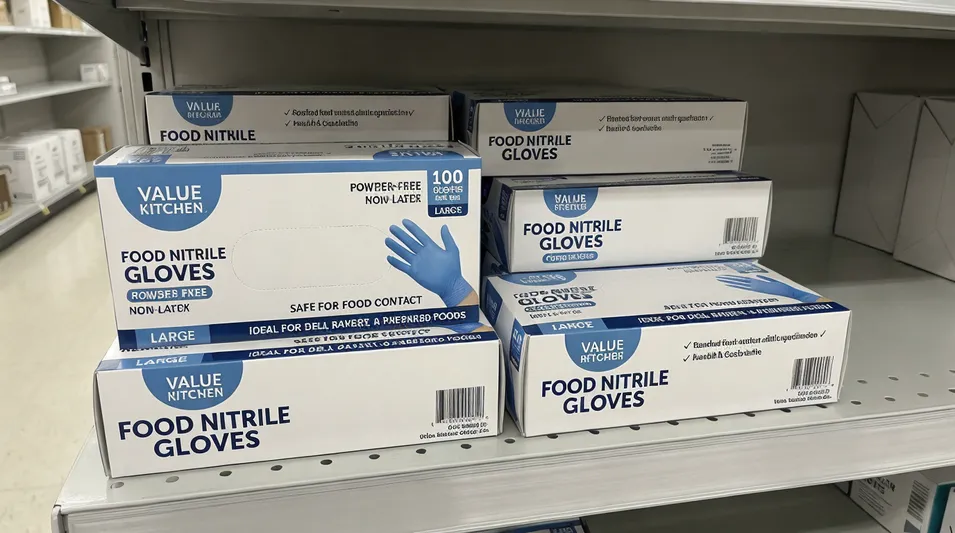
Standard food nitrile gloves pack at 10 boxes per carton, 100 gloves per box. Carton dimensions are optimized for 40HQ loading — a properly loaded 40HQ carries approximately 2,000 boxes, or 200,000 gloves per container at standard pack configuration.
Standard pack configuration, optimized for 40HQ container loading.
Consistent count per box across all food-contact SKUs.
Full container yield at standard pack configuration.
From order confirmation for standard food-contact SKUs.
Carton labeling can be configured to match your receiving requirements:
For food-contact SKUs, we include the food-contact compliance declaration and lot traceability documentation in the carton labeling by default. This is a requirement for buyers supplying HACCP-audited facilities, and building it into the standard label setup avoids the back-and-forth at shipment time.
Pre-shipment inspection through SGS or Bureau Veritas is available on request. For repeat orders on established SKUs, we maintain a rolling production schedule that allows us to confirm ship dates at order placement.
One 40HQ container for standard food-contact SKUs — approximately 2,000 boxes at 100 gloves per box. For buyers who want to test the product before committing to a full container, we support sample orders that ship within 5–7 business days with full certification and food-contact compliance documentation included.
Our food nitrile gloves are produced under FDA 510(k) clearance and meet the material requirements for food-contact use. The FDA 510(k) reference, CE declaration of conformity, and food-contact compliance documentation ship with every container. For buyers supplying US food processing facilities or food service distributors, this is the documentation package your buyers' procurement teams require.
Standard food nitrile uses thiuram and carbamate accelerators in the vulcanization process — the standard chemistry for nitrile glove production. Accelerator-free food nitrile uses a sulfur-donor cure system instead, producing a glove with no detectable accelerator residue. For most food processing and food service applications, standard food nitrile is the correct specification. For buyers supplying nutraceutical manufacturing, pharmaceutical-adjacent food production, or European food processing facilities with sensitization compliance requirements, the accelerator-free variant satisfies procurement standards that standard nitrile cannot meet.
Blue and white are standard production colors for food-contact SKUs. Blue is the most common specification for food processing lines because it's visually detectable against most food products — a HACCP contamination control requirement. White is standard for food service and commercial kitchen supply. Custom colors are available for runs over one container on request.
Our powder-free process runs post-stripping chlorination followed by a final rinse stage, with documented process parameters — bath concentration, contact time, rinse volume. We provide a powder-free declaration and material safety data as part of the standard food-contact documentation package. For buyers whose customers operate under HACCP audit or BRC certification, this documentation satisfies the supplier qualification requirements for powder-free glove supply.
Yes. OEM and private-label projects run on our production lines with our compound and QC process — no subcontracting. Custom packaging, carton printing, and regulatory documentation under your brand name are standard capabilities. MOQ is one 40HQ container. Contact us to discuss your project requirements.
Food-contact nitrile gloves are a compliance-driven purchase. Your buyers need documentation, not just product — and the documentation has to hold up under facility audits, import inspections, and procurement qualification processes.
glovemfg has manufactured nitrile gloves since 2007. The certifications in place — FDA 510(k), CE, EN 455, ISO 9001:2015, ASTM D6319 — were built for the medical and healthcare market, which means they exceed what most food processing procurement requires. When you source food nitrile gloves from us, you're sourcing from a facility where the compliance infrastructure was built to satisfy FDA import reviewers and European hospital procurement — not retrofitted to meet food-contact minimums.
For the full industrial nitrile range, including heavy-duty, accelerator-free, and textured fingertip variants, see our industrial nitrile gloves page. For manufacturing background and facility details, see about glovemfg.
Ready to discuss specifications or request samples? Send us your target market, volume expectations, and any existing specification you're working from — we'll respond with a detailed quote, the relevant certification documentation, and a sample shipment.