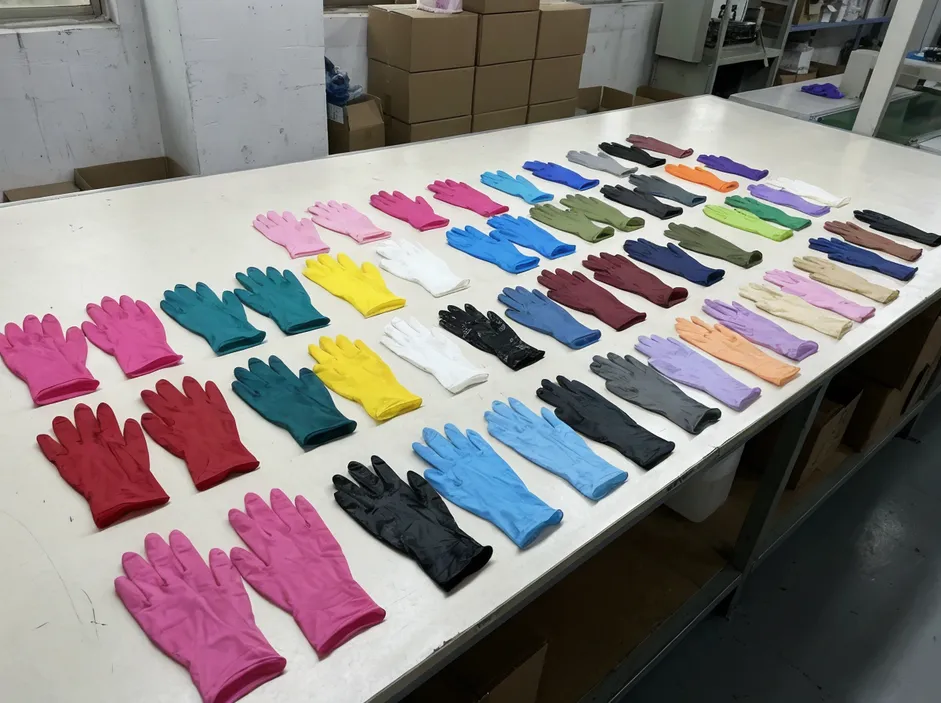
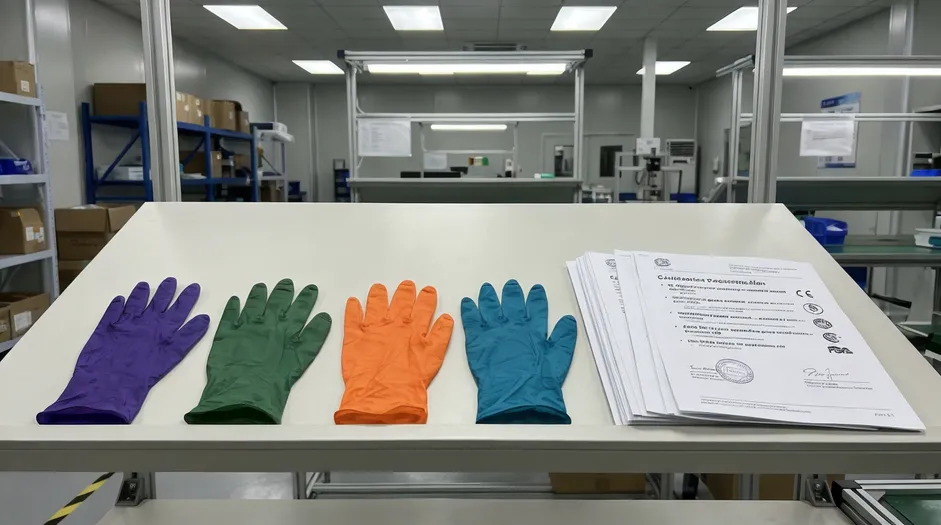
Pink, red, teal, yellow, or any custom match: we develop the formulation in-house, lock it to your spec, and hold it consistent across every reorder. CE, EN455, ASTM D6319, FDA 510(k) certified.
Our standard color rotation covers purple, violet, green, and orange — those SKUs are in continuous production and ship from existing inventory cycles. This page is for everything else: pink, red, teal, yellow, white, black beyond standard, or any color your brand program requires that isn't already in the rotation.
Color nitrile gloves in this custom range are developed through our in-house compounding lab. You provide a Pantone reference number, a physical sample, or a brand style guide color — we formulate the compound, run an internal dip test, and submit a production sample for your approval before anything goes to full production. The locked formulation then becomes your SKU, reproducible across every subsequent order without reformulation.
This isn't a novelty service. The buyers who use it are building private-label programs, supplying brand-specific procurement contracts, or running multi-color safety systems that require colors we don't stock in rotation. The commercial logic is straightforward: a color that's yours and not available from commodity suppliers is a margin-protective SKU. Your downstream customers can't price-shop it against a generic catalog item.
Browse our standard color variants in the full range
Need pink, red, teal, yellow, white, black, or a brand-specific Pantone? That's what this page covers.
The development sequence matters because it's where most color programs go wrong with other suppliers — a factory that doesn't control its own compound can't guarantee the production run matches the sample you approved. Here's how we run it.
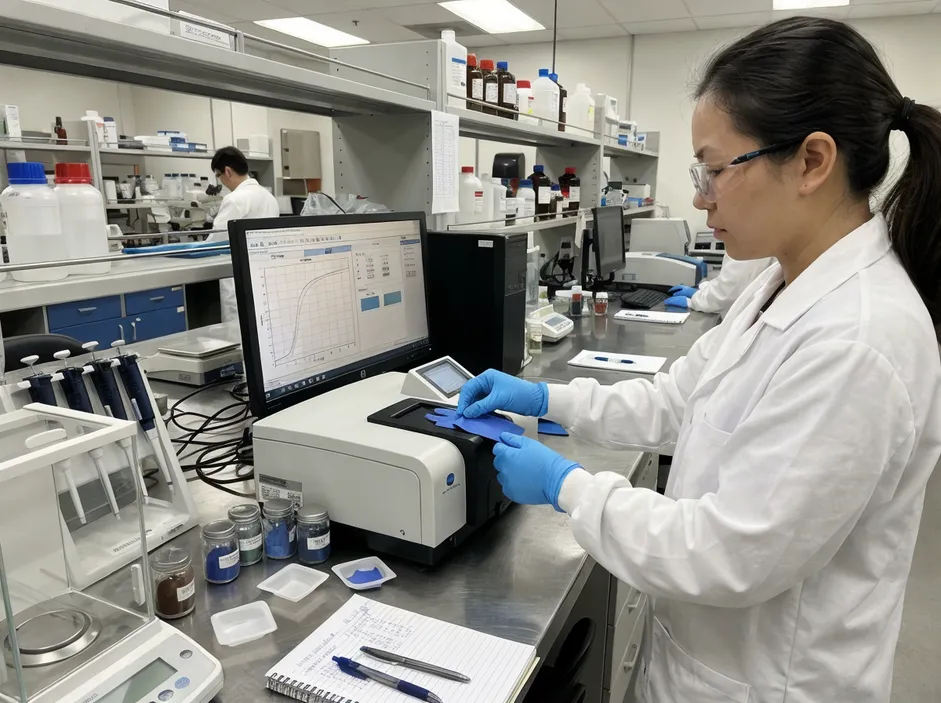
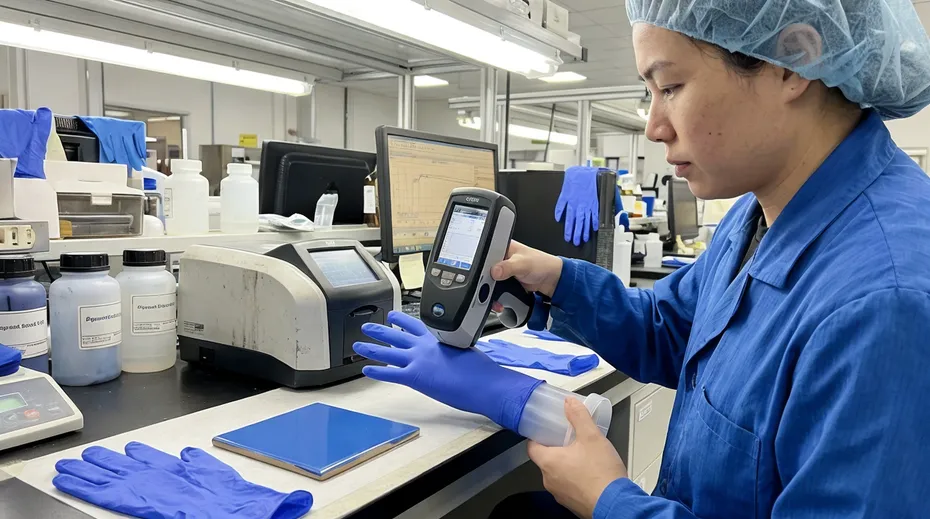
You send us a Pantone reference number or a physical color sample. Our compounding lab formulates a pigment loading and dispersion spec against that reference, then runs an internal dip test on a small batch. We check the cured glove color against your reference using spectrophotometer measurement — not a visual check, because visual checks are operator-dependent. If the first formulation is off, we adjust and re-test internally before anything goes to you.
Once the internal dip test passes our color standard, we run a small production sample — typically 2–3 boxes — and ship it to you for approval. This is the sample you evaluate against your brand standard, your packaging, and your downstream customer's expectations. We don't move to full production until you've signed off in writing.
Your approved color becomes a locked compound specification in our system: pigment loading percentage, dispersion method, cure profile, viscosity target. That record is what we pull for every production run of your SKU. The color your customer approves in the first container is the color they receive in the fifth.
Covers formulation development cost and provides a viable opening inventory position.
Yes — with a minimum of one 20GP equivalent per color. Below that, line changeover and QC overhead doesn't make sense for either side.
The commercial risk in color nitrile sourcing isn't the first order — it's the reorder. A supplier who can match your color on the first container but drifts on the second has cost you a customer complaint, a potential return, and the credibility of your private-label brand.
Color drift in nitrile gloves has two root causes: pigment batch variation and compound viscosity variation. If a factory buys pigment from multiple suppliers without a locked specification, the color shifts when the pigment lot changes. If the nitrile compound isn't mixed in-house to a locked viscosity spec, viscosity changes affect pigment dispersion — the color shifts even if the pigment itself is consistent.
The practical result: the color your customer approves on the production sample is the color in every subsequent container, without you having to re-specify or re-approve between orders. For a private-label program where your brand's color is part of your product identity, that consistency is what protects your downstream customer relationships.
Pigment for each color SKU is sourced from a single approved supplier. Incoming batch testing against our color standard is completed before any pigment enters production — no lot-to-lot substitution.
Compound is mixed in-house in our compounding lab to a locked viscosity specification. Viscosity directly affects pigment dispersion — controlling it eliminates a second independent source of color drift.
Every production run — including reorders — is checked against a physical color standard using spectrophotometer measurement before the run is approved for packaging. No visual-only approval.
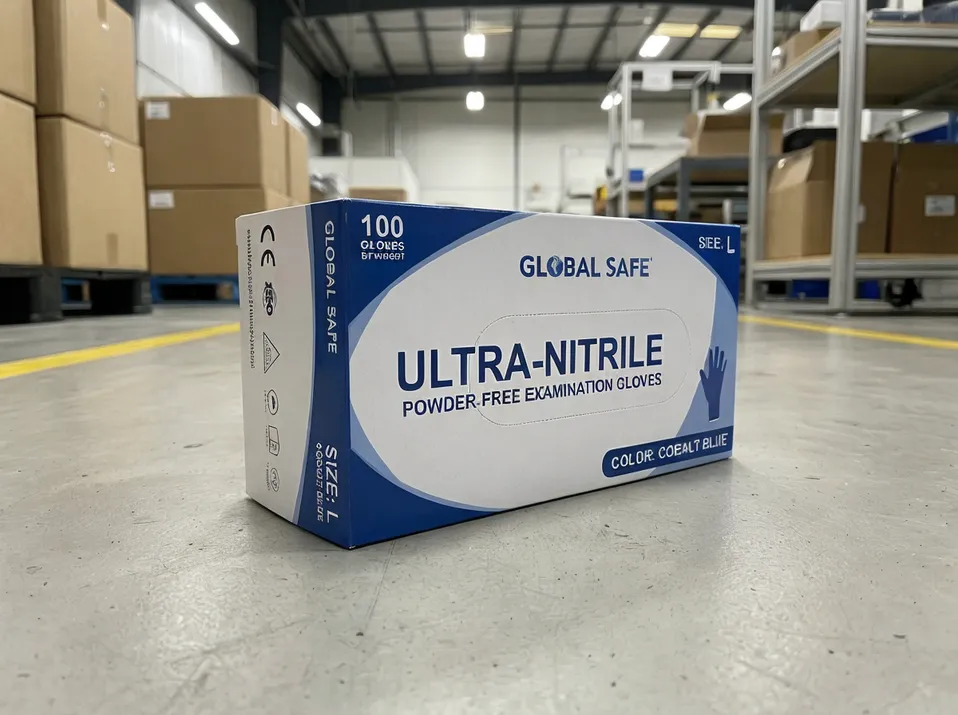
100 gloves per box, 10 boxes per carton. A 40HQ container carries approximately 2,000 cartons (200,000 boxes) for examination-grade SKUs. Industrial-grade SKUs with heavier wall thickness load at slightly lower density due to carton weight limits — confirm exact loading figures when you request a quote, since it varies by size mix.
For private-label programs, we print your brand name, logo, color name, size, lot number, manufacture date, and expiry date on the inner box. Carton labeling can be configured to your DC receiving requirements or Amazon FBA specifications.
We handle country-of-origin documentation, packing lists, and pre-shipment inspection coordination with SGS or Bureau Veritas if your procurement process requires third-party verification.
Samples for color approval ship within 5–7 business days and include the full certification documentation package for the specific lot and color.
A question we get regularly: do custom color gloves carry the same certifications as standard SKUs? Yes — the certifications are tied to the compound specification and manufacturing process, not to the color. A custom pink nitrile glove produced on our dipping lines under our AQL 1.5 inspection standard carries the same certifications as our standard purple or green SKUs.
For buyers supplying regulated markets, this matters at the procurement stage. A hospital network or dental chain that requires FDA 510(k)-cleared examination gloves can specify a custom color without losing compliance coverage. A food processing customer running a HACCP color-coding program can specify a custom color and still meet food-contact material requirements.
Accelerator-free option: Available on custom color runs. If you're supplying European healthcare procurement where Type IV allergy compliance is a requirement, flag this when you submit your color brief and we'll formulate accordingly.
For downstream market compliance beyond our certifications — REACH, RoHS, food-contact material regulations in specific markets — we can provide material composition documentation and test reports on request. Custom color development includes a full material safety data review as part of the formulation process.
European conformity — applies to custom color SKUs produced under the same compound specification.
Medical gloves standard — retained on custom color runs regardless of pigment selection.
Nitrile examination glove specification — compound-tied, not color-tied.
Cleared for examination use — hospital and dental procurement can specify custom colors without losing clearance.
This product page covers custom and non-rotation colors. If your program requires a color we already produce in continuous rotation, you'll get faster lead times and lower development risk by starting with an existing SKU.
Highest-volume color in the range; default specification for dental and veterinary distribution in North America and Europe.
Blue-shifted purple; used in multi-color coding systems and aesthetics supply.
Medical and food-contact grade; standard in laboratory and produce-line applications.
Heavier gauge for industrial color-coding programs.
High-visibility; specified in construction, utilities, and manufacturing safety programs.
Send us a Pantone reference and we'll tell you directly — sometimes a slight shade adjustment to an existing formulation is faster and cheaper than a full custom development.
View full color rangeAny color with a Pantone reference or a physical sample we can measure. We've produced pink, rose, coral, red, teal, turquoise, yellow, white, and various custom brand colors. The practical constraint is pigment stability through the nitrile dipping and curing process — some very light or fluorescent colors require additional formulation work to achieve stability, which we'll flag during the development stage. If a color isn't achievable to your standard, we'll tell you before you commit to an MOQ.
One 40HQ container per color. For examination-grade gloves, that's approximately 2,000 boxes (200,000 gloves). This covers the formulation development cost and gives you a viable opening inventory. If you need two colors, you can split a 40HQ with a minimum of one 20GP equivalent per color — confirm the split when you submit your RFQ.
From Pantone reference to approved production sample: typically 3–4 weeks. From sample approval to full production completion: 25–35 days. Total from brief to shipment-ready: approximately 7–9 weeks for a new color. Reorders on an established locked spec run at standard lead time — 25–35 days — with no reformulation delay.
Yes. Certifications are tied to the compound specification and manufacturing process, not the color. Custom color SKUs produced on our lines under our standard AQL 1.5 inspection carry CE, EN455 (medical grade), ASTM D6319, and FDA 510(k) coverage. Full documentation — CE declaration of conformity, FDA 510(k) reference, internal test reports — is available per production lot.
Yes. Send us a physical sample — a swatch, a packaging panel, or even a competitor glove in the target color — and our compounding lab will measure it with a spectrophotometer and develop a formulation to match. A Pantone reference is faster because it eliminates measurement ambiguity, but a physical sample works. Digital color references (hex codes, RGB values) are less reliable because screen color profiles vary — a physical reference or Pantone number is always preferable.
Shelf life is 5 years from manufacture date under proper storage conditions: below 25°C, away from UV sources, in original sealed cartons. Color doesn't affect shelf life — the compound specification determines aging characteristics, and custom color SKUs use the same base compound as standard SKUs. We print manufacture date and expiry date on every carton and inner box.
If you have a Pantone reference, a physical sample, or even just a description of the color and the market you're supplying — send it to us. We'll confirm whether it's achievable, estimate the development timeline, and get you a quote based on your volume and grade requirements.
Most buyers in this category start by sending a color brief and requesting a sample before committing to a full container. We can have samples to you within 3–4 weeks of receiving your color reference.