What is the standard thickness for blue nitrile gloves, and how does it affect performance?
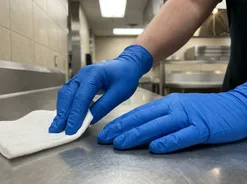
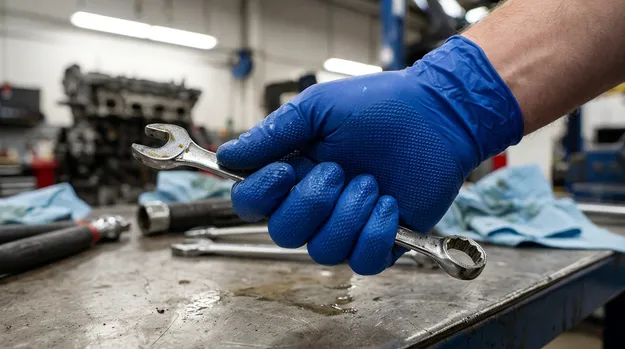
Standard blue nitrile examination gloves typically run 0.08-0.10mm at the palm. Cleaning and industrial-grade SKUs typically run 0.10-0.15mm.
Thicker walls improve puncture resistance and extend wear time in abrasive environments. Thinner walls improve tactile sensitivity for examination and precision handling.
The key control point is not nominal thickness alone, but tolerance across the full glove. A glove that measures 0.10mm at the palm but 0.07mm at the fingertip can fail tensile testing under EN 455 and ASTM D6319.
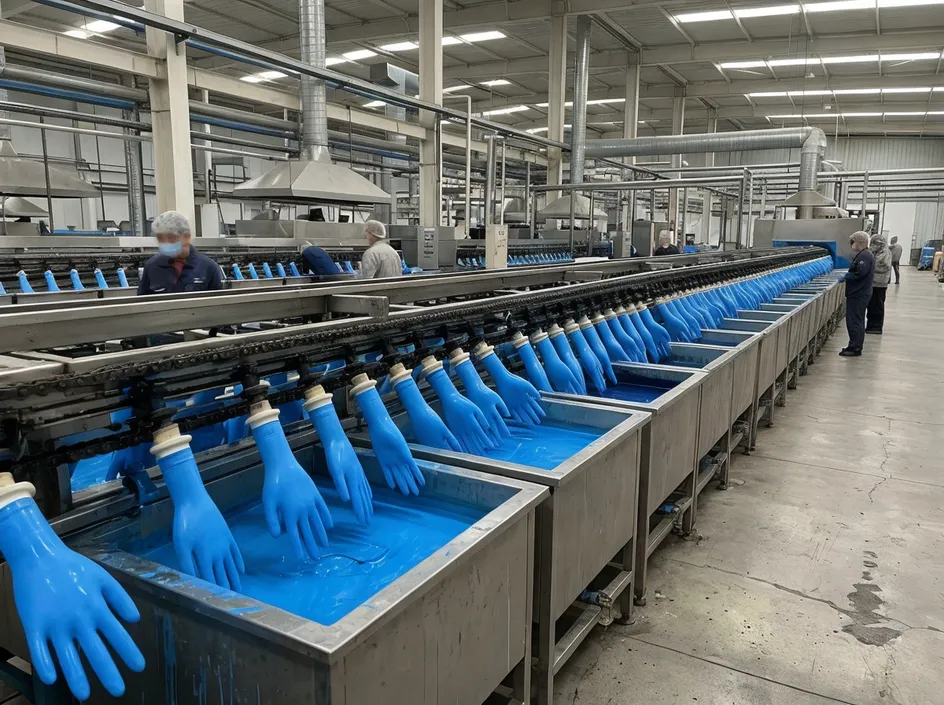
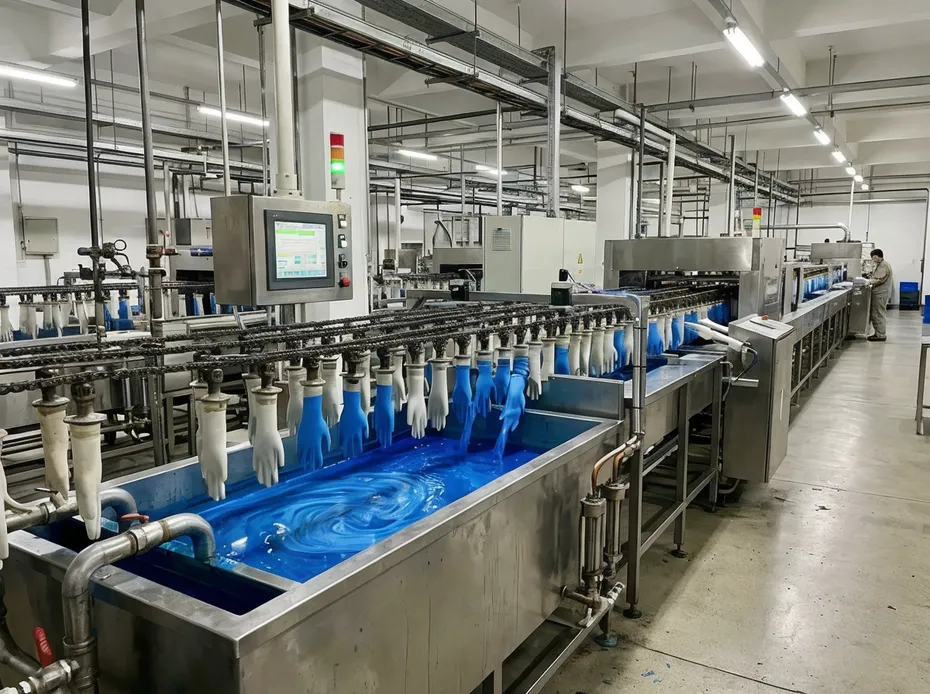
Our automated dipping process holds +/-0.02mm tolerance across palm, finger, and cuff, which is what keeps AQL results clean at destination.
What certifications do I need for blue nitrile gloves in European medical procurement?
EN 455 is the baseline requirement for European hospital and dental procurement. CE marking is required for market access.
For buyers supplying public health tenders in EU member states, procurement departments typically request the CE declaration of conformity and EN 455 test reports.
ISO 9001:2015 is also typically required as a quality management system certification for approved vendor lists. We hold all three, and the documentation ships with sample orders.
What is the difference between standard blue, cobalt blue, and indigo nitrile gloves?
Mechanical performance and certification coverage are identical across all three shades. The difference is pigment concentration and resulting color appearance.
Standard blue is the light-to-medium blue that dominates the examination glove market. Cobalt blue is deeper and more saturated for private-label brands that want shelf differentiation within the blue category.
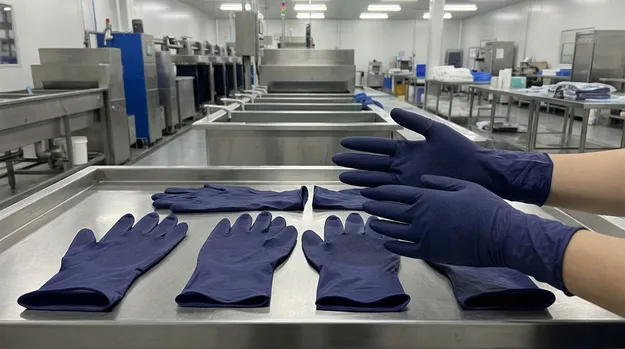
Indigo is near-navy, positioned between blue and black, and is increasingly specified by industrial and tattoo supply distributors that want a darker aesthetic without moving to full black. All three are available for OEM programs from one container MOQ.
What is AQL 1.5 and why does it matter for my supply chain?
AQL (Acceptable Quality Level) 1.5 means that in a statistically sampled inspection, the maximum acceptable defect rate is 1.5 defects per 100 units.
Many factories use AQL 2.5 as their default outgoing standard, which is a 67% higher defect tolerance. We run AQL 1.5 across 100% of production lots.
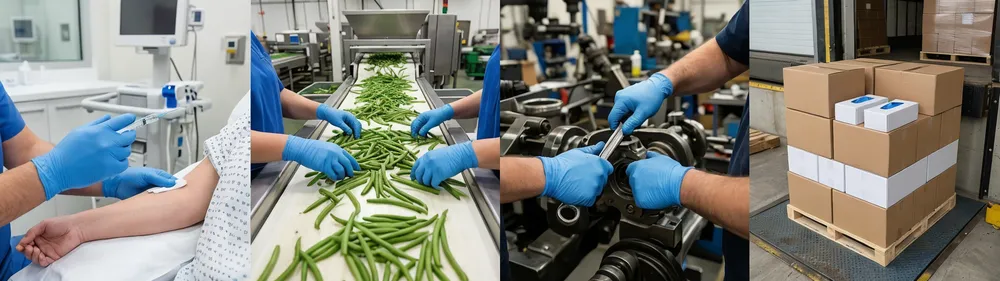
That means fewer defective units reach your warehouse and fewer complaints reach downstream customers. For distributors supplying healthcare or food processing accounts, where failures create returns and account risk, this tighter standard is often the difference between a clean supply record and a recurring quarterly issue.
What is the MOQ for blue nitrile gloves, and can I mix SKUs in one container?
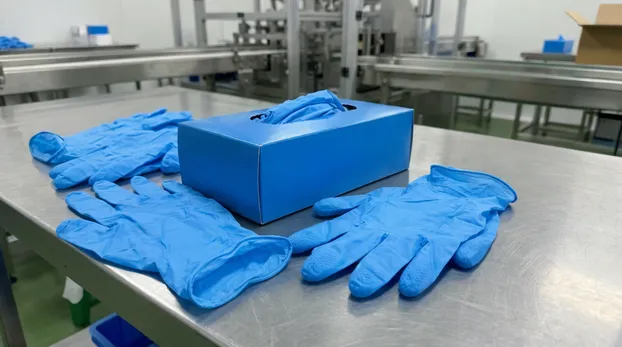
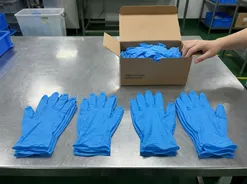
MOQ for standard blue nitrile SKUs is one 40HQ container, approximately 2,000 boxes (200,000 gloves at 100 pcs/box).
Mixed-SKU loading is supported. Carton dimensions are standardized across the blue nitrile line, so multiple SKUs can be combined in one container without losing loading efficiency.
For new buyers, sample orders are available before full container commitment. Samples ship within 5-7 business days with full certification documentation.
Are accelerator-free blue nitrile gloves available?
Yes. We run accelerator-free compound on a dedicated line using a sulfur-donor cure system instead of the thiuram and carbamate accelerators used in standard nitrile vulcanization.
The resulting glove passes EN 455 with no detectable accelerator residue, a specification that European hospital procurement departments increasingly require to manage Type IV allergic reaction risk in healthcare workers.
This is available as an OEM option on blue nitrile exam and medical examination SKUs, with the same MOQ as standard SKUs.