Heavy-Duty Industrial Nitrile

8 Mil Industrial
Nitrile Gloves

8 mil wall thickness, powder-free, full-hand texture — built for the industrial environments where standard nitrile isn't enough.

Manufactured on automated dipping lines with in-house compound control. Every glove passes online pinhole detection. AQL 1.5 outgoing inspection on every lot.

ISO 9001:2015 CE ASTM D6319 18+ Years Nitrile-Only
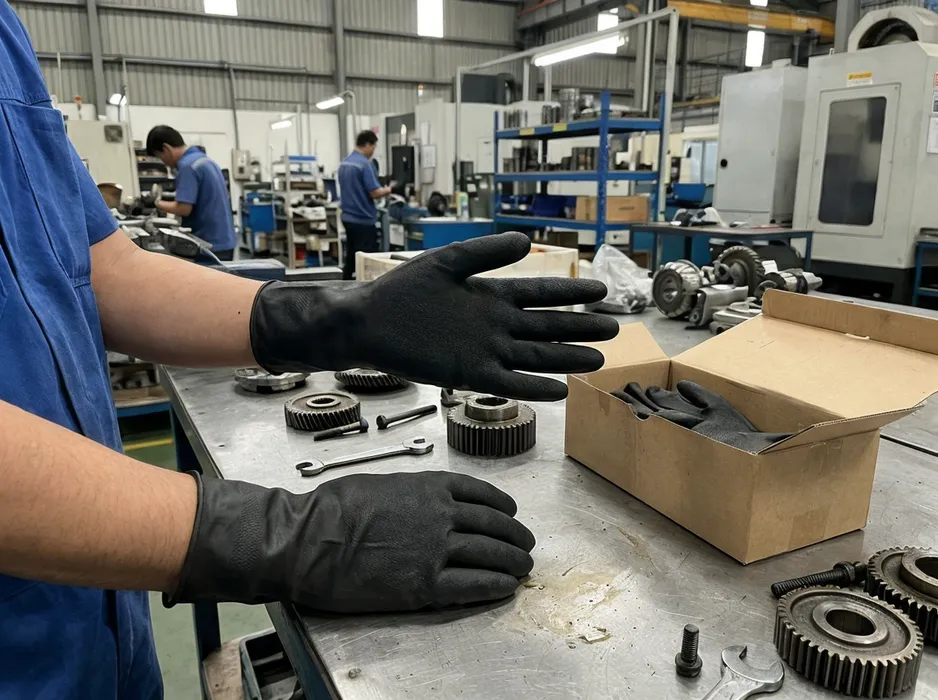
8 mil industrial nitrile gloves — heavy-duty black nitrile gloves for industrial use
Specification Context

What 8 Mil Means — and When It's the Right Specification

Eight mil (0.20mm nominal wall thickness) is the heavy end of the industrial nitrile range. Most general-purpose industrial gloves run 0.10–0.12mm at the palm. Our heavy-duty standard industrial line runs 0.13–0.15mm. The 8 mil specification goes further — it's the configuration for environments where puncture events are frequent, chemical contact is sustained rather than incidental, and a glove failure has real consequences for the worker and for your customer's liability exposure.

The buyers who specify 8 mil are typically supplying chemical processing plants, oil and gas maintenance operations, waste management contractors, automotive body shops, and metalworking facilities. These aren't accounts where the purchasing decision is driven by price-per-box alone — they're accounts where a glove failure generates an incident report, and where your customer's safety manager has sign-off on the specification. Getting the spec right protects your customer's operation and protects your account from complaints that trace back to under-specced product.

We produce 8 mil industrial nitrile on the same 8 automated dipping lines that run our full industrial range — the same in-house compound, the same online pinhole detection, the same AQL 1.5 outgoing inspection. What changes is the dipping cycle: additional passes through the compound bath build the wall thickness to the 8 mil target, and the cure profile is adjusted to match the heavier gauge. The result is a glove with the same process discipline as our thinner variants, at a specification that covers the applications where thinner product generates complaints.

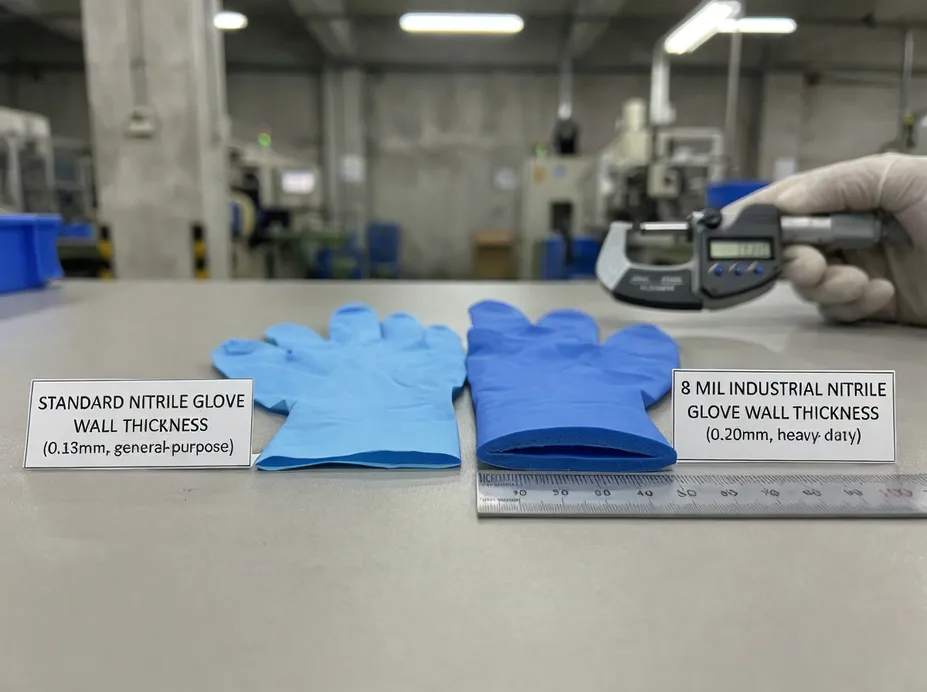
Cross-section comparison of 8 mil vs standard nitrile glove wall thickness
0.10–0.12mm
General-purpose industrial
0.13–0.15mm
Heavy-duty standard
0.20mm
8 mil — this spec

When spec matters most: In accounts where a glove failure generates an incident report and the safety manager has sign-off on the specification, under-specced product creates complaints that trace back to the supplier. 8 mil closes that gap.

Product Data

Technical Specifications

Request Full TDS
Full Specification Table
Nominal Wall Thickness 8 mil (0.20mm)
Palm Thickness (typical) 0.18–0.22mm
Finger Thickness (typical) 0.20–0.24mm
Cuff Thickness (typical) 0.15–0.18mm
Length 240mm (standard)
Surface Texture Full-hand micro-texture
Finish Powder-free, chlorinated
Accelerator Standard (thiuram/carbamate cure system)
Color Black, Blue (standard); other colors on request
Sizes S, M, L, XL
AQL Standard AQL 1.5
Pinhole Detection Online electrical, 100% of production
Tensile Strength (before aging) ≥14 N (typical)
Elongation at Break (before aging) ≥500% (typical)
Certifications
ISO 9001:2015 CE ASTM D6319

Specifications shown are industry-standard values for this product type. Actual values may vary by production lot. Contact us for the full technical data sheet and test reports for the specific lot.

Key Performance Highlights

Wall Thickness 0.20mm
Tensile Strength ≥14 N
Elongation at Break ≥500%

Quality Assurance

  • Online electrical pinhole detection — 100% of production
  • AQL 1.5 outgoing inspection on every lot
  • In-house compound control on 8 automated dipping lines
  • Cure profile adjusted for heavier 8 mil gauge
Full Technical Data Sheet

Get lot-specific test reports and the complete TDS for your compliance review.

Request TDS
Market Segments

Where 8 Mil Industrial Nitrile Moves: Market Segments Worth Building Into Your Line

The 8 mil specification opens market segments that standard industrial nitrile can't serve reliably. Each of these segments has distinct volume patterns and reorder logic — worth understanding when you're building your SKU mix.

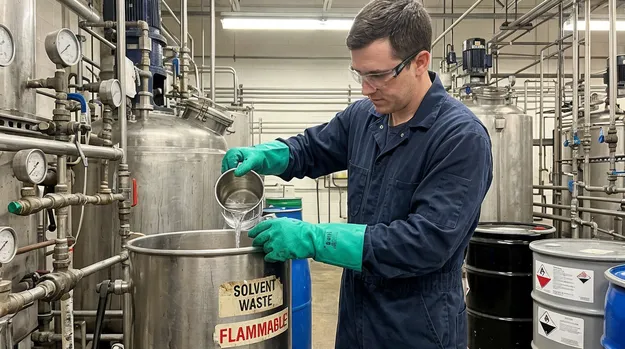
Chemical processing facility worker wearing 8 mil nitrile gloves handling solvents
Core Segment

Chemical Processing & Industrial Cleaning

Facilities handling solvents, acids, caustics, and industrial cleaning compounds need a glove with enough wall thickness to provide meaningful permeation resistance and puncture protection during sustained contact. Safety distributors supplying chemical plants, refineries, and industrial cleaning contractors typically run annual supply agreements — once you're on the approved vendor list with the right specification, the reorder pattern is predictable and the price sensitivity is lower than in commodity segments.

The 8 mil spec is defensible in these accounts because the alternative — a thinner glove that generates incident reports — costs your customer far more than the per-box price difference.

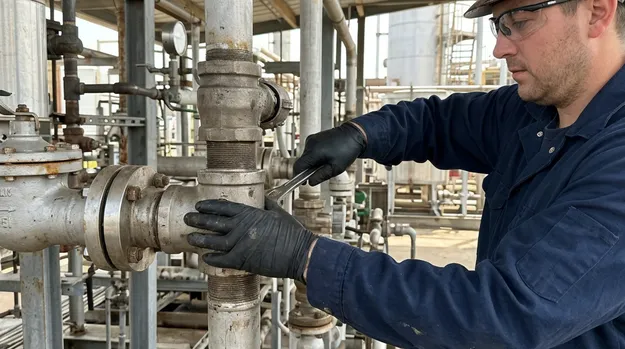
Oil and gas maintenance worker using black 8 mil nitrile gloves on pipe fittings
High-Value Segment

Oil & Gas Maintenance

Glove specification is often written into site safety procedures. Maintenance contractors on upstream and downstream oil and gas sites handle lubricants, hydraulic fluids, and light chemical compounds as a routine part of the job. The 8 mil wall thickness handles the puncture and abrasion demands of working around metal fittings, pipe threads, and rough surfaces.

Black colorway is the standard in this segment — it masks contamination and is the default specification for most site safety programs. Consistent demand from Middle East and Southeast Asia distributors supplying EPC contractors makes the black 8 mil SKU the one to lead with in those markets.

Black Industrial Nitrile Gloves
Waste management worker with 8 mil nitrile gloves handling mixed waste stream
Contract-Locked Volume

Waste Management & Environmental Services

Workers handling mixed waste streams, sharps exposure risk, and chemical contamination require heavy-duty protection. The 8 mil specification provides the puncture resistance that thinner gloves can't reliably deliver in this environment.

Waste management contractors typically operate on municipal or commercial service contracts with standardized PPE specifications — once the 8 mil nitrile is written into the contract spec, the volume is locked in for the contract term.

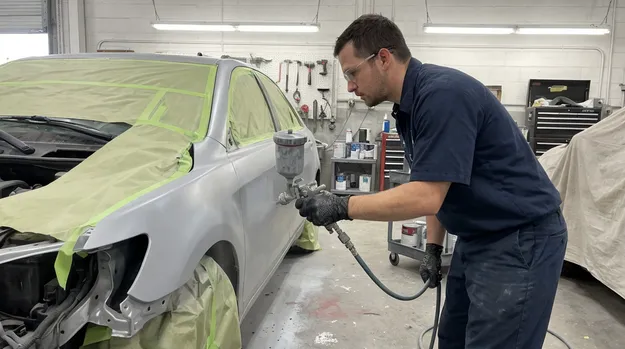
Automotive body shop technician wearing 8 mil powder-free nitrile gloves applying primer
Share Gain Opportunity

Automotive Body & Collision Repair

8 mil has been gaining share from thicker rubber alternatives in this segment. Body shop technicians work with body fillers, primers, solvents, and paint compounds — applications that require chemical resistance and tactile dexterity simultaneously. The 8 mil nitrile delivers both better than latex or vinyl alternatives.

The powder-free specification is required in paint environments where powder contamination causes finish defects. Automotive body supply distributors who carry 8 mil nitrile alongside their standard automotive nitrile line can cover both the service bay and the body shop from a single supplier.

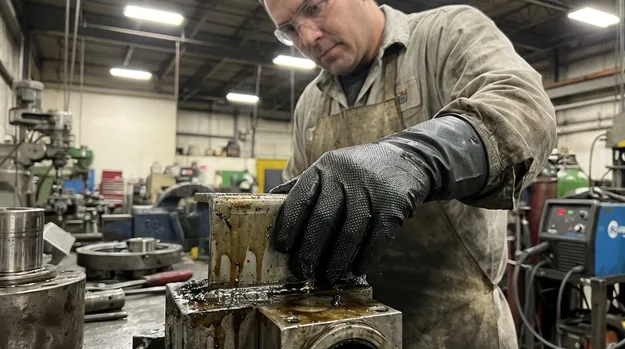
Metalworking fabrication worker using 8 mil textured nitrile gloves on oily metal surface
Reduced Complaint Rate

Metalworking & Fabrication

Machining operations, welding prep, and metal finishing involve sharp edges, cutting fluids, and surface treatment chemicals. The 8 mil wall thickness reduces cut-through incidents from metal burrs and sharp edges, and the full-hand texture maintains grip on oily metal surfaces.

Industrial safety distributors supplying job shops and fabrication facilities find that 8 mil nitrile reduces the complaint rate compared to standard industrial spec, which justifies the per-unit price premium to their customers.

Heavy Duty Industrial Nitrile Gloves
Build Your SKU Mix

Covering Multiple Segments From One Specification

The 8 mil specification serves chemical processing, oil & gas, waste management, automotive body, and metalworking from a single SKU. Distributors who position it correctly across these verticals build predictable annual volume with lower price sensitivity than commodity industrial nitrile.

Manufacturing Process

How We Build the 8 Mil Wall — Process Details That Affect Your AQL Results

The 8 mil specification isn't just a thicker version of a standard glove — it requires a different production approach, and the details matter for the consistency you'll see across a full container order.

Multi-Pass Dipping Process

Standard industrial nitrile at 0.10–0.12mm is typically achieved in two to three dipping passes. Eight mil requires four to five passes depending on compound viscosity and target thickness profile. Each additional pass adds cure time in the oven, and the cure profile is adjusted to ensure full vulcanization through the thicker wall without over-curing the outer surface.

Over-cured nitrile becomes brittle at the fingertips — a failure mode that shows up as cracking during donning. We tune the oven temperature profile and conveyor speed specifically for the 8 mil production run; we don't use the same cure settings as the standard line.

In-House Compound Viscosity Control

Viscosity management is more critical at 8 mil than at thinner specs. A viscosity drop mid-run that causes a 0.01mm thickness variation at 0.10mm nominal is a 10% deviation. The same drop at 0.20mm nominal is a 5% relative deviation — but the absolute wall thickness still needs to stay within the 0.18–0.22mm palm range to meet specification.

Our in-house compounding lab monitors bath viscosity continuously and adjusts formulation during the run. This is the mechanism that keeps your third container consistent with your first sample. Factories that buy pre-mixed compound from third-party suppliers can't make this adjustment in real time — which is why thickness drift on heavy-gauge gloves is a common complaint from buyers who've sourced 8 mil from trading companies.

Online Pinhole Detection — Every Glove

Online pinhole detection runs on every glove, every line. At 8 mil, the electrical leak test is actually more reliable than at thinner specs — the thicker wall makes micro-defects easier to detect because the resistance differential between a sound glove and a pinhole is larger.

Every glove that fails the electrical test is pulled automatically before it reaches the stripping station. The AQL 1.5 outgoing inspection records that ship with your container reflect the full production lot, not a pre-selected sample.

Full-Hand Micro-Texture — Built Into the Former

Full-hand micro-texture is applied during the dipping process, not as a post-processing step. The texture pattern is built into the ceramic hand formers, so it's consistent across every glove in the production run.

At 8 mil, the texture depth is calibrated to maintain grip performance without creating stress concentration points in the glove wall — a design detail that matters for puncture resistance in abrasive environments.

4–5
Dipping Passes
vs. 2–3 for standard industrial nitrile
AQL 1.5
Outgoing Inspection
Full production lot records ship with every container
100%
Electrical Leak Test
Every glove, every line — auto-reject before stripping
Compliance

Certifications and Compliance for Your Markets

The 8 mil industrial nitrile glove carries the same certification coverage as our broader industrial line.

ISO 9001:2015

Quality management — required by most institutional and industrial procurement processes.

CE Marking

European conformity — covers EU import and distribution requirements.

ASTM D6319

Nitrile examination gloves standard — North American industrial and safety distribution reference.

Documentation That Ships With Every Container

  • CE declaration of conformity
  • ISO 9001 certificate
  • Internal test reports for the specific production lot
  • Technical data sheet and material safety documentation

Regulated Procurement Environments

The 8 mil specification positions well for buyers whose customers operate in regulated procurement environments. Chemical processing facilities, oil and gas contractors, and waste management operations often require documented glove specifications as part of their site safety programs.

We can provide the technical data sheet, test reports, and material safety documentation needed to support your customer's internal approval process. Third-party pre-shipment inspection through SGS or Bureau Veritas is available if your procurement process requires independent verification.

Customization Options for 8 Mil Industrial Nitrile

The 8 mil SKU supports the same customization dimensions as our broader industrial line, with a few practical notes on what affects MOQ and lead time.

Color

Black and blue are standard production colors, available from the regular production schedule. Green, orange, and white are available on custom runs. Color customization on 8 mil requires a minimum of one 40HQ container per color — compound pigmentation and line changeover cost doesn't make sense below that volume. We'll tell you this upfront rather than after you've committed to a development run.

Length

Standard length is 240mm. Extended cuff versions at 300mm are available for applications requiring forearm protection — chemical handling and waste management accounts sometimes specify the longer cuff. Extended cuff adds approximately 8–10% to per-unit weight and affects container loading efficiency slightly; worth factoring into your landed cost calculation.

Branding & Packaging

Carton printing, box labeling, and inner bag branding under your brand name. We prepare regulatory documentation — CE declaration of conformity, ASTM D6319 reference, country-of-origin certificates — under your brand name for markets where you hold the import registration. This is a standard OEM service, not a special request.

Accelerator-Free Formulation

If your accounts include healthcare-adjacent industrial environments where Type IV sensitization compliance is required, we can produce the 8 mil specification in accelerator-free compound. This runs on a dedicated line using a sulfur-donor cure system. MOQ and lead time are the same as standard 8 mil; the compound development for accelerator-free 8 mil has already been validated. See our accelerator-free industrial nitrile variant for more detail on the specification.

Minimum Order Quantity

One 40HQ Container

Approximately 1,500–1,800 boxes at 100 gloves per box. The heavier gauge reduces per-carton piece count compared to standard industrial. Custom formulation or non-standard color runs carry the same one-container MOQ.

Container Loading and Landed Cost for 8 Mil

The heavier gauge affects your landed cost calculation in ways that are worth understanding before you build your margin model.

Standard Industrial Nitrile (0.10–0.12mm)

Boxes per 40HQ ~2,000 boxes
Gloves per box 100
Carton pack 10 boxes/carton
Weight per glove 4–5 g

8 Mil Industrial Nitrile

Boxes per 40HQ 1,500–1,800 boxes
Gloves per box 100
Limiting factor Weight, not cubic
Weight per glove 7–8 g

Landed Cost Implication

A 40HQ of 8 mil industrial nitrile reaches its weight limit before its cubic limit. Your per-box freight cost is higher than for standard industrial, and that needs to be in your landed cost model when you're pricing to your customers. Factor this into your margin model before committing to a price list.

Carton Labeling

Configured to your requirements — Amazon FBA, distributor DC barcode standards, or your own warehouse receiving format. This is a checklist item at order placement, not a special request.

Lead Time

30–40 days from order confirmation — slightly longer than standard industrial because the additional dipping passes and extended cure time add production hours per unit.

Repeat Orders

For repeat orders on established SKUs, we maintain a rolling production schedule that allows us to confirm ship dates at order placement.

Specification Guide

8 Mil vs. Other Industrial Nitrile Specifications — Choosing the Right Gauge

The full industrial nitrile range covers 0.08mm through 0.20mm+. The right spec depends on the end-use environment, not a general preference for "thicker is better." Over-speccing adds landed cost without reducing complaints; under-speccing creates incident exposure.

Application Recommended Spec Why
General assembly, janitorial, light automotive Standard (0.10–0.12mm) Over-speccing adds landed cost without reducing complaints
Chemical handling, metalworking, waste management Heavy-duty (0.13–0.15mm) or 8 mil Depends on exposure duration and chemical type
Sustained chemical contact, oil and gas, body shop 8 mil (0.20mm) Puncture resistance and permeation resistance justify the spec
Electronics, precision assembly Textured fingertip (0.08–0.10mm) Tactile sensitivity is the priority; 8 mil is over-spec

When 8 Mil Is the Right Call

Accounts where the cost of a glove failure — an incident report, a chemical exposure claim, a customer complaint — is higher than the per-unit price premium. If your customer's safety manager is specifying the glove, 8 mil is usually the specification they're looking for.

When Standard Industrial Is Sufficient

If the purchasing department is specifying on price, they're probably in the standard industrial segment. Specifying 8 mil into a price-driven account adds cost without a corresponding reduction in complaints or incidents.

Not sure which spec fits your current accounts?

Send us your end-use environment description — we'll recommend the configuration and send back a quote with the relevant technical documentation.

Get a Spec Recommendation
FAQ

Frequently Asked Questions

Technical and commercial questions from distributors and procurement teams evaluating 8 mil industrial nitrile.

What is the actual wall thickness of your 8 mil industrial nitrile gloves?

Eight mil equals 0.20mm nominal. Our production target for the palm is 0.18–0.22mm, with finger thickness typically running 0.20–0.24mm. The cuff runs slightly thinner at 0.15–0.18mm — this is standard for nitrile dipping because the cuff area has less mechanical demand than the palm and finger zones. Full thickness measurements by zone are available in the technical data sheet; contact us for the specific lot report.

What chemical resistance does 8 mil nitrile provide?

Eight mil nitrile provides meaningful permeation resistance against petroleum-based solvents, oils, greases, many acids and caustics at moderate concentrations, and most industrial cleaning compounds. The thicker wall extends breakthrough time compared to standard industrial nitrile, which matters for sustained contact applications. We can provide permeation test results for the chemicals relevant to your accounts. Note that nitrile — at any thickness — is not suitable for ketones (acetone, MEK) or certain chlorinated solvents; for those applications, a different glove material is required.

What is the MOQ for 8 mil industrial nitrile gloves?

One 40HQ container — approximately 1,500–1,800 boxes at 100 gloves per box, depending on size mix and exact wall thickness. For buyers who want to test the specification before committing to a full container, we support sample orders that ship within 5–7 business days with full certification documentation included.

How does your 8 mil glove compare to 8 mil offerings from other suppliers?

The specification — 8 mil nominal wall thickness — is consistent across the industry. The difference is in process consistency across a full container order. Our in-house compounding lab monitors bath viscosity continuously and adjusts formulation during the production run, which is how we hold the 0.18–0.22mm palm thickness tolerance across the full lot rather than just the sample set. Online pinhole detection on every glove, every line, keeps AQL results at destination consistent with our outgoing inspection records. If you've had thickness drift or pinhole complaints on 8 mil product from other suppliers, those are almost always compounding and in-line detection problems — both of which we've engineered against specifically.

Can you produce 8 mil industrial nitrile under our brand name?

Yes. OEM and private-label projects run on our production lines with our compound and QC process — no subcontracting. Packaging customization, carton printing, and regulatory documentation under your brand name are standard. MOQ is one 40HQ container. Contact us to discuss your project requirements.

What is the lead time for 8 mil industrial nitrile gloves?

30–40 days from order confirmation for standard SKUs. The additional dipping passes and extended cure time for the 8 mil specification add production hours compared to standard industrial. For repeat orders on established SKUs, we confirm ship dates at order placement based on our rolling production schedule.

Factory-Direct Sourcing

Get a Quote for 8 Mil Industrial Nitrile Gloves

If you're sourcing 8 mil industrial nitrile for chemical handling, oil and gas, waste management, or automotive body shop accounts, send us your target volume and any specification requirements — color, length, branding, certifications needed for your market. We'll respond with a detailed quote, the relevant technical documentation, and a sample shipment if you want to verify the specification before committing to a container.

Most buyers in this segment start with a sample order to test with one or two accounts before placing the first container. We can ship samples within 5–7 business days with the full certification package included.

Contact Our Sales Team

Address

South Side of the Road, 500 Meters West of Heng'er Road, Zhilan No. 3 Village, Gaomi Economic Development Zone, Gaomi, Weifang, Shandong, China

Sample shipments include the full certification package. Most buyers test with one or two accounts before committing to a container.