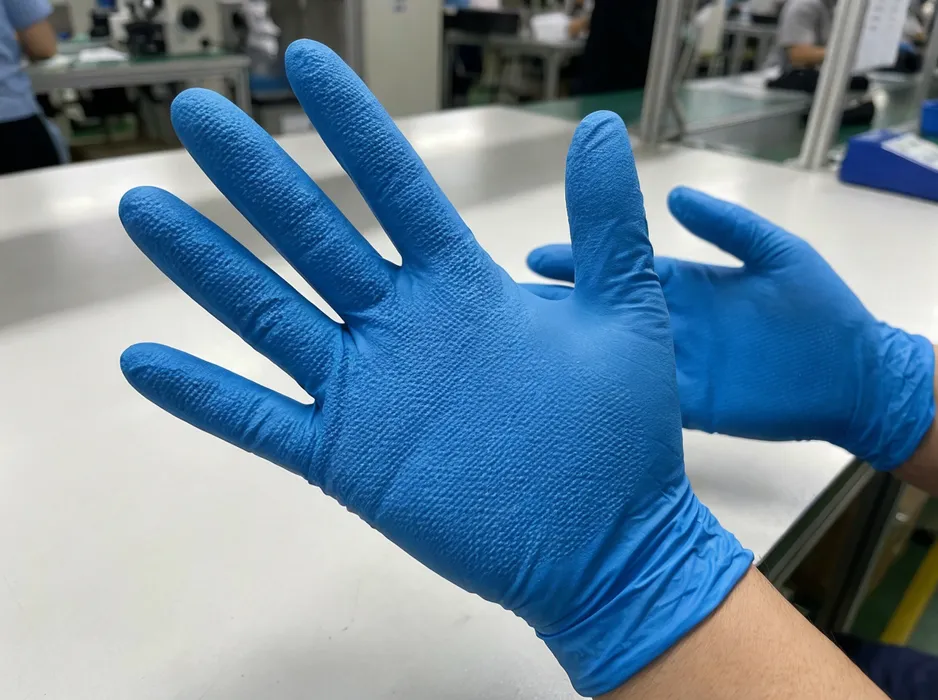
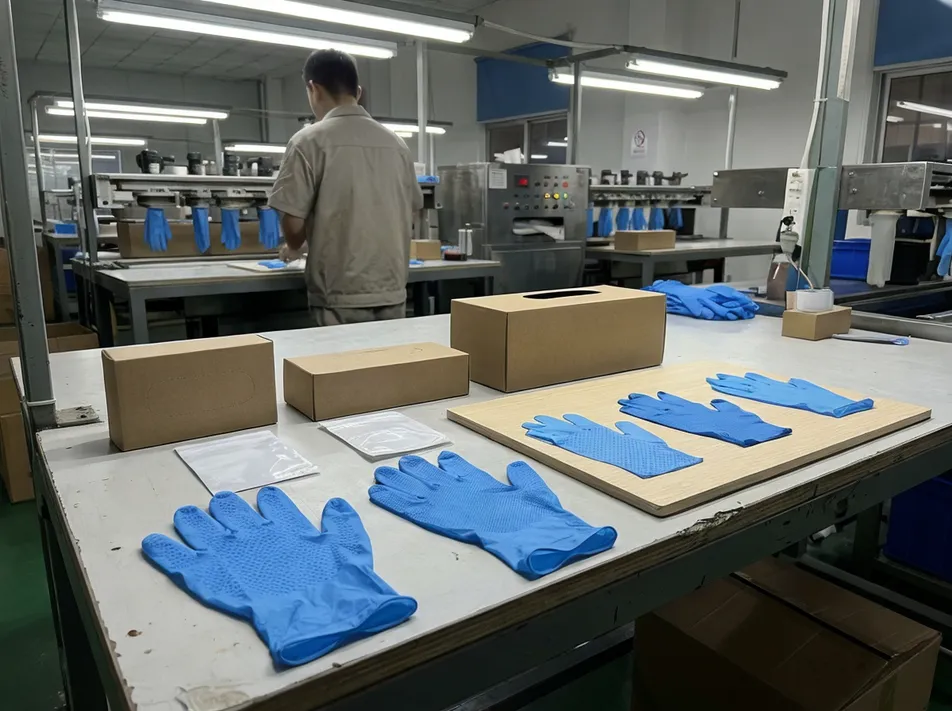
Full micro-texture across the entire palm and fingers — not just the fingertips — for applications where a smooth glove loses grip and costs you returns.
Produced on our automated dipping lines through a controlled coagulant process. Same CE, EN 455, ASTM D6319, and FDA 510(k) certification coverage as our standard blue nitrile line.
Most blue nitrile gloves — including our own exam and disposable SKUs — carry texture only at the fingertips. That's sufficient for dry examination work and general handling. It is not sufficient when the wearer's hands are wet, oily, or handling slick surfaces under sustained grip pressure.
A fingertip-textured glove on a wet food processing line or an automotive detailing bay will slip, and a glove that slips gets removed. A glove that gets removed isn't protecting anyone, and it's generating complaints back to whoever supplied it.
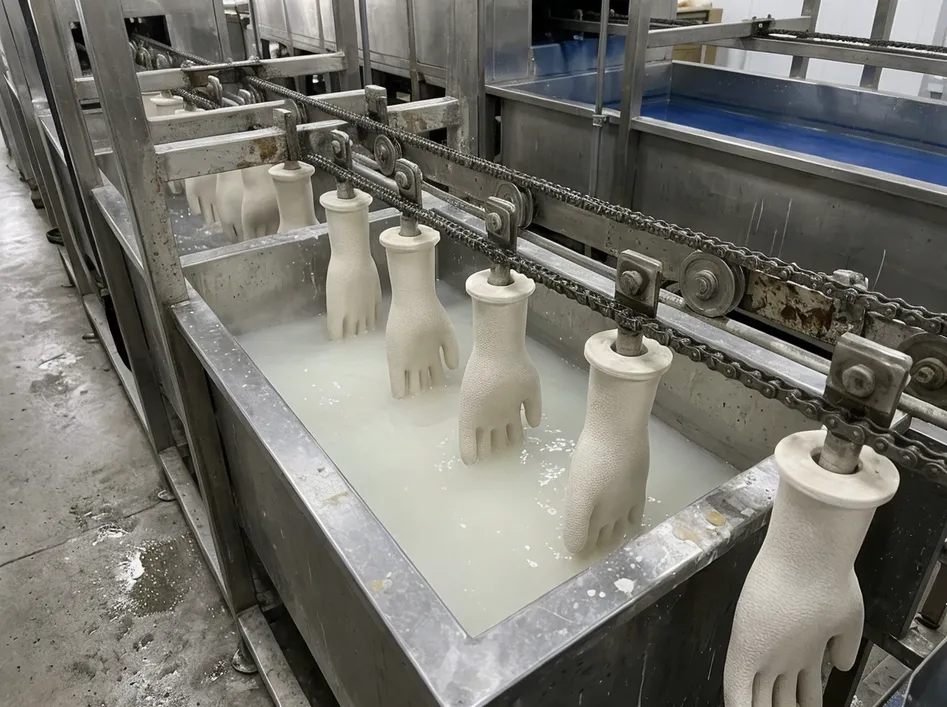
The textured blue nitrile gloves in this SKU carry micro-texture across the full palm and all five fingers. The texture profile is produced during the dipping process itself — the ceramic hand formers pass through a coagulant bath at a controlled concentration that creates a uniform micro-rough surface across the entire glove exterior before the nitrile compound is applied.
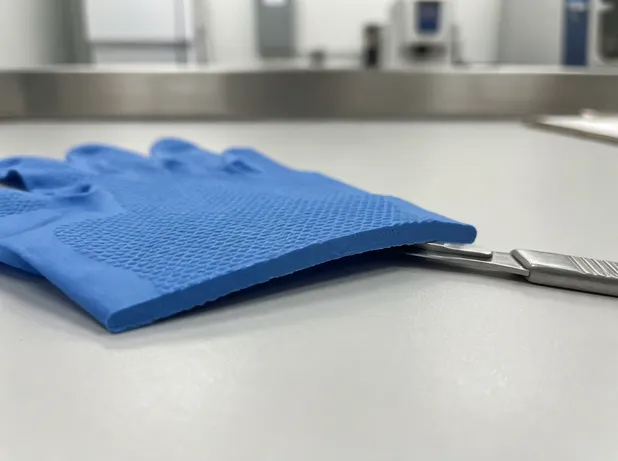
This is not a post-process embossing or mechanical roughening step. The texture is integral to the glove wall, which means it doesn't wear off with use and doesn't create thin spots at the texture peaks the way mechanical post-treatment can.
We've tested both approaches. Post-process texture treatments reduce wall thickness at the texture peaks by 0.01–0.02mm — not catastrophic on a thick industrial glove, but on a 0.10mm examination-grade wall, that's a meaningful reduction in the margin before pinhole failure.
The coagulant process adds texture without removing material — preserving the full wall integrity at every point.
The base specification is otherwise identical to our standard blue nitrile line: powder-free, 0.10–0.12mm palm thickness, 240mm length, AQL 1.5 outgoing inspection, full certification coverage. The texture is the differentiation — everything else is the same controlled process.
| Parameter | Specification |
|---|---|
| Texture coverage | Full palm and fingers (micro-texture) |
| Texture method | Coagulant process (in-process, not post-treatment) |
| Thickness — palm | 0.10 – 0.12 mm (typical) |
| Thickness — finger | 0.12 – 0.15 mm (typical) |
| Length | 240 mm (standard) |
| Sizes | XS, S, M, L, XL |
| Tensile strength (before aging) | ≥ 14 MPa (EN 455 / ASTM D6319) |
| Elongation at break (before aging) | ≥ 500% |
| Powder | Powder-free |
| Color | Standard blue (pigment compounded in, not surface-applied) |
| AQL inspection standard | 1.5 (100% of production lots) |
| Packaging | 100 pcs/box, 10 boxes/carton |
| Certifications | ISO 9001:2015, CE, EN 455, ASTM D6319, FDA 510(k) |
Specifications shown are typical production values. Actual values may vary by lot. Contact us for detailed test reports and product data sheets.
0.10–0.12mm at the palm versus 0.08–0.10mm on our standard disposable blue. Applications that need full-palm texture involve more abrasive contact and longer wear cycles. The extra wall extends wear time and reduces per-task glove consumption — which matters for your buyers' cost-per-use calculation.
Full-palm micro-texture produced in-process via coagulant bath — texture is integral to the wall, not applied post-manufacture.
Standard fingertip texture for general-purpose examination and handling.
100% synthetic nitrile — no latex proteins, no allergy risk.
Medical-grade exam gloves with FDA 510(k) clearance for clinical environments.
Chemical-resistant nitrile for janitorial, sanitation, and facility maintenance.
Deep cobalt pigment for high-visibility contamination detection in food processing.
Distinctive indigo color for color-coded safety protocols and cross-contamination control.
The distinction between fingertip-texture and full-palm texture is the kind of specification detail that separates a commodity glove program from one your buyers will pay a premium to stay on. These are the segments where that distinction is commercially meaningful.
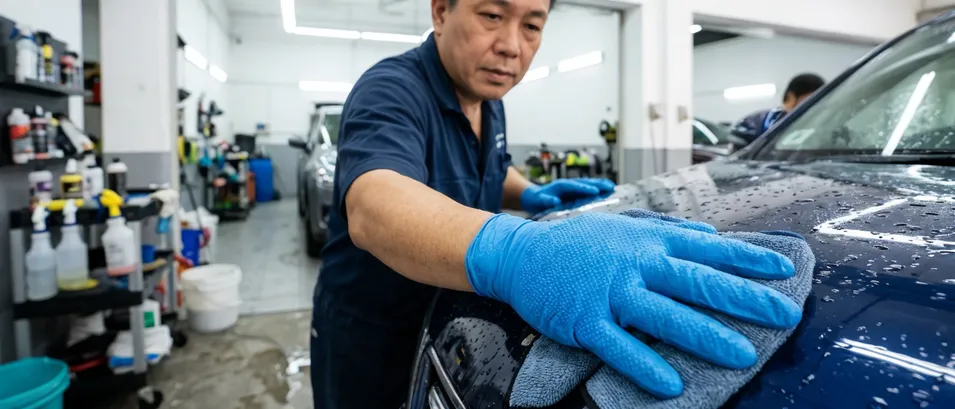
Detailing operations — wash, clay bar, polish, wax — involve sustained contact with wet and oily surfaces across the entire palm, not just the fingertips. A fingertip-textured glove slips on a polishing pad or a wet panel. Detailing supply distributors serving professional shops and mobile detailers are a high-reorder segment: shops go through 2–4 boxes per week per technician, and once a product is in the workflow, switching costs are real. Full-palm texture is a specification that detailing distributors can use to justify a premium SKU over commodity exam gloves — the performance difference is immediately apparent to the end user.
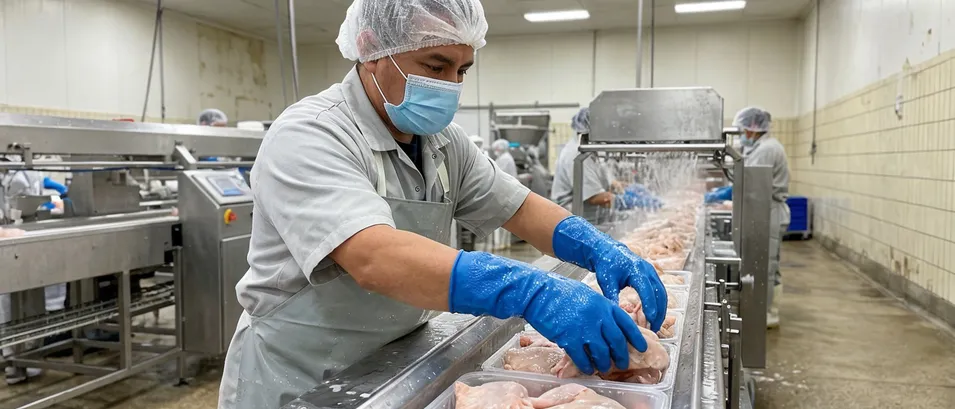
Meat packing, seafood processing, and produce handling lines require grip on wet, slick, and often cold surfaces. Workers on these lines handle product continuously for hours; a glove that slips increases handling errors and fatigue. Food processing distributors supplying these facilities run high volumes on continuous replenishment cycles — a single mid-size processing plant can consume 50,000–100,000 gloves per month. Blue is the preferred color in food processing specifically because it's detectable against most food products, and the full-palm texture version gives your buyers a differentiated SKU for the wet-handling segment within that market.
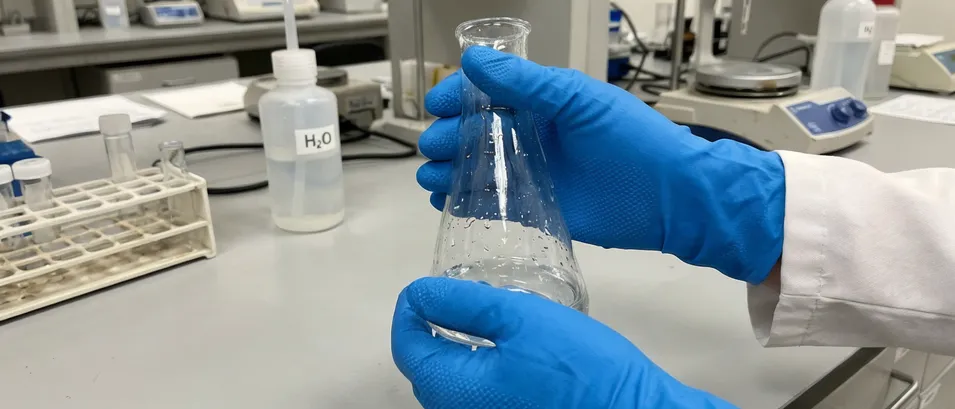
Research labs, pharmaceutical QC, and industrial testing environments handle glass, vials, and wet specimens where grip failure means dropped samples and contaminated results. Lab supply distributors often carry both smooth and textured nitrile; the textured SKU commands a higher price point and is specified by lab managers who've had grip failures with standard gloves. The full-palm texture on this SKU covers grip scenarios that fingertip-only texture doesn't — holding a wet flask by the body, not just the neck.
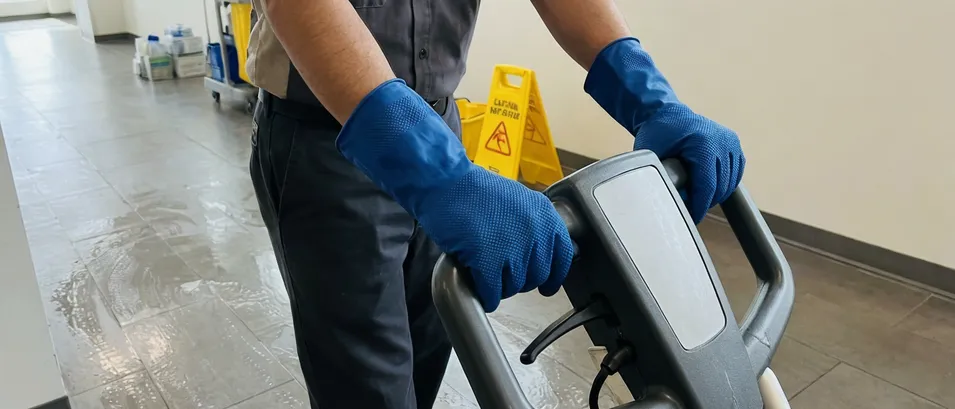
Commercial cleaning operations involve sustained contact with wet surfaces, cleaning solutions, and slick floor materials. The heavier wall on this SKU (0.10–0.12mm) also extends wear time compared to standard exam-grade gloves, reducing per-task consumption. Janitorial supply distributors can position this as a premium cleaning glove — better grip, longer wear — at a price point above commodity disposables but below reusable rubber gloves.
Distributor note: The automotive detailing segment has been the fastest-growing channel for this SKU among our existing buyers. If you're building a distribution program for that market, it's worth leading with the full-palm texture specification — it's the detail that closes the sale with professional shops.
The coagulant process that produces the full-palm texture on this SKU is worth understanding, because it's the reason the texture is consistent across production runs rather than variable.
In standard nitrile dipping, ceramic hand formers are dipped in a coagulant solution, then in the nitrile compound bath. The coagulant causes the nitrile to gel on contact with the former surface, building up the glove wall across multiple dip passes. For a smooth glove, the coagulant concentration is tuned to produce a uniform, even gel layer.
For the textured SKU, we adjust the coagulant concentration and the former surface preparation to produce a controlled micro-rough gel layer before the nitrile compound is applied. The nitrile compound then conforms to this micro-rough surface, producing texture that is part of the glove wall rather than applied to it. The texture depth and density are controlled by the coagulant concentration — a parameter we set and monitor in our in-house compounding lab, not a variable left to line operator judgment.
The texture profile on a container ordered today will match the texture profile on a container ordered in 18 months, because the process parameter is documented and controlled.
We've had buyers switch to us specifically because their previous supplier's texture was inconsistent between orders — sometimes pronounced, sometimes barely perceptible — because the texture was being applied post-process by a step that wasn't tightly controlled. Our coagulant process doesn't have that variability.
The in-house compounding lab also means we can adjust the texture profile for OEM programs — coarser texture for heavy industrial applications, finer texture for laboratory or food-contact use — without outsourcing the formulation work.
Our Manufacturing CapabilitiesSet and monitored in-house, not left to line operator judgment
Part of the glove wall — not applied post-process
| Certification | Relevance |
|---|---|
| ISO 9001:2015 | Quality management system — required for most approved vendor lists |
| CE Marking | EU market access |
| EN 455 | Medical gloves for single use — European medical and food-contact procurement |
| ASTM D6319 | Nitrile examination gloves — North American healthcare and industrial |
| FDA 510(k) | Medical device clearance — US healthcare distribution channels |
All five certifications apply to this SKU. The full documentation package — CE declaration of conformity, FDA 510(k) reference, ISO certificate, and internal test reports for the specific production lot — ships with sample orders and is available for container orders on request.
EN 455 compliance covers food-contact use in European markets. If your buyers require additional food-contact documentation (EU Regulation 10/2011 compliance letters), contact us — we can provide the relevant documentation for your specific market.
ASTM D6319 is the relevant standard for US food processing distribution. Both EN 455 and ASTM D6319 are in place. FDA 21 CFR compliance letters are available on request for your specific market.
The textured blue nitrile SKU is available for OEM and private-label programs with the following customization options.
| Parameter | Options |
|---|---|
| Texture profile | Standard micro-texture (default) · Coarser texture for heavy industrial (on request) · Finer texture for lab/food-contact (on request) |
| Thickness | 0.10–0.12mm standard · Heavier wall (0.12–0.15mm) available for industrial programs |
| Color | Standard blue · Custom shade matching available via in-house compounding lab |
| Cuff | Standard beaded cuff · Extended cuff (270mm) available |
| Accelerator-free | Available on dedicated line — same texture process, sulfur-donor cure system |
| Labeling & packaging | Custom carton artwork, box inserts, inner bag printing — handled in-house |
| MOQ | 1 × 40HQ container (~2,000 boxes) for standard SKU · Same MOQ for custom texture profile |
The accelerator-free option on this SKU is worth noting for buyers targeting European healthcare or food processing procurement. The texture process is fully compatible with our accelerator-free compound — we run the same coagulant process on the accelerator-free line. You get the full-palm grip performance without the accelerator residue that European hospital and food-contact procurement departments increasingly flag.
Custom texture profile development runs through our in-house compounding lab. We adjust coagulant concentration on a test batch, produce samples for your evaluation, and lock the parameter into your production specification once approved. No third-party development fees.
Standard packaging: 100 gloves per box, 10 boxes per carton. Container loading is identical to the rest of the blue nitrile line — carton dimensions are standardized across all SKUs, so you can mix this SKU with others in a single container without losing loading efficiency.
| Container | Cartons | Gloves (pieces) | Boxes |
|---|---|---|---|
| 20GP | ~900 | ~900,000 | ~9,000 |
| 40HQ | ~2,000 | ~2,000,000 | ~20,000 |
The slightly heavier wall on this SKU (0.10–0.12mm vs. 0.08–0.10mm on standard disposable blue) adds marginal weight per carton — typically 3–5% more than the standard disposable SKU. Factor this into your freight calculation for large container orders. The difference is small, but worth knowing before you finalize your cost model.
Pre-shipment inspection by SGS or Bureau Veritas is available if your procurement process requires third-party verification. We coordinate directly with the inspection agency.
The blue nitrile line covers seven SKUs. Use the decision logic below to match the right SKU to your buyers' application requirements.
Full-palm micro-texture · 0.10–0.12mm wall
Choose this when your buyers work with wet, oily, or slick surfaces and need grip across the entire palm, not just the fingertips. Automotive detailing, food processing, laboratory handling, and janitorial programs are the primary segments.
Best for wet & oily surface gripFingertip texture · 0.08–0.10mm wall
The general-purpose SKU for dry examination, light industrial, and food service use where full-palm grip isn't the specification driver. Lower wall thickness means better tactile sensitivity and lower per-unit cost.
Best for dry use & cost-sensitive programsFingertip texture · 0.10–0.12mm wall
Similar wall thickness to this SKU, but fingertip texture only. Choose this for cleaning and sanitation programs where extended wear and chemical splash resistance matter more than wet-surface grip.
Best for cleaning & sanitation programsFingertip texture · 0.10mm standard wall · EN 455 & ASTM D6319
Choose this for medical and dental procurement where the certification documentation set is the primary specification driver.
Best for examination-grade documentationIf your buyers need grip on wet surfaces, this is the SKU. If they need examination-grade documentation, go to the exam gloves. If they need general-purpose disposable coverage at the lowest landed cost, go to the disposable blue.
View Full Blue Nitrile LineDecision-support answers for procurement, specification, and OEM program evaluation.
Fingertip texture covers the top two-thirds of each finger — the zone that contacts surfaces in pinch-grip tasks like examination, typing, or picking up small objects. Full-palm texture extends the micro-rough surface across the entire palm and all fingers, covering the contact zone for power grip, wrap grip, and sustained palm contact.
For dry examination work, fingertip texture is sufficient. For wet or oily surfaces — food processing, automotive detailing, wet laboratory handling — full-palm texture is the specification that prevents grip failure. The practical test: if the wearer's palm contacts the surface under load, you need full-palm texture.
No. The texture is produced during the dipping process and does not affect the mechanical properties that EN 455 and ASTM D6319 test — tensile strength, elongation at break, and pinhole integrity.
Our textured blue nitrile gloves carry the same CE, EN 455, ASTM D6319, and FDA 510(k) certifications as the smooth-surface SKUs in the blue nitrile line. Test reports for the textured SKU specifically are available with sample orders.
MOQ is one 40HQ container, approximately 2,000 boxes (200,000 gloves at 100 pcs/box). Mixed-SKU loading with other blue nitrile SKUs is supported — carton dimensions are standardized across the line.
For new buyers, sample orders ship within 5–7 business days with full certification documentation before full container commitment.
Yes. We adjust texture density and depth through coagulant concentration in our in-house compounding lab. Coarser texture for heavy industrial applications and finer texture for laboratory or food-contact use are both available.
Custom texture profile development requires a test batch and sample approval before production lock-in. MOQ is the same as the standard SKU — one 40HQ container. No additional development fees for established texture profile types.
Yes. The coagulant texture process is fully compatible with our accelerator-free compound line. We run a sulfur-donor cure system on the dedicated accelerator-free line — the same texture process applies.
The resulting glove carries full-palm texture with no detectable accelerator residue, meeting the specification that European hospital and food-contact procurement departments increasingly require. Same MOQ as the standard textured SKU.
The full-palm texture adds a small amount of surface friction that can slow donning speed compared to a smooth glove — relevant for high-frequency glove changes in examination settings where speed matters.
For medical examination use where gloves are changed between every patient, the standard Blue Nitrile Exam Gloves are a better fit. The textured SKU is optimized for sustained-wear applications, not rapid-change examination workflows.
Send us your target application, volume, and destination market — we'll confirm the right specification, arrange samples, and send a detailed quote.
Blue Nitrile Exam Gloves
Smooth-surface, rapid-change examination workflow specification.
DisposableDisposable Blue Nitrile Gloves
High-volume single-use specification for general industrial and food-contact use.
Latex-FreeLatex Free Blue Nitrile Gloves
Allergy-safe specification for healthcare and food-processing procurement.
CleaningBlue Nitrile Cleaning Gloves
Chemical-resistant specification for janitorial and facilities management programs.
Color-CodedCobalt Blue Nitrile Gloves
Distinctive cobalt shade for color-coded safety and contamination-control programs.
Color-CodedIndigo Nitrile Gloves
Deep indigo specification for premium private-label and OEM differentiation.