Chemical Resistant · Factory-Direct

Chemical Resistant
Industrial Nitrile Gloves

High-acrylonitrile nitrile gloves engineered for chemical handling — thicker wall, tighter compound spec, full-hand texture for wet and oily grip.

Built on the same 8 automated dipping lines that hold EN 455 and FDA 510(k) for our medical line — the process discipline doesn't get dialed back because the end use is industrial chemical handling.

ISO 9001:2015 CE ASTM D6319 18+ Years Nitrile-Only AQL 1.5 Outgoing
Technical Foundation

What Makes a Nitrile Glove Actually Chemical Resistant

Not all nitrile gloves resist chemicals equally, and the difference isn't marketing — it's acrylonitrile content and wall thickness. Nitrile's chemical resistance comes from the acrylonitrile monomer in the polymer chain: higher acrylonitrile content means tighter polymer packing, slower permeation rates for oils, fuels, and many solvents.

A standard general-purpose nitrile glove at 0.10mm with a mid-range acrylonitrile content will handle incidental contact with light chemicals. A glove formulated for chemical handling environments needs a higher-acrylonitrile compound and a heavier wall — both to slow permeation and to provide the puncture resistance that chemical drum handling and industrial cleaning work demand.

Our Chemical-Grade Compound Approach

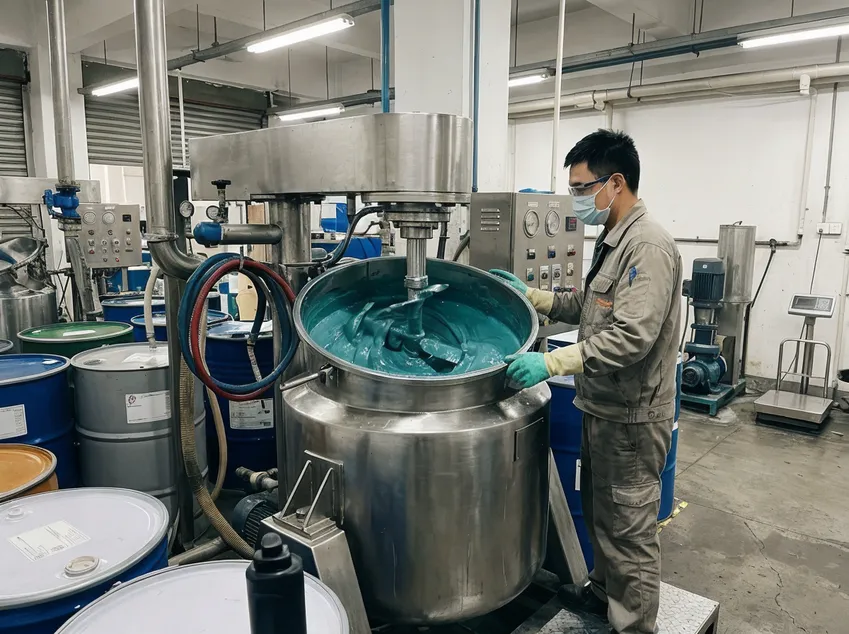
Our chemical resistant industrial nitrile gloves are built on a high-acrylonitrile compound formulated in our in-house compounding lab. We don't buy pre-mixed compound for this SKU — the acrylonitrile ratio is a variable we control, not a fixed input from a third-party supplier.

Wall thickness runs 0.13–0.15mm at the palm, which is the heavy-duty end of our industrial range. Full-hand micro-texture handles grip in wet, oily, and chemically contaminated conditions.

0.13–0.15mm
Palm Wall Thickness
AQL 1.5
Outgoing Inspection

This product is for buyers whose downstream customers work in environments where the cost of a glove failure is measured in chemical burns or regulatory incidents, not just inconvenience. For general automotive or janitorial supply, our standard industrial nitrile gloves at 0.10–0.12mm are the right spec and the better margin story.

Chemical Drum Handling

Heavy wall and high-acrylonitrile compound for sustained contact with industrial chemicals.

Industrial Cleaning

Full-hand micro-texture maintains grip in wet and chemically contaminated conditions.

Metalworking

Puncture resistance and oil/solvent barrier for machining and metal treatment environments.

Waste Management

Regulatory-grade protection where glove failure means chemical contact, not just inconvenience.

Technical Data

Product Specifications

Specifications shown are industry-standard values for this product type. Actual specifications may vary by production lot. Contact us for detailed product data sheets and test reports for the specific lot.

Full Specification Table

Parameter Specification
Wall Thickness (palm) 0.13–0.15mm (typical)
Wall Thickness (finger) 0.11–0.13mm (typical)
Wall Thickness (cuff) 0.08–0.10mm (typical)
Surface Texture Full-hand micro-texture
Powder Powder-free
Accelerator Standard (thiuram/carbamate cure system)
Cuff Style Beaded cuff
Length 240mm (typical)
Available Colors
Black · Blue
Sizes
XS S M L XL
AQL Standard 1.5
Pinhole Detection Online electrical, 100% of production
Packaging 100 gloves/box, 10 boxes/carton
Certifications
ISO 9001:2015 CE ASTM D6319

Wall Thickness by Zone

Palm 0.13–0.15mm
Finger 0.11–0.13mm
Cuff 0.08–0.10mm

Heavy-duty end of our industrial range. Palm zone engineered for maximum chemical permeation resistance.

Full Technical Data Sheet

Tensile strength, elongation-at-break, and force-at-break values per ASTM D6319 available on request.

Request Full TDS

100% Pinhole Detection

Online electrical pinhole detection on every glove produced — not sampled, not batch-tested. Every unit.

Compound Engineering

The Compound Behind the Chemical Resistance

Nitrile rubber is a copolymer of acrylonitrile and butadiene. The acrylonitrile component is what gives nitrile its oil and chemical resistance — the nitrile groups in the polymer chain are polar, which means they resist non-polar solvents like petroleum distillates, oils, and many industrial chemicals. The butadiene component provides elasticity and flexibility.

The ratio between the two determines the performance trade-off: higher acrylonitrile content improves chemical resistance but reduces low-temperature flexibility; lower acrylonitrile content is more flexible but permeates faster under chemical exposure.

For chemical handling applications, we formulate toward the higher-acrylonitrile end of the range. Our compounding lab adjusts the acrylonitrile-to-butadiene ratio specifically for this SKU — it's not the same compound we run for our standard industrial line, and it's not the same compound we run for our textured fingertip precision assembly gloves. Each compound is formulated for its application.

We've been running the chemical-resistant compound since 2014, when a Gulf-region chemical distributor asked us to develop a glove that could handle their customers' drum-handling operations. The formulation has been refined since then, but the core acrylonitrile ratio has stayed consistent because it works.

The heavier wall — 0.13–0.15mm — adds a second layer of protection beyond the compound chemistry. Permeation time through a nitrile membrane increases with wall thickness; a thicker glove buys more time before breakthrough, which matters in environments where workers handle chemicals for extended periods rather than incidental contact.

We hold the compound viscosity to tight tolerances during production — bath temperature at ±1°C, viscosity monitored continuously, formulation adjusted in real time as the bath depletes. That's how the 0.13–0.15mm thickness spec holds across a full container order, not just the sample set you approved before placing the order.

Get a quote for your chemical handling accounts
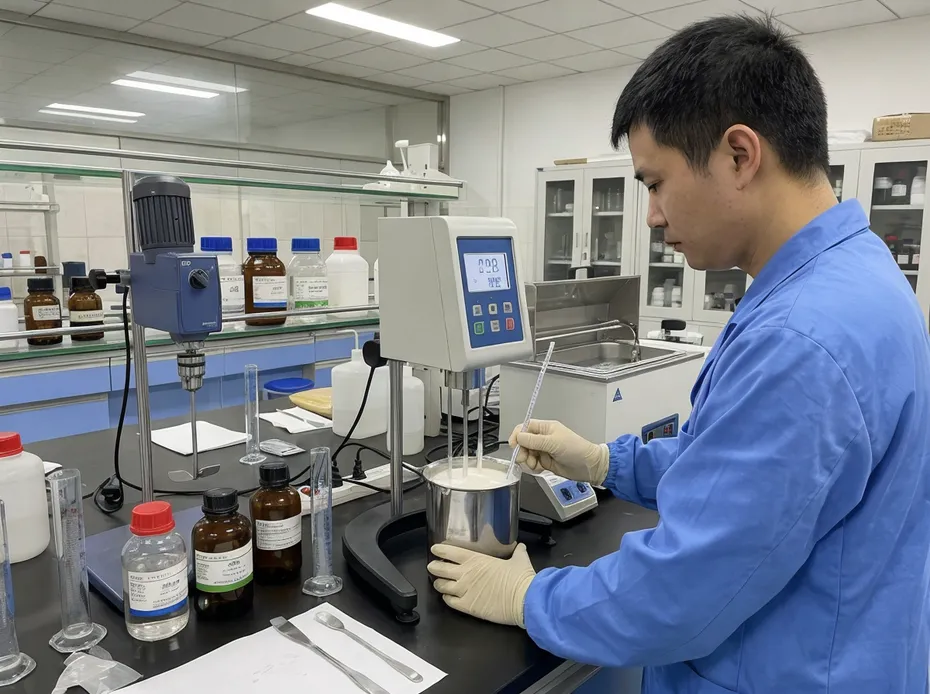
Nitrile compound formulation lab with viscosity monitoring equipment
±1°C
Bath Temp Tolerance
0.13–0.15mm
Wall Thickness
2014
Compound Since

Acrylonitrile Ratio Trade-Off

Chemical Resistance Higher ACN
Low-Temp Flexibility Lower ACN

This SKU is formulated toward the high-acrylonitrile end — optimized for chemical handling, not cold-storage assembly.

Performance Boundaries

Chemical Resistance Profile: What This Glove Handles

Nitrile's chemical resistance is broad but not universal. Here's an honest breakdown of where this glove performs and where it doesn't — because over-claiming chemical resistance is how distributors end up with returned product and liability exposure.

Strong Resistance
Suitable for extended contact
  • Petroleum-based oils and greases
  • Gasoline, diesel, and most petroleum distillates
  • Many aliphatic hydrocarbons
  • Dilute acids and bases (light concentrations)
  • Hydraulic fluids
  • Many industrial cleaning agents and detergents
Moderate Resistance
Incidental or short-duration contact only
  • Aromatic hydrocarbons (toluene, xylene)
    Permeation occurs — splash protection only, not immersion
  • Ketones (acetone, MEK)
    Limited resistance — short-duration contact only
  • Concentrated acids
    Splash protection only — not for immersion or prolonged contact
Not Recommended
Specify a different glove material
  • Halogenated solvents (methylene chloride, chloroform, TCE)
  • Strong oxidizing acids (concentrated nitric, chromic acid)
  • Ketone-based solvents at high concentration

For halogenated solvents or strong oxidizers, neoprene or butyl rubber is the correct specification. We'll tell you that directly rather than oversell the nitrile.

Buyer Guidance for Distribution Accounts

For buyers supplying chemical distribution or industrial cleaning accounts, the petroleum oils, hydraulic fluids, and dilute acid/base categories cover the majority of end-use exposures.

For buyers whose accounts work with halogenated solvents or strong oxidizers, a different glove material is the correct specification — and we'll tell you that directly rather than oversell the nitrile.

Need Permeation Data for a Specific Chemical?

Specific permeation and degradation data per ASTM F739 or EN 374 is available for individual chemicals on request. Contact us with your target chemical list and we'll provide the relevant test data.

Request Chemical Test Data
Distribution Intelligence

Market Segments: Where Chemical Nitrile Gloves Generate Repeatable Volume

Six segments with predictable reorder patterns, documented specification requirements, and real switching costs — the conditions that protect distribution margin.

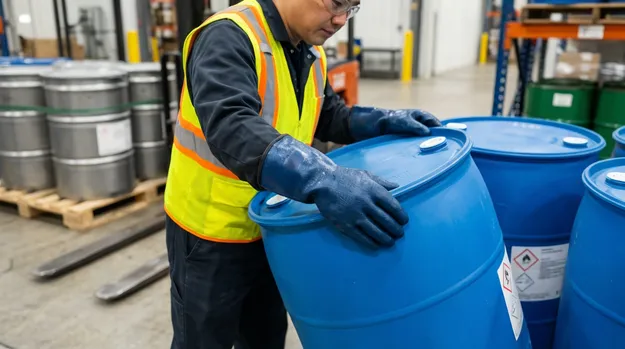
Chemical distribution drum handling with heavy-duty nitrile gloves
Chemical Distribution

Chemical Distribution & Industrial Supply

The core segment. Drum-handling operations, industrial cleaning contractors, and manufacturing facilities consume heavy-duty nitrile at predictable rates. Specification requirement is consistent: heavier gauge, full-hand texture, documented chemical resistance.

Once you're in the spec for a chemical distributor's approved supplier list, the reorder pattern is quarterly or better. This is not a spot-buy segment.

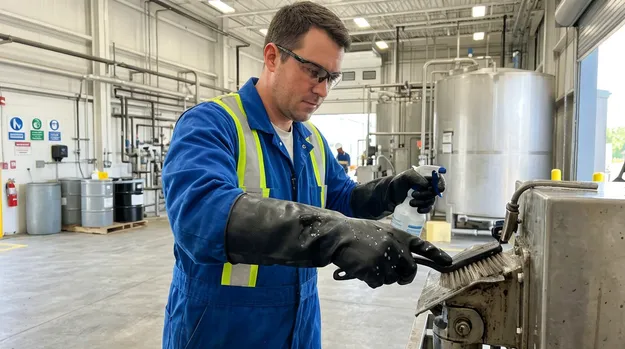
Industrial cleaning contractor using chemical resistant nitrile gloves
Facilities Services

Industrial Cleaning & Facilities Services

Runs on contract cycles — annual or multi-year service agreements with standardized glove specifications across a facility portfolio. The glove spec gets written into the service contract, protecting your distribution margin for the contract term.

Heavy-duty nitrile in black or blue is the standard specification. Volume per account is moderate, but reorder frequency is high and switching cost is real — retraining, re-speccing, re-stocking.

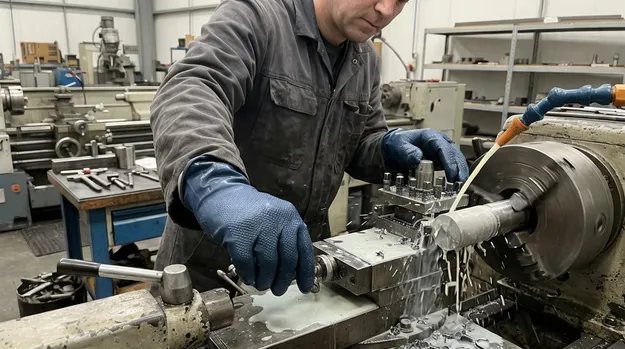
Metalworking machining operation with nitrile gloves for cutting fluid handling
Metalworking

Metalworking & Machining

Cutting fluid handling, parts cleaning, and general machine operation. Cutting fluids are oil-based or water-soluble emulsions — both within nitrile's resistance profile. Full-hand texture handles grip requirements for wet metalworking environments.

Metalworking supply distributors typically carry a narrow glove SKU range. A heavy-duty chemical-resistant nitrile covers most accounts' requirements without needing multiple SKUs.

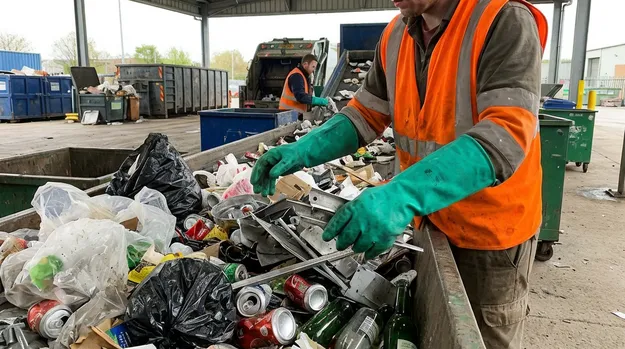
Waste management environmental services requiring puncture and chemical resistant gloves
Waste & Environmental

Waste Management & Environmental Services

Requires puncture resistance and chemical resistance simultaneously — the two properties that define this glove's specification. Waste handling involves unknown chemical exposures, sharp debris, and extended wear.

The 0.13–0.15mm wall handles the puncture requirement; the high-acrylonitrile compound handles chemical exposure. For distributors supplying waste management contractors, this is the specification that reduces liability exposure — a selling point that supports margin.

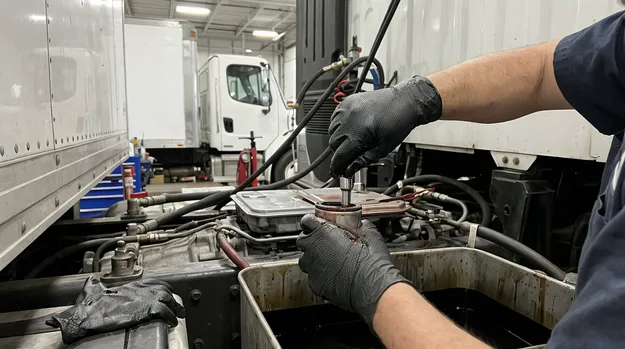
Automotive fleet maintenance brake fluid and transmission fluid handling with nitrile gloves
Automotive & Fleet

Automotive Service & Fleet Maintenance

At the heavy end — transmission fluid changes, brake fluid handling, parts washing with solvent-based cleaners — requires more than the standard 0.10–0.12mm general-purpose nitrile.

Fleet maintenance operations handling brake fluid, transmission fluid, and parts-washing solvents will generate complaints with under-spec gloves. The chemical-resistant variant at 0.13–0.15mm is the right specification, and the price premium over standard nitrile is supportable because the alternative is glove failures and end-user complaints.

Segment Pattern

What These Segments Share

  • Documented specification requirements — not spot buys
  • Predictable reorder cycles: quarterly or better
  • Real switching costs that protect your margin once you're in spec
  • Liability-reduction logic that supports price premium over standard nitrile
OEM & Private Label

Customization Options for Your Distribution Business

Standard production colors, size ratio adjustments, full OEM branding, custom formulation, and accelerator-free variants — all from the same compound and production line.

Color

Black and blue are standard production colors. Black is the default for automotive and industrial accounts; blue is common in food-adjacent and pharmaceutical-adjacent industrial environments. Both are available from standard production runs without MOQ premium.

Size Range

XS through XL in standard production. If your accounts skew toward a specific size distribution — common in regional markets — we can adjust the size ratio within a container order.

Typical Starting Ratios

XS
10%
S
30%
M
40%
L
15%
XL
5%

North American default. European buyers typically run heavier on M and L. Tell us your market and we'll suggest a starting ratio.

OEM & Private Label

The chemical-resistant compound and production process run under your brand name. Custom carton printing, box labeling, and inner bag branding are standard OEM services.

Regulatory documentation — CE declaration of conformity, ASTM D6319 test reports, country-of-origin certificates — is prepared under your brand name. No subcontracting; your product runs on our lines with our compound and QC process.

Custom Formulation

If your accounts require a specific elongation-at-break target, a particular chemical resistance profile beyond our standard compound, or a color match from a Pantone reference, our compounding lab handles the development.

Custom formulation projects carry the same MOQ as standard OEM — one 40HQ container.

Accelerator-Free Option

Accelerator-Free Variant

If your chemical-handling accounts include healthcare-adjacent industrial environments — pharmaceutical manufacturing, dental labs, medical device assembly — we can produce the chemical-resistant specification in an accelerator-free compound.

This opens procurement categories that standard nitrile can't enter. Ask us about this option if your distribution territory includes European healthcare-adjacent industrial accounts.

Ask About Accelerator-Free
Accelerator-free nitrile gloves for pharmaceutical and healthcare-adjacent industrial environments

Minimum Order Quantity

One 40HQ Container — Standard & Custom

MOQ for standard SKUs: one 40HQ container, approximately 2,000 boxes. Custom formulation and OEM projects carry the same MOQ. No premium for private label or custom carton printing at container volume.

Quality Checkpoints Specific to Chemical-Resistant Production

The category page covers our general QC process in detail — see the full manufacturing overview. For the chemical-resistant SKU specifically, there are two checkpoints that matter more than they do for standard industrial production.

Compound Batch Verification

Because the chemical resistance of this glove depends on the acrylonitrile content of the compound, we run a compound verification test on every batch before it goes to the dipping line. Acrylonitrile content is confirmed against the formulation spec; batches outside tolerance don't go to production.

This is a step we added after seeing a competitor's product fail chemical resistance testing at a buyer's warehouse — the root cause was compound substitution mid-production run. We test every batch.

Wall Thickness at the Finger

For chemical-resistant applications, fingertip thickness matters more than it does for general-purpose gloves — the fingertips are the highest-contact area in most chemical handling tasks. Our in-process inspection pulls dimensional checks at the palm, finger, and cuff every two hours per line.

SKU Finger Thickness Spec Action
Chemical-Resistant 0.11–0.13mm Line stops if below floor
Standard Industrial 0.09–0.11mm Standard in-process check
100%
Online pinhole detection on every glove
AQL 1.5
Outgoing inspection on every finished lot
Ships With
Compound batch verification records in container documentation

Certifications Covering Your Chemical Handling Markets

Full certification documentation ships with every container.

Certification Relevance for Chemical Handling Distribution
ISO 9001:2015 Quality management system — required by most institutional and industrial procurement processes
CE Marking EU import and distribution — covers industrial protective equipment requirements
ASTM D6319 North American standard for nitrile examination gloves — the reference standard your US and Canadian buyers use

North American Distribution

For buyers supplying North American industrial distribution, ASTM D6319 is the standard your procurement contacts reference.

European Safety Distribution

For European safety distributors, CE marking covers the import requirement.

EN 374 Chemical-Specific Testing Available

If your accounts require EN 374 (chemical protective gloves) documentation specifically — common in European industrial safety procurement — contact us. We can provide permeation and degradation test data for specific chemicals against EN 374 protocols.

EN 374 testing is chemical-specific, so the relevant data depends on what your accounts are actually handling. Send us the chemical list and we'll pull the applicable test results.

Buyer Guidance

Frequently Asked Questions

What is the MOQ for chemical resistant industrial nitrile gloves?

One 40HQ container for standard SKUs — approximately 2,000 boxes at 100 gloves per box. For buyers who want to test the product before committing to a full container, we support sample orders that ship within 5–7 business days with full certification documentation and compound test reports included.

What chemicals do nitrile gloves resist, and what are the limits?

Nitrile provides strong resistance to petroleum oils, greases, gasoline, diesel, hydraulic fluids, and dilute acids and bases — the chemical exposures that cover most industrial handling applications. Resistance to aromatic hydrocarbons (toluene, xylene) and ketones (acetone, MEK) is limited to short-duration or splash contact, not extended immersion. Nitrile is not recommended for halogenated solvents or strong oxidizing acids. For specific chemical resistance data, send us your target chemical list and we'll provide permeation test results for the relevant exposures.

How does wall thickness affect chemical resistance performance?

Thicker wall increases breakthrough time — the time before a chemical permeates through the glove membrane to skin contact. Our chemical-resistant SKU at 0.13–0.15mm provides longer breakthrough time than standard industrial nitrile at 0.10–0.12mm for the same compound. For applications involving extended chemical contact (drum handling, parts washing), the heavier gauge is the correct specification. For incidental contact applications, standard industrial nitrile is sufficient and the lower per-unit cost protects your margin.

What is the difference between chemical resistant nitrile and standard industrial nitrile?

Two differences: compound formulation and wall thickness. Our chemical-resistant SKU uses a higher-acrylonitrile compound that slows permeation rates for oils and many solvents. The wall runs 0.13–0.15mm versus 0.10–0.12mm for standard industrial. The full-hand micro-texture is also specific to this SKU — standard industrial uses fingertip texture only. The result is a glove with better chemical permeation resistance, higher puncture resistance, and better grip in wet and oily conditions, at a higher per-unit cost. If your accounts are in chemical handling, waste management, or heavy metalworking, the specification is justified. If they're in general assembly or janitorial supply, standard industrial is the right call.

Can you produce chemical resistant nitrile gloves under our brand name?

Yes. OEM and private-label projects run on our production lines with our compound and QC process — no subcontracting. Custom carton printing, box labeling, and regulatory documentation under your brand name are standard. MOQ is one 40HQ container. Contact us to discuss your project.

Do you offer EN 374 chemical protective glove certification?

EN 374 testing is chemical-specific — the standard requires permeation testing against a defined list of chemicals, and the certification scope depends on which chemicals are tested. We can provide permeation and degradation test data for specific chemicals against EN 374 protocols. Send us your target chemical list and we'll confirm what test data is available and what additional testing may be needed for your specific market requirements.

Factory-Direct Sourcing

Source the Chemical-Resistant Spec from a Factory That Controls the Compound

The chemical resistance of a nitrile glove is only as reliable as the compound it's made from — and the compound is only as consistent as the manufacturer's control over the formulation. We mix in-house, test every batch, and hold the acrylonitrile ratio to spec across your full container order. That's the sourcing argument for this product in one sentence.

glovemfg has manufactured nitrile gloves since 2007 from an 18,000 m² facility in Weifang. Learn more about our manufacturing capabilities →

If you're building a chemical handling SKU into your distribution line — or replacing a supplier whose product has been generating complaints — send us your current specification and target volume. We'll respond with a detailed quote, the relevant certification and compound test documentation, and a sample shipment if you want to verify the product before committing to a container.

glovemfg in-house compound mixing for chemical resistant nitrile gloves
2007
Est. Year
18,000 m²
Facility Size
In-House
Compound Mixing
AQL 1.5
QC Standard