GloveMFG

DNOOO blank theme is active for local preview.

Blue Nitrile vs Latex Gloves: Which Holds Up Better for High-Volume Medical and Industrial Use

If you're running a medical supply distribution business or stocking PPE for industrial accounts, you've already narrowed it down to two options. Latex has decades of clinical history. Blue nitrile has taken over most high-volume procurement in the last fifteen years. The question isn't which one sounds better — it's which one holds up across a full year of orders without creating downstream problems for your customers.

Here's the short answer: for high-volume medical and industrial distribution, blue nitrile is the lower-risk, more commercially durable choice. Latex still wins in specific surgical and fine-tactile applications, but for the bulk of examination, procedural, and industrial-grade volume, nitrile gives you fewer allergy complaints, more consistent supply, and a sourcing chain that doesn't depend on natural rubber commodity swings.

The rest of this article shows you exactly where that verdict holds and where it doesn't.

Head-to-Head: The Properties That Actually Drive Procurement Decisions

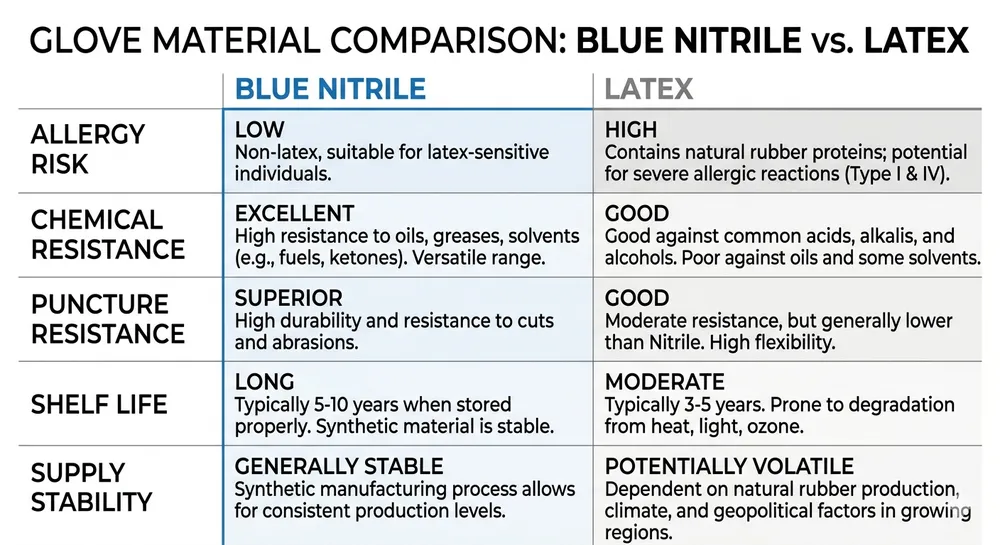
Before getting into scenarios, here's the comparison matrix that matters for buyers sourcing at container scale.

Property Blue Nitrile Latex
Allergy risk Near-zero (synthetic, latex-protein-free) Type I hypersensitivity risk — up to 17% sensitization in high-exposure healthcare workers
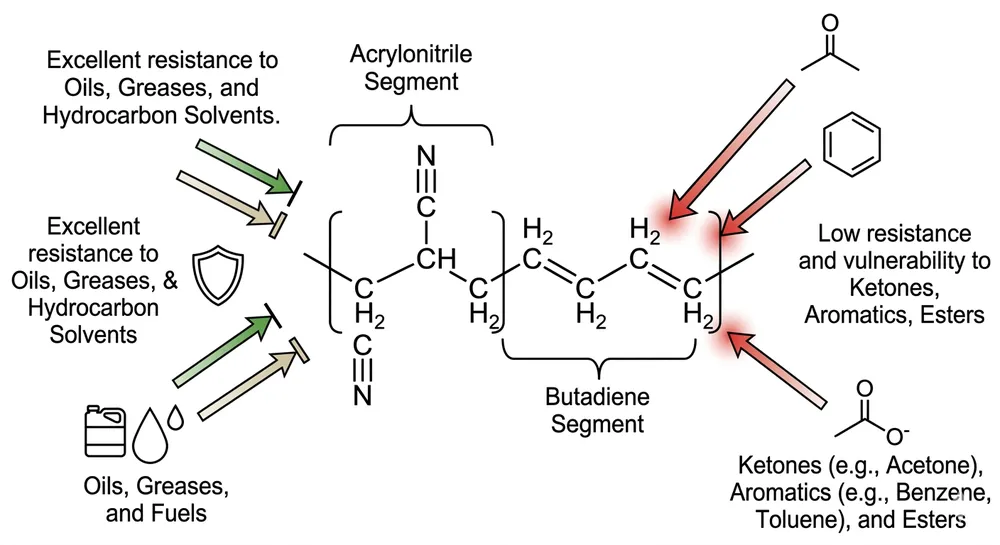
Chemical resistance Strong against oils, solvents, many acids Moderate — degrades faster with hydrocarbon exposure
Puncture resistance Higher — synthetic polymer structure Moderate — natural rubber is more elastic but tears under sharp puncture
Tensile strength Comparable to latex at equivalent thickness Slightly higher elongation at break
Thickness range 0.08–0.15mm (controllable in manufacturing) Typically 0.10–0.18mm, less consistent across batches
Shelf life 3–5 years (synthetic, stable) 2–3 years (natural rubber degrades faster)
Supply chain stability Stable — petrochemical feedstock Volatile — natural rubber commodity pricing
Color coding Blue is a standard visual identifier for nitrile Natural off-white/tan; dyed latex less common
Regulatory compliance FDA 510(k), CE, EN455, ASTM D6319 achievable FDA and CE achievable, but latex-specific allergen labeling required in EU/US
Side-by-side property comparison chart of blue nitrile gloves versus latex gloves for medical and industrial use

The allergy row is the one that ends most latex conversations at the procurement level. Once a hospital system or food processing facility has had an incident — or even a formal complaint — they move to nitrile and don't come back. We've seen this pattern consistently across our North American and European accounts over the past decade.

The Hidden Cost Latex Buyers Discover Too Late

The unit price comparison between latex and nitrile is closer than it used to be. But the real cost gap shows up downstream, and it's not on the invoice.

Allergen liability exposure. In the US and EU, latex gloves require specific allergen labeling. If your downstream customer — a clinic, a food plant, a lab — has a Type I latex allergy incident involving product you supplied, the liability chain runs back to the distributor. Nitrile eliminates that exposure entirely. For distributors building accounts in healthcare, that's not a minor compliance footnote — it's a material risk reduction.

Shelf life and inventory write-off risk. Natural rubber degrades. A container of latex gloves sitting in a warm warehouse for 18 months will show accelerated aging — brittleness, tackiness, reduced tensile strength. Nitrile holds its properties for 3–5 years under standard storage conditions, so your inventory turns don't have to race against material degradation. (We've had buyers come to us specifically after writing off a partial container of latex that sat too long in a Southeast Asian distribution hub — it's a real cost that doesn't show up in the per-box price.)

Supply price volatility. Natural rubber is a commodity. Latex glove pricing moves with rubber futures, weather events in Southeast Asian growing regions, and seasonal harvest cycles. Nitrile feedstock pricing is more stable and more predictable for annual contract negotiations. If you're quoting your customers fixed annual pricing, nitrile gives you a more defensible cost floor.

Regulatory friction in new markets. If you're expanding into EU markets or healthcare accounts that require EN455 compliance, latex gloves carry additional documentation requirements around residual protein content. Nitrile skips that layer entirely.

Where Latex Still Wins — and Why It Matters for Your SKU Mix

Latex isn't obsolete. There are specific applications where it genuinely outperforms nitrile, and if your accounts include these segments, you need to know where the line is.

Surgical and fine-tactile procedures. Latex has a higher elongation at break and a more natural tactile feel that some surgeons and dental professionals still prefer for fine motor work. Surgical-grade latex gloves remain in use in operating rooms where the clinical team has been screened for latex sensitivity. If you're supplying surgical suites rather than examination rooms, this matters.

High-stretch applications. Latex stretches further before tearing. In applications where the glove needs to conform tightly over irregular shapes — certain dental procedures, some laboratory handling tasks — latex's elasticity is a functional advantage.

Price-sensitive short-run procurement. In markets where latex is locally produced and nitrile is imported, latex can still win on landed cost for buyers who aren't concerned about allergen risk. This is more relevant in Southeast Asian domestic markets than in North American or European distribution.

For most high-volume medical examination, food processing, industrial maintenance, and laboratory supply accounts, none of these exceptions apply. The bulk of the market has moved to nitrile for good commercial reasons.

Application Showdown: Three Scenarios, Three Verdicts

Scenario 1: Hospital System or Clinic Network — Examination Gloves at Scale

A regional hospital network buying 500,000–2,000,000 gloves per quarter for examination and procedural use.

Winner: Blue Nitrile — decisively.

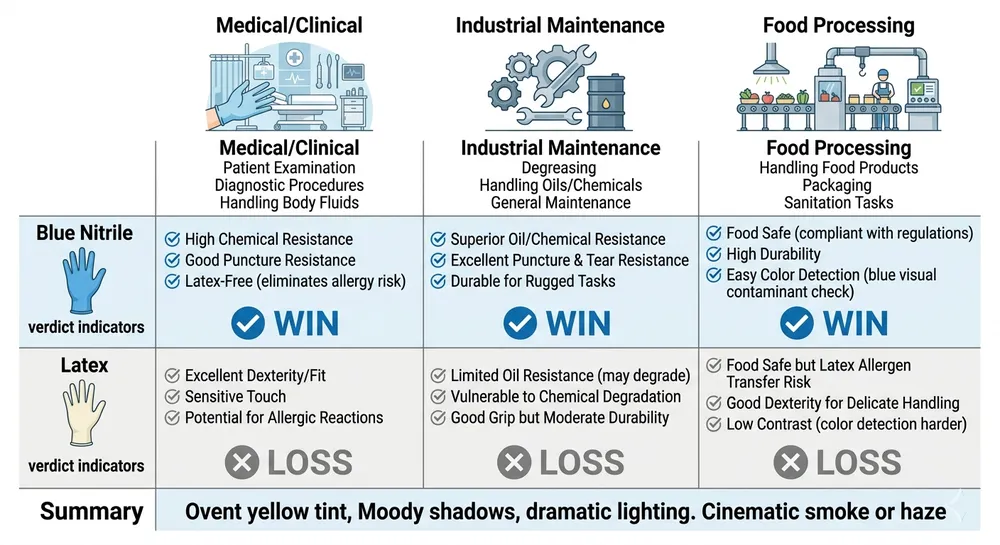
Healthcare facilities have moved away from latex for examination use because the allergy risk is institutional, not individual. Staff rotate, patients have undisclosed sensitivities, and a single incident creates documentation, incident reporting, and potential liability. Blue nitrile eliminates that category of risk. The color coding also matters operationally — blue is a recognized visual identifier that helps facilities manage glove type segregation across departments. At this volume, the per-box price difference between nitrile and latex is negligible against the risk reduction value.

Scenario 2: Industrial Maintenance and Chemical Handling

A safety supply distributor stocking gloves for automotive workshops, manufacturing plants, and chemical handling environments.

Winner: Blue Nitrile — on chemical resistance and durability.

Latex degrades with hydrocarbon exposure — oils, greases, and many solvents attack natural rubber faster than they attack nitrile polymer. For mechanics, maintenance technicians, and chemical handlers, nitrile holds up longer per pair, which means your customer's per-use cost is lower even if the per-box price is similar. Puncture resistance is also higher in nitrile, which matters in environments with metal shavings, sharp edges, or abrasive surfaces. (Textured fingertip variants — which we produce on the same lines — add grip in oily conditions, which is a spec worth calling out to industrial accounts.)

Scenario 3: Food Processing and Packaging Lines

A food safety distributor supplying gloves to meat processing, bakery, and ready-meal production facilities.

Winner: Blue Nitrile — on color coding and contamination detection.

Blue is the standard color for food-contact gloves precisely because it's visually distinct from most food products. If a glove tears during processing, the blue fragment is detectable against most food backgrounds — a critical food safety control point. Latex in natural or off-white color fails this test. Beyond color, nitrile's chemical resistance handles the sanitizers and cleaning agents used in food processing environments better than latex. Most food safety auditors and HACCP programs now specify powder-free nitrile as the default — latex requires additional justification.

Decision map showing which glove type wins across medical, industrial, and food processing application scenarios

What to Verify Before the Container Ships

This is where most sourcing problems actually originate — not in the spec comparison, but in the gap between the spec sheet and what arrives at your warehouse.

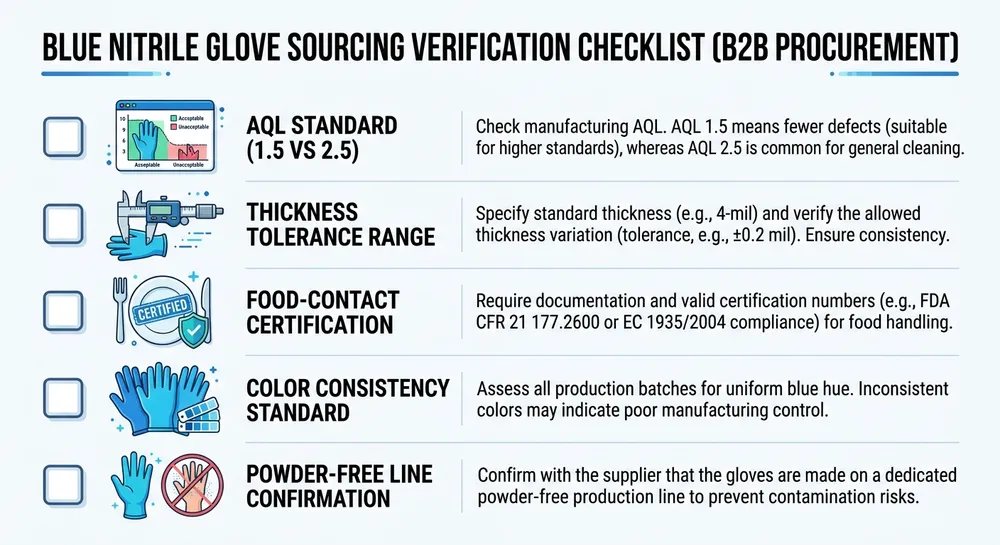
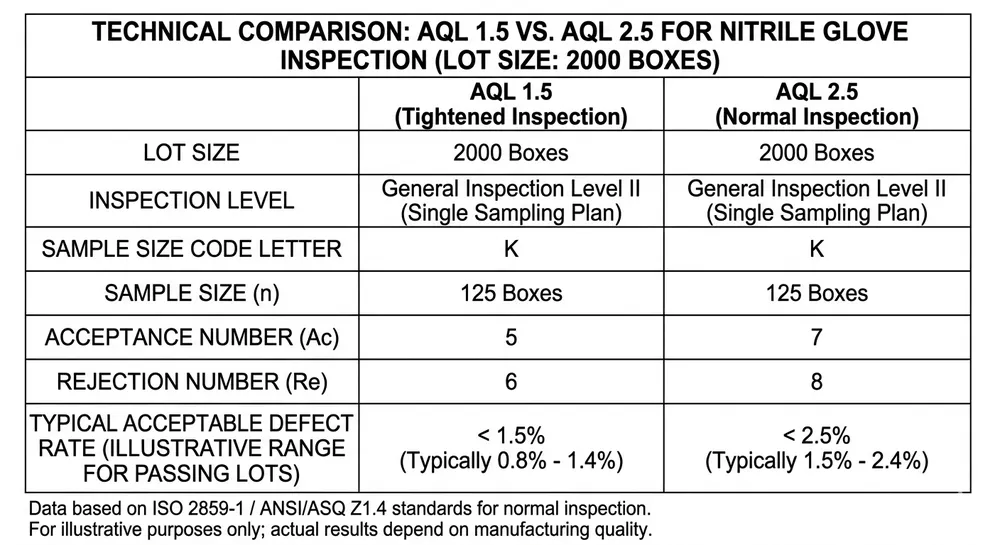
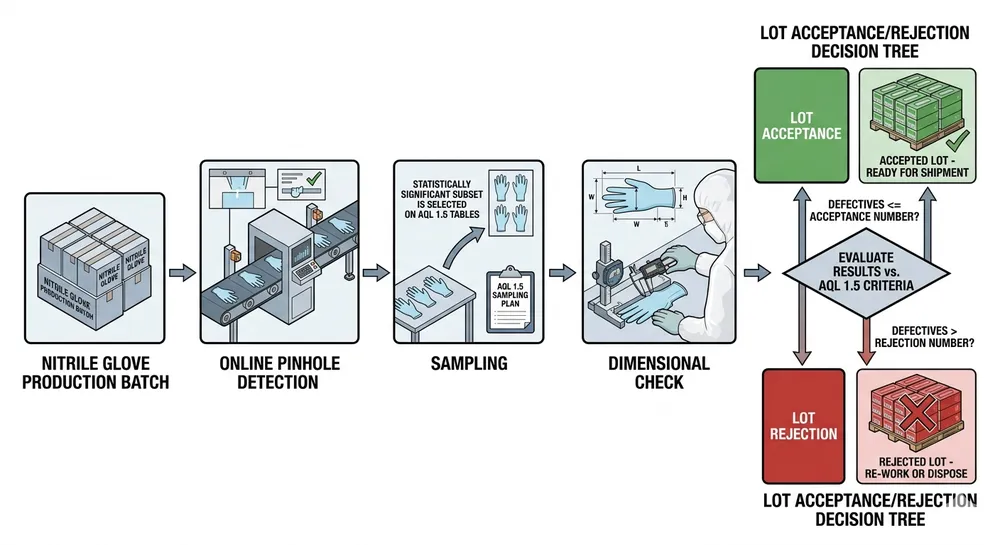
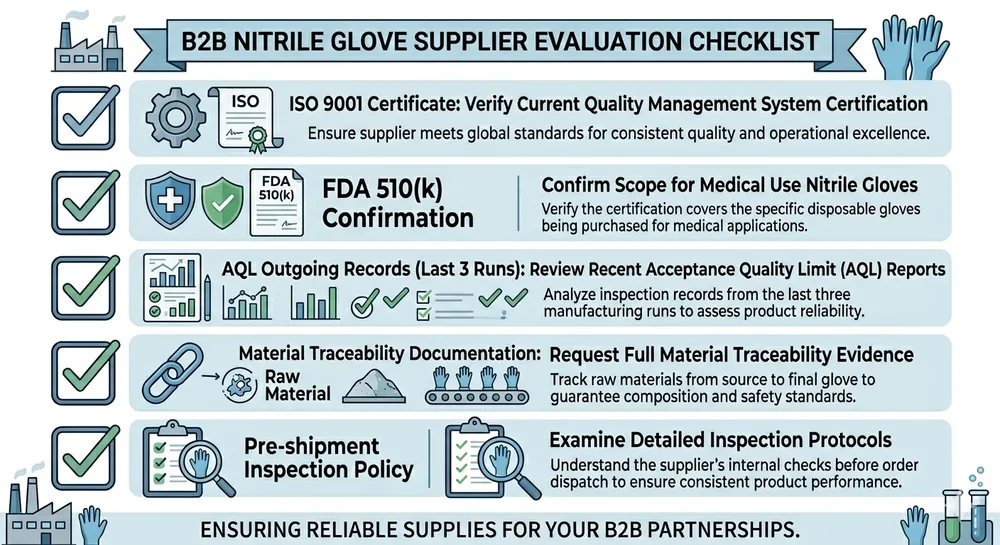
AQL standard and inspection level. AQL 1.5 is the standard for medical-grade examination gloves. AQL 2.5 is common for industrial grade. Know which your account requires and confirm it in writing before the order. We run AQL 1.5 across all medical-grade lines with online pinhole detection — but not every factory does, and the difference shows up at destination port inspection, not before.

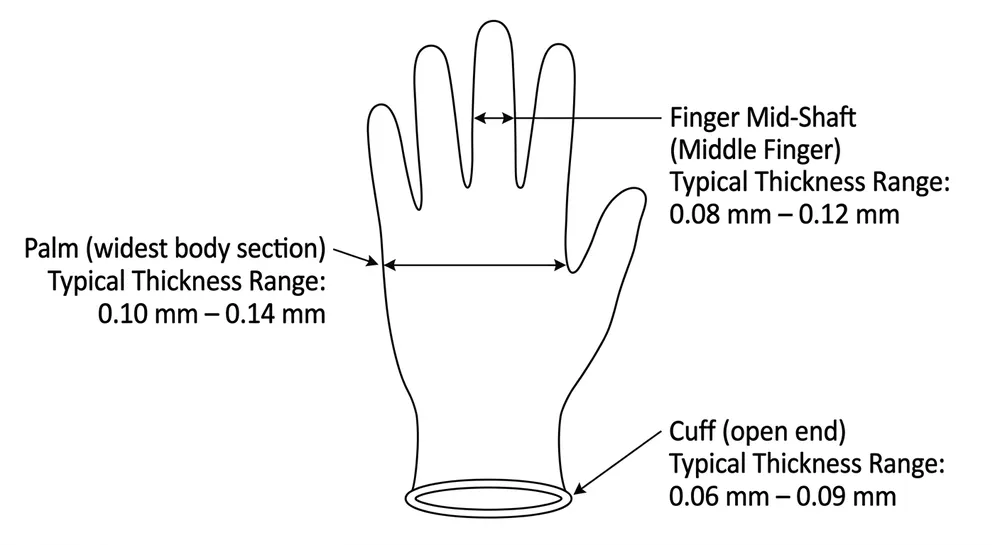
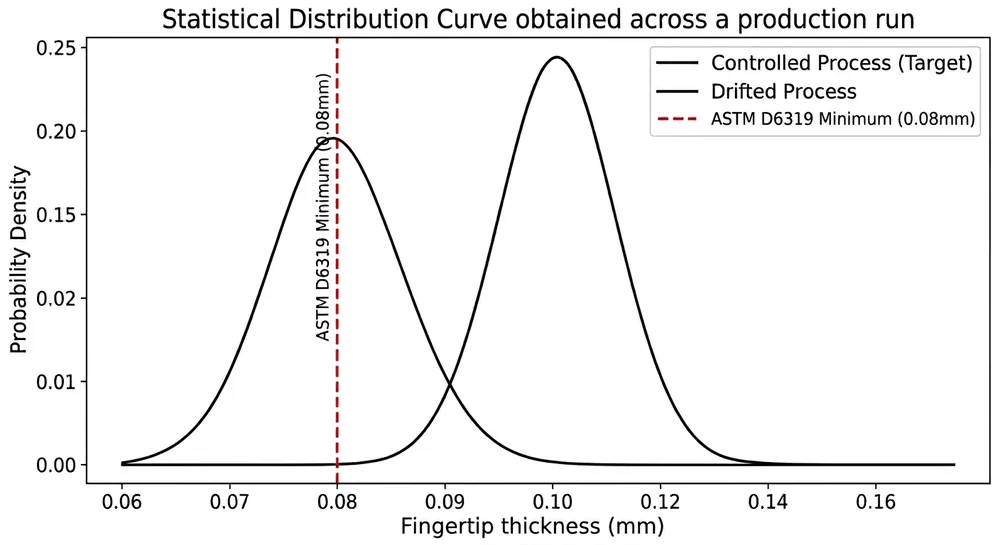
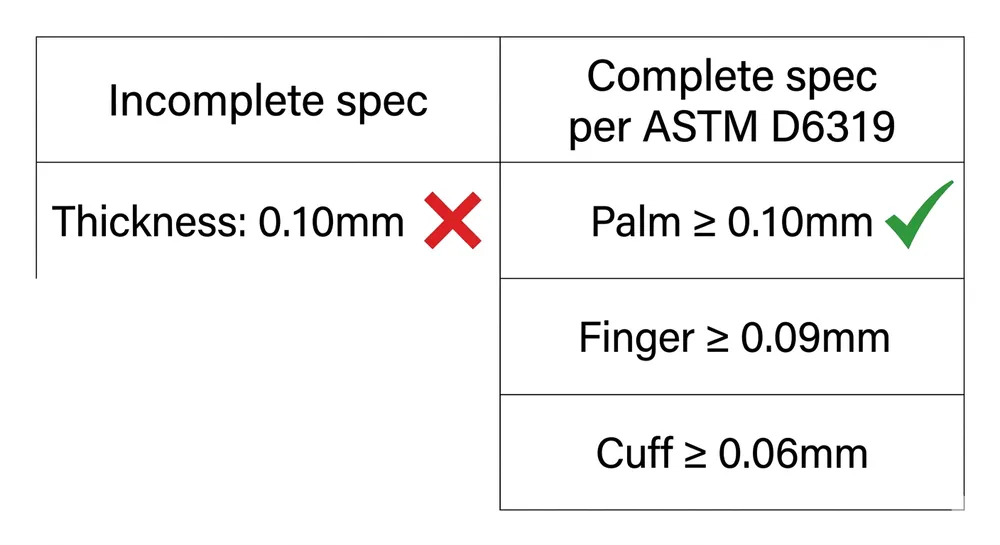
Thickness tolerance and consistency. A glove spec'd at 0.10mm palm thickness that measures 0.07mm at the fingertip fails AQL at the destination. Thickness variation is the most common spec drift issue between sample shipments and full container orders. Ask for thickness measurements at palm, finger, and cuff — not just a single-point average. Our 8 automated dipping lines hold 0.08–0.15mm tolerance across the full glove, which is what makes container-to-container consistency possible.

Accelerator-free certification if required. Standard nitrile gloves use chemical accelerators (thiurams, carbamates) in the vulcanization process. These can cause Type IV delayed hypersensitivity reactions — different from latex allergy but still a clinical concern for high-exposure healthcare workers. If your medical accounts are specifying accelerator-free gloves, confirm this explicitly. We produce accelerator-free variants from the same facility — it's a formulation change, not a different product line.

Powder-free verification. All medical-grade nitrile should be powder-free. Confirm this is documented in the product certificate, not just stated verbally. Powdered gloves are banned for medical use in the US (FDA 2017 ban) and restricted in EU medical device regulations.

Color consistency across batches. Blue nitrile color is not standardized across manufacturers — the shade varies by formulation. If your accounts use blue for color-coded contamination control (food processing, pharmacy), confirm the color standard and request batch-to-batch color consistency documentation. This is a detail that gets missed in initial RFQs and causes complaints six months into a supply relationship.

Certifications relevant to your market. For US distribution: FDA 510(k) for medical examination gloves, ASTM D6319 for industrial nitrile. For EU: CE marking under EN455 for medical, EN374 for chemical protection. Confirm the certificate number is current and the scope covers the specific SKU you're ordering — not just the factory's general certification.

Sourcing Blue Nitrile at Container Scale: What the Spec Sheet Doesn't Tell You

The comparison between nitrile and latex is straightforward once you understand the commercial logic. The harder part is finding a nitrile supplier who can hold spec across a full year of orders — not just the first sample shipment.

We've been manufacturing nitrile gloves exclusively since 2007. The facility runs 8 fully automated dipping lines across 18,000 square meters, with an annual output of 1.2 billion pieces. When you're placing quarterly container orders, that capacity means your order isn't competing with someone else's for line time.

The in-house compounding lab is what makes thickness consistency possible at scale. We control the nitrile formulation — we're not buying pre-mixed compound and hoping the batch is consistent. When a buyer reports thickness variation between their first and third container, the root cause is almost always compound variability. Owning the formulation is how we prevent that.

Standard SKUs ship from 1 container (approximately 2,000 boxes). OEM and private-label orders — custom color, custom branding, accelerator-free formulation — are supported from the same lines. ISO 9001:2015, CE, EN455, ASTM D6319, and FDA 510(k) certifications cover the full medical and industrial grade range.

If you're currently sourcing latex and evaluating a switch to nitrile, or if you're adding a blue nitrile SKU to an existing PPE line, the Blue Nitrile Gloves category page covers the full specification range — thickness options, grade classifications, and available certifications.

Frequently Asked Questions

Are blue nitrile gloves truly latex-free? Yes. Blue nitrile gloves are made from synthetic nitrile butadiene rubber — no natural latex proteins. They are safe for users with Type I latex hypersensitivity. This is the primary clinical reason most healthcare facilities have switched from latex examination gloves to nitrile over the past 15 years.

What thickness of nitrile glove is equivalent to standard latex examination gloves? Standard latex examination gloves typically run 0.10–0.12mm at the palm. Nitrile at the same thickness range (0.10–0.12mm) provides comparable barrier protection with higher puncture resistance. For industrial use where durability is the priority, 0.13–0.15mm nitrile is the more common spec.

Can nitrile gloves replace latex for surgical use? Surgical-grade nitrile gloves exist and are used in latex-sensitive environments, but standard examination-grade nitrile is not a direct surgical substitute. Surgical gloves require sterile packaging, higher elongation specifications, and specific tactile sensitivity standards. If your accounts include surgical supply, confirm the surgical-grade certification separately.

What does AQL 1.5 mean in practice for a distributor? AQL 1.5 means that in a standard sampling inspection, the acceptable quality level allows no more than 1.5 defects per 100 units. For a 10,000-glove lot, that translates to a maximum of 150 defective units before the lot fails inspection. AQL 2.5 — common for industrial grade — allows 2.5 defects per 100. The difference matters if your accounts are medical facilities with strict incoming inspection protocols.

How do I verify a factory's FDA 510(k) clearance covers the specific glove I'm ordering? The FDA 510(k) database is publicly searchable at fda.gov. Look up the clearance number the factory provides and confirm the device description matches the product type (examination glove, nitrile, powder-free) and that the clearance is not expired or withdrawn. A factory can hold 510(k) clearance for one SKU and sell you a different one — always match the clearance number to the specific product in your purchase order.

Indigo Nitrile Gloves vs Black Nitrile Gloves: Color, Contrast, and Application Fit for Tattoo Studios and Automotive Detailing

Color is not a cosmetic decision in nitrile gloves. It is a workflow decision — and for tattoo studios and automotive detailing operations, the wrong color choice creates real downstream problems: contamination you can't see, client-facing optics that undercut your brand, and sourcing headaches when your supplier can't hold a consistent shade across container orders.

The short verdict: indigo wins for tattoo studios where ink transfer visibility is a safety and hygiene signal. Black wins for heavy automotive detailing where grease concealment is the priority. But the sourcing story behind each choice is where most buyers get tripped up — and that's what this comparison is actually about.

Why Color Matters at the Formulation Level, Not Just the Surface

Most buyers think of glove color as a dye applied after the fact. It isn't. Color is compounded into the nitrile formulation before the dipping process begins. The pigment load, dispersion method, and stabilizer chemistry all affect the final glove — not just its appearance, but its physical properties.

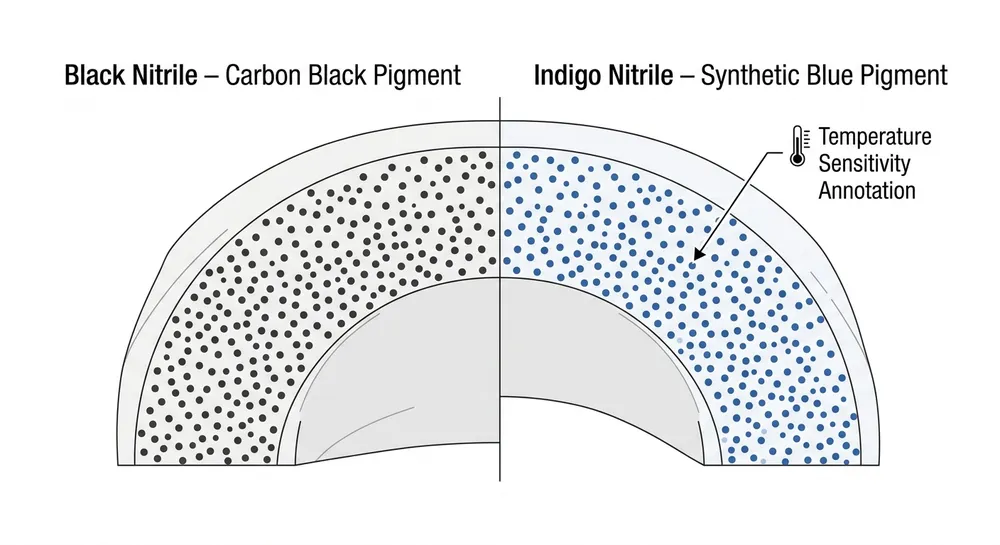
Black nitrile gets its depth from carbon black pigment. Carbon black is a high-load, chemically stable pigment that disperses evenly in nitrile compound and has been used in glove manufacturing for decades. It's forgiving in production: minor batch-to-batch variation in pigment concentration doesn't produce a visible color shift, so black is the easiest specialty color to hold consistent across large runs. That's a big reason black became the default for tattoo and automotive markets in the first place — it's reliable to manufacture at scale.

Indigo is a different story. True indigo-tone nitrile uses organic or synthetic blue pigment blended to hit a specific mid-tone — deeper than standard powder-blue exam gloves, lighter than navy. The challenge is that blue pigments are more sensitive to compound temperature and dwell time during dipping. A 5°C variance in the dipping bath that wouldn't register on a black glove can shift an indigo glove visibly toward green or gray. We run our indigo compound with tighter bath temperature tolerances than our standard blue lines — ±2°C versus the ±5°C that's acceptable for commodity colors. (That tighter window is why indigo from a factory without in-house compounding control tends to drift between shipments.)

The practical consequence for buyers: black is available from a wider supplier base with lower color-consistency risk. Indigo requires a factory that owns its compound formulation and can document color spec — ideally with a Pantone reference and a tolerance band in the product spec sheet.

Side-by-side cross-section diagram showing carbon black pigment dispersion in black nitrile versus blue organic pigment dispersion in indigo nitrile glove compound

Head-to-Head Specification Matrix

Dimension Indigo Nitrile Black Nitrile
Pigment type Synthetic organic blue Carbon black
Color consistency tolerance Tight (Pantone-referenced, ±ΔE 1.5 typical) Loose (visually stable across wide batch variation)
Dye migration risk Low when properly stabilized; higher with low-grade compound Very low — carbon black is chemically inert
Thickness range available 0.08–0.12mm (exam/light industrial) 0.08–0.15mm (full range)
Contrast on skin High — mid-tone shows ink, product transfer clearly Low — dark surface conceals transfer
Contrast on dark surfaces Moderate Low
Supplier availability Specialty — requires compounding capability Broad — commodity SKU at most factories
Color documentation Requires Pantone spec + batch CoC Standard CoC sufficient
AQL standard (glovemfg) AQL 1.5 AQL 1.5
Certifications available ISO 9001, CE, EN455, ASTM D6319, FDA 510(k) ISO 9001, CE, EN455, ASTM D6319, FDA 510(k)
MOQ (glovemfg) ~1 container (approx. 2,000 boxes) ~1 container (approx. 2,000 boxes)

One note on the AQL row: most factories apply AQL 1.5 to their standard blue or black lines and quietly run AQL 2.5 on specialty colors because the inspection overhead is higher. We apply AQL 1.5 across all SKUs including indigo — that's documented in our outgoing inspection records and available for review before you commit to a container.

Tattoo Studio Supply: Why Indigo's Contrast Is a Workflow Asset

The tattoo industry's shift toward black nitrile was driven by aesthetics — black looks professional, matches studio equipment, and became the visual shorthand for "serious artist." That logic is sound for branding. It breaks down for contamination control.

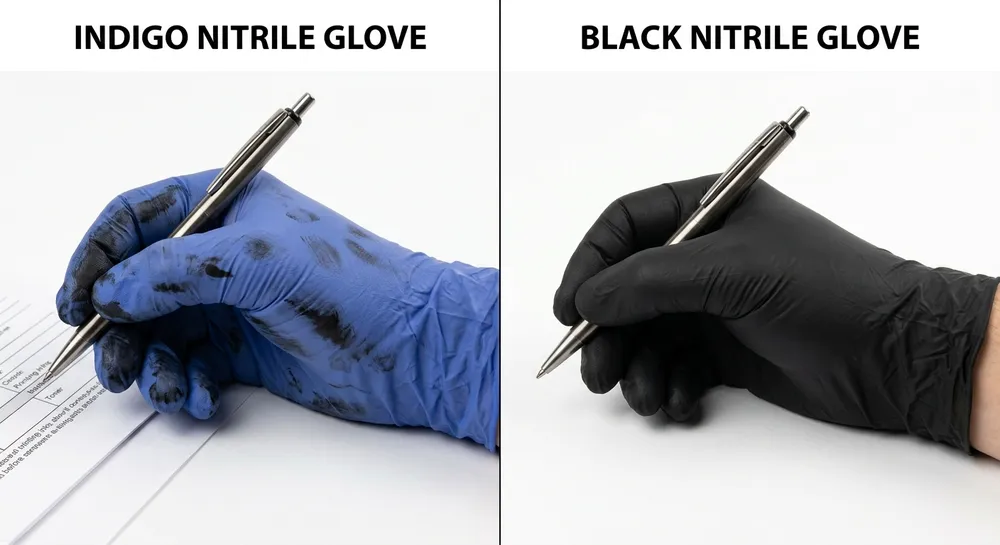
During a tattoo session, ink transfer from the work surface to the glove is continuous. With black gloves, that transfer is invisible. An artist working a multi-hour session has no visual cue when their glove surface has accumulated enough ink and product residue to warrant a change. The contamination is there — it's just hidden. For studios operating under health department inspection, that's a documentation and hygiene risk, not just an aesthetic one.

Indigo gloves solve this at the workflow level. The mid-tone surface shows ink transfer clearly — a dark stain on an indigo glove is visible within minutes of contact. Artists change gloves when they see contamination, not on a timer. That's a better hygiene protocol, and it's one that health inspectors can observe directly during a studio visit.

For distributors supplying tattoo studios, this is a margin argument as much as a hygiene argument. Indigo is a specialty SKU that commands a price premium over commodity black — typically 8–15% at the wholesale level depending on volume. Studios that understand the contamination-visibility benefit will pay it. Your job is to source indigo from a factory that can hold color consistency across reorders, because a studio that switches to indigo and then receives a shipment that looks gray-blue instead of true indigo will blame the distributor, not the factory.

Indigo Nitrile Gloves from a factory with documented Pantone-referenced color spec protect your reorder relationship. Generic indigo from a spot-buy supplier does not.

Indigo nitrile glove showing visible ink transfer contrast against skin during a tattoo procedure compared to black nitrile with no visible contamination indicator

Automotive Detailing Supply: When Black's Concealment Is the Feature

Automotive detailing is the inverse scenario. The work involves heavy contact with grease, polish compounds, tire dressing, and solvent-based products. A glove that shows every product transfer is not a hygiene asset here — it's visual noise that makes the technician look dirty to the client before the job is done.

Black nitrile dominates automotive detailing for a reason: it conceals product buildup, maintains a clean professional appearance through a full detail session, and doesn't signal contamination to a client watching their car being worked on. That's a legitimate commercial function, not just vanity.

There is one scenario where indigo has a role in automotive detailing: client-facing interior work. When a technician is working inside a vehicle — cleaning leather, treating surfaces, applying interior dressings — a client sitting nearby can see the gloves. Some premium detailing operations use indigo or other mid-tone colors specifically for interior work to signal "clean gloves, clean products." It's a brand positioning choice, not a technical one. (We've had a few detailing supply distributors build a two-SKU kit around this — black for exterior/engine work, indigo for interior — and it's been a successful upsell for them.)

For the majority of automotive detailing volume, black is the right call. It's available at higher volumes, lower per-unit cost, and from a broader supplier base. The sourcing risk is lower and the end-user preference is established.

The B2B Sourcing Trade-Off: Availability, Documentation, and Color Drift Risk

This is where the comparison gets commercially important for distributors and importers.

Black nitrile is a commodity color. Nearly every nitrile glove factory produces it. That broad availability keeps pricing competitive and gives you multiple sourcing options if your primary supplier has a capacity issue. The trade-off is that "black nitrile" is not a single spec — thickness, formulation, and AQL standard vary widely across suppliers. You can switch factories on black and maintain color consistency. You cannot necessarily maintain quality consistency without re-qualifying the supplier.

Indigo nitrile is a specialty color with a much shorter supplier list. The factories that produce it reliably — meaning consistent Pantone-referenced color across container orders — are the ones with in-house compounding labs. Without that, you're buying indigo from a factory that sources pre-mixed compound from a third-party compounder, and color consistency across your second and third container orders depends on whether that compounder's batch matches the first one. It usually doesn't, not precisely.

We compound our nitrile in-house. When a buyer orders indigo from us, we assign a Pantone reference (typically in the PMS 2748–2756 range for standard indigo-tone gloves, adjusted per customer spec), document the ΔE tolerance in the product spec sheet, and retain a color standard sample for every production run. If your third container looks different from your first, you have documentation to hold us to. Most factories cannot offer that because they don't own the compound.

For distributors building a specialty SKU for tattoo supply or premium detailing channels, that documentation is what protects your private-label brand. A color that drifts between shipments is a customer service problem that lands on you, not the factory.

Blue Nitrile Gloves from our standard lines ship with the same AQL 1.5 standard and certification package — the specialty color doesn't change the quality floor.

Decision matrix comparing indigo and black nitrile glove sourcing risk across supplier availability, color consistency documentation, MOQ flexibility, and specialty channel margin

Application Showdown: Which Color Wins by Scenario

Scenario 1 — Tattoo supply distributor building a house brand Indigo wins. The contamination-visibility argument is real and communicable to studio owners. The price premium is defensible. The risk is color consistency across reorders — source from a factory with Pantone documentation or your brand takes the blame for drift. Black is a fallback if your volume doesn't justify the specialty sourcing overhead, but it's a commodity play with no differentiation story.

Scenario 2 — Automotive detailing wholesale, high-volume standard SKU Black wins. No contest. The end-user preference is established, the supplier base is broad, and the concealment function is genuinely useful for the work. Indigo has a niche in premium interior detailing kits but doesn't displace black as the core SKU.

Scenario 3 — Medical/exam glove distributor adding a colored SKU for cross-sell Indigo wins on visual differentiation from standard blue exam gloves. It reads as premium without the clinical association of blue. Color-coding protocols in some facilities also benefit from a distinct mid-tone that isn't blue, black, or white. Verify dye migration compliance for your target market — our indigo formulation passes EN455 and ASTM D6319, which covers most North American and European import requirements.

Scenario 4 — Private-label brand entering the tattoo or body art supply channel Indigo is the right anchor color for brand positioning, but only if you can hold it. A private-label indigo glove that ships gray-blue on the second order destroys the brand faster than never launching it. Qualify your factory's compounding capability before committing to the SKU, not after. Ask for the Pantone reference, the ΔE tolerance, and a retained color standard from the first production run. If the factory can't provide those three things, they can't hold your color.

What to Verify Before You Place a Container Order

Whether you're ordering indigo or black, the verification checklist is different for each.

For black nitrile:

  • Confirm AQL standard (1.5 vs 2.5 — the difference is significant at destination port)
  • Request pinhole detection records — online AQL inspection, not just end-of-line sampling
  • Confirm thickness spec at palm and fingertip separately — fingertip thinning is the most common spec drift point
  • Verify certifications match your target market (FDA 510(k) for US medical, CE + EN455 for EU)

For indigo nitrile:

  • All of the above, plus:
  • Request the Pantone reference number and ΔE tolerance in writing before the order
  • Ask whether the factory compounds in-house or sources pre-mixed compound
  • Request a retained color standard sample from the production run — this is your reference for future reorder disputes
  • Confirm that AQL 1.5 applies to the colored SKU, not just standard lines
  • Ask for indigo nitrile gloves color stability documentation if your end market involves prolonged UV exposure or chemical contact

The color documentation ask is the fastest way to separate factories that actually control their indigo compound from those that are buying pre-mixed and hoping for the best. A factory with real compounding capability answers that question in one email. A factory without it deflects or sends you a generic spec sheet with no color reference.

FAQ

Does indigo nitrile cost more than black nitrile at the factory level? Yes, typically 8–15% more per box at comparable thickness and AQL spec. The premium comes from tighter production tolerances, higher pigment cost for synthetic blue versus carbon black, and the additional QC overhead of color documentation. For specialty channels like tattoo supply, that premium is recoverable in your margin — end users in those channels expect to pay more for a differentiated product.

Can I order both indigo and black from the same production run to consolidate a container? Yes, with a caveat. Both colors can ship in the same container, but they run on separate production batches — you can't mix colors mid-run. Minimum per-color quantity applies. For a standard container order (~2,000 boxes), splitting 60/40 between black and indigo is workable. Below 800 boxes per color, the line changeover economics get tight and we'd discuss whether a single-color container makes more sense for your first order.

What is dye migration risk and does it matter for my application? Dye migration refers to pigment transferring from the glove surface to skin or the material being handled. For black nitrile, carbon black is chemically inert and migration risk is negligible under normal use. For indigo, the risk depends on pigment stabilization in the compound — a well-formulated indigo glove passes EN455 Part 3 biocompatibility testing with no migration concern. A poorly stabilized one can leave a faint blue tint on light-colored surfaces. Ask for EN455 Part 3 test reports specifically for the colored SKU, not just the standard blue line.

Is indigo nitrile available in accelerator-free formulation? Yes. Accelerator-free (Type IV allergy-safe) formulation is available in indigo from our facility. The compounding adjustment for accelerator-free doesn't affect color stability — we run the same Pantone-referenced pigment system in both standard and accelerator-free indigo compound. This matters for tattoo studios where artist skin sensitivity is a real concern.

What certifications apply to colored nitrile gloves? The same certifications apply regardless of color — ISO 9001:2015, CE, EN455, ASTM D6319, and FDA 510(k) all cover our colored SKUs including indigo and black. Color is a formulation variable, not a separate product category for certification purposes. The test reports are run on the actual colored compound, not on a proxy standard-blue sample.

Latex-Free vs Accelerator-Free Nitrile Gloves: What Procurement Teams Must Understand Before Specifying Allergy-Safe PPE

Every nitrile glove sold today is latex-free. That's not a premium feature — it's the baseline. Nitrile is a synthetic rubber; it contains no natural rubber latex proteins by definition. So when a supplier lists "latex-free" on a spec sheet, they're telling you something that's already true of every nitrile glove in the market.

The problem is that "latex-free" has become a proxy for "allergy-safe" in procurement language — and that conflation is costing healthcare facilities, dental practices, and food-processing operations real money in worker compensation claims, compliance failures, and emergency glove replacements mid-contract.

The allergy risk that actually affects nitrile glove users isn't from latex. It's from the chemical accelerators used to vulcanize the nitrile compound during manufacturing. These are two entirely different biological mechanisms, two different affected populations, and two different specifications. If you're sourcing gloves for an environment where Type IV sensitivity is a documented risk — and in European hospital tenders, it increasingly is a documented requirement — specifying "latex-free nitrile" without asking about accelerator content is specifying the wrong thing.

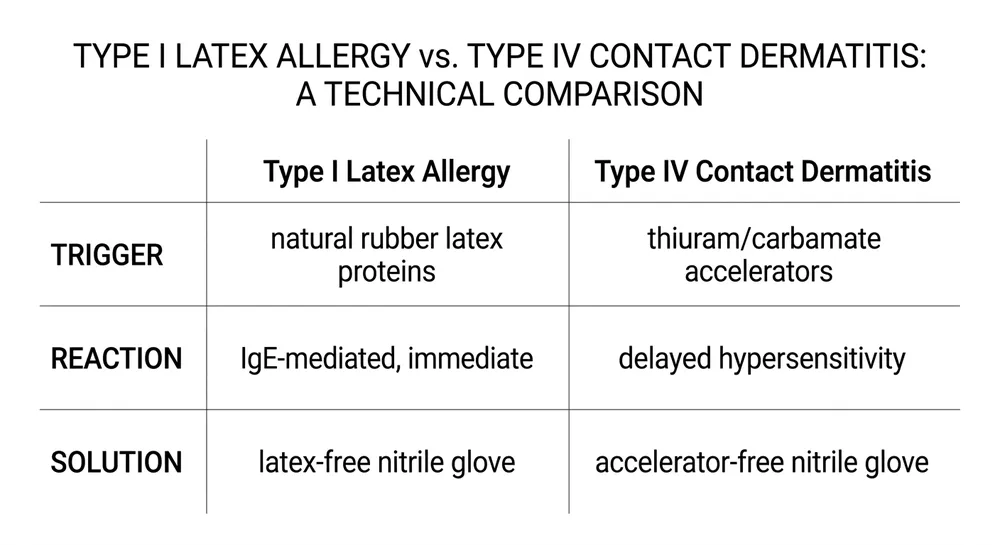
Here's the short version before we go deeper: latex-free nitrile addresses Type I (IgE-mediated) allergy to natural rubber proteins. Accelerator-free nitrile addresses Type IV (T-cell mediated) delayed hypersensitivity to vulcanization chemicals. A glove can be both, either, or — in the case of standard nitrile — neither concern addressed beyond the baseline.

Type I vs Type IV: The Allergy Mechanism Your Spec Sheet Needs to Reflect

The distinction matters because the two reactions have different triggers, different timelines, and different regulatory responses.

Type I — IgE-mediated latex allergy is an immediate hypersensitivity reaction to natural rubber latex proteins (primarily Hev b proteins). Symptoms appear within minutes: urticaria, rhinitis, in severe cases anaphylaxis. The affected population is workers with documented latex sensitization — historically a significant concern in healthcare settings before nitrile became the dominant glove material. Because all nitrile gloves contain zero natural rubber latex, any nitrile glove eliminates this risk. No special formulation required.

Type IV — T-cell mediated contact dermatitis is a delayed hypersensitivity reaction, typically appearing 24–72 hours after exposure. The trigger is not latex protein — it's the residual chemical accelerators left in the glove after vulcanization. The most common culprits are thiurams (thiuram disulfide, tetramethylthiuram) and carbamates (zinc diethyldithiocarbamate), which are standard components in conventional nitrile cure systems. A worker wearing standard nitrile gloves every day can develop progressive contact dermatitis from accelerator residue even though the gloves are fully latex-free.

This is the reaction that standard "latex-free" labeling does nothing to address — and it's the one that's increasingly showing up in occupational health reports, EU tender requirements, and hospital procurement specifications.

Diagram comparing Type I IgE-mediated latex allergy and Type IV T-cell mediated accelerator contact dermatitis mechanisms

What "Latex-Free" Actually Covers — and What It Doesn't

When a nitrile glove is labeled latex-free, the claim is accurate and verifiable. Nitrile (acrylonitrile-butadiene rubber) is synthesized without natural rubber latex. EN 455-3 testing for residual latex proteins will return non-detectable results. FDA 510(k) clearance for exam gloves requires latex protein content disclosure. These are real, testable standards.

What latex-free labeling does not address:

  • The presence or absence of thiuram accelerators
  • The presence or absence of carbamate accelerators
  • The total extractable chemical content beyond latex proteins
  • Compliance with EN ISO 21420, which covers chemical sensitizers more broadly

A supplier who lists "latex-free, powder-free" on a spec sheet without disclosing accelerator content is giving you half the allergy picture. That's not necessarily deceptive — most standard nitrile gloves are manufactured with conventional accelerator cure systems, and for the majority of end users, this is fine. The issue arises when you're supplying into environments where Type IV sensitivity is a known or probable risk: surgical and exam glove use in healthcare, dental assistant roles with prolonged daily wear, food processing lines with high-frequency glove changes.

For those markets, "latex-free" is a necessary condition, not a sufficient one.

What "Accelerator-Free" Actually Requires at the Manufacturing Level

This is where the specification gets technically meaningful — and where supplier claims need scrutiny.

Conventional nitrile vulcanization uses sulfur-based accelerators (thiurams, carbamates, dithiocarbamates) to cross-link the polymer chains during the dipping and curing process. These accelerators dramatically speed up cure time and improve glove mechanical properties. The trade-off is residual accelerator content in the finished glove — typically in the range of parts per million, but sufficient to trigger Type IV sensitization in susceptible individuals with repeated exposure.

Accelerator-free nitrile gloves eliminate this by using an alternative cure chemistry. The two main approaches are:

Sulfur-donor cure systems — replace conventional accelerators with sulfur-donor compounds that provide cross-linking without leaving thiuram or carbamate residues. This is the approach we use on our dedicated accelerator-free line at glovemfg. The cure chemistry is more demanding to control — temperature uniformity across the dipping line matters more, and compound viscosity needs tighter management — but the result is a glove that tests non-detectable for the accelerators covered under EN ISO 21420 and European hospital tender specifications.

Peroxide cure systems — use organic peroxides as the cross-linking agent instead of sulfur chemistry entirely. Peroxide-cured nitrile tends to have slightly different mechanical properties (typically higher tensile strength, different elongation profile) and is used in some high-end surgical glove formulations.

The critical point for procurement: "accelerator-free" is a manufacturing claim that requires documentation. A supplier cannot make a standard nitrile glove accelerator-free by washing it or adding a coating. The compound formulation and cure system must be different from the ground up. If a supplier offers you an accelerator-free SKU but cannot provide test reports showing non-detectable thiuram and carbamate levels, the claim is unverifiable.

(We run our accelerator-free compound on a physically separate line — not just a different batch on the same line. Cross-contamination from conventional accelerator residue in the dipping tanks is a real risk if you're sharing equipment, and it's something worth asking about explicitly when you evaluate suppliers.)

Side-by-Side: Latex-Free vs Accelerator-Free Nitrile

Dimension Latex-Free Nitrile (Standard) Accelerator-Free Nitrile
Allergy mechanism addressed Type I (IgE-mediated, latex proteins) Type IV (T-cell mediated, chemical accelerators)
Trigger substance eliminated Natural rubber latex proteins Thiurams, carbamates, dithiocarbamates
Reaction timeline Immediate (minutes) Delayed (24–72 hours)
Relevant standard EN 455-3 (latex protein content) EN ISO 21420, EN 455-3 combined
Applicable to all nitrile? Yes — all nitrile is latex-free by definition No — requires specific accelerator-free formulation
Cost premium vs standard nitrile None (baseline) Moderate — typically 15–30% over standard nitrile
Availability at container scale Universal Limited to manufacturers with dedicated lines
Documentation to request FDA 510(k) or CE/EN 455 certificate EN ISO 21420 test report + accelerator residue panel
European hospital tender compliance Necessary but not sufficient Increasingly required as standalone specification
Typical end-user populations General medical, industrial, food-contact Healthcare workers with documented Type IV sensitivity, surgical teams, dental
Side-by-side comparison matrix of latex-free and accelerator-free nitrile gloves showing allergy type, standards, cost, and documentation requirements

The Hidden Compliance Cost: What Happens When You Specify the Wrong Grade

The downstream cost of a misspecified glove order isn't the price difference between SKUs. It's the cost of a mid-contract switch.

A hospital system that specifies standard latex-free nitrile for a 12-month supply contract, then discovers three months in that several staff members are developing contact dermatitis consistent with Type IV accelerator sensitivity, faces a specific set of problems: occupational health investigations, potential workers' compensation exposure, an emergency re-specification process, and the cost of sourcing accelerator-free gloves on short notice — typically at spot pricing rather than contract pricing, and often from a different supplier than the original contract holder.

We've seen this play out with European hospital accounts. The pattern is consistent: the initial tender specifies "latex-free nitrile exam gloves" without an accelerator-free clause, the contract runs for a quarter, dermatitis cases surface in the occupational health log, and the procurement team is suddenly looking for an accelerator-free alternative mid-year. The re-sourcing cost — including the premium for short-notice container orders and the administrative overhead of a mid-contract supplier change — typically exceeds the cost difference between standard and accelerator-free gloves over the full contract term.

The smarter approach, particularly for healthcare and dental supply contracts, is to assess the end-user risk profile before the tender goes out. If the facility has any documented history of contact dermatitis in glove-wearing staff, or if the contract covers surgical or high-frequency exam use, the accelerator-free specification should be the default, not an upgrade.

For industrial and food-contact applications where glove wear is intermittent and Type IV sensitivity history is not documented, standard latex-free nitrile is the correct specification — and paying the accelerator-free premium is unnecessary cost.

Procurement Decision Guide: Matching Specification to End-User Risk

The decision isn't complicated once you have the right information. Here's how to work through it.

Step 1: Identify the end-user wear pattern. High-frequency, prolonged daily wear (surgical teams, dental assistants, exam glove use in clinical settings) carries higher Type IV sensitization risk than intermittent industrial use. The longer and more frequent the contact, the more relevant accelerator-free specification becomes.

Step 2: Check for documented sensitivity history. If the facility or workforce has any occupational health records of contact dermatitis attributed to glove use, accelerator-free is the correct specification regardless of wear frequency. This is not a precautionary upgrade — it's the clinically indicated grade.

Step 3: Assess the regulatory environment. European hospital tenders increasingly include explicit accelerator-free requirements, often citing EN ISO 21420 or referencing thiuram-free and carbamate-free as tender conditions. If you're supplying into EU healthcare procurement, check the tender language carefully — "latex-free" alone may not satisfy the allergy-safe specification.

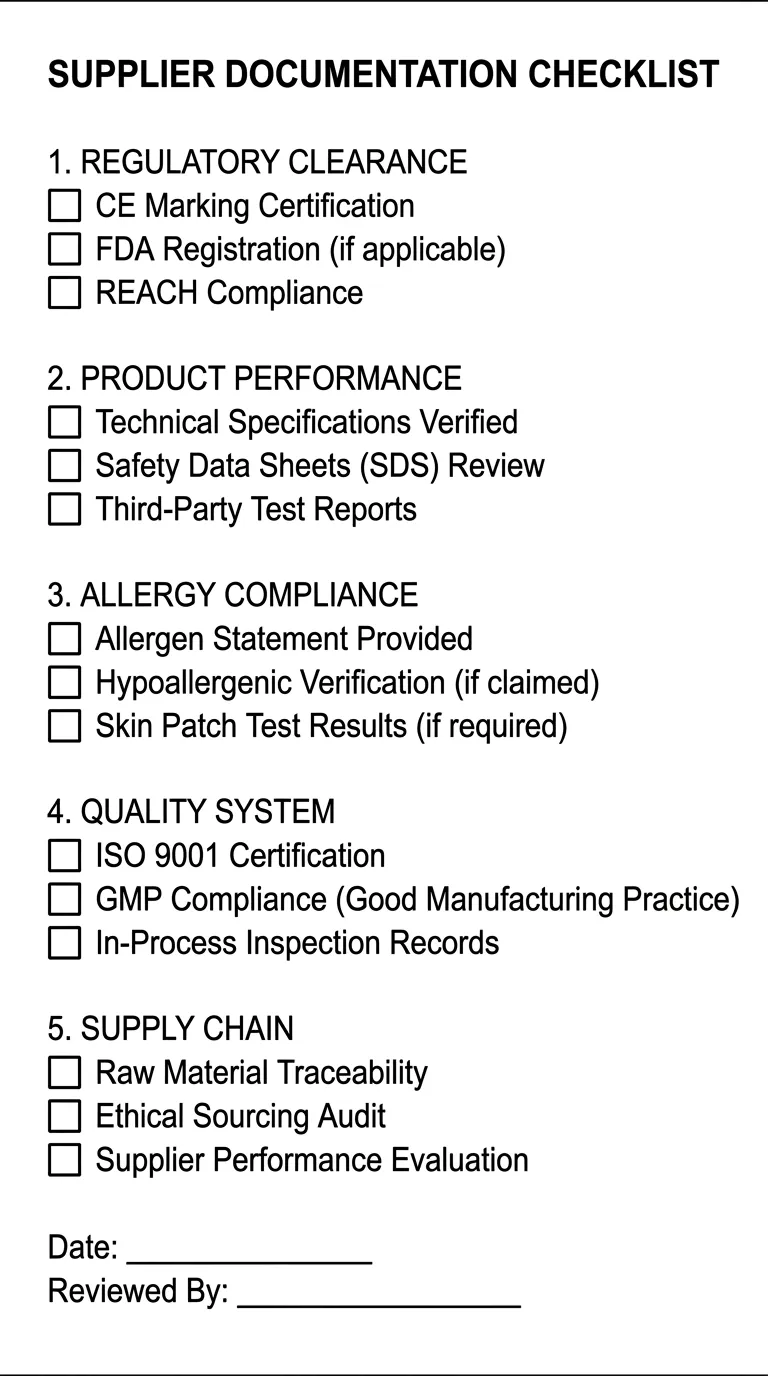
Step 4: Evaluate your supplier's documentation capability. Accelerator-free claims require test reports. Specifically: an extractable accelerator panel showing non-detectable thiuram and carbamate levels, ideally from an accredited third-party lab. If your supplier cannot produce this documentation, the claim is unverifiable and the specification is commercially meaningless.

Procurement decision tree for selecting standard latex-free vs accelerator-free nitrile gloves based on end-user risk profile

Application Scenarios: Which Specification Wins

Scenario 1: European Hospital Exam Glove Tender

A medical distributor is bidding on a 12-month supply contract for a regional hospital network in Germany. The tender specification references EN 455 compliance and includes a clause requiring gloves suitable for staff with documented contact dermatitis history.

Winner: Accelerator-free nitrile. The tender language effectively requires it. Standard latex-free nitrile satisfies EN 455-3 for latex protein content but does not address the accelerator sensitivity clause. Bidding standard nitrile risks disqualification or mid-contract replacement. The 15–30% cost premium over standard nitrile is absorbed into the contract pricing — and is far less than the cost of a mid-contract re-specification.

Scenario 2: US Industrial Safety Distributor, General Manufacturing Accounts

A safety products distributor supplies nitrile exam and industrial gloves to manufacturing facilities across the Midwest. End users are machine operators and assembly workers with no documented glove allergy history. Glove use is task-specific, not continuous daily wear.

Winner: Standard latex-free nitrile. The Type IV sensitization risk is low given intermittent use and no documented sensitivity history. The accelerator-free premium adds cost without addressing a documented risk. Standard latex-free nitrile with AQL 1.5 inspection and FDA 510(k) clearance is the correct specification for this account profile. Paying the accelerator-free premium here is margin erosion without clinical justification.

Scenario 3: Dental Supply Distributor, North American Market

A dental supply company is building a private-label nitrile glove line for dental practices. Dental assistants wear gloves for 6–8 hours daily. The company's existing accounts have flagged occasional staff complaints about hand irritation after extended wear.

Winner: Accelerator-free nitrile. The wear pattern (prolonged daily contact) and the existing irritation complaints are both indicators of probable Type IV sensitization risk. Switching to accelerator-free eliminates the most likely chemical trigger. For a private-label program, the accelerator-free specification also becomes a differentiator — dental practices are increasingly aware of this issue, and a supplier who can document accelerator-free compliance has a stronger value proposition than one who can only offer "latex-free."

Verifying Accelerator-Free Claims Before Your Container Ships

This is where most procurement processes fall short. The claim is easy to make; the documentation is what separates a verifiable specification from a marketing label.

What to request from any supplier claiming accelerator-free:

  1. Extractable accelerator test report — specifically covering thiuram disulfide, tetramethylthiuram monosulfide (TMTM), tetramethylthiuram disulfide (TMTD), zinc diethyldithiocarbamate (ZDEC), and zinc dibutyldithiocarbamate (ZDBC). Results should show non-detectable or below-threshold levels. Ask for the lab name and accreditation status.
  1. EN ISO 21420 compliance documentation — this standard covers chemical sensitizers in protective gloves and is the relevant European framework for accelerator-free claims in PPE procurement.
  1. Manufacturing process confirmation — ask whether the accelerator-free SKU is produced on a dedicated line or shares equipment with standard nitrile production. Shared equipment creates cross-contamination risk that can invalidate the accelerator-free claim even if the compound formulation is correct.
  1. Batch-level traceability — for healthcare contracts, request that the accelerator-free test report corresponds to the specific production batch in your order, not a generic product certification from a previous run.

At glovemfg, our accelerator-free Latex Free Blue Nitrile Gloves are produced on a dedicated line using a sulfur-donor cure system. The in-house compounding lab formulates the accelerator-free compound separately from our standard nitrile batches — this is what makes it possible to offer both grades from the same facility without subcontracting or relying on a third-party compounder. Test reports covering the accelerator residue panel are available with each order. If you're evaluating suppliers for an accelerator-free tender requirement, that documentation package is what you should be asking for as a baseline.

For a broader look at how allergy compliance intersects with blue nitrile glove specification, see our guide on latex-free blue nitrile gloves and allergy compliance.

What the Certifications Actually Cover

Certification language in glove procurement is frequently misread. Here's what the relevant standards actually address:

EN 455-3 — covers residual powder and chemical content in medical gloves, including latex protein levels. This is the standard that confirms a glove is latex-free in the clinical sense. It does not test for or set limits on accelerator content.

EN ISO 21420 — the European standard for protective gloves, covering chemical sensitizers including accelerators. This is the relevant standard for accelerator-free claims in PPE procurement. A glove that complies with EN ISO 21420 for chemical sensitizers has been tested against the accelerator compounds most associated with Type IV contact dermatitis.

ASTM D6319 — the US standard for nitrile exam gloves, covering physical performance (tensile strength, elongation, puncture resistance) and latex protein content. Like EN 455-3, it does not specifically address accelerator content. FDA 510(k) clearance references ASTM D6319 for exam gloves.

CE marking under EU MDR — medical device regulation compliance for exam and surgical gloves sold in Europe. CE marking requires EN 455 compliance but does not automatically require accelerator-free formulation unless the product is specifically labeled and tested as such.

The practical implication: a glove can carry CE marking, EN 455 compliance, and FDA 510(k) clearance and still contain conventional accelerator levels. These certifications confirm the glove is safe for general medical use — they don't confirm it's suitable for workers with documented Type IV sensitivity unless the accelerator-free specification is explicitly tested and documented separately.

(This is the gap that European hospital tenders are increasingly closing by adding explicit accelerator-free language to tender requirements — the existing certification framework doesn't automatically cover it.)

Cost and MOQ Reality at Container Scale

The accelerator-free premium is real but manageable at container scale. Here's how it typically breaks down.

Standard latex-free nitrile and accelerator-free nitrile share the same base polymer and most of the same manufacturing process. The cost difference comes from three sources: the alternative cure chemistry (sulfur-donor compounds cost more than conventional accelerators), tighter process control requirements on the dipping line, and lower production volume per SKU (accelerator-free runs are typically smaller than standard runs, which affects line efficiency).

At container scale — roughly 2,000 boxes per container for standard exam glove SKUs — the accelerator-free premium typically runs 15–30% over equivalent standard nitrile. The exact figure depends on glove thickness, size mix, and certification package required. For a healthcare distributor building a contract bid, this premium needs to be factored into the tender pricing from the start, not discovered after award.

MOQ for accelerator-free SKUs is generally higher than for standard nitrile because the dedicated line run needs to justify the compound changeover. At glovemfg, our standard MOQ for Blue Nitrile Gloves is one container (approximately 2,000 boxes) for standard SKUs. Accelerator-free SKUs follow the same container-scale MOQ — we don't require larger minimums for the accelerator-free grade, which is not always the case with manufacturers who subcontract their accelerator-free production.

For distributors building a mixed portfolio — standard nitrile for industrial accounts, accelerator-free for healthcare and dental — sourcing both grades from the same manufacturer simplifies the supplier relationship, consolidates the certification documentation, and reduces the logistics overhead of managing two separate supply chains.

Sourcing Checklist: What to Verify Before Placing an Accelerator-Free Order

Use this as your pre-order verification framework when evaluating suppliers for accelerator-free nitrile gloves:

  • [ ] Compound formulation confirmed — supplier has confirmed the cure system (sulfur-donor or peroxide) and can describe why it eliminates conventional accelerator residues
  • [ ] Dedicated production line — accelerator-free SKUs are not produced on shared equipment with standard nitrile
  • [ ] Extractable accelerator test report available — covers thiurams (TMTM, TMTD) and carbamates (ZDEC, ZDBC) at minimum; results show non-detectable or below-threshold levels
  • [ ] EN ISO 21420 compliance documentation — for European procurement; confirm the specific test scope matches your tender requirements
  • [ ] Batch traceability — test reports can be linked to specific production batches, not just product-level certifications
  • [ ] CE marking scope — confirm whether CE marking covers the accelerator-free claim specifically or only general EN 455 compliance
  • [ ] MOQ and lead time confirmed — accelerator-free runs may have different scheduling than standard production; confirm before committing to a contract timeline
  • [ ] Sample order available — request a pre-production sample with accompanying test report before committing to container volume

For a detailed guide on the accelerator-free medical nitrile gloves specification and what the manufacturing process looks like from the inside, that resource covers the formulation and QC side in more depth.

The Specification Decision, Summarized

Latex-free nitrile is the correct baseline for any application where natural rubber latex allergy is a concern — which, in practice, means all nitrile gloves already satisfy this requirement.

Accelerator-free nitrile is the correct specification when:

  • End users have documented Type IV contact dermatitis history attributed to glove use
  • The application involves prolonged daily wear (surgical, dental, high-frequency clinical exam use)
  • The procurement is for European healthcare tenders that explicitly require accelerator-free or EN ISO 21420 compliance
  • You're building a private-label program for healthcare or dental markets where allergy-safe differentiation has commercial value

The two specifications are not interchangeable, and "latex-free" does not imply "accelerator-free." If your current supplier's spec sheet lists latex-free without disclosing accelerator content, that's the first question to ask before your next container order.

If you're sourcing for a market where both grades are needed — standard nitrile for industrial accounts, accelerator-free for healthcare — request a quote with your target market, annual volume, and size mix. We'll confirm the correct SKU, the certification package that matches your tender or compliance requirements, and container pricing for both grades.

Blue Nitrile Cleaning Gloves for Food Service: FDA Food-Contact Compliance and Thickness Selection Guide

The question we hear most from food service distributors isn't "what's your price per case." It's "are these actually FDA food-contact approved, and how do I prove it to my customer?" That's the right question. A glove that looks compliant on a spec sheet but lacks the documentation trail will get pulled from a food service account the moment an auditor walks in.

This guide covers what FDA food-contact compliance actually means for nitrile gloves, why blue is a functional specification in food environments rather than a color preference, how to match thickness to task, and what documents you should be asking for before a container ships.

Blue nitrile cleaning gloves laid flat next to FDA compliance documentation for food-contact materials

What FDA 21 CFR 177.2600 actually requires from nitrile gloves

Most buyers have heard "FDA approved" used loosely. The specific regulation that governs rubber articles intended for repeated food contact is 21 CFR 177.2600 — it defines which elastomers, accelerators, and compounding ingredients are permitted in gloves that will touch food directly.

For nitrile gloves, this means the formulation itself must use only FDA-listed ingredients at permitted levels. It's not a glove-level certification you stamp on a box — it's a material compliance requirement that starts in the compounding lab. A manufacturer who doesn't control their own nitrile compound can't reliably certify 177.2600 compliance, because they don't fully know what's in the formulation they're buying from a third-party compounder.

We run our own compounding lab in Qingdao. Every batch of nitrile compound is formulated in-house, which means we can produce a full ingredient declaration against 177.2600 for any food-contact SKU. When a distributor's customer gets audited, that declaration is what keeps the account.

The practical checklist for 177.2600 compliance:

  • Elastomer type and grade must be listed under the regulation's permitted materials
  • Accelerators (typically zinc dibutyldithiocarbamate or similar) must be within permitted concentration limits
  • Plasticizers, antioxidants, and colorants must each appear on the FDA-permitted list
  • The finished glove must be powder-free (see below)

One thing buyers sometimes miss: 177.2600 compliance is a self-declaration by the manufacturer, not a third-party certification. What you're verifying is whether the manufacturer can actually back that declaration with formulation data — not just a checkbox on a product page.

Why powder-free is a hard requirement, not a preference

The FDA banned powdered gloves for food contact and medical use in January 2017 (21 CFR Parts 880, 884, and 895). This isn't a gray area. Powdered gloves — typically dusted with cornstarch as a donning lubricant — are prohibited in food-contact applications in the US market.

The contamination risk is direct: powder particles shed into food during handling. For food service operations running HACCP programs, a powdered glove is a documented foreign body hazard.

Every Blue Nitrile Cleaning Gloves we produce for food service accounts is powder-free by default. The donning performance comes from the chlorination process applied after stripping — the glove surface is treated to reduce tackiness without adding any particulate material.

When reviewing a supplier's spec sheet, verify two things specifically:

  1. "Powder-free" must appear as a stated specification, not just implied
  2. The chlorination or polymer coating method should be documented — some low-cost suppliers skip the post-treatment step and compensate with light powder dusting that doesn't appear on the label

(We've seen containers arrive at US ports with gloves labeled "powder-free" that failed the shake test. The documentation gap was that the supplier had no process record for the chlorination step — just a label claim.)

Blue color as a functional food safety specification

Blue is the standard color for food-contact gloves in HACCP-compliant food service operations, and the reason is practical: blue is not a naturally occurring color in most food ingredients or food preparation surfaces. A torn glove fragment, a fingertip piece, or a cuff section that falls into a food product is immediately visible against white, beige, cream, or light-colored food backgrounds.

This is a foreign body detection protocol, not an aesthetic preference. Many food service chains and institutional kitchens specify blue gloves in their HACCP plans precisely because the color contrast supports visual inspection at the line level.

The color-coding function extends further. In facilities that use HACCP zone color-coding — blue for ready-to-eat, red for raw meat, yellow for poultry — blue nitrile fits the ready-to-eat zone standard used by most North American and European food safety programs. For more on how color-coding works across food service applications, see our article on blue nitrile gloves color coding.

For distributors supplying food service chains, this means blue isn't interchangeable with clear or black for this segment. A buyer who substitutes a clear or black glove into a blue-specified HACCP plan creates a compliance gap for their customer. Blue is the SKU that protects the account.

Thickness selection for food service tasks

Thickness is where most spec sheets are vague and most sourcing mistakes happen. "Food service nitrile glove" covers tasks with very different mechanical demands — light prep work, general cleaning, and heavy-duty chemical sanitation are not the same application, and they don't need the same glove.

The mil rating (1 mil = 0.0254mm) is the standard thickness measure. Here's how we map thickness to food service task type:

Task category Recommended thickness Typical mil rating Notes
Light food prep, short-duration handling Thin 3 mil (0.076mm) High tactile sensitivity; not for chemical exposure
General cleaning, dishwashing, surface sanitation Standard 4 mil (0.10mm) Most common food service SKU; balances dexterity and durability
Heavy-duty chemical cleaning, degreaser contact Thick 6 mil (0.15mm) Required when gloves contact concentrated sanitizers or degreasers
Extended-wear prep, high-abrasion tasks Thick 6 mil (0.15mm) Reduces glove change frequency; better puncture resistance
Chart mapping nitrile glove thickness in mil to food service task categories from light prep to heavy chemical cleaning

A few things worth knowing about how thickness interacts with compliance:

The 4 mil standard weight is the most common food service SKU for a reason — it passes ASTM D6319 tensile and elongation requirements comfortably while maintaining enough dexterity for prep work. At 3 mil, you're at the lower edge of ASTM D6319 compliance; the glove works for light tasks but won't hold up to repeated chemical exposure or extended wear.

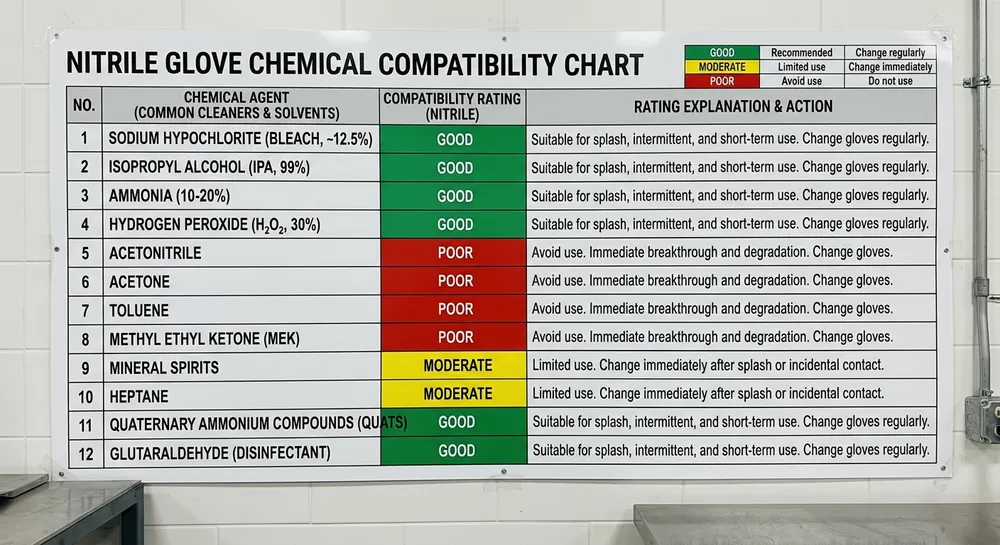
At 6 mil, the glove is rated for chemical resistance applications. If your customer's kitchen uses quaternary ammonium sanitizers, chlorine-based cleaners, or commercial degreasers at working concentration, 6 mil is the specification that keeps the glove intact through a full cleaning cycle.

Our 8 automated dipping lines hold thickness tolerance to ±0.02mm across the palm and fingertip zones. That matters for food service accounts because a glove that measures 4 mil at the palm but 2.8 mil at the fingertip — where most punctures happen — isn't actually a 4 mil glove. We run 100% AQL 1.5 outgoing inspection with online pinhole detection on every production run, so thickness drift and micro-perforations get caught before the container loads.

(AQL 1.5 means a maximum acceptable defect rate of 1.5 per 100 units at the inspection sample size. The industry default for many food service suppliers is AQL 2.5 — that's a 67% higher defect tolerance. For a food service chain running 10,000 pairs per week, the difference is measurable in glove failures per shift.)

Certification documents to require before placing a bulk order

This is where food service sourcing goes wrong most often. A supplier sends a sample that passes your internal check, you place a container order, and the documentation package that arrives with the shipment doesn't support what your customer's auditor needs to see.

The documents that matter for food-contact nitrile gloves:

FDA 510(k) clearance — glovemfg holds FDA 510(k) clearance, which covers the glove's safety and performance claims for the US market. For food service distributors selling into regulated institutional accounts (hospitals, school districts, government food service), 510(k) is often a procurement requirement. Ask for the clearance number and verify it against the FDA database.

ASTM D6319 test report — this is the standard for nitrile examination gloves covering tensile strength, elongation at break, and AQL. A current test report (within 12 months) from an accredited third-party lab confirms the glove meets the mechanical performance standard. Lot-specific reports are better than generic product-level reports.

21 CFR 177.2600 food-contact declaration — a written declaration from the manufacturer confirming the formulation complies with the regulation, ideally with the ingredient list attached. This is what your customer's food safety auditor will ask for.

AQL inspection records — lot-level inspection records showing the AQL standard applied, sample size, and acceptance/rejection result. These are your traceability documents if a quality issue surfaces after delivery.

Lot traceability — each carton should carry a lot number that traces back to a specific production run, dipping line, and compound batch. Without this, a quality issue in the field can't be isolated to a specific production window.

We provide all five document types as standard for food-contact orders. The 510(k) clearance number is on file; ASTM D6319 reports are updated annually through a third-party lab; and lot traceability runs from the compound batch through the finished carton label.

For distributors building a supplier qualification file, these five documents are the minimum. Some institutional buyers — particularly healthcare-adjacent food service accounts — will also ask for a Certificate of Conformance per shipment. We issue those on request.

Sourcing at container scale: what changes for food service accounts

Single-SKU food service accounts are straightforward. Multi-site food service chains — regional restaurant groups, contract food service operators, institutional distributors — have a different problem: they need formulation consistency across multiple container orders placed over 12 months, because their HACCP documentation references a specific glove specification.

If the compound formulation shifts between your Q1 and Q3 orders, the glove that passed your customer's initial qualification may not match what arrives in the second container. This is a real problem with suppliers who buy compound from the spot market rather than controlling their own formulation.

Our in-house compounding lab locks the formulation for each approved SKU. When you place a repeat order against the same item number, the compound batch is produced from the same formula. That's what makes multi-site procurement manageable — your customer's food safety team qualified one specification, and that's what they keep receiving.

Standard MOQ for food-contact blue nitrile is one container (approximately 2,000 boxes). OEM and private-label options are available for distributors who want to build a house brand in the food service segment — we can produce to your label with the full compliance documentation package under your brand name.

For Blue Nitrile Gloves in food service grades, the typical container configuration is 100 gloves per box, 10 boxes per case, 200 cases per container — but we can adjust box count and case configuration to match your customer's stocking unit.

FAQ

Are blue nitrile gloves FDA food-contact approved?

FDA food-contact compliance for nitrile gloves is governed by 21 CFR 177.2600, which sets permitted ingredients for rubber articles in repeated food contact. A glove is compliant when its formulation uses only FDA-listed materials at permitted levels and is powder-free. The manufacturer must be able to provide a written declaration and ingredient data to support the claim — "FDA approved" as a label phrase without documentation behind it is not sufficient for institutional food service accounts.

What thickness nitrile glove is right for food service?

4 mil is the standard for general food service cleaning and prep. Use 3 mil only for short-duration light prep where tactile sensitivity matters more than durability. Specify 6 mil when gloves will contact concentrated chemical sanitizers, degreasers, or when extended wear is required. The 4 mil weight covers roughly 80% of food service applications.

Why are powdered gloves banned for food contact?

The FDA banned powdered gloves in January 2017 under 21 CFR Parts 880, 884, and 895. Cornstarch powder used as a donning lubricant sheds particulates that contaminate food and create documented foreign body hazards in HACCP-managed operations. All food-contact nitrile gloves for the US market must be powder-free.

What is AQL 1.5 and why does it matter for food service?

AQL (Acceptable Quality Level) 1.5 means the outgoing inspection accepts a maximum defect rate of 1.5 per 100 units at the standard sample size. The common industry default is AQL 2.5, which tolerates 67% more defects. For food service operations running high glove volumes, the difference shows up as glove failures per shift — pinhole defects that allow cross-contamination are the specific failure mode that AQL inspection is designed to catch.

What documents should I request from a nitrile glove supplier for food service accounts?

At minimum: FDA 510(k) clearance number (verifiable in the FDA database), ASTM D6319 test report from an accredited lab, 21 CFR 177.2600 food-contact declaration with ingredient data, AQL inspection records per lot, and lot traceability from compound batch to finished carton. For healthcare-adjacent food service accounts, add a per-shipment Certificate of Conformance.

Can I order private-label blue nitrile gloves with food-contact compliance documentation?

Yes. We produce OEM and private-label food-contact blue nitrile under buyer brand names with the full compliance documentation package — 510(k) reference, ASTM D6319 reports, and 177.2600 declaration — issued under the finished product specification. MOQ is one container for standard SKUs. Request a quote with your target thickness, box configuration, and certification requirements.

How Color-Coding with Blue Nitrile Gloves Reduces Cross-Contamination Risk in Food and Medical Facilities

Color-coding gloves sounds simple. Assign a color to a zone, train the staff, done. What actually happens in most facilities is something different: the color scheme exists on paper, the gloves arrive in whatever shade the last supplier shipped, and the person doing the audit finds three different blues in three different departments — none of them matching the protocol document.

That gap between the written procedure and what's actually on the line is where cross-contamination risk lives. And in food processing or clinical environments, that gap has real consequences: failed inspections, product recalls, HAI incidents, and the liability that follows.

This guide covers how to build a color-coding system that holds — from protocol design through sourcing decisions to the inspection checkpoints that tell you whether it's actually working.

Color-coded nitrile glove zone assignment diagram for food processing and medical facility departments

Why the Color Scheme Fails Before Anyone Puts on a Glove

The failure usually starts at the procurement stage, not the training stage.

A facility writes a protocol: blue for ready-to-eat food contact, green for raw protein handling, yellow for sanitation, red for waste. The protocol goes to the safety manager. The safety manager sends a purchase order to whoever has the best price that week. The gloves arrive — and the "blue" from Supplier A is a deep navy, the "blue" from Supplier B is a pale powder blue, and the "blue" from Supplier C is closer to teal. Staff can't reliably distinguish them under processing floor lighting. The color-coding system is technically in place and functionally useless.

We see this pattern regularly when buyers come to us after a failed audit. The protocol was sound. The sourcing wasn't tied to the protocol.

Three things break color-coding systems before training ever becomes the issue:

  • Inconsistent color across supplier batches. If your glove supplier doesn't hold color to a defined standard across production runs, your protocol degrades every time you reorder.
  • Inadequate contrast under facility lighting. A color that reads clearly under office fluorescents may be ambiguous under the yellow-tinted lighting common in cold storage or processing areas.
  • No specification lock between procurement and operations. The safety team defines the protocol; procurement buys on price. Without a written color spec tied to the purchase order, the two functions work against each other.

Blue nitrile gloves are the most common choice for clean-zone or ready-to-eat food contact applications for a specific reason: blue has no natural analog in most food environments. A blue fragment in a food product is immediately visible — which is why blue is the default color for food-contact PPE in HACCP-compliant facilities. That visibility advantage disappears if your "blue" varies between orders.

Building a Protocol That Survives Contact with Reality

A color-coding protocol needs four components to hold up in practice.

1. Zone definition with contamination logic, not just geography

Don't assign colors by room. Assign them by contamination risk level and transfer pathway. The question to answer for each zone: what contaminant, if transferred to another zone, creates the highest consequence? That answer determines which zones need the hardest color boundaries.

In a food processing facility, the critical boundary is typically between raw protein handling and ready-to-eat contact surfaces. In a clinical setting, it's between patient contact zones and sterile preparation areas. Map the transfer pathways first, then assign colors to create maximum visual contrast at those boundaries.

2. A color specification, not just a color name

"Blue" is not a specification. For sourcing purposes, define the color with enough precision that a supplier can match it consistently across orders. Pantone references work for this — most glove manufacturers with in-house compounding capability can match to a Pantone target. (We use Pantone references for all custom color orders; it's the only way to hold consistency across production runs separated by months.)

For standard blue nitrile gloves, the typical food-contact blue falls in the Pantone 2935–2945 range — a mid-to-deep blue with enough saturation to read clearly under processing floor lighting. Pale blues and teals are harder to distinguish from each other and from some green variants under certain lighting conditions.

3. A single-supplier or approved-supplier policy for each color

Color consistency requires process consistency. If you're sourcing the same color from multiple suppliers simultaneously, you will get variation. Either designate one supplier per color in your protocol, or require that all approved suppliers match the same Pantone reference and provide color confirmation with each shipment.

4. A retraining trigger tied to supplier changes

Every time the glove supplier changes — even for the same color — run a visual comparison before the new stock goes to the floor. Put a glove from the new batch next to a glove from the previous batch under your facility's actual lighting. If staff can't reliably distinguish them from adjacent colors in your protocol, the new batch doesn't go into rotation until the issue is resolved.

Step-by-step checklist for implementing a nitrile glove color-coding protocol in food or medical facilities

The Sourcing Spec That Protects Your Protocol

Once the protocol is defined, the sourcing decision determines whether it holds. These are the specification parameters that matter for color-coded glove programs.

Color consistency across production runs

Ask your supplier directly: how do you control color consistency between batches? The answer tells you a lot. A supplier with in-house compounding capability controls the colorant concentration at the compound mixing stage — that's where color is set, not at the dipping stage. A supplier buying pre-mixed compound from a third party has less control over batch-to-batch color variation.

We mix our own nitrile compound, which means we control colorant loading directly. When a buyer specifies a Pantone target, we match it at the compound stage and hold it there. For repeat orders, we keep the formulation record so the color doesn't drift between your first container and your fifth.

Thickness and AQL standard

Color-coding is a contamination control tool. It only works if the gloves themselves don't fail during use. A glove that tears during food handling or patient contact defeats the purpose of the color system — the contamination event happens regardless of what color the glove was.

For food processing applications, specify a minimum palm thickness of 0.10mm with fingertip reinforcement if your application involves sharp edges or bone contact. For clinical examination use, 0.08–0.10mm is standard, but verify that the supplier's AQL standard is 1.5, not 2.5. The difference: at AQL 1.5, the acceptable defect rate is roughly half that of AQL 2.5. In a high-volume clinical environment, that difference shows up in glove failure rates over time.

Powder-free specification

For both food contact and medical applications, powder-free is non-negotiable. Cornstarch powder from powdered gloves contaminates food products and triggers allergic responses in sensitized patients. Any color-coding program for food or medical use should specify powder-free as a baseline requirement, not an option.

Certification coverage

For food contact: verify EN 455 or ASTM D6319 compliance depending on your market. For medical examination use in North America, FDA 510(k) clearance is the relevant credential. For European medical procurement, CE marking under EN 455 is required. These aren't interchangeable — a glove with FDA 510(k) clearance isn't automatically CE-marked, and vice versa.

Our Blue Nitrile Gloves carry ISO 9001:2015, CE, EN 455, ASTM D6319, and FDA 510(k) — the full stack for both North American and European distribution. If your buyers operate across both markets, that matters for your compliance documentation.

Common Implementation Failures and How to Prevent Them

These are the failure modes we hear about most often from buyers who've already run a color-coding program and found it breaking down.

Failure: Staff reuse gloves across zones

This is a training and enforcement issue, but it's also a glove economics issue. If gloves are rationed or staff feel pressure to conserve them, they'll carry a glove from one zone into another rather than change. The fix isn't just retraining — it's ensuring adequate glove supply at every zone transition point. Dispensers at zone boundaries, not just at the start of a shift, reduce the friction of changing gloves.

Failure: Color ambiguity under processing conditions

Wet gloves, gloves covered in product residue, and gloves viewed under non-standard lighting all reduce color discrimination. Test your color scheme under actual working conditions before finalizing it. Put gloved hands next to each other under your facility's lighting, with the gloves wet and with product residue present. If the colors are ambiguous in those conditions, they're ambiguous when it matters.

Failure: Protocol not reflected in purchase orders

The safety manager writes the protocol. Procurement buys on price. The gloves that arrive are technically "blue" but don't match the protocol's color. This is a process gap, not a supplier gap. The fix: the color specification (including Pantone reference or approved supplier list) must be written into the purchase order template, not just the safety manual.

Failure: No incoming inspection for color

Most facilities inspect incoming gloves for quantity and packaging condition. Few inspect for color match against the protocol standard. Add a simple visual check to your incoming inspection: compare a glove from each new shipment against a reference sample from the previous approved batch. Flag any shipment where the color is visibly different before it goes to the floor.

Failure: Single-color programs in multi-hazard environments

Some facilities implement blue gloves facility-wide and call it a color-coding program. That's not color-coding — that's just a glove program. Color-coding requires at least two colors with a defined boundary between them. If your facility has more than one contamination risk category (and most do), a single-color program doesn't address the cross-contamination pathway.

Diagram showing five common failure modes in nitrile glove color-coding programs with prevention notes

Validating That the System Is Working

A color-coding program that isn't audited isn't a program — it's a document. These are the practical checkpoints that tell you whether the system is functioning.

Monthly color audit

Pull one glove from each color in active use. Compare them side by side under facility lighting. Confirm they match the reference samples in your protocol document. If any color has drifted — from a new supplier batch, a substitution, or a purchasing error — catch it here before it becomes an audit finding.

Zone observation check

During a normal shift, observe zone transitions. Are staff changing gloves at the designated transition points? Are the correct colors present at each zone? This doesn't require a formal audit — a 15-minute walkthrough by a supervisor covers it. Document what you observe.

Glove failure log

Track glove tears, punctures, and integrity failures by zone and by glove lot. If a specific lot shows elevated failure rates, pull it from rotation and notify your supplier. A color-coding program built on gloves that fail during use is providing false assurance — the color is correct but the barrier isn't intact.

Supplier batch documentation

For each incoming shipment, retain the lot number, production date, and any test reports provided by the supplier. If a contamination event occurs, you need to be able to trace which glove lot was in use in which zone on which date. This is standard HACCP documentation practice, but it's often not applied to gloves specifically.

Annual protocol review

Facility layouts change. Processes change. Staff turn over. Review the color-coding protocol annually against the current facility map and contamination risk assessment. A protocol written for a facility configuration that no longer exists is worse than no protocol — it creates false confidence.

Upstream Control: What Has to Be Right Before the Gloves Reach Your Facility

The most common sourcing mistake in color-coded glove programs is treating color as a cosmetic specification. It isn't. Color consistency is a process control output — it reflects whether the manufacturer controls their compound formulation tightly enough to hold a target across production runs.

When evaluating suppliers for a color-coded program, ask for batch-to-batch color consistency data. A supplier who can show you color measurements (L\a\b\* values or Pantone delta-E readings) across multiple production lots is demonstrating process control. A supplier who says "we'll match your sample" without being able to show historical consistency data is telling you they don't measure it.

The same logic applies to thickness. A supplier who holds 0.10mm palm thickness on the sample shipment but drifts to 0.08mm on the third container isn't holding spec — they're holding the sample. Ask for production lot test reports, not just pre-shipment sample results.

For buyers building a color-coded program across multiple SKUs (different colors for different zones), sourcing all colors from a single manufacturer simplifies this considerably. One supplier relationship, one set of certification documents, one incoming inspection protocol. The color consistency question becomes: does this manufacturer hold color across their full product range, not just within a single SKU?

We supply multi-color programs to distributors who service food processing and healthcare accounts. The typical setup is two to four colors from our standard range, all produced on the same lines with the same compound base, differentiated only by colorant. That means the thickness, AQL standard, and certification coverage are identical across colors — your protocol doesn't have to account for different glove performance characteristics by zone.

If your program requires a color outside our standard range, custom color matching is available from our in-house compounding lab. MOQ for custom color runs starts at one 40HQ container. For buyers building a private-label color-coded program, we can produce each color under your brand with matched Pantone references and consistent lot documentation. Request a quote with your color requirements and we'll confirm feasibility and lead time.

Practical Recommendation

A functional color-coding program has three dependencies: a protocol that maps colors to contamination risk (not just geography), a sourcing spec that locks color consistency into the purchase order, and an audit routine that catches drift before it becomes a compliance failure.

The protocol work is yours. The sourcing side is where we can help — consistent color across production runs, full certification coverage for food and medical applications, and the documentation trail your QC team needs for HACCP compliance.

If you're building or rebuilding a color-coded glove program and want to discuss specifications, send your zone requirements and volume to our team. We'll recommend the right SKU configuration and provide reference samples for your color validation before you commit to a container order.

Blue Nitrile Glove Suppliers for UK Importers: Factory-Direct Sourcing, EN 455 Compliance, and Container Pricing Review

The UK market for blue nitrile gloves runs through a layered supply chain that most importers never fully see. At the front end, you have domestic distributors and PPE wholesalers offering next-day delivery and familiar account terms. Behind them — usually two or three steps removed — are the factories in China, Malaysia, and Thailand that actually make the product. That distance between buyer and manufacturer is where pricing opacity, spec inconsistency, and compliance uncertainty tend to accumulate.

This article maps the current supplier landscape for UK importers sourcing blue nitrile gloves at container scale. It covers what EN 455 compliance actually requires from your supplier's documentation, how post-Brexit UKCA/CE marking affects your import paperwork, and what separates a factory worth dealing with directly from one that will cost you a rejected container at Felixstowe.

The 10 suppliers profiled below represent the realistic range of options available to a UK importer today — from domestic PPE distributors with strong local logistics to factory-direct manufacturers with the certifications and capacity to supply at volume. The goal is not a ranked list. It is a sourcing framework that helps you decide which model fits your procurement situation.

Diagram showing the supply chain layers between UK importers and nitrile glove factories in Asia

Why UK Importers Struggle to Find Factory-Direct Blue Nitrile Glove Suppliers

The structural problem is not a shortage of suppliers — it is a shortage of visibility. Search for "blue nitrile gloves suppliers UK" and you will find pages of distributors, PPE wholesalers, and aggregator listings. Most of them are buying from the same three or four factories in Shandong or Selangor and reselling under their own brand or a private label. The factory name rarely appears on the product page.

This matters for two reasons. First, pricing. A domestic distributor buying at container rates and reselling in pallet quantities is adding 25–40% to the landed factory cost before you see a price. If you are buying 50,000 boxes a year, that margin compression is real money. Second, specification control. When you buy through a distributor, the spec sheet you receive reflects what the distributor ordered — not necessarily what the factory is capable of. If you need a specific thickness tolerance, an accelerator-free formulation, or a particular AQL level, you need to be talking to the factory directly, or at minimum to a supplier who can give you factory-level documentation.

The post-Brexit compliance picture has added another layer of friction. Before 2021, CE marking under EU Medical Device Regulation was the standard for medical-grade nitrile gloves entering the UK. Post-Brexit, the UK Conformity Assessed (UKCA) mark became the UK-specific requirement — but the transition timeline has been extended multiple times, and as of 2024, CE-marked products continue to be accepted in Great Britain under a recognition arrangement. The practical implication: your supplier needs to hold CE marking at minimum, and ideally should be able to provide UKCA documentation or confirm their CE certification is issued by a UK-approved body. Many distributors cannot tell you which notified body issued their supplier's CE certificate, let alone whether it qualifies under the UK's post-Brexit recognition rules.

What EN 455 Compliance Actually Requires from Your Supplier

EN 455 is the European standard for single-use medical examination gloves. It has four parts, and all four matter for medical procurement:

  • EN 455-1: Freedom from holes — AQL testing for pinholes using water-leak method
  • EN 455-2: Physical properties — tensile strength, elongation at break, thickness
  • EN 455-3: Biological evaluation — biocompatibility, residual powder levels, protein content
  • EN 455-4: Shelf life determination — accelerated ageing and real-time ageing protocols

When a supplier says their gloves are "EN 455 compliant," the question to ask is: which parts, tested by which notified body, and when was the certificate last renewed? A certificate issued in 2019 against an older version of the standard may not satisfy current NHS procurement requirements. EN 455-2 was updated in 2015 and EN 455-3 in 2015 as well — certificates predating those revisions are not current.

For UK medical and dental procurement, the practical checklist is:

Requirement What to verify
EN 455-1 AQL level for pinholes — AQL 1.5 is tighter than the standard's minimum
EN 455-2 Tensile strength ≥6N before ageing, ≥4N after; elongation ≥500%
EN 455-3 Powder-free confirmed; accelerator-free if NHS or dental use
EN 455-4 Shelf life ≥3 years with supporting ageing data
CE marking Notified body name and number on certificate
UKCA status Confirm CE body is UK-approved or UKCA certificate available

(We see a lot of certificates that pass EN 455-2 on tensile strength but have no post-ageing data attached. That gap matters if your buyer is storing product for 18 months before use.)

The accelerator-free requirement deserves specific attention for NHS and dental supply chains. Type IV latex allergy is well-documented, but accelerator chemicals used in nitrile vulcanisation — primarily thiurams and carbamates — are increasingly implicated in occupational contact dermatitis among healthcare workers. NHS procurement frameworks and dental practice groups are actively specifying accelerator-free gloves. A supplier without in-house compounding capability cannot reliably produce accelerator-free formulations — they are dependent on their raw material supplier's compound, which may change without notice.

EN 455 parts 1 through 4 compliance checklist for nitrile glove importers

Supplier Evaluation Criteria for UK Container Orders

Before reviewing specific suppliers, here is the evaluation framework that separates a reliable factory-direct source from a distributor with a factory tour photo on their website.

Certifications: CE (with notified body number), EN 455 parts 1–4, ISO 9001:2015. For US-parallel supply chains, FDA 510(k) and ASTM D6319 are additional signals of a factory operating to export-grade QC. A factory holding FDA 510(k) has been through a more rigorous documentation review than one with CE alone.

AQL level: The industry default for nitrile gloves is AQL 2.5 for pinholes. AQL 1.5 is a tighter standard — it means a smaller acceptable defect rate per batch. For medical and dental supply, AQL 1.5 outgoing inspection is the differentiator. Ask specifically: is AQL 1.5 applied at outgoing inspection, or only at incoming raw material? The answer tells you whether the factory is controlling quality at the point that protects your customer.

Capacity and line allocation: A factory running 4 lines at full capacity for domestic orders cannot reliably allocate line time to a new UK container account without displacing existing production. Ask for annual capacity figures and current utilisation. A factory with 1+ billion piece annual capacity and 8 lines has genuine scheduling flexibility. A factory with 200 million piece capacity and 4 lines is likely running at or near full utilisation.

Lead time with confirmed ship dates: The standard lead time for a container order from a Chinese factory is 25–35 days from order confirmation. What matters more than the headline number is whether the factory provides a confirmed ship date at order — not a range, not an estimate. Confirmed ship dates mean the factory has allocated line time before accepting your order.

MOQ and SKU flexibility: For UK importers building a product range, the ability to mix sizes within a container order (S/M/L/XL) without separate MOQ requirements per size is commercially important. A factory that requires 1 full container per size is effectively forcing you to overstock slow-moving sizes.

OEM and private label capability: If you are building a branded PPE range, the factory needs to handle custom box printing, logo placement, and colour-coded packaging. Ask for samples of existing OEM work, not just a yes/no answer.

10 Blue Nitrile Glove Suppliers Worth Evaluating for UK Importers

The suppliers below represent the realistic range of sourcing options for a UK importer. They are grouped by supplier model — domestic UK distributors, international trading companies, and factory-direct manufacturers — because the model determines what you can and cannot control in your supply chain.

UK-Based Distributors and PPE Wholesalers

1. Unigloves (UK) Website: unigloves.com Unigloves is one of the most established PPE brands in the UK market, with a dedicated blue nitrile range under their Pearl and Gold lines. They operate UK warehousing and offer next-day delivery on standard SKUs. Their gloves carry CE marking and EN 455 certification. For importers looking to white-label or buy at container scale directly, Unigloves operates as a brand rather than a factory — their manufacturing is outsourced to Asian production partners. Useful for urgent replenishment; less useful if you need factory-level specification control or OEM capability.

2. Polyco Healthline Website: polyco.com Polyco Healthline is a UK-headquartered PPE distributor with a broad nitrile glove range including their Finite and Bodyguards blue nitrile lines. They supply NHS trusts, food processing, and industrial accounts across the UK. Like Unigloves, they are a brand and distribution operation rather than a manufacturer. Strong on local stock depth and account management; limited on factory-direct pricing or custom specification work.

3. Supermax Healthcare (UK distribution) Website: supermaxhealthcare.com Supermax is a Malaysian manufacturer with a UK distribution presence. Their gloves carry CE, EN 455, and FDA certifications. As a manufacturer-owned distribution operation, they offer more factory-level documentation than a pure UK distributor — you can obtain batch-level test reports and traceability back to the production line. Lead times for non-stock items run longer than domestic distributors, but the certification depth is stronger.

4. Ansell (UK) Website: ansell.com Ansell is a global PPE manufacturer with a significant UK market presence. Their TouchNTuff and Micro-Touch nitrile lines are widely specified in healthcare and laboratory settings. Ansell operates at the premium end of the market — their pricing reflects brand positioning and global distribution infrastructure. For buyers who need a globally recognised brand name on the box, Ansell is a credible option. For buyers optimising landed cost on commodity-grade blue nitrile, the premium is hard to justify.

5. Shield Scientific Website: shieldscientific.com Shield Scientific supplies laboratory and cleanroom-grade nitrile gloves to UK research institutions, pharmaceutical manufacturers, and NHS laboratories. Their blue nitrile range is positioned at the technical end of the market — thicker gauges, tighter AQL, and cleanroom packaging options. Less relevant for standard medical examination or food-contact procurement; highly relevant if your buyer base includes pharmaceutical or life sciences accounts.

Comparison matrix of UK nitrile glove supplier models showing distributor versus factory-direct trade-offs

International Trading Companies and Sourcing Agents

6. Globus Group Website: globusgroup.co.uk Globus Group is a UK-based PPE company that sources and distributes nitrile gloves under their Bodyguards brand, with manufacturing partnerships in Asia. They have supplied NHS and local authority contracts and carry relevant UK compliance documentation. Their model sits between a pure distributor and a sourcing agent — they have more factory visibility than a typical UK wholesaler, but they are not a manufacturer. Useful for buyers who want UK-based account management with some factory-level documentation access.

7. Medline Industries (UK) Website: medline.com Medline is a US-headquartered medical supply company with UK operations. Their nitrile glove range covers medical examination, surgical, and industrial grades. For UK importers, Medline is primarily a supply channel rather than a factory-direct option — they source from multiple manufacturing partners and distribute under their own brand. Strong on compliance documentation for NHS procurement; less competitive on unit pricing for commodity-grade blue nitrile at container scale.

8. Rubberex (Malaysia) Website: rubberex.com Rubberex is a Malaysian nitrile glove manufacturer that sells directly to international importers including UK buyers. They hold CE, EN 455, and FDA certifications and offer OEM capability. As a manufacturer, they can provide factory-level documentation, batch test reports, and direct line allocation. Lead times from Malaysia to UK ports run 28–35 days. For UK importers comfortable with direct factory sourcing, Rubberex represents a credible Asian manufacturer alternative to Chinese supply.
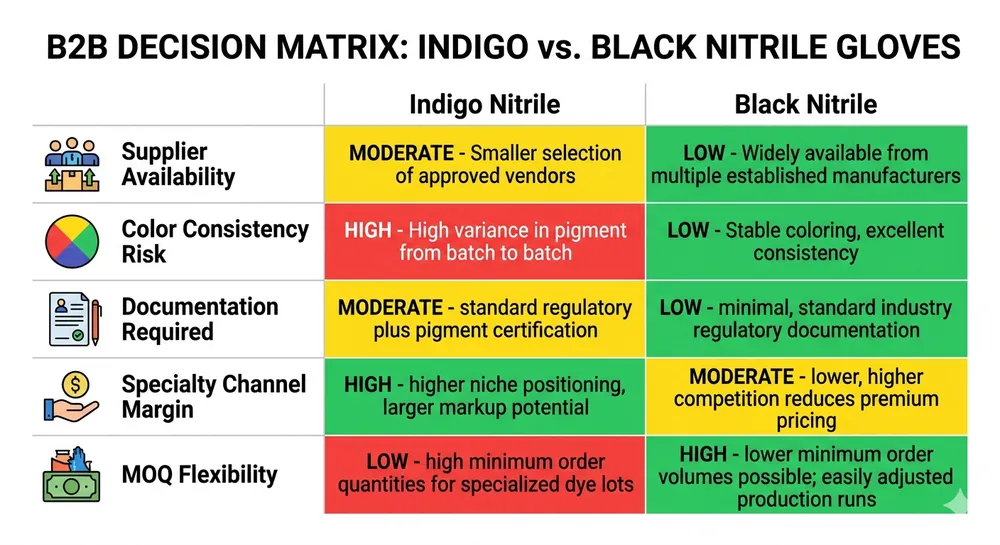
9. Top Glove (international export) Website: topglove.com Top Glove is the world's largest glove manufacturer by volume, headquartered in Malaysia. They supply blue nitrile gloves to distributors and importers globally, including UK accounts. Their scale means pricing is competitive on commodity SKUs, and their certification portfolio is comprehensive. The trade-off is MOQ — Top Glove's direct export programme is oriented toward large-volume buyers, and smaller UK importers typically access their product through regional distributors rather than direct factory accounts.

10. Hartalega (Malaysia) Website: hartalega.com.my Hartalega is a Malaysian manufacturer known for thin-wall nitrile technology and high-volume automated production. Their NEXT Generation Integrated Glove Manufacturing Complex runs highly automated lines with consistent thickness tolerances. They supply to medical and industrial markets globally. Like Top Glove, direct access for smaller UK importers is limited — their primary channel is through appointed distributors. For buyers with sufficient volume to qualify for a direct account, Hartalega's technical capabilities are strong.

The Cost of Convenience: What UK Distributor Pricing Actually Includes

Buying from a UK distributor is the right answer in specific situations: urgent orders under 50,000 boxes, emergency replenishment when a container is delayed, or when your customer needs next-day delivery and you cannot hold stock. Local convenience has genuine value, and it is worth paying for when the situation demands it.

The question is whether you are paying for convenience you actually need, or paying for it by default because the factory-direct alternative feels complicated.

A UK distributor buying blue nitrile gloves at container rates from a Chinese or Malaysian factory is typically paying £2.80–£3.80 per box (100 gloves, powder-free, standard medical grade) depending on thickness and certification level. By the time that product reaches you at pallet quantities, the price is typically £4.50–£6.50 per box, depending on the distributor's margin structure and your account volume. That spread — £1.70 to £2.70 per box — is the cost of the distribution layer.

At 100,000 boxes per year, that spread is £170,000–£270,000 in additional cost versus buying at or near factory-direct landed cost. At 50,000 boxes, it is £85,000–£135,000. These are not precise figures — they are representative of the margin structure in this supply chain, and your actual numbers will depend on specification, volume, and supplier. But the order of magnitude is real, and it is the reason serious importers at repeat volume eventually move toward factory-direct sourcing.

(The other cost that rarely appears in a distributor's price is specification drift. When a distributor switches their factory source — which happens more often than buyers realise — the product in the box may change without the SKU changing. Factory-direct sourcing eliminates that risk because you are specifying directly with the manufacturer.)

The landed cost calculation for a factory-direct container order from China to a UK port typically looks like this:

Cost component Approximate range
Factory price (FOB Qingdao) £2.60–£3.60 per box
Ocean freight (20ft container, China–Felixstowe) £1,800–£2,800 per container
UK import duty (nitrile gloves, HS 4015.19) 2.7% on CIF value
UK VAT (medical-grade, zero-rated) 0% for EN 455 medical examination gloves
Customs clearance and port handling £350–£600
Inland delivery to your warehouse £150–£400

A 20ft container holds approximately 2,000 boxes of standard blue nitrile gloves (100-count, powder-free). At a factory price of £3.00 per box and total logistics cost of approximately £0.25–£0.35 per box, your landed cost per box is in the £3.25–£3.35 range — versus £4.50–£6.50 from a UK distributor at pallet quantities. The margin you recover funds your next container order.

Factory-Direct Sourcing: What to Verify Before You Commit

The risk in factory-direct sourcing is not the factory — it is the gap between the sample and the production run. We have seen this pattern enough times to know where it happens: the sample is pulled from a controlled batch, inspected carefully, and shipped to the buyer. The production run is pulled from a standard batch under normal line conditions. If the factory's QC process does not apply the same inspection standard to outgoing production as it does to samples, the container that arrives at your warehouse will not match what you approved.

The verification steps that close this gap:

Pre-shipment inspection: Either your own inspector or a third-party inspection company (SGS, Bureau Veritas, Intertek) at the factory before the container is sealed. This is standard practice for serious importers and costs £300–£600 per inspection. It is cheap insurance against a rejected container.

AQL level confirmation in writing: Ask the factory to confirm in the purchase order that outgoing inspection is conducted at AQL 1.5 for pinholes and AQL 2.5 for physical properties. If they cannot confirm this in writing, they are not applying it consistently.

Batch test reports with shipment: Every container should be accompanied by batch-level test reports — not just a copy of the annual EN 455 certificate. Batch reports show the actual test results for the specific production run in your container.

Thickness measurement at multiple points: EN 455-2 specifies minimum thickness at the palm, finger, and cuff. Ask for the actual measured values from the production batch, not just "meets EN 455-2." A glove that measures 0.10mm at the palm and 0.07mm at the fingertip is technically within some interpretations of the standard but will fail at the thin point under stress.

Accelerator-free documentation: If you need accelerator-free gloves, ask for a chemical analysis report confirming the absence of thiurams, carbamates, and dithiocarbamates — not just a supplier declaration. The analysis should be from an accredited laboratory, not an internal factory test.

For more detail on how AQL standards work in practice for nitrile glove procurement, see our guide to AQL standards for nitrile gloves.

Pre-shipment verification checklist for factory-direct nitrile glove orders from China

How glovemfg Serves UK Container Importers

We have been manufacturing nitrile gloves in Qingdao since 2007. The facility runs 8 fully automated dipping lines across 18,000 square meters, with 220 people on the floor and annual output at 1.2 billion pieces. We do not make latex gloves, vinyl gloves, or a mixed PPE catalog — only nitrile, across medical, industrial, and food-contact grades, from one facility.

For UK importers specifically, the certifications that matter are CE marking and EN 455 parts 1–4. We hold both, along with ISO 9001:2015, ASTM D6319, and FDA 510(k). The FDA 510(k) clearance is worth noting because it requires a more rigorous documentation review than CE alone — it means our QC system has been audited against a standard that most UK-focused factories do not bother with. For buyers who need to demonstrate supplier due diligence to NHS procurement or hospital group purchasing organisations, that documentation depth matters.

Our outgoing inspection runs at AQL 1.5 for pinholes — tighter than the EN 455-1 minimum and tighter than the AQL 2.5 standard most factories apply. We run 100% online pinhole detection on every line using automated water-inflation testing, and AQL 1.5 sampling at outgoing QC before container sealing. The practical result: our rejection rate at destination ports is below 0.3% across all export markets. (We track this because our UK and European buyers report back when they have issues — and the absence of reports is the data point we care about most.)

The accelerator-free capability is a genuine differentiator for NHS and dental procurement. We run an in-house compounding lab, which means we formulate our own nitrile compound rather than buying pre-mixed compound from a raw material supplier. That control lets us produce accelerator-free formulations — confirmed by third-party chemical analysis, not just a supplier declaration — without changing our production line setup. Most factories cannot do this because they do not own their compound formulation.

On lead time: we confirm ship dates at order, not at production start. A UK container order placed today gets a confirmed loading date within 48 hours of order confirmation. Standard lead time is 25–35 days from order to vessel departure from Qingdao. We do not quote ranges and then revise them — if we cannot meet a date, we say so before you place the order.

MOQ for standard blue nitrile SKUs is 1 container (approximately 2,000 boxes). Size mixing within a container is supported without separate per-size MOQ requirements — you can split a container across S/M/L/XL based on your sales mix. OEM and private label are available on the same container MOQ, including custom box printing and colour-coded packaging.

For UK importers building a blue nitrile gloves wholesale programme, the economics of factory-direct sourcing at container scale are straightforward. The certification depth, AQL standard, and lead time reliability are the variables that determine whether the first container becomes a repeat programme.

You can review our full Blue Nitrile Gloves product range, including thickness grades, accelerator-free options, and OEM specifications.

Which Sourcing Route Fits Your Situation

The honest answer is that the right sourcing model depends on your order pattern, not on which supplier has the best marketing.

Buy from a UK distributor when:

  • You need delivery in under 5 days
  • Your order is under 20,000 boxes and you cannot hold container-scale stock
  • You are in an emergency replenishment situation
  • You are testing a new SKU before committing to a container order

Move to factory-direct when:

  • You are buying 50,000+ boxes per year on a predictable schedule
  • You need EN 455 batch-level documentation for NHS or hospital procurement
  • You need accelerator-free formulations that your current distributor cannot reliably source
  • You are building a private-label PPE range and need OEM capability
  • Your current distributor has had two or more specification inconsistency issues in the past 12 months

The hybrid model — buying from a UK distributor for urgent replenishment while running a factory-direct container programme for planned volume — is what most serious importers land on. The distributor relationship covers your emergency buffer; the factory-direct programme covers your margin.

The compliance question is worth addressing directly: post-Brexit UKCA/CE marking is not a reason to avoid factory-direct sourcing from China. A Chinese factory holding CE certification from a UK-approved notified body satisfies the current UK import requirements for medical examination gloves. The documentation you need is the CE certificate with the notified body number — your customs broker can confirm whether that body is on the UK's approved list. If you need UKCA marking specifically, ask the factory whether their CE certificate was issued by a UK-approved body, or whether they have initiated UKCA certification separately.

Frequently Asked Questions

What is the minimum order for a factory-direct container of blue nitrile gloves shipped to the UK? A standard 20ft container holds approximately 2,000 boxes of powder-free blue nitrile gloves (100-count). That is the practical MOQ for factory-direct sourcing from most Chinese manufacturers. Some factories require a full 40ft container (approximately 4,000 boxes) as their minimum — confirm this before requesting a price. At glovemfg, the MOQ is 1 × 20ft container with size mixing supported within that container.

Do EN 455-certified gloves from China meet UK import requirements post-Brexit? Yes, provided the CE certificate was issued by a notified body that is either UK-approved or recognised under the current UK-EU mutual recognition arrangement. The UK has extended acceptance of CE-marked medical devices for Great Britain through a transitional period. Your customs broker or a UK regulatory consultant can confirm the current status for your specific product category. The key document to request from your supplier is the CE certificate with the notified body name and number — not just a declaration of conformity.

What is the difference between AQL 1.5 and AQL 2.5 for nitrile gloves, and does it matter for UK procurement? AQL 2.5 means that in a standard sampling inspection, a batch with up to 2.5% defective units may be accepted. AQL 1.5 applies a tighter acceptance threshold — approximately 40% fewer defects accepted per batch. For NHS procurement and hospital group purchasing, AQL 1.5 is increasingly specified in tender documents. For industrial and food-contact procurement, AQL 2.5 is typically sufficient. The practical difference shows up at destination port inspection — a batch that passes AQL 2.5 at the factory may fail a buyer's incoming inspection at AQL 1.5. See our detailed guide to AQL standards for nitrile gloves for the full breakdown.

Are accelerator-free blue nitrile gloves available from factory-direct suppliers? Yes, but not from all factories. Accelerator-free formulations require the factory to control their own nitrile compound — factories that buy pre-mixed compound from a raw material supplier cannot reliably produce accelerator-free gloves because the compound formulation is outside their control. Ask specifically whether the factory runs an in-house compounding lab and whether they can provide third-party chemical analysis confirming the absence of thiurams and carbamates — not just a supplier declaration.

What documentation should I request for a UK container import of medical-grade blue nitrile gloves? At minimum: CE certificate with notified body number, EN 455 parts 1–4 test reports (batch-level, not just annual certificate), ISO 9001:2015 certificate, commercial invoice, packing list, bill of lading, and a certificate of origin. For NHS or hospital procurement, also request: AQL inspection report for the specific production batch, accelerator-free chemical analysis if applicable, and shelf life documentation per EN 455-4. Your freight forwarder will handle the customs entry, but the compliance documentation is your responsibility to collect from the supplier before the container ships.

To discuss container pricing, EN 455 documentation, or accelerator-free specifications for your UK import programme, Request Quote with your grade, size range, and annual volume — we will return a container-level price and confirmed lead time within 48 hours.