The container that gets held at the port isn't the one with the worst gloves. It's the one where nobody confirmed which AQL standard was actually used before it shipped.
We see this more than we should. A buyer specifies AQL 1.5 on the purchase order. The factory ships to AQL 2.5 — not out of malice, but because that's their default outgoing inspection level and nobody pushed back. The gloves look fine in photos. The sample passed. Then a downstream customer runs their own incoming inspection and the lot fails. Now you're dealing with a return, a credit dispute, and a gap in your supply chain.
The difference between AQL 1.5 and AQL 2.5 isn't a footnote in the spec sheet. For blue nitrile gloves going into medical, food-processing, or regulated industrial channels, it's the line between a container you can sell and one you can't.

What AQL Actually Measures — and What It Doesn't
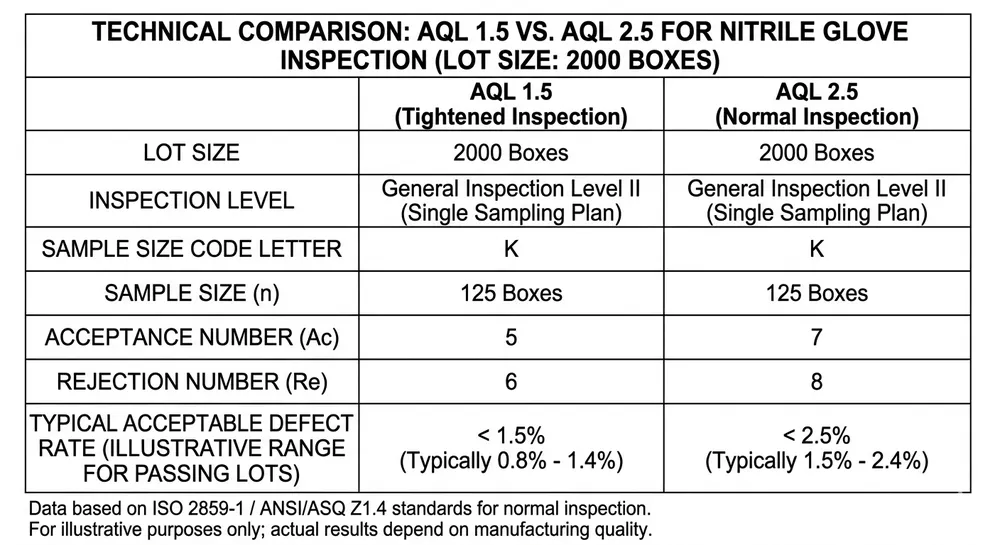
AQL stands for Acceptable Quality Limit. It defines the maximum percentage of defective units that is considered acceptable in a lot for the purposes of sampling inspection. Under ISO 2859-1 (the international standard most glove manufacturers reference), AQL 1.5 means the process average of defects should not exceed 1.5% — AQL 2.5 allows up to 2.5%.
That gap sounds small. In practice, it changes the math on every container you import.
For a lot of 10,000 boxes (a typical 20-foot container of examination gloves), the difference plays out in the inspection table:
| Parameter | AQL 1.5 | AQL 2.5 |
|---|---|---|
| Acceptable defect rate | ≤1.5% | ≤2.5% |
| Sample size (General Level II) | ~315 units | ~315 units |
| Acceptance number (Ac) | 7 | 14 |
| Rejection number (Re) | 8 | 15 |
| Defective units allowed per 10,000 boxes | ~150 | ~250 |
The sample size is the same. What changes is how many defects are allowed before the lot is rejected. At AQL 2.5, a factory can ship a lot with nearly double the defect count and still pass inspection.
(This is why "passed AQL inspection" on a test report means nothing without the AQL level specified. We always print the level on our outgoing QC reports — if a supplier's report doesn't show it, ask.)
The Defect Types That Actually Trigger Port Rejections
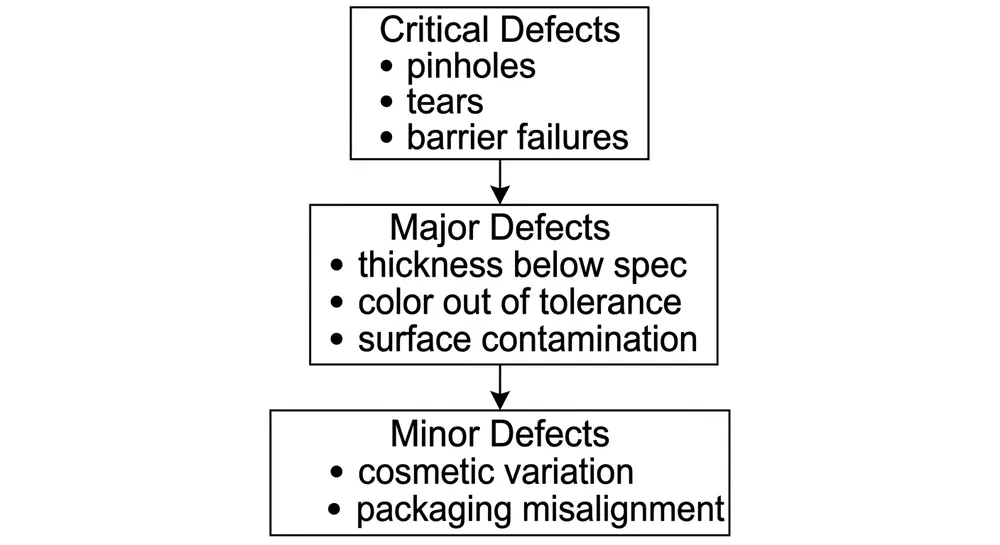
Not all defects are equal under AQL sampling. The standard classifies defects into three categories: critical, major, and minor. For nitrile examination gloves, the breakdown typically looks like this:
Critical defects — pinholes, tears, complete seal failures. These are tested separately, often at AQL 1.5 or tighter regardless of the overall lot AQL, because a single pinhole in a medical glove is a barrier failure.
Major defects — thickness below specification, color inconsistency outside tolerance, rolled cuffs that don't unroll cleanly, surface contamination visible to the naked eye. These are the defects most commonly cited in port rejection reports.
Minor defects — cosmetic issues that don't affect function: slight color variation within tolerance, minor surface texture inconsistency, packaging label misalignment.
When a buyer specifies AQL 2.5 for major defects, they're accepting that up to 2.5% of gloves in the lot may have a major defect and the lot still ships. For a distributor supplying hospitals or food processors, that's a problem — because your downstream customer's incoming inspection may be running at AQL 1.5 or tighter.
The rejection doesn't happen at the factory. It happens at your customer's dock.
How the Inspection Is Actually Run on the Line
Understanding the standard is one thing. Knowing how it gets executed at the factory level is where sourcing decisions get made or broken.
At our facility, outgoing inspection on blue nitrile gloves runs at AQL 1.5 as the default — not AQL 2.5. That's a deliberate choice, not a marketing claim. We supply into North American and European medical channels where downstream customers run their own incoming inspection, often at AQL 1.5. If we shipped to AQL 2.5 and our buyers' customers inspected at AQL 1.5, we'd be generating returns. We've structured our QC to eliminate that gap before the container leaves Qingdao.
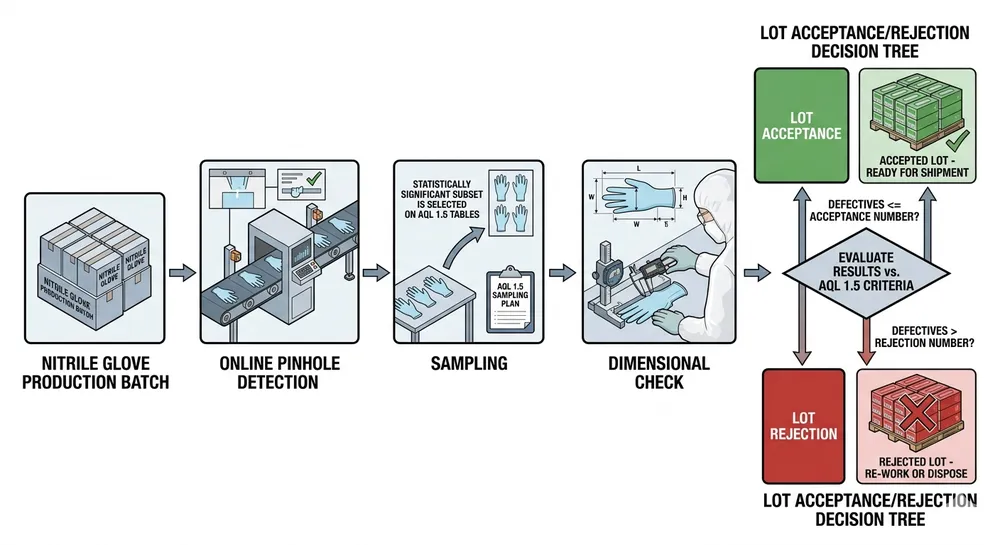
The inspection process on our lines works in layers:
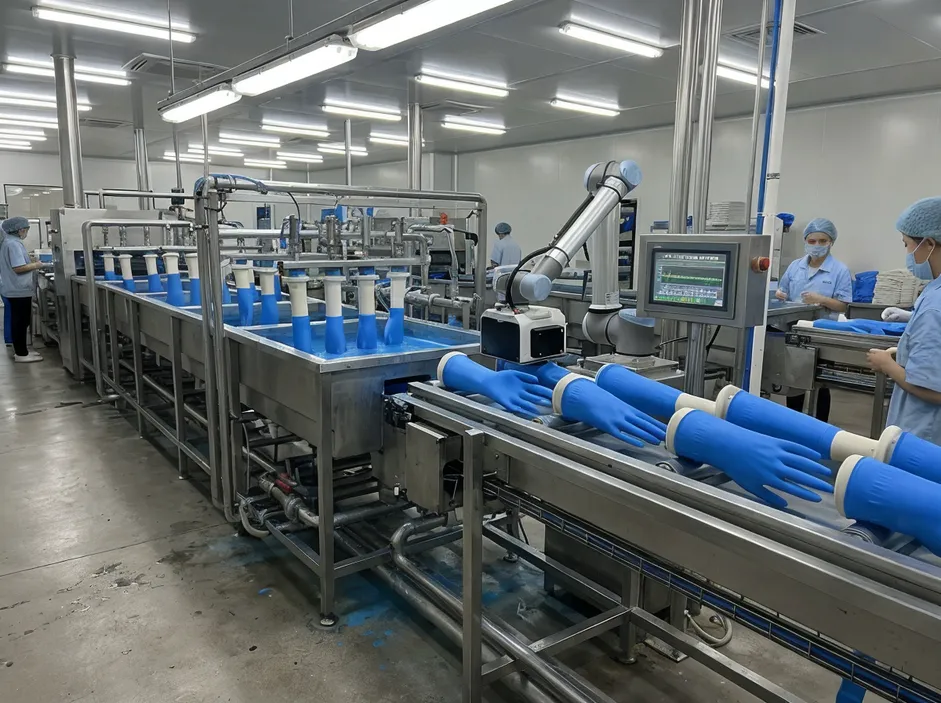
Online pinhole detection runs continuously during production. Every glove passes through an automated electrical leak test before it's counted as a finished unit. This is separate from AQL sampling — it's 100% screening for the defect type that causes the most serious downstream problems.
Outgoing AQL sampling happens after gloves are packed into boxes and palletized. QC pulls samples according to the ISO 2859-1 table for the lot size, inspects against the defect classification list, and records the acceptance/rejection decision with the AQL level documented.
Thickness measurement is checked at multiple points — palm, finger, fingertip — because a glove that measures 0.10mm at the palm and 0.07mm at the fingertip is a thickness failure even if the average looks acceptable. We run this check on every production batch, not just on outgoing samples.
The reason we run it this way: a container that fails incoming inspection at the destination port costs everyone more than the inspection cost savings ever justified. We've seen what happens when factories cut corners on QC to hit a lower unit price — the cost lands on the buyer, not the factory.
What AQL 1.5 Costs vs. What AQL 2.5 Saves
Here's the commercial reality: AQL 1.5 inspection costs more to run than AQL 2.5. Larger effective sample sizes, tighter acceptance criteria, more QC labor per container. That cost gets built into the unit price.
The question isn't whether AQL 1.5 is more expensive. It is. The question is what AQL 2.5 actually costs you when something goes wrong.
| Cost scenario | AQL 1.5 | AQL 2.5 |
|---|---|---|
| Factory QC cost per container | Higher | Lower |
| Unit price premium | ~2–5% typical | Baseline |
| Port rejection risk | Low | Higher |
| Downstream customer return risk | Low | Moderate to high |
| Cost of a rejected container (freight, re-inspection, disposal or rework) | Rare | Periodic |
| Regulatory exposure (FDA, CE medical channels) | Managed | Potential gap |
A single rejected container — freight back, re-inspection fees, disposal or rework, and the supply gap it creates — typically costs more than the AQL 1.5 premium across an entire year's worth of orders. Most of our buyers in the US and Canada figured this out after their first rejection event. After that, AQL 1.5 stops being a premium and starts being the baseline they won't negotiate away.
(We've had buyers come to us specifically because a previous supplier was running AQL 2.5 and calling it AQL 1.5 on the paperwork. That's a different problem — and it's why we make our QC reports available for review before the container ships.)
The Sourcing Trap: When AQL Level Gets Lost in the Order Chain
The most common way AQL level gets misapplied isn't fraud — it's ambiguity. A purchase order says "AQL inspection required." The factory interprets that as their standard level, which is AQL 2.5. The buyer assumes it means AQL 1.5 because that's what they've always used. Nobody clarifies. The container ships.
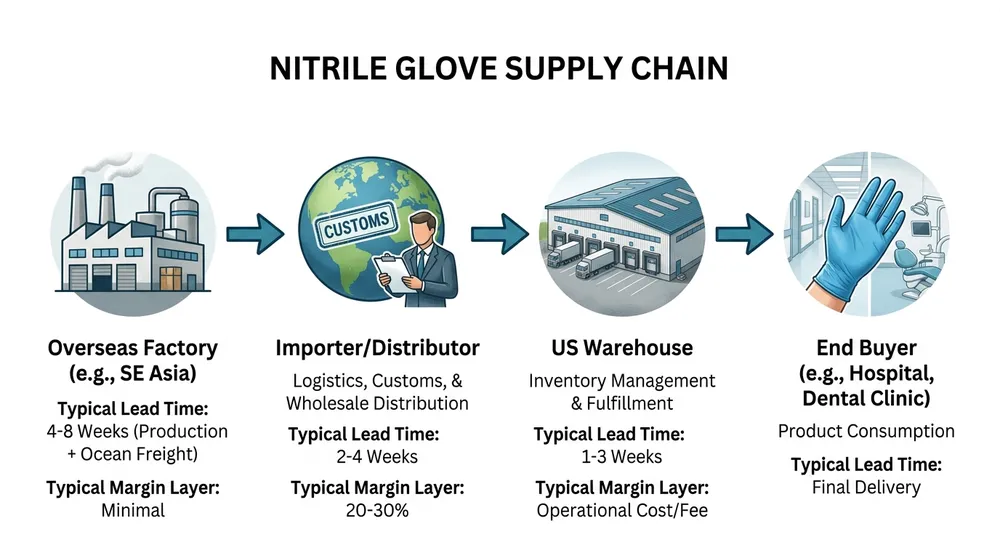
This happens more often in multi-tier supply chains: importer buys from trading company, trading company sources from factory, factory runs their default inspection. By the time the gloves reach the end distributor, the AQL level that was actually applied may be two steps removed from what was specified.
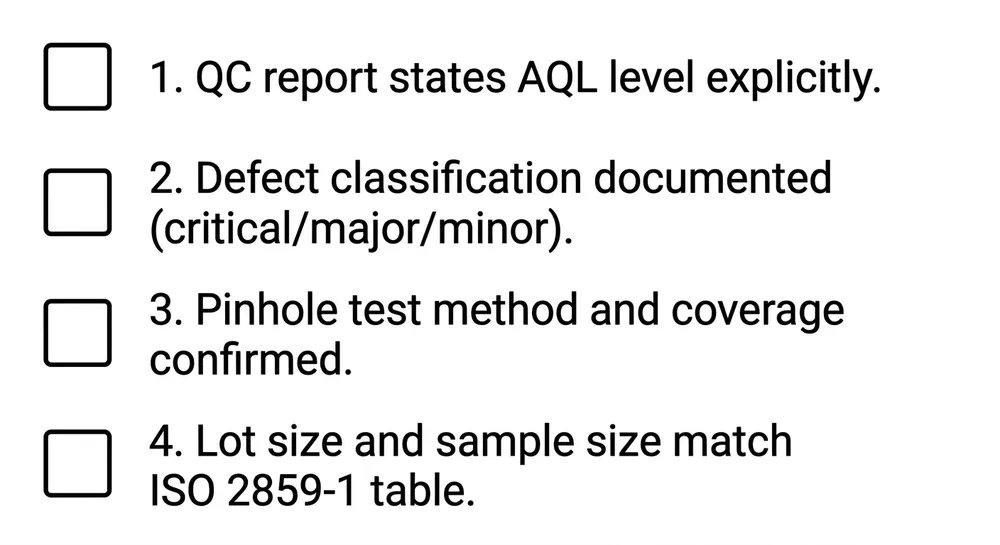
What to verify before the container ships:
- QC report must state the AQL level explicitly — "AQL 1.5, General Inspection Level II" or equivalent. "Passed AQL inspection" without a level is not a verifiable claim.
- Defect classification must be documented — which defects were classified as critical, major, minor, and what acceptance numbers were applied to each.
- Pinhole test method and coverage — 100% online electrical test, or sampled? For medical-grade gloves, sampled pinhole testing is not sufficient.
- Lot size and sample size — confirm the sample size matches the ISO 2859-1 table for the actual lot size. Undersized samples are a common shortcut.
If a supplier can't produce a QC report with these four elements, the AQL level they quoted you is not verifiable. That's the document you need before you release payment, not after the container arrives.
Which Standard Your Market Actually Requires
AQL level isn't just a quality preference — in regulated channels, it's a compliance requirement.
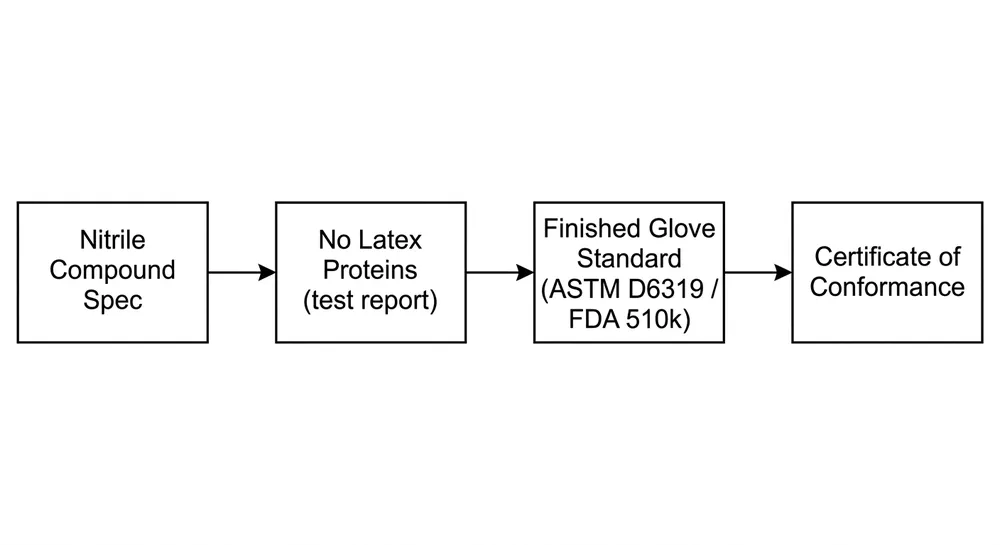
FDA 510(k) medical examination gloves (US market): ASTM D6319 governs nitrile examination gloves for medical use. The standard references AQL 1.5 for critical defects (pinholes) and AQL 2.5 for major defects as the minimum acceptable levels. Many US hospital group purchasing organizations and distributors require AQL 1.5 across all defect categories as a condition of their supplier qualification.
CE-marked medical gloves (EU/UK market): EN 455 series governs medical gloves in Europe. AQL 1.5 is the standard reference level for freedom from holes under EN 455-1. Distributors supplying NHS or EU hospital systems typically require AQL 1.5 documentation as part of their supplier audit package.
Industrial and food-contact channels: Requirements vary. Food processing facilities with HACCP programs often specify AQL 1.5 for gloves used in direct food contact. General industrial use — maintenance, assembly, light chemical handling — may accept AQL 2.5 where the application doesn't involve barrier-critical tasks.
Private label and retail: If you're building a private label program for pharmacy or medical retail, your end retailer's compliance team will specify the AQL level. Most major pharmacy chains in North America require AQL 1.5 for examination gloves on their shelves.
The practical guidance: if your buyers are in medical, food-contact, or regulated industrial channels, specify AQL 1.5 and get the documentation to prove it. If you're sourcing for general industrial distribution where the end use is non-critical, AQL 2.5 may be acceptable — but confirm with your downstream customers before you lock in the spec.
Making the Right Call for Your Order
The decision between AQL 1.5 and AQL 2.5 comes down to where your gloves end up and what your downstream customers require.
If you're distributing into medical or food-contact channels, AQL 1.5 is the right spec. The unit price premium is real but small relative to the cost of a single rejection event. More importantly, it's what your customers' incoming inspection is likely running — and mismatching that creates returns you don't want.
If you're distributing into general industrial channels where the end use is non-critical, AQL 2.5 may be a reasonable cost trade-off. The key is confirming that with your customers before you specify it, not after a rejection.
Either way, the AQL level needs to be on the purchase order, confirmed in the factory's QC report, and documented before the container ships. That's not extra paperwork — it's the difference between a container you can sell and one you're negotiating over.
We run AQL 1.5 as our standard outgoing inspection level across all blue nitrile glove production. If your order requires specific documentation — QC reports, pinhole test records, thickness measurement data — we produce those as part of the standard export package. Request a quote with your target market, volume, and any compliance requirements, and we'll confirm the inspection documentation that comes with the order.