The most common sourcing mistake we see with cleaning-application gloves isn't choosing the wrong size or the wrong color. It's ordering a standard examination-grade nitrile glove for a chemical cleaning environment without checking whether the formulation and thickness actually hold up to the agents your end users are handling.
A glove that degrades mid-task doesn't just fail the worker — it creates a liability event for the distributor who specified it. Understanding what nitrile resists, what it doesn't, and how to write that into your purchase spec is the difference between a clean reorder cycle and a container of returns.
What "chemical resistance" actually means for a nitrile glove
Chemical resistance in a glove context isn't binary. It's a function of three variables working together: the polymer chemistry of the nitrile compound, the glove's wall thickness, and the duration and concentration of the chemical exposure.
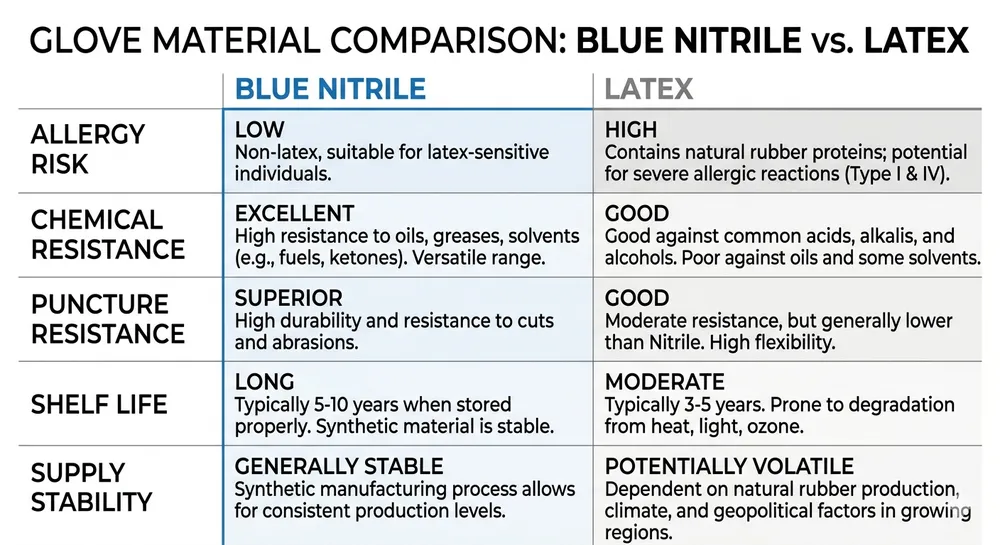
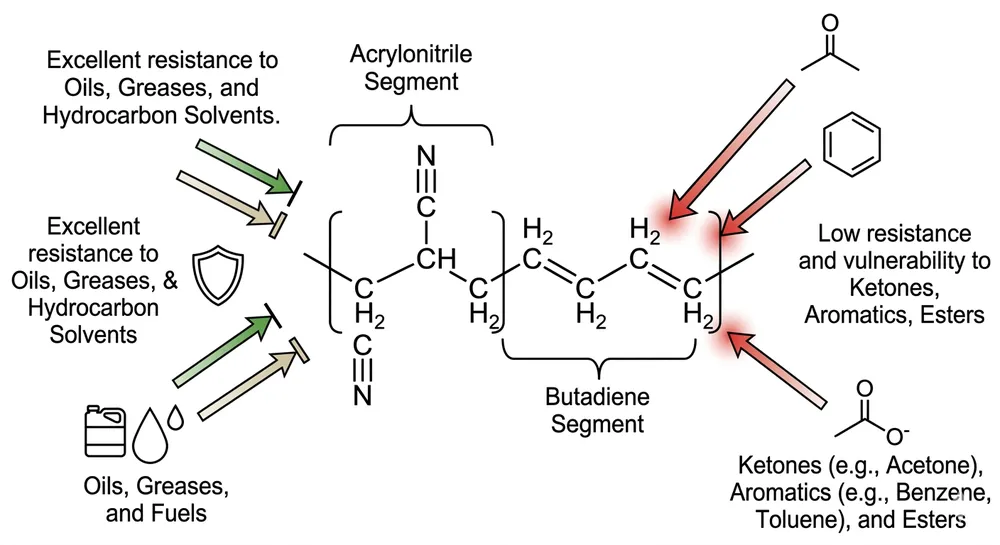
Nitrile — acrylonitrile butadiene rubber — resists oils, greases, and many aqueous solutions well because the acrylonitrile component creates a relatively polar polymer chain that repels nonpolar hydrocarbons. That's why nitrile outperforms latex in petroleum-based environments. But the same chemistry that makes nitrile resistant to oils makes it vulnerable to strong polar solvents like ketones and aromatic hydrocarbons, which swell and soften the polymer matrix.
For cleaning applications specifically, the relevant question isn't "is this a nitrile glove?" — it's "what acrylonitrile content is in the compound, and is the wall thickness appropriate for the contact time and concentration your buyers' customers are working with?"
Most distributor guides skip both questions. We don't, because we mix our own compound and can actually answer them.

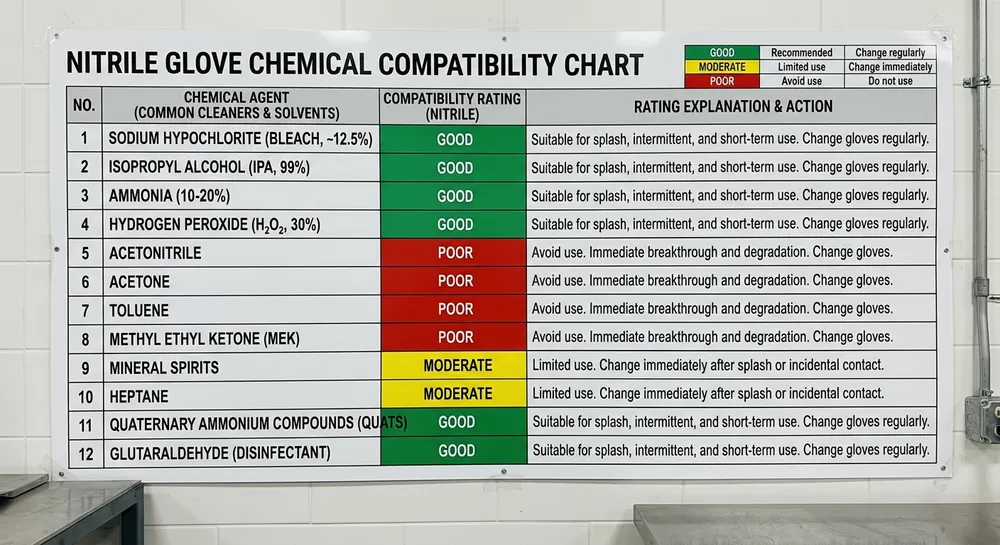
Chemical compatibility table: common cleaning agents rated for nitrile
The table below covers the agents most commonly encountered in janitorial, commercial kitchen, and healthcare surface-disinfection environments. Ratings reflect standard nitrile compound at 4–6 mil (0.10–0.15mm) wall thickness under typical cleaning-task contact times (under 30 minutes per shift).
| Cleaning Agent | Nitrile Compatibility | Degradation Risk | Notes |
|---|---|---|---|
| Sodium hypochlorite (bleach, ≤10%) | Good | Low | Aqueous solution; nitrile holds well at standard cleaning concentrations |
| Quaternary ammonium compounds (quats) | Good | Low | Common in food service and healthcare disinfection; compatible at use-dilution concentrations |
| Isopropyl alcohol (IPA, ≤70%) | Good | Low–Moderate | Acceptable for short-contact disinfection tasks; extended immersion increases permeation risk |
| Ethanol (≤70%) | Good | Low–Moderate | Similar profile to IPA; standard hand-hygiene and surface-wipe applications are within tolerance |
| Phosphoric acid (dilute, ≤10%) | Good | Low | Common in descaling and kitchen cleaning; nitrile handles dilute acids well |
| Sodium hydroxide / caustic cleaners (≤10%) | Good | Low–Moderate | Acceptable at cleaning concentrations; concentrated caustic requires thicker gauge |
| Hydrogen peroxide (≤30%) | Moderate | Moderate | Oxidizing agent; acceptable for surface disinfection concentrations, not for concentrated industrial use |
| Citric acid / organic acids | Good | Low | Routine food-contact and descaling applications; no significant degradation |
| Petroleum-based degreasers | Good | Low | Nitrile's core strength; resists hydrocarbon-based cleaning solvents well |
| Acetone / MEK (ketones) | Poor | High | Swells and softens nitrile rapidly; not suitable for ketone-based cleaning agents |
| Toluene / xylene (aromatics) | Poor | High | Aromatic solvents attack nitrile polymer; use butyl or neoprene instead |
| Chlorinated solvents (e.g., DCM) | Poor | High | Rapid permeation; nitrile is not appropriate for chlorinated solvent cleaning tasks |
| Concentrated acids (>30%) | Poor | High | Requires thicker gauge or alternative polymer; standard cleaning-grade nitrile insufficient |
Reading this table for sourcing decisions: "Good" compatibility means the glove maintains integrity under normal cleaning task conditions. It does not mean unlimited exposure time or concentrated industrial use. If your buyers' customers are using any agent in the "Poor" category, a standard blue nitrile cleaning glove is the wrong product — and specifying it creates a downstream liability problem.
For the agents in the "Moderate" column, thickness and contact time become the deciding variables. That's where the next section matters.
How acrylonitrile content and wall thickness change the resistance picture
Standard nitrile compound for examination and cleaning gloves typically runs 28–34% acrylonitrile content by weight. At that range, you get the flexibility and tactile sensitivity buyers expect from a disposable cleaning glove, with solid resistance to the aqueous and mild solvent environments that cover most janitorial and food-service applications.
Higher-acrylonitrile formulations — 38–42% range — improve resistance to oils, fuels, and some polar solvents, but the tradeoff is a stiffer, less elastic glove. For cleaning applications where dexterity matters (food prep, lab surface work, dental operatory cleaning), that tradeoff often isn't worth it. For industrial cleaning tasks involving petroleum-based degreasers or light solvent contact, the higher-AN compound is worth specifying.
We run both formulations in-house. Most of our cleaning-application buyers land on the standard compound at 4–6 mil because it covers the majority of their market's actual use cases. The higher-AN grade comes up for industrial safety distributors whose customers are doing maintenance cleaning alongside production work. (The request usually comes after a complaint about glove swelling — which is how most buyers discover their current supplier was running a lower-AN compound than the spec sheet implied.)
Wall thickness interacts with chemical resistance in a straightforward way: more material means longer permeation time before a chemical reaches the skin. For the agents in the "Moderate" category above — concentrated alcohols, hydrogen peroxide, dilute caustics — moving from a 4 mil to a 6 mil glove can meaningfully extend safe working time. It won't change the fundamental compatibility rating, but it buys time in applications where contact is incidental rather than continuous.
| Thickness (mil) | Approx. mm | Typical Application Fit |
|---|---|---|
| 3–4 mil | 0.08–0.10mm | Light cleaning, food contact, short-contact disinfection tasks |
| 4–6 mil | 0.10–0.15mm | General janitorial, healthcare surface cleaning, commercial kitchen |
| 6–8 mil | 0.15–0.20mm | Industrial maintenance cleaning, extended chemical contact, higher-risk environments |
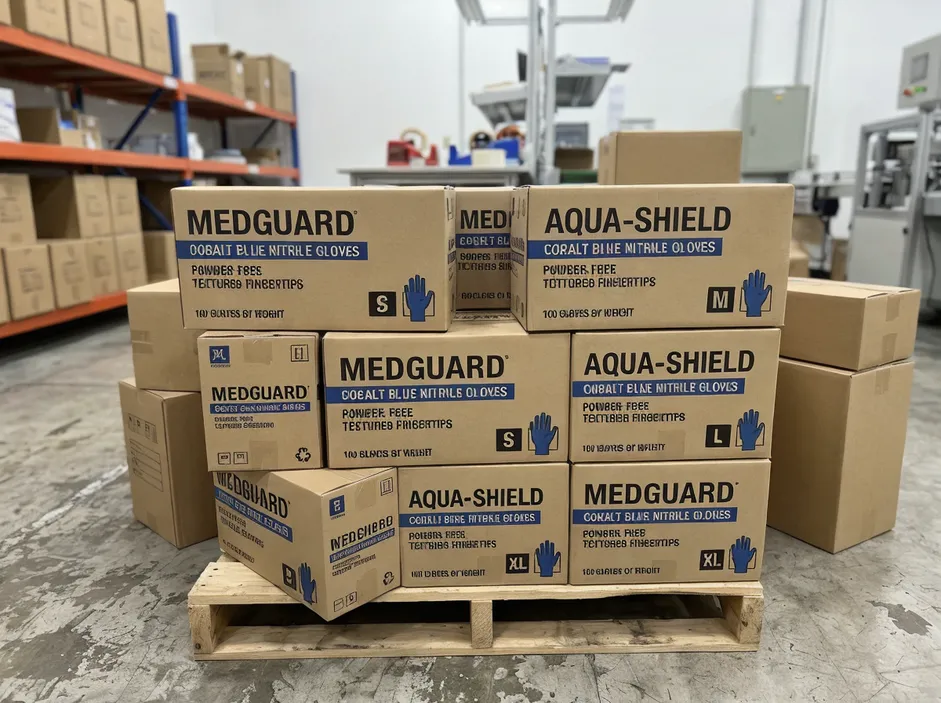
Our standard Blue Nitrile Cleaning Gloves run at 4–6 mil with online thickness verification on every production run. If your application sits at the upper end of the moderate-risk range, we can confirm the exact gauge and formulation before you commit to a container.
Where standard blue nitrile cleaning gloves fit — and where they don't
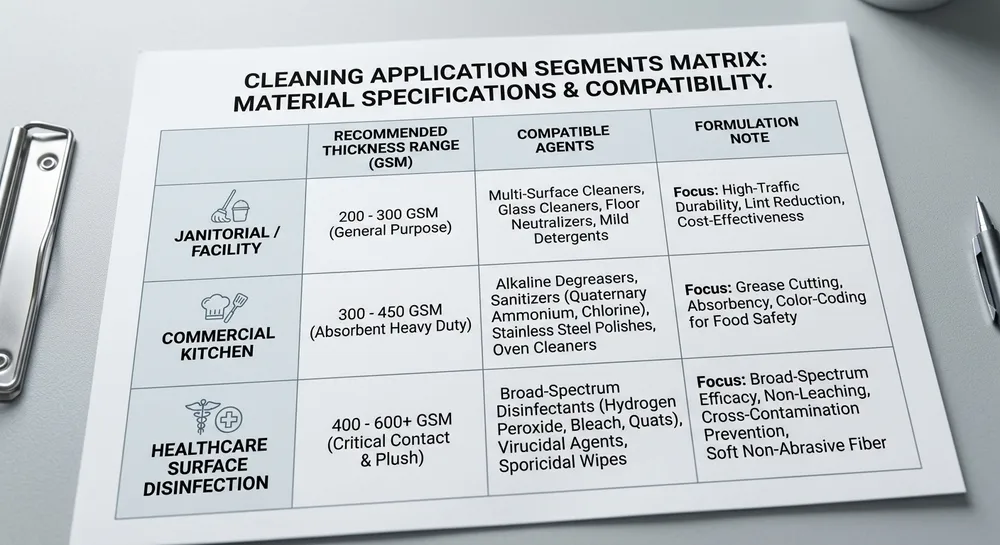
Three market segments drive most of the demand we see for cleaning-application nitrile:
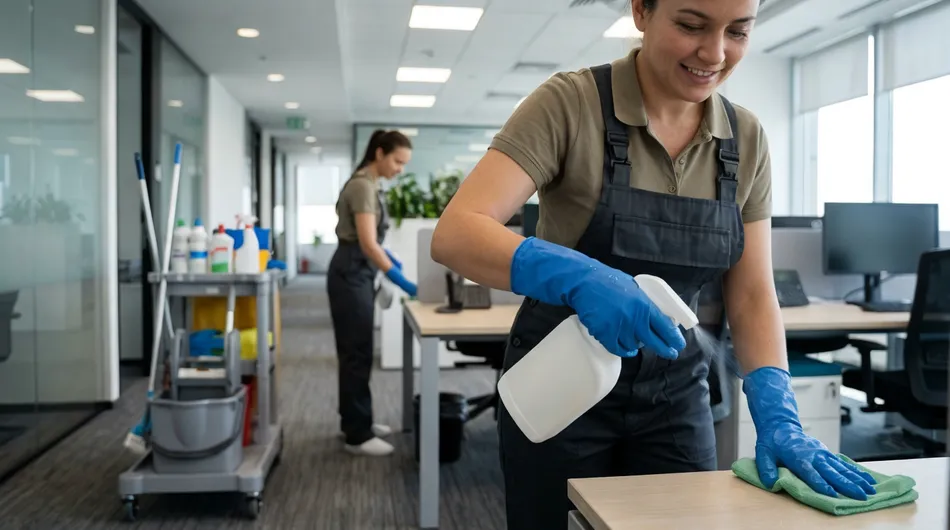
Janitorial and facility services. The dominant agents are bleach solutions, quat-based disinfectants, and general-purpose degreasers — all well within standard nitrile's range. Volume is high, margin is thin, and buyers in this segment are price-sensitive. A 4–5 mil standard-compound glove covers the application and keeps landed cost competitive. The Blue Nitrile Gloves category page covers the full SKU range for this segment.
Commercial kitchen and food-service sanitation. Agents here include quats, citric acid descalers, and sodium hypochlorite at cleaning concentrations. Nitrile handles all of these. The additional spec consideration for food-service buyers is food-contact compliance — our gloves carry the relevant certifications for food-handling environments, which matters when your buyer is supplying a restaurant group or food processing facility with documented compliance requirements.
Healthcare surface disinfection. IPA and ethanol-based disinfectants at 60–70% concentration are the primary agents. Standard nitrile is acceptable for the short-contact wipe tasks that make up most of this work. Where it gets more nuanced is in facilities using higher-concentration disinfectants or oxidizing agents like accelerated hydrogen peroxide — those applications benefit from a thicker gauge and a confirmed formulation spec. For buyers supplying hospital environmental services departments, this is worth a conversation before the first container ships.
Where standard blue nitrile cleaning gloves are the wrong answer: any application involving ketones (acetone-based cleaners, nail polish remover in salon environments), aromatic solvents, or chlorinated cleaning agents. If your buyers' customers are in industrial maintenance, automotive, or specialty chemical cleaning, look at our chemical resistant industrial nitrile gloves instead — those are formulated and gauged for heavier chemical exposure.
The sourcing gap most buyers don't catch until a container arrives
Here's what the generic chemical resistance tables don't tell you: the rating on a distributor's compatibility chart assumes a specific compound formulation and a specific wall thickness. When you order from a catalog supplier, you often don't know which formulation you're getting — and neither does the distributor, because they're not the manufacturer.
We've had buyers come to us after receiving a container where the gloves swelled or discolored after contact with quat-based disinfectants. In every case, the root cause was a lower-acrylonitrile compound than what the spec sheet implied — the factory had substituted a cheaper formulation without updating the documentation. The distributor had no way to catch it because they don't have a compounding lab and can't verify the compound independently.
Because we mix our own compound, we can tell you the acrylonitrile content of the specific formulation going into your order. We can provide compound batch records as part of the outgoing documentation if your procurement process requires it. That's not a standard offering from a catalog supplier — it's only possible when the manufacturer controls the compound.
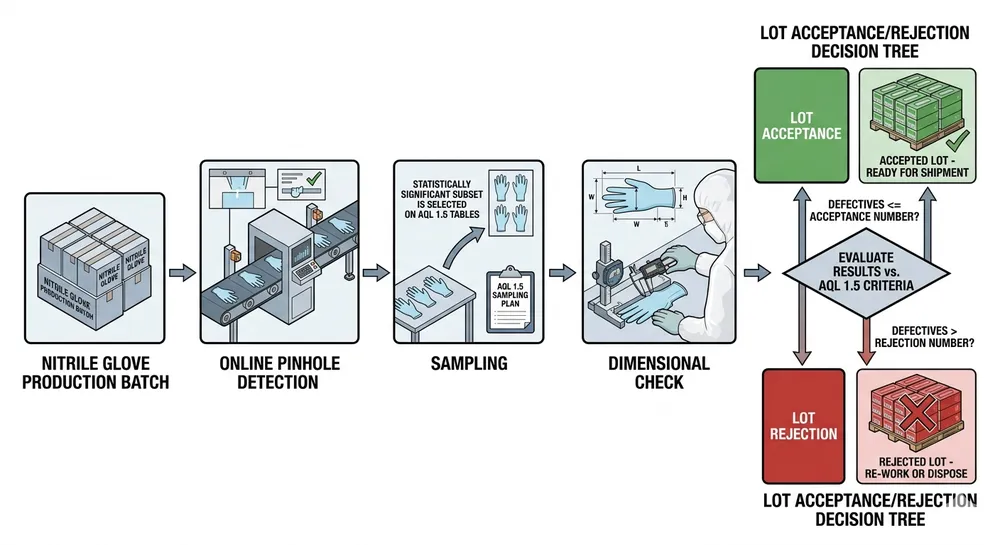
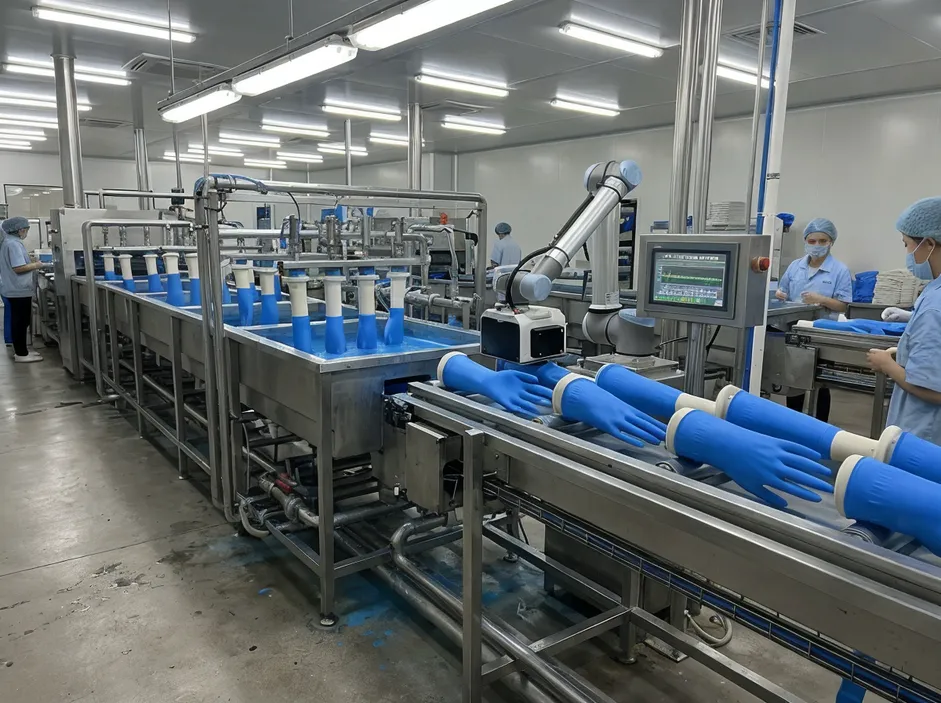
The other failure mode we see is pinhole failures in chemical exposure scenarios. A pinhole that's acceptable in a standard examination context becomes a chemical exposure event when the glove is in contact with a disinfectant for 20 minutes. Our 100% AQL 1.5 outgoing inspection with online electrical pinhole detection on every line is specifically designed to catch this. AQL 1.5 means tighter acceptance criteria than the AQL 2.5 most factories use — fewer defective units reach your warehouse, and fewer complaints reach your customers' safety officers.
(We added the online pinhole detection system in 2016 after a batch of gloves passed outgoing visual inspection but showed elevated pinhole rates at a European buyer's incoming inspection. The electrical test catches what visual inspection misses — it's been part of every line since.)
How to write chemical resistance into your RFQ spec
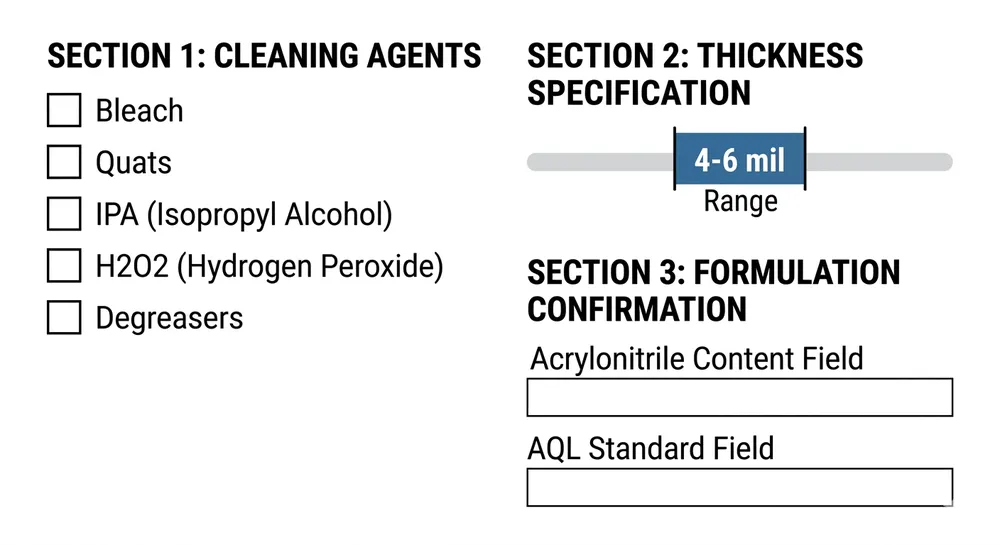
Most RFQs for cleaning gloves specify color, size range, and box count. That's enough for a commodity order. If your application has any chemical exposure component, you need three more data points in the spec:
1. The specific cleaning agents in use. Not "disinfectants" — the actual product category. Quat-based, bleach-based, IPA-based, and hydrogen peroxide-based disinfectants have different compatibility profiles. If your buyer's customer uses multiple agents, list all of them.
2. The required thickness range. Use mil or mm, not "standard" or "heavy duty" — those terms mean different things to different factories. For general cleaning applications, 4–6 mil (0.10–0.15mm) is the right range. For extended chemical contact, specify 6 mil minimum.
3. Formulation confirmation. Ask the supplier to confirm the acrylonitrile content range of the compound being used for your order. A factory running in-house compounding can answer this. A factory buying pre-mixed compound from a third party often can't — and that's a signal worth noting.
A complete spec for a cleaning-application order might read: "Blue nitrile, powder-free, 4–6 mil palm thickness, standard acrylonitrile compound (28–34% AN content), AQL 1.5 outgoing inspection, compatible with sodium hypochlorite ≤10% and quaternary ammonium disinfectants at use-dilution concentrations."
That spec gives a manufacturer enough information to confirm the right formulation and flag any mismatch before production starts — not after the container arrives.
Frequently asked questions
Do nitrile gloves protect against bleach?
Yes, for standard cleaning concentrations. Sodium hypochlorite at ≤10% — the range used in janitorial and healthcare surface cleaning — is well within standard nitrile's compatibility range. Concentrated industrial bleach (>10%) at extended contact times is a different situation and warrants a thicker gauge. For the dilute solutions your buyers' customers are actually using, a 4–6 mil standard nitrile glove is appropriate.
What cleaning chemicals break down nitrile gloves?
Ketones (acetone, MEK), aromatic solvents (toluene, xylene), and chlorinated solvents (methylene chloride, TCE) degrade nitrile rapidly. These aren't common in standard janitorial or food-service cleaning, but they appear in industrial maintenance, automotive, and specialty chemical cleaning environments. If your buyers' customers work in those segments, standard blue nitrile cleaning gloves are the wrong spec — you need a heavier industrial grade or a different polymer.
What's the difference between AQL 1.5 and AQL 2.5 for chemical cleaning applications?
AQL 1.5 allows fewer defective units per lot than AQL 2.5. In a standard examination context, the difference is marginal. In a chemical cleaning context, a pinhole is a chemical exposure event — so the tighter standard matters more. If you're supplying buyers whose customers handle disinfectants or cleaning chemicals regularly, AQL 1.5 outgoing inspection is worth specifying.
Can I get a higher-acrylonitrile formulation for industrial cleaning applications?
Yes, if you're sourcing factory-direct from a manufacturer with in-house compounding. We run higher-AN compound for industrial-grade SKUs. The tradeoff is a stiffer glove with slightly reduced elongation — acceptable for maintenance cleaning tasks, less ideal for food prep or fine-detail work. Tell us the specific agents and contact conditions and we'll confirm whether the standard or higher-AN formulation is the right call for your application.
What's the minimum order for a custom formulation or specific thickness spec?
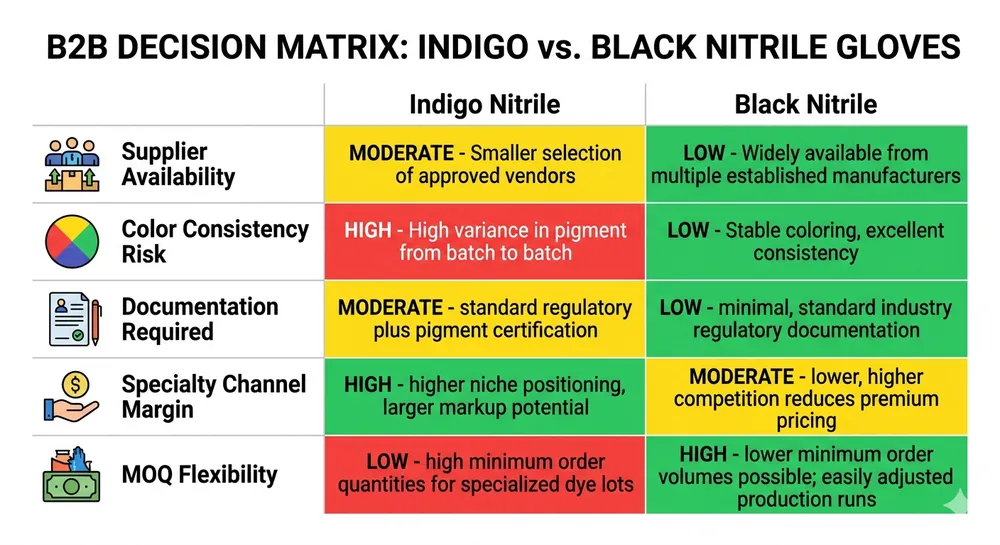
For standard SKUs within our existing formulation range, MOQ is one 40HQ container (approximately 2,000 boxes). Custom formulation projects — specific AN content, accelerator-free compound, or non-standard thickness — start at the same MOQ. We don't charge a formulation development fee for specifications that fall within our existing compound range; it's a production parameter adjustment, not a new development project.
If you're ready to confirm the right formulation and thickness for your cleaning application, submit an RFQ with your agent list, required thickness, and target volume — we'll come back with a confirmed spec and pricing within one business day.