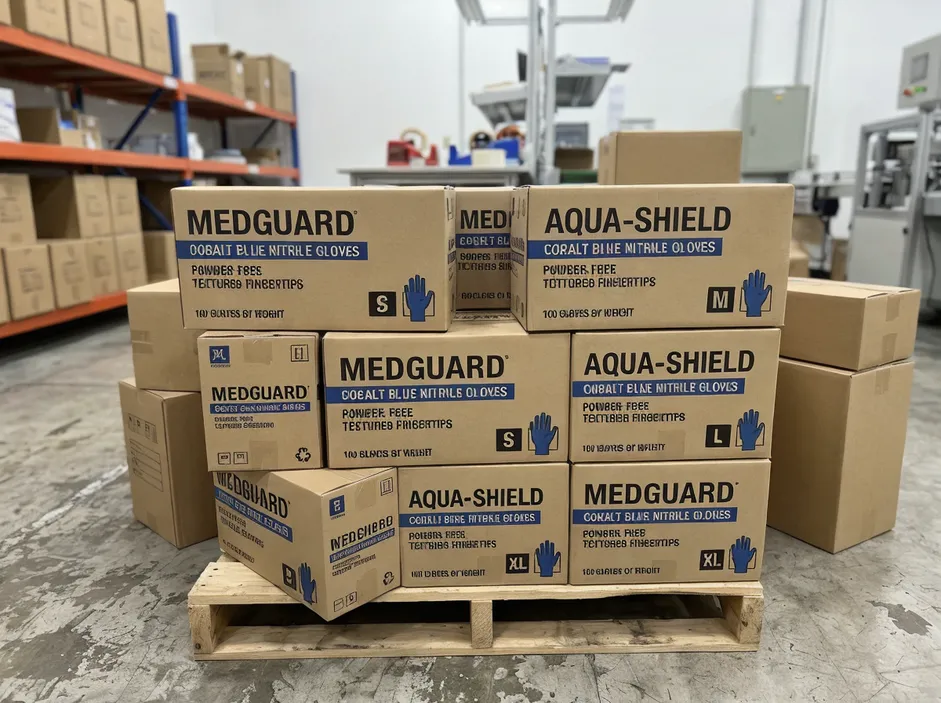
Color is not a cosmetic decision in nitrile gloves. It is a workflow decision — and for tattoo studios and automotive detailing operations, the wrong color choice creates real downstream problems: contamination you can't see, client-facing optics that undercut your brand, and sourcing headaches when your supplier can't hold a consistent shade across container orders.
The short verdict: indigo wins for tattoo studios where ink transfer visibility is a safety and hygiene signal. Black wins for heavy automotive detailing where grease concealment is the priority. But the sourcing story behind each choice is where most buyers get tripped up — and that's what this comparison is actually about.
—
Why Color Matters at the Formulation Level, Not Just the Surface
Most buyers think of glove color as a dye applied after the fact. It isn't. Color is compounded into the nitrile formulation before the dipping process begins. The pigment load, dispersion method, and stabilizer chemistry all affect the final glove — not just its appearance, but its physical properties.
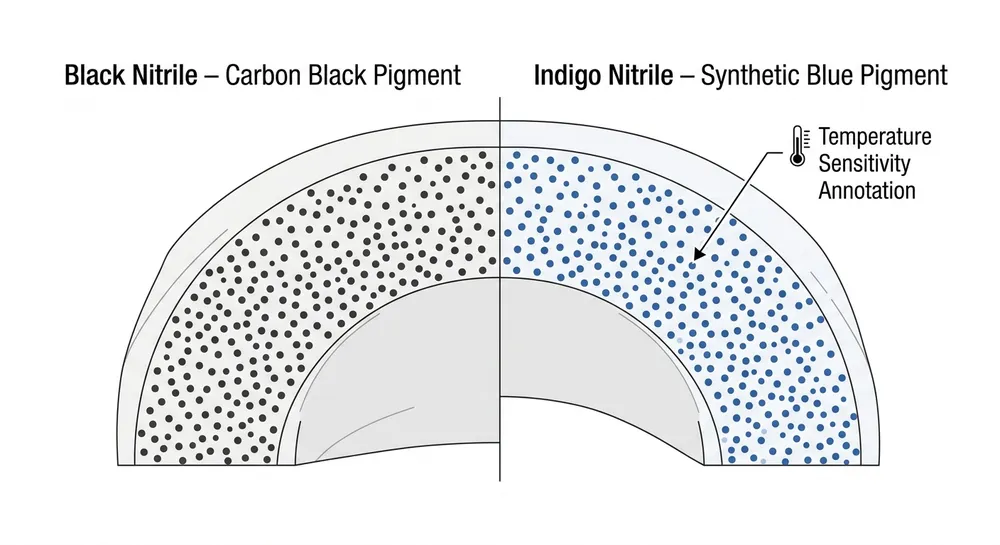
Black nitrile gets its depth from carbon black pigment. Carbon black is a high-load, chemically stable pigment that disperses evenly in nitrile compound and has been used in glove manufacturing for decades. It's forgiving in production: minor batch-to-batch variation in pigment concentration doesn't produce a visible color shift, so black is the easiest specialty color to hold consistent across large runs. That's a big reason black became the default for tattoo and automotive markets in the first place — it's reliable to manufacture at scale.
Indigo is a different story. True indigo-tone nitrile uses organic or synthetic blue pigment blended to hit a specific mid-tone — deeper than standard powder-blue exam gloves, lighter than navy. The challenge is that blue pigments are more sensitive to compound temperature and dwell time during dipping. A 5°C variance in the dipping bath that wouldn't register on a black glove can shift an indigo glove visibly toward green or gray. We run our indigo compound with tighter bath temperature tolerances than our standard blue lines — ±2°C versus the ±5°C that's acceptable for commodity colors. (That tighter window is why indigo from a factory without in-house compounding control tends to drift between shipments.)
The practical consequence for buyers: black is available from a wider supplier base with lower color-consistency risk. Indigo requires a factory that owns its compound formulation and can document color spec — ideally with a Pantone reference and a tolerance band in the product spec sheet.
—
Head-to-Head Specification Matrix
| Dimension | Indigo Nitrile | Black Nitrile |
|---|---|---|
| Pigment type | Synthetic organic blue | Carbon black |
| Color consistency tolerance | Tight (Pantone-referenced, ±ΔE 1.5 typical) | Loose (visually stable across wide batch variation) |
| Dye migration risk | Low when properly stabilized; higher with low-grade compound | Very low — carbon black is chemically inert |
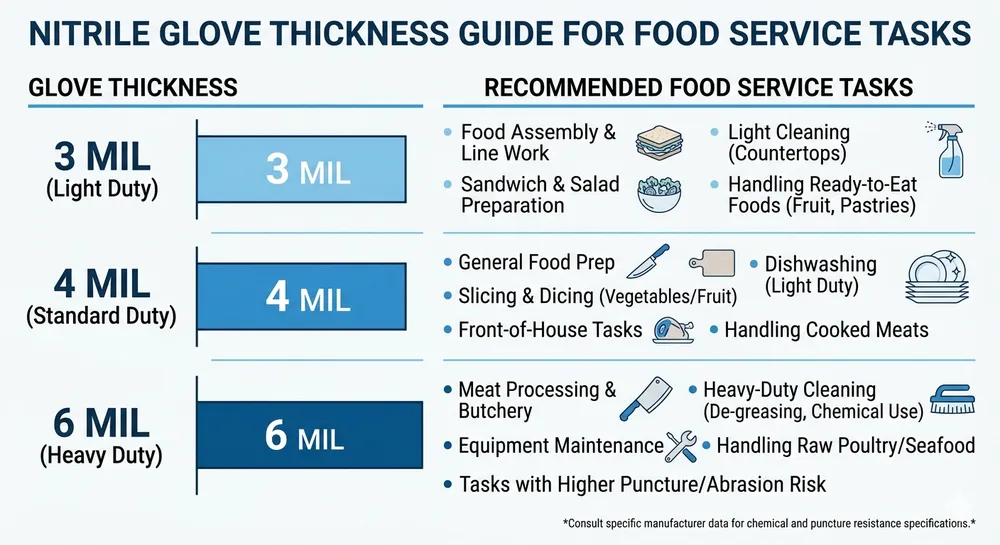
| Thickness range available | 0.08–0.12mm (exam/light industrial) | 0.08–0.15mm (full range) |
| Contrast on skin | High — mid-tone shows ink, product transfer clearly | Low — dark surface conceals transfer |
| Contrast on dark surfaces | Moderate | Low |
| Supplier availability | Specialty — requires compounding capability | Broad — commodity SKU at most factories |
| Color documentation | Requires Pantone spec + batch CoC | Standard CoC sufficient |
| AQL standard (glovemfg) | AQL 1.5 | AQL 1.5 |
| Certifications available | ISO 9001, CE, EN455, ASTM D6319, FDA 510(k) | ISO 9001, CE, EN455, ASTM D6319, FDA 510(k) |
| MOQ (glovemfg) | ~1 container (approx. 2,000 boxes) | ~1 container (approx. 2,000 boxes) |
One note on the AQL row: most factories apply AQL 1.5 to their standard blue or black lines and quietly run AQL 2.5 on specialty colors because the inspection overhead is higher. We apply AQL 1.5 across all SKUs including indigo — that's documented in our outgoing inspection records and available for review before you commit to a container.
—
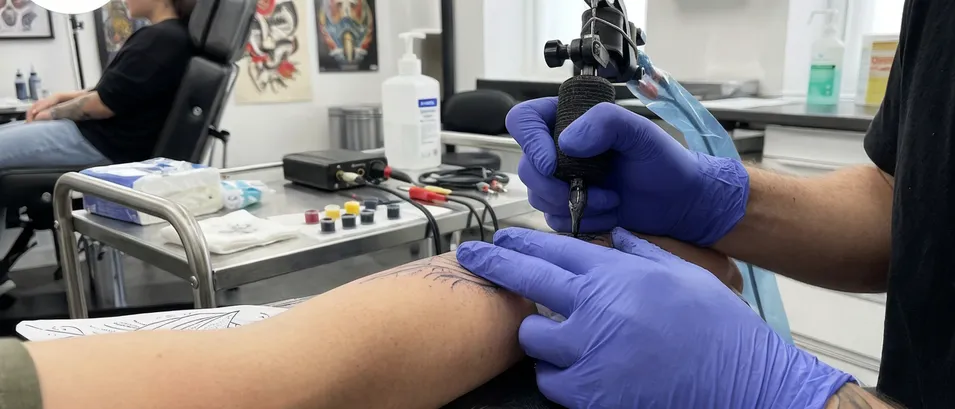
Tattoo Studio Supply: Why Indigo's Contrast Is a Workflow Asset
The tattoo industry's shift toward black nitrile was driven by aesthetics — black looks professional, matches studio equipment, and became the visual shorthand for "serious artist." That logic is sound for branding. It breaks down for contamination control.
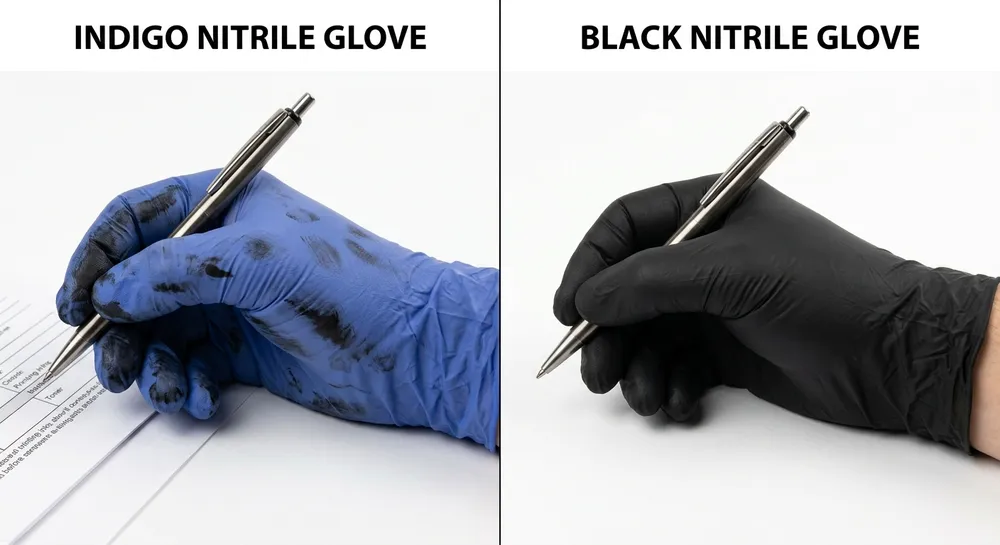
During a tattoo session, ink transfer from the work surface to the glove is continuous. With black gloves, that transfer is invisible. An artist working a multi-hour session has no visual cue when their glove surface has accumulated enough ink and product residue to warrant a change. The contamination is there — it's just hidden. For studios operating under health department inspection, that's a documentation and hygiene risk, not just an aesthetic one.
Indigo gloves solve this at the workflow level. The mid-tone surface shows ink transfer clearly — a dark stain on an indigo glove is visible within minutes of contact. Artists change gloves when they see contamination, not on a timer. That's a better hygiene protocol, and it's one that health inspectors can observe directly during a studio visit.
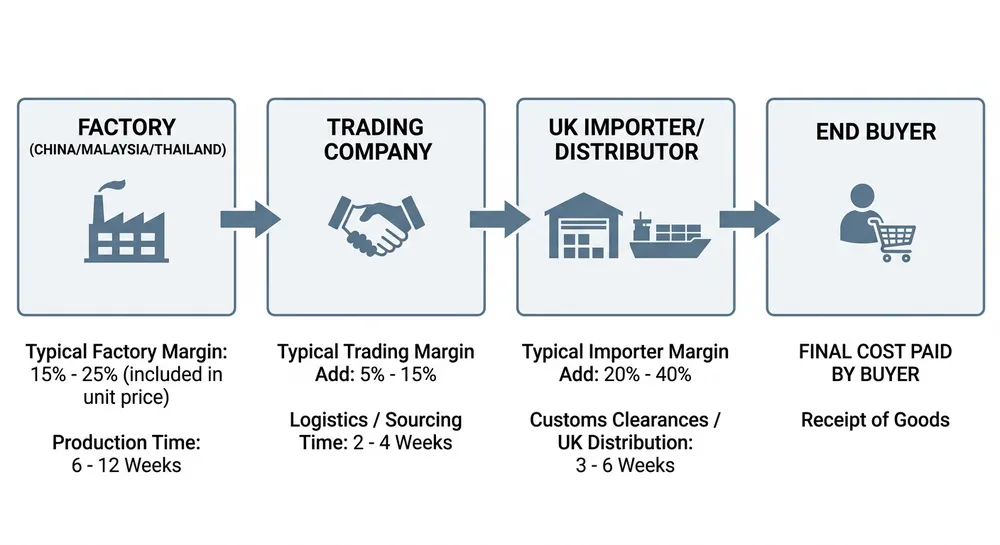
For distributors supplying tattoo studios, this is a margin argument as much as a hygiene argument. Indigo is a specialty SKU that commands a price premium over commodity black — typically 8–15% at the wholesale level depending on volume. Studios that understand the contamination-visibility benefit will pay it. Your job is to source indigo from a factory that can hold color consistency across reorders, because a studio that switches to indigo and then receives a shipment that looks gray-blue instead of true indigo will blame the distributor, not the factory.
Indigo Nitrile Gloves from a factory with documented Pantone-referenced color spec protect your reorder relationship. Generic indigo from a spot-buy supplier does not.
—
Automotive Detailing Supply: When Black's Concealment Is the Feature
Automotive detailing is the inverse scenario. The work involves heavy contact with grease, polish compounds, tire dressing, and solvent-based products. A glove that shows every product transfer is not a hygiene asset here — it's visual noise that makes the technician look dirty to the client before the job is done.
Black nitrile dominates automotive detailing for a reason: it conceals product buildup, maintains a clean professional appearance through a full detail session, and doesn't signal contamination to a client watching their car being worked on. That's a legitimate commercial function, not just vanity.
There is one scenario where indigo has a role in automotive detailing: client-facing interior work. When a technician is working inside a vehicle — cleaning leather, treating surfaces, applying interior dressings — a client sitting nearby can see the gloves. Some premium detailing operations use indigo or other mid-tone colors specifically for interior work to signal "clean gloves, clean products." It's a brand positioning choice, not a technical one. (We've had a few detailing supply distributors build a two-SKU kit around this — black for exterior/engine work, indigo for interior — and it's been a successful upsell for them.)
For the majority of automotive detailing volume, black is the right call. It's available at higher volumes, lower per-unit cost, and from a broader supplier base. The sourcing risk is lower and the end-user preference is established.
—
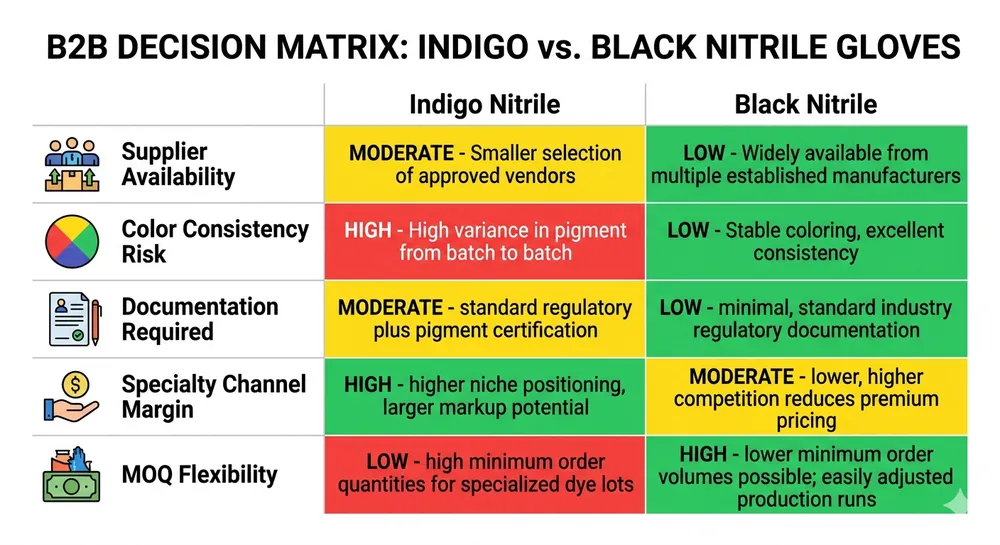
The B2B Sourcing Trade-Off: Availability, Documentation, and Color Drift Risk
This is where the comparison gets commercially important for distributors and importers.
Black nitrile is a commodity color. Nearly every nitrile glove factory produces it. That broad availability keeps pricing competitive and gives you multiple sourcing options if your primary supplier has a capacity issue. The trade-off is that "black nitrile" is not a single spec — thickness, formulation, and AQL standard vary widely across suppliers. You can switch factories on black and maintain color consistency. You cannot necessarily maintain quality consistency without re-qualifying the supplier.
Indigo nitrile is a specialty color with a much shorter supplier list. The factories that produce it reliably — meaning consistent Pantone-referenced color across container orders — are the ones with in-house compounding labs. Without that, you're buying indigo from a factory that sources pre-mixed compound from a third-party compounder, and color consistency across your second and third container orders depends on whether that compounder's batch matches the first one. It usually doesn't, not precisely.
We compound our nitrile in-house. When a buyer orders indigo from us, we assign a Pantone reference (typically in the PMS 2748–2756 range for standard indigo-tone gloves, adjusted per customer spec), document the ΔE tolerance in the product spec sheet, and retain a color standard sample for every production run. If your third container looks different from your first, you have documentation to hold us to. Most factories cannot offer that because they don't own the compound.
For distributors building a specialty SKU for tattoo supply or premium detailing channels, that documentation is what protects your private-label brand. A color that drifts between shipments is a customer service problem that lands on you, not the factory.
Blue Nitrile Gloves from our standard lines ship with the same AQL 1.5 standard and certification package — the specialty color doesn't change the quality floor.

—
Application Showdown: Which Color Wins by Scenario
Scenario 1 — Tattoo supply distributor building a house brand Indigo wins. The contamination-visibility argument is real and communicable to studio owners. The price premium is defensible. The risk is color consistency across reorders — source from a factory with Pantone documentation or your brand takes the blame for drift. Black is a fallback if your volume doesn't justify the specialty sourcing overhead, but it's a commodity play with no differentiation story.
Scenario 2 — Automotive detailing wholesale, high-volume standard SKU Black wins. No contest. The end-user preference is established, the supplier base is broad, and the concealment function is genuinely useful for the work. Indigo has a niche in premium interior detailing kits but doesn't displace black as the core SKU.
Scenario 3 — Medical/exam glove distributor adding a colored SKU for cross-sell Indigo wins on visual differentiation from standard blue exam gloves. It reads as premium without the clinical association of blue. Color-coding protocols in some facilities also benefit from a distinct mid-tone that isn't blue, black, or white. Verify dye migration compliance for your target market — our indigo formulation passes EN455 and ASTM D6319, which covers most North American and European import requirements.
Scenario 4 — Private-label brand entering the tattoo or body art supply channel Indigo is the right anchor color for brand positioning, but only if you can hold it. A private-label indigo glove that ships gray-blue on the second order destroys the brand faster than never launching it. Qualify your factory's compounding capability before committing to the SKU, not after. Ask for the Pantone reference, the ΔE tolerance, and a retained color standard from the first production run. If the factory can't provide those three things, they can't hold your color.
—
What to Verify Before You Place a Container Order
Whether you're ordering indigo or black, the verification checklist is different for each.
For black nitrile:
- Confirm AQL standard (1.5 vs 2.5 — the difference is significant at destination port)
- Request pinhole detection records — online AQL inspection, not just end-of-line sampling
- Confirm thickness spec at palm and fingertip separately — fingertip thinning is the most common spec drift point
- Verify certifications match your target market (FDA 510(k) for US medical, CE + EN455 for EU)
For indigo nitrile:
- All of the above, plus:
- Request the Pantone reference number and ΔE tolerance in writing before the order
- Ask whether the factory compounds in-house or sources pre-mixed compound
- Request a retained color standard sample from the production run — this is your reference for future reorder disputes
- Confirm that AQL 1.5 applies to the colored SKU, not just standard lines
- Ask for indigo nitrile gloves color stability documentation if your end market involves prolonged UV exposure or chemical contact
The color documentation ask is the fastest way to separate factories that actually control their indigo compound from those that are buying pre-mixed and hoping for the best. A factory with real compounding capability answers that question in one email. A factory without it deflects or sends you a generic spec sheet with no color reference.
—
FAQ
Does indigo nitrile cost more than black nitrile at the factory level? Yes, typically 8–15% more per box at comparable thickness and AQL spec. The premium comes from tighter production tolerances, higher pigment cost for synthetic blue versus carbon black, and the additional QC overhead of color documentation. For specialty channels like tattoo supply, that premium is recoverable in your margin — end users in those channels expect to pay more for a differentiated product.
Can I order both indigo and black from the same production run to consolidate a container? Yes, with a caveat. Both colors can ship in the same container, but they run on separate production batches — you can't mix colors mid-run. Minimum per-color quantity applies. For a standard container order (~2,000 boxes), splitting 60/40 between black and indigo is workable. Below 800 boxes per color, the line changeover economics get tight and we'd discuss whether a single-color container makes more sense for your first order.
What is dye migration risk and does it matter for my application? Dye migration refers to pigment transferring from the glove surface to skin or the material being handled. For black nitrile, carbon black is chemically inert and migration risk is negligible under normal use. For indigo, the risk depends on pigment stabilization in the compound — a well-formulated indigo glove passes EN455 Part 3 biocompatibility testing with no migration concern. A poorly stabilized one can leave a faint blue tint on light-colored surfaces. Ask for EN455 Part 3 test reports specifically for the colored SKU, not just the standard blue line.
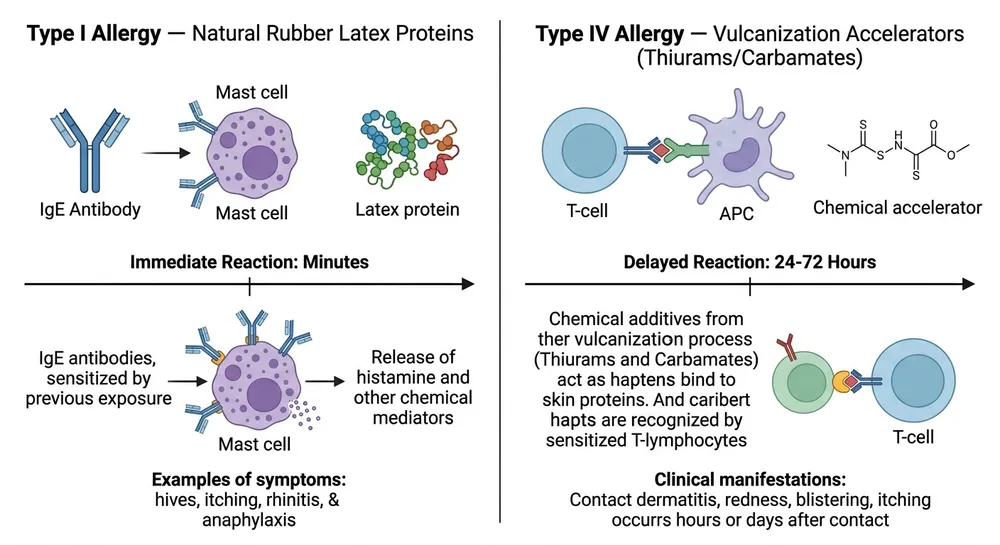
Is indigo nitrile available in accelerator-free formulation? Yes. Accelerator-free (Type IV allergy-safe) formulation is available in indigo from our facility. The compounding adjustment for accelerator-free doesn't affect color stability — we run the same Pantone-referenced pigment system in both standard and accelerator-free indigo compound. This matters for tattoo studios where artist skin sensitivity is a real concern.
What certifications apply to colored nitrile gloves? The same certifications apply regardless of color — ISO 9001:2015, CE, EN455, ASTM D6319, and FDA 510(k) all cover our colored SKUs including indigo and black. Color is a formulation variable, not a separate product category for certification purposes. The test reports are run on the actual colored compound, not on a proxy standard-blue sample.