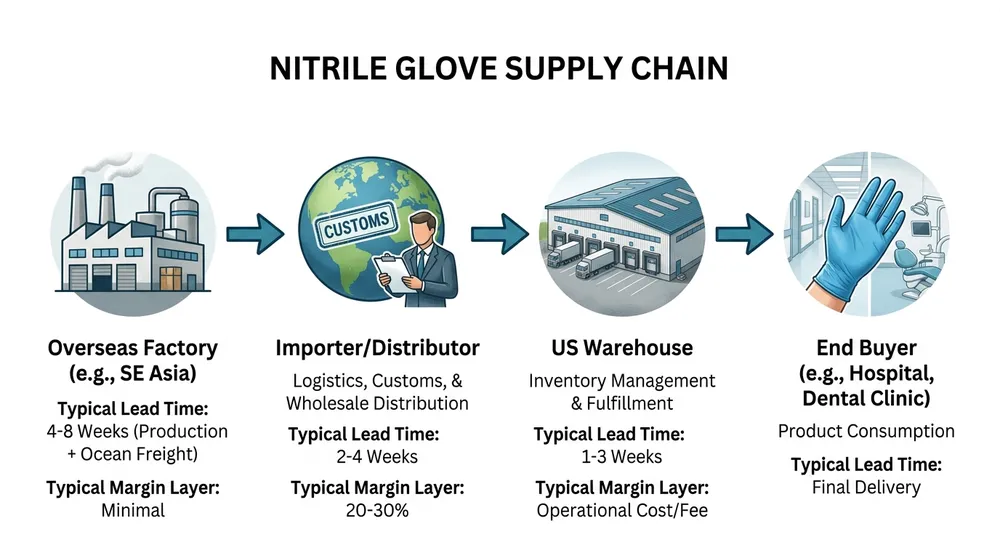
The US market for blue nitrile gloves runs through a layered supply chain — manufacturers overseas, national distributors, regional wholesalers, and specialty safety suppliers all competing for the same container-scale orders. If you're screening suppliers right now, you're probably looking at a mix of domestic distributors with warehouse stock and import options with longer lead times but better unit economics. Both have a place. The question is which one fits your order profile.
This article maps the real supplier landscape: ten companies actively serving the US market, what each model is built for, and where the cost-of-convenience math starts working against you at volume.
One framing note before the list: most of what's called a "US supplier" in this category is a distributor or importer, not a manufacturer. The gloves are made in Malaysia, China, Thailand, or Vietnam. The domestic entity handles warehousing, compliance documentation, and last-mile logistics. That's a legitimate and often necessary service — but it's worth understanding what you're paying for.

What Serious Buyers Check Before Placing a Container Order
Before the list, the criteria. A supplier name means nothing without knowing what to verify. These are the checkpoints that separate a reliable sourcing relationship from a spec-drift problem at destination port.
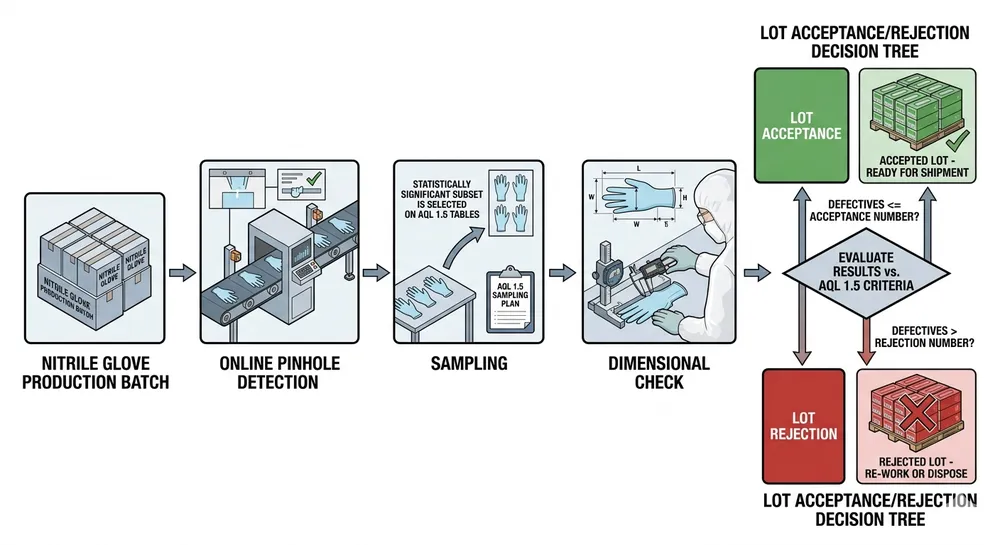
AQL standard and inspection protocol — AQL 1.5 is the medical-grade benchmark. AQL 2.5 is common in industrial supply. If a supplier can't tell you which standard their outgoing inspection runs at, that's a gap. The difference shows up in rejection rates at your customer's receiving dock, not in the sales conversation.
Thickness tolerance and consistency — Blue nitrile gloves are typically specified at 0.08–0.12mm palm thickness. The failure mode isn't the average — it's the variance. A glove that measures 0.10mm at the palm and 0.06mm at the fingertip will fail pinhole testing. Ask for AQL data across a full production run, not just a sample report.
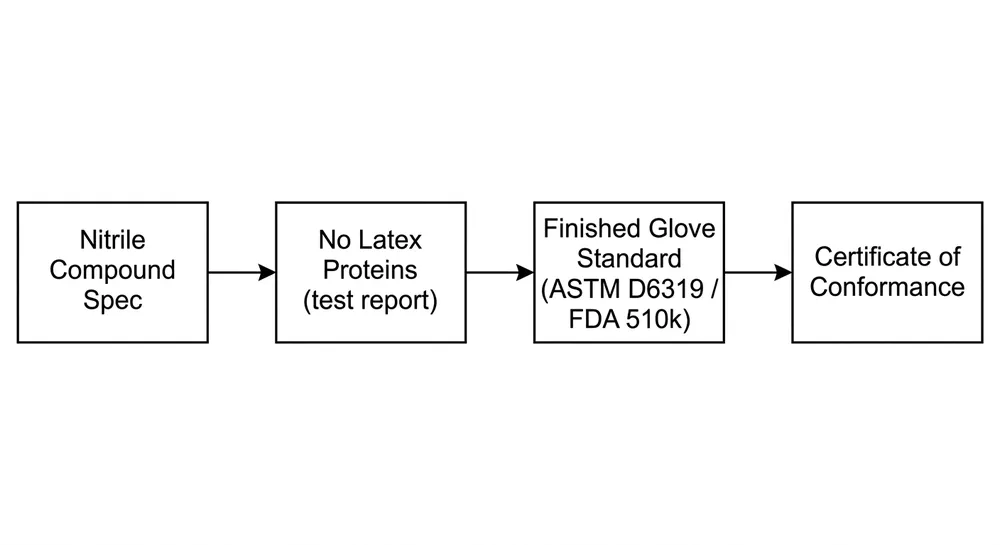
Certification coverage for your end market — FDA 510(k) clearance for medical exam use, ASTM D6319 for industrial nitrile, EN455 for European medical. If you're selling into healthcare, the 510(k) number needs to be on the box. If you're selling into food processing, you need food-contact compliance documentation. Distributors often carry multiple SKUs with different cert coverage — confirm which cert applies to which SKU before you commit.
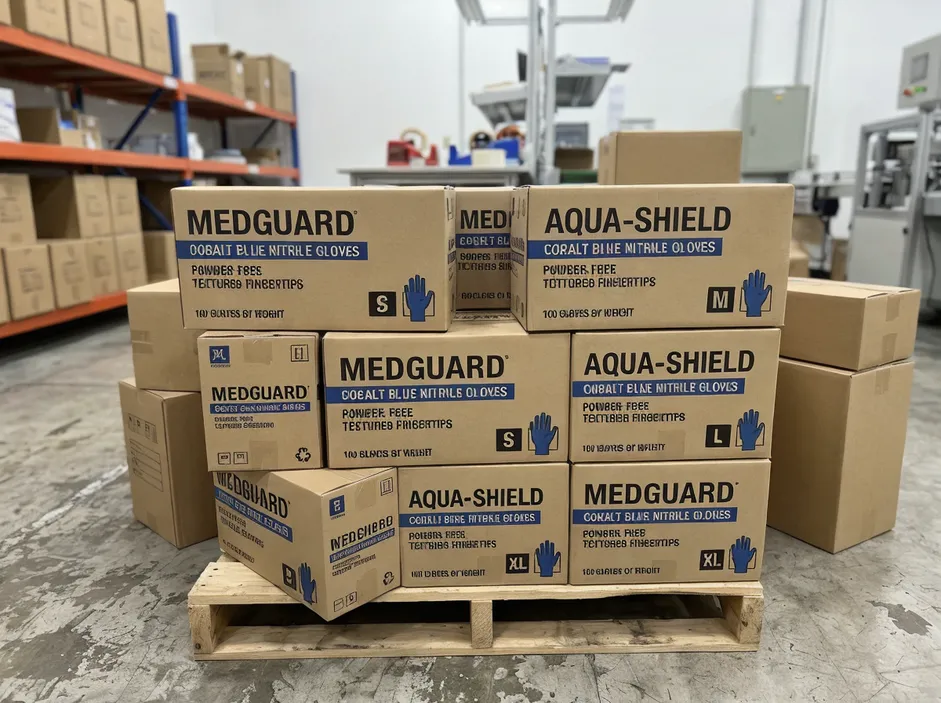
MOQ and container economics — A full 20-foot container of blue nitrile gloves typically holds 1,000–1,200 cases (100 boxes per case, 100 gloves per box). If your order is below that threshold, domestic distributor stock usually makes more sense than a direct import. Above that threshold, the per-unit economics of factory-direct start to pull ahead.
Spec consistency between sample and production run — This is the most common failure point we see from buyers switching suppliers. The sample shipment passes. The first container passes. The third container has a color shift, a thickness variance, or a packaging change. Ask any supplier you're evaluating: what's your process for maintaining spec lock across repeat orders?
(That last question is a useful filter — suppliers who can answer it specifically are worth talking to further. Suppliers who give you a generic quality assurance answer probably don't have a real answer.)
The 10 Suppliers: US Market Landscape
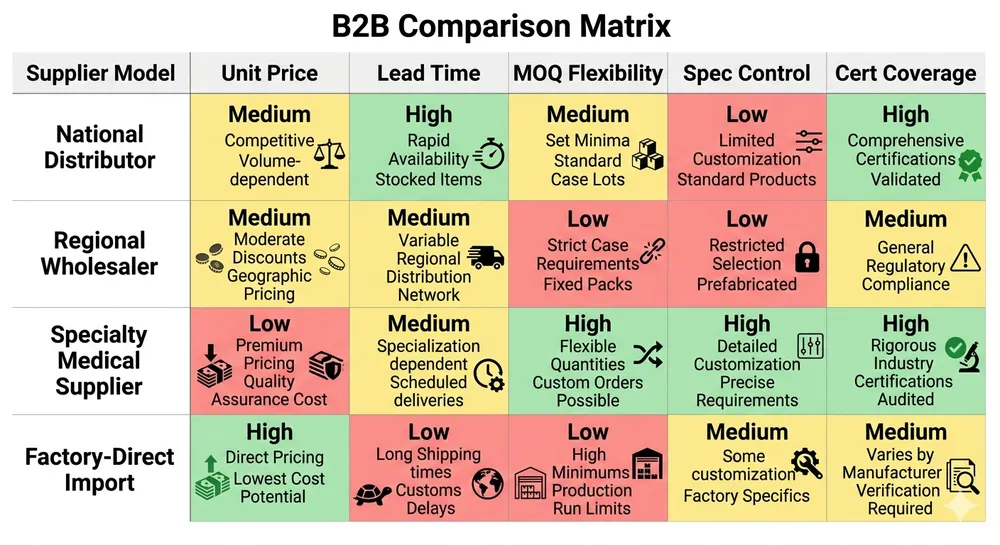
These ten companies represent the active supply landscape for blue nitrile gloves in the US market. They span national distributors, specialty safety suppliers, medical supply chains, and direct-import operators. Each has a different value proposition — the right one depends on your order size, urgency, and end-market requirements.
—
1. Medline Industries — medline.com
Medline is one of the largest privately held medical supply distributors in the US, with a broad nitrile glove portfolio covering exam-grade and procedure-grade SKUs. Their blue nitrile exam gloves carry FDA 510(k) clearance and are stocked in multiple distribution centers nationally.
Best for: Healthcare distributors and medical supply chains needing documented compliance, reliable domestic stock, and consolidated invoicing across a broad PPE catalog.
Trade-off: Medline's pricing reflects their full-service distribution model — warehousing, compliance management, and national logistics are built into the unit cost. For buyers who need gloves and nothing else, that overhead compresses margin.
—
2. Ansell — ansell.com
Ansell is a global PPE manufacturer with a significant US distribution presence. Their TouchNTuff and Microflex lines include blue nitrile options for industrial and laboratory applications. Ansell sells through authorized distributors and direct to large accounts.
Best for: Industrial safety distributors and MRO buyers who need a recognized brand name on the box — particularly for accounts where brand specification matters more than unit cost.
Trade-off: Ansell's brand premium is real. You're paying for the name, the liability coverage, and the global compliance infrastructure. For commodity blue nitrile at volume, that premium is hard to justify unless your end customer specifically requires it.
—
3. Kimberly-Clark Professional — kcprofessional.com
Kimberly-Clark's professional division distributes nitrile gloves under the Kleenguard brand, primarily targeting industrial and manufacturing end-users. Their blue nitrile options are widely available through safety distributors and janitorial supply channels.
Best for: Industrial safety distributors with existing Kimberly-Clark account relationships, particularly in manufacturing, automotive, and facilities maintenance segments.
Trade-off: Kleenguard nitrile is positioned as a mid-tier industrial product. Medical-grade buyers will need to look elsewhere for 510(k)-cleared SKUs.
—
4. Grainger — grainger.com
Grainger is the dominant US MRO and industrial safety distributor, carrying blue nitrile gloves from multiple brands including their own Condor private label. Their national branch network and next-day delivery capability make them the default choice for industrial buyers with urgent or fragmented demand.
Best for: Industrial buyers with unpredictable demand patterns, small top-up orders, or multi-location distribution needs where consolidated purchasing matters more than unit cost.
Trade-off: Grainger's convenience pricing is well above import economics. A buyer placing 50+ cases per month through Grainger is leaving meaningful margin on the table compared to a direct import program.
—
5. McKesson Medical-Surgical — mckesson.com
McKesson is one of the largest healthcare distributors in North America. Their nitrile glove portfolio covers exam-grade blue nitrile with full FDA documentation, and they serve hospital systems, long-term care facilities, and medical distributors at scale.
Best for: Medical distributors and healthcare GPO members who need FDA-compliant blue nitrile with consolidated billing, EDI ordering, and healthcare-specific logistics.
Trade-off: McKesson's model is built for healthcare supply chain integration, not commodity PPE distribution. Their pricing and minimum order structures reflect that. Non-healthcare buyers will find better economics elsewhere.
—
6. Uline — uline.com
Uline is a major US packaging and industrial supply distributor with a substantial PPE catalog including blue nitrile gloves in multiple sizes and case quantities. They stock domestically and offer next-day shipping across most of the continental US.
Best for: Small-to-mid-volume buyers who need reliable domestic stock, simple ordering, and fast replenishment — particularly food processing, light manufacturing, and janitorial supply accounts.
Trade-off: Uline's nitrile gloves are sourced from multiple manufacturers and the spec consistency across reorders is not always guaranteed. For buyers who need color-lot consistency or specific AQL documentation, Uline's catalog model creates risk.
—
7. Cardinal Health — cardinalhealth.com
Cardinal Health is a major healthcare distribution and manufacturing company with a significant nitrile glove portfolio. Their Flexal line of nitrile exam gloves is FDA 510(k)-cleared and widely used in clinical settings. They serve hospital systems, surgery centers, and medical distributors.
Best for: Medical distributors serving acute care and ambulatory surgery accounts where FDA documentation and GPO contract pricing are prerequisites.
Trade-off: Cardinal Health's distribution model is optimized for healthcare. Industrial and food-contact buyers will find their compliance infrastructure over-engineered for non-medical applications — and priced accordingly.
—
8. Protective Industrial Products (PIP) — pipusa.com
PIP is a US-based safety products distributor and brand owner with a broad nitrile glove line under the G-Tek and MaxiFlex brands. They serve industrial safety distributors and work through a national rep network.
Best for: Industrial safety distributors looking for a mid-market brand with reasonable pricing, decent spec documentation, and broad size availability.
Trade-off: PIP sources from multiple overseas factories. Spec consistency across production runs is variable — buyers who have experienced lot-to-lot variation in thickness or color should ask for AQL data by production lot before committing to volume.
—
9. Fastenal — fastenal.com
Fastenal operates one of the largest branch networks in US industrial distribution, with blue nitrile gloves stocked at most locations. Their model combines local branch inventory with national supply chain support, making them a practical option for multi-site industrial accounts.
Best for: Industrial buyers with distributed facilities who need local pickup capability and consolidated national account management — particularly construction, manufacturing, and utilities.
Trade-off: Fastenal's glove pricing is branch-level convenience pricing. For buyers consolidating volume, the per-unit cost is significantly above what a direct import program would deliver at the same annual volume.
—
10. Zoro Tools (Zoro.com) — zoro.com
Zoro is a US online industrial distributor (a Grainger subsidiary) carrying blue nitrile gloves from multiple brands at competitive online pricing. Their model is catalog-driven with no minimum order requirements and fast domestic shipping.
Best for: Small distributors, resellers, and buyers testing new SKUs who need low-MOQ access to multiple nitrile glove brands without committing to a direct import program.
Trade-off: Zoro's pricing is better than branch-level industrial distribution but still carries the full domestic distribution margin stack. At any meaningful volume, the economics of a direct import program are substantially better.
—
The Cost of Domestic Convenience at Volume
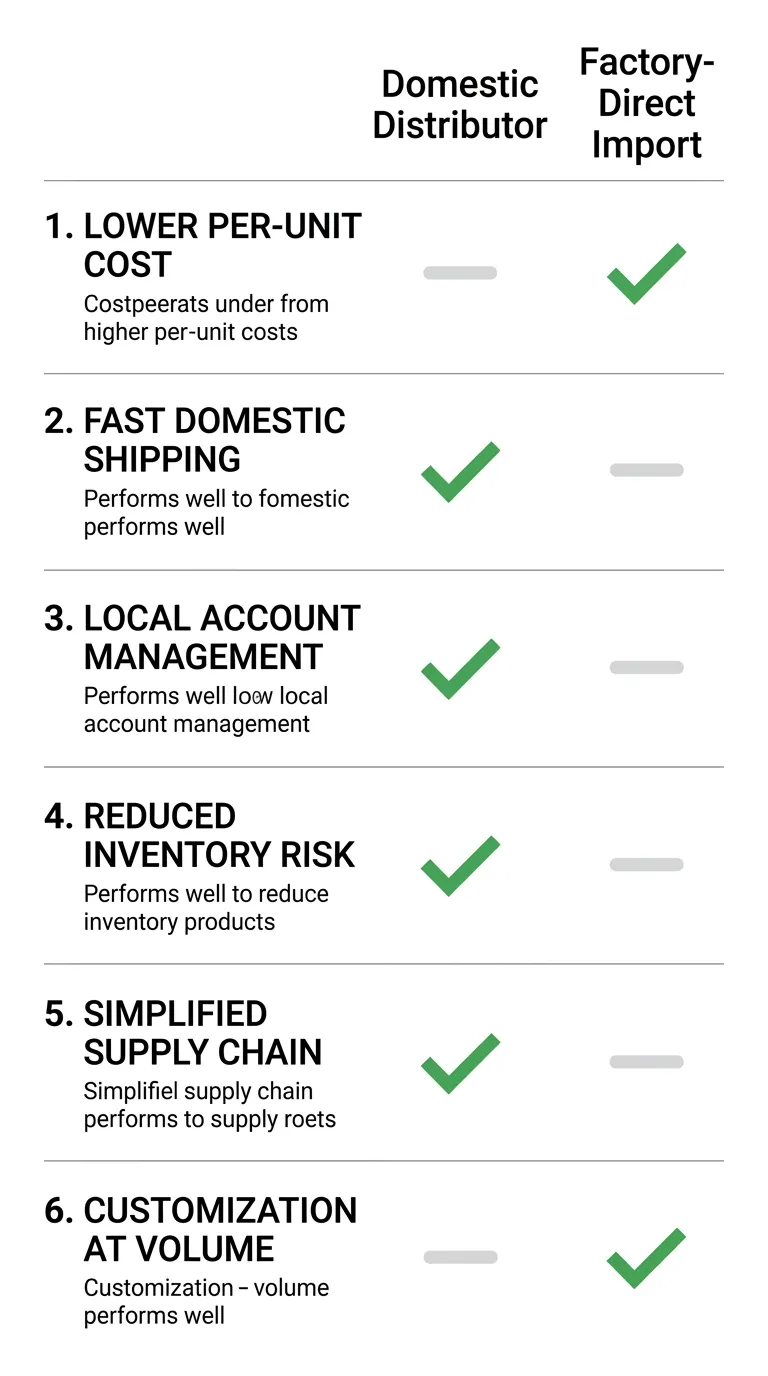
Every supplier on this list provides real value — domestic stock, fast replenishment, consolidated invoicing, compliance documentation. For urgent orders, small top-ups, and accounts where speed matters more than unit cost, domestic distribution is the right answer.
The math changes at volume.
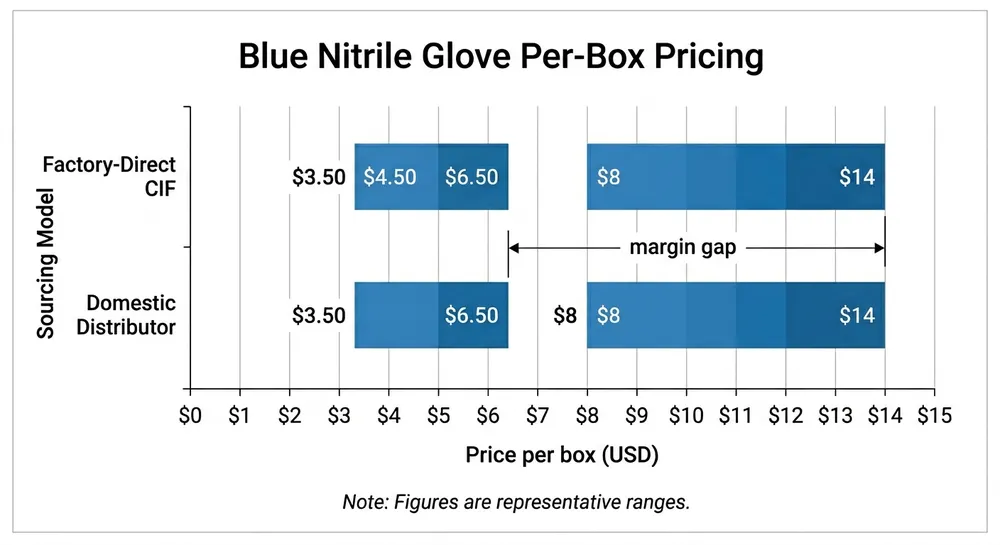
A typical blue nitrile exam glove from a domestic distributor in the US runs $8–$14 per box of 100 at standard distributor pricing, depending on grade, brand, and account terms. The same specification sourced factory-direct from a certified manufacturer in China typically lands at $3.50–$6.50 per box CIF US port, depending on thickness, AQL standard, and container volume. (These are representative ranges based on market patterns — your actual landed cost depends on freight, duties, and your specific spec.)
That gap — $4–$8 per box — is the cost of domestic convenience. On a 500-case order, it's $20,000–$40,000. On an annual program of 5,000 cases, it's $200,000–$400,000. At that scale, the question isn't whether factory-direct makes sense. The question is whether your current supplier relationship is worth the premium.
The honest answer: sometimes it is. If you're in a regulated healthcare environment where your GPO contract requires a specific brand, or if your order pattern is too fragmented to justify a container program, domestic distribution is the right call. But if you're placing repeat container-scale orders and paying domestic distributor pricing, you're funding someone else's warehouse.
Where Local Supply Still Wins
Before you move any volume to a direct import program, be honest about where domestic supply is genuinely the better answer:
- Emergency replenishment — A container takes 25–35 days from China to US port. If your customer calls with a 3-day lead time requirement, your domestic distributor relationship is worth every dollar of the premium.
- Fragmented multi-SKU orders — If you're buying 10 cases of medium, 8 cases of large, and 5 cases of small across three different grades, a domestic distributor's catalog model is more efficient than managing three separate import SKUs.
- Compliance timing — If you're entering a new regulated market (hospital systems, government contracts) and need FDA documentation fast, domestic distributors have the paperwork ready. A new factory relationship takes time to qualify.
- Trial volume before commitment — Testing a new glove SKU with your customers before committing to a container is a legitimate use of domestic distributor stock. We actually recommend this — run 50–100 cases through your distribution before you lock in a 12-month import program.
The goal isn't to replace your domestic supplier relationships. The goal is to know which orders belong in each channel.
Factory-Direct Import: What the Economics Actually Look Like
A direct import program from a certified nitrile glove manufacturer works best when three conditions are met: your volume justifies a container (roughly 1,000 cases minimum for a 20-foot container), your spec is stable enough to lock in for a production run, and your lead time tolerance is 30–45 days.
When those conditions are met, the economics are straightforward. You're removing the domestic distribution margin layer — typically 25–45% above landed cost — and replacing it with a direct factory relationship. The trade-off is lead time, minimum order commitment, and the upfront work of qualifying a supplier.
The qualification work is where most buyers either do it right or pay for it later. The questions that matter:
Does the factory run AQL 1.5 or AQL 2.5? For medical exam gloves, AQL 1.5 is the standard. Some factories quote AQL 1.5 but run AQL 2.5 in practice. Ask for outgoing inspection records from the last three production runs, not just a certificate.
What's the thickness tolerance across the glove? Palm thickness is easy to spec. Fingertip thickness is where variance shows up. A factory that can hold ±0.01mm tolerance at the fingertip across a full production run has real process control. One that can't will give you pinhole failures at destination.
What certifications cover the specific SKU you're ordering? FDA 510(k) clearance is product-specific, not factory-wide. The 510(k) number on the factory's certificate needs to match the exact SKU — thickness, color, size range — you're ordering. We've seen buyers receive gloves that were technically from an FDA-registered factory but not covered by the 510(k) they thought they were buying.
How does the factory handle spec drift between orders? This is the question that separates manufacturers with real process control from ones who got lucky on the first container. Ask for their compound batch records and how they maintain color consistency across production lots.
We run 8 fully automated dipping lines at our Qingdao facility, with an in-house compounding lab that controls the nitrile formulation directly. That's not a standard setup — most factories buy compound from a third-party supplier and have limited ability to adjust when a batch runs off-spec. Owning the compound means we can hold color and thickness consistency across a 12-month program in a way that third-party compound buyers can't reliably do. Our Blue Nitrile Gloves product line covers medical exam, industrial, and food-contact grades from the same facility, all under AQL 1.5 outgoing inspection.
Sourcing Decision Framework: Which Channel Fits Your Order
Use this as a quick-reference guide before your next sourcing decision:
| Order Profile | Recommended Channel |
|---|---|
| Under 100 cases, urgent | Domestic distributor (Grainger, Uline, Fastenal) |
| 100–500 cases, standard lead time | Regional wholesaler or specialty distributor |
| 500+ cases, repeat program | Evaluate factory-direct import |
| Medical-grade, FDA documentation required | Verify 510(k) coverage regardless of channel |
| Private label / OEM packaging | Factory-direct only |
| Custom spec (thickness, color, accelerator-free) | Factory-direct only |
The private label and custom spec rows are worth noting. No domestic distributor can give you OEM packaging or a custom formulation — those capabilities only exist at the factory level. If your business model involves building a branded glove line or differentiating on spec (accelerator-free for latex-sensitive accounts, for example), the factory-direct conversation is the only conversation worth having.
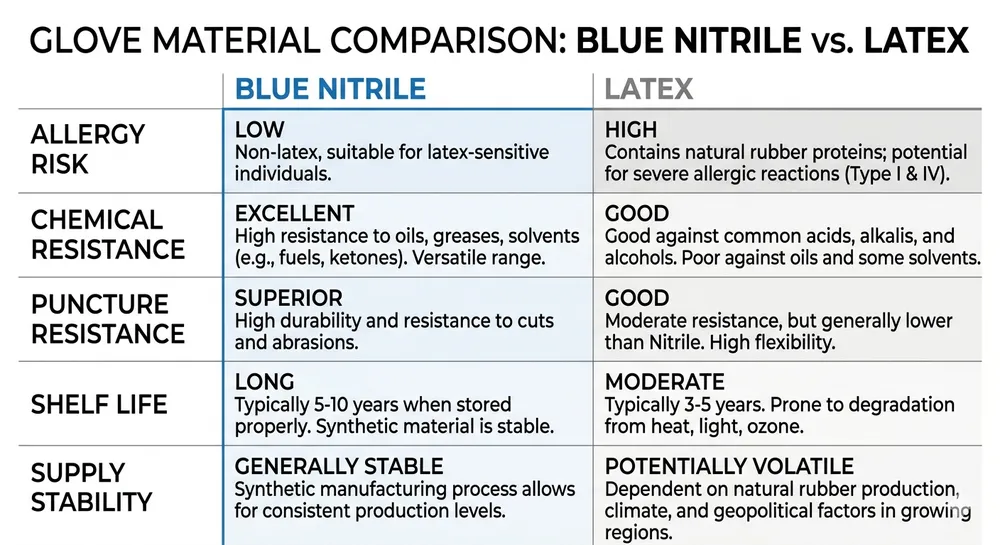
(Accelerator-free nitrile is a growing segment — we're seeing more requests from dental and surgical accounts where Type IV allergy documentation is becoming a procurement requirement. Worth building into your product line if you're not already there.)
Supplier Evaluation Checklist Before You Commit
Whether you're qualifying a domestic distributor or a factory-direct supplier, these are the documents and data points worth requesting before your first container:
- [ ] AQL inspection standard (1.5 or 2.5) and outgoing inspection records from last 3 production runs
- [ ] FDA 510(k) clearance number matched to the specific SKU (thickness, color, size range)
- [ ] ASTM D6319 test report for industrial-grade SKUs
- [ ] EN455 certification if selling into European accounts
- [ ] Thickness measurement data: palm, finger, cuff — not just average, but variance range
- [ ] Color consistency standard (Pantone or internal reference) and lot-to-lot tolerance
- [ ] Pinhole detection method (online AQL testing vs. offline sampling)
- [ ] Packaging specification: box count, case count, carton dimensions, pallet configuration
- [ ] Lead time from order confirmation to container loading
- [ ] Reorder spec lock process — how do they maintain consistency across repeat orders?
A supplier who can answer all ten of these specifically is worth talking to further. A supplier who deflects on AQL data or can't provide thickness variance records is telling you something important about their process control.
Matching Your Volume to the Right Sourcing Route
The US blue nitrile glove market has enough supplier depth that you shouldn't be stuck with a single sourcing model. The ten companies above cover the full range from emergency spot-buy to annual import programs — the question is whether your current sourcing mix is optimized for your actual order profile.
If you're placing repeat orders above 500 cases and buying through domestic distribution, the landed cost gap is worth a direct conversation with a factory. If you're below that threshold or your demand is unpredictable, domestic stock is the right answer and the premium is justified.
For buyers ready to evaluate a factory-direct program — whether for standard blue nitrile exam gloves, industrial-grade SKUs, or OEM private label — our team works through the qualification process directly. We can provide AQL inspection records, thickness variance data, and 510(k) documentation for the specific SKUs you're evaluating. Request a quote with your target spec, annual volume, and destination port, and we'll come back with a landed cost comparison you can put next to your current supplier pricing.