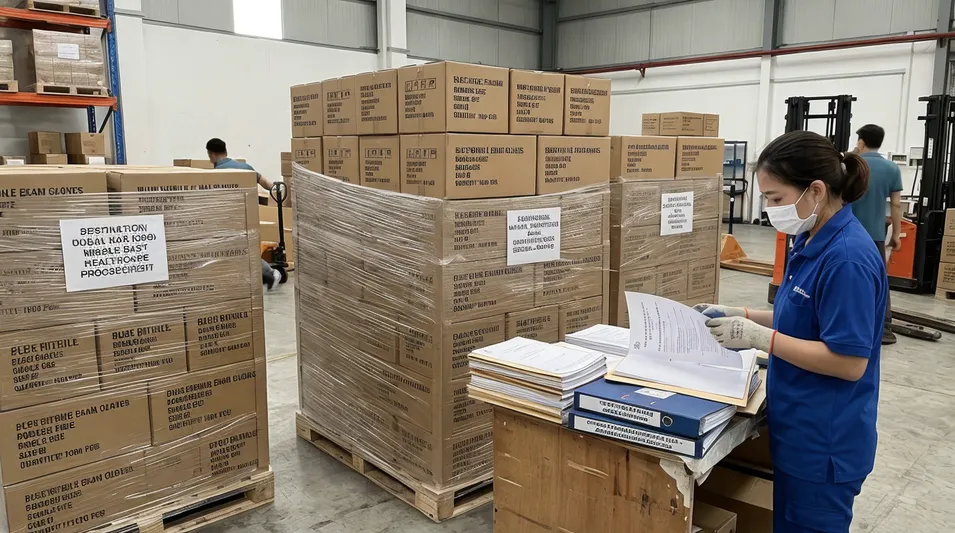
The most common sourcing problem we see isn't a bad factory. It's a distributor who approved a sample, placed a container order, and received product that was technically within the supplier's stated tolerances — but not within what the distributor actually needed. The spec sheet looked fine. The gloves didn't.
Blue nitrile gloves are one of the most ordered SKUs in US medical and industrial distribution, which means the market is full of suppliers quoting similar numbers. Knowing which numbers actually matter — and how to verify them before the container ships — is what separates a clean import from a costly return.
This breakdown covers the specifications that drive real sourcing decisions: thickness, AQL, certifications, color consistency, and the questions worth asking before you commit to volume.

Thickness Tolerances: The Number That Decides Your AQL Pass Rate
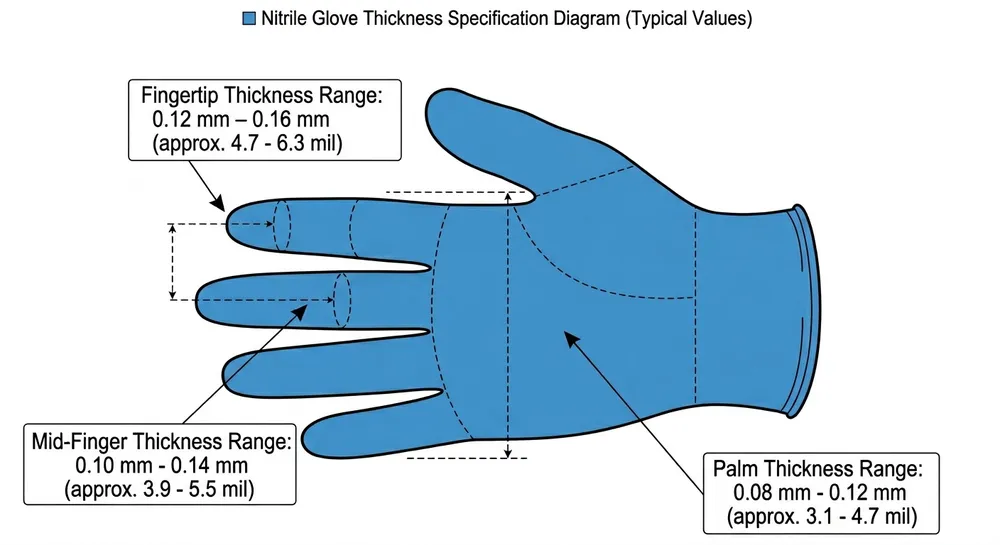
Glove thickness is quoted as a single number — 0.10mm, 0.12mm — but that number is a nominal value, not a guarantee at every point on the glove. The fingertip is always thinner than the palm. The question is how much thinner, and whether that gap is controlled.
At our facility, we run 8 fully automated dipping lines with a controlled thickness tolerance of 0.08–0.15mm across the glove body. That range isn't arbitrary — it's the window where the glove passes pinhole detection, maintains tactile sensitivity for medical and food-contact use, and survives the tensile stress of donning without tearing at the fingertip seam.
Here's what the thickness tiers look like in practice for blue nitrile:
| Grade | Nominal Thickness | Typical Application | Key Risk Below Spec |
|---|---|---|---|
| Lightweight exam | 0.08–0.10mm | Medical exam, food handling | Pinhole failure at fingertip |
| Standard exam | 0.10–0.12mm | General medical, dental | Tear on donning if fingertip dips below 0.08mm |
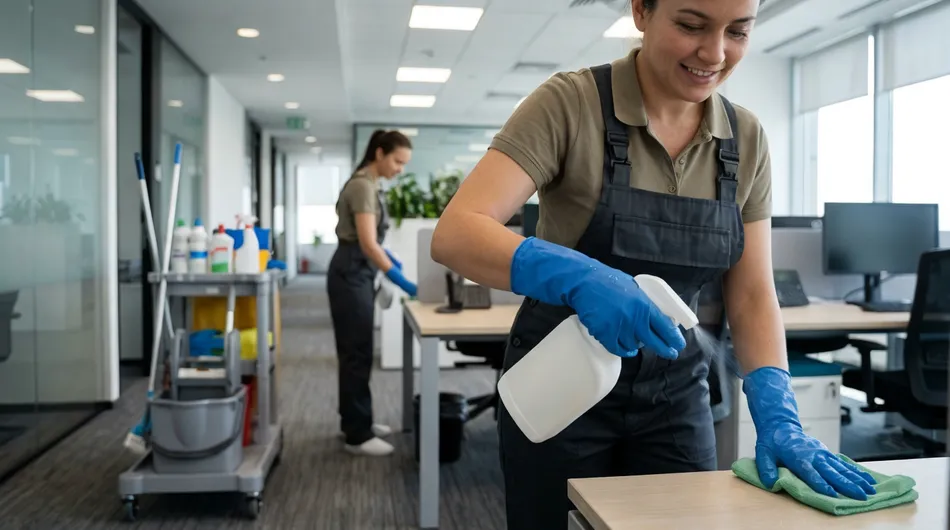
| Industrial / heavy | 0.12–0.15mm | Chemical handling, janitorial | Reduced tactile sensitivity above 0.15mm |
The failure mode we see most often in incoming inspection at destination ports isn't a glove that's too thin overall — it's a glove where the fingertip measurement drops below the palm measurement by more than the tolerance allows. A supplier quoting "0.10mm" may be measuring at the palm. Ask specifically for fingertip thickness data.
(We include fingertip measurements in our outgoing inspection reports as standard — it's one of the first things US buyers ask for, and it should be.)
AQL Standards: What 1.5 vs 2.5 Actually Costs You
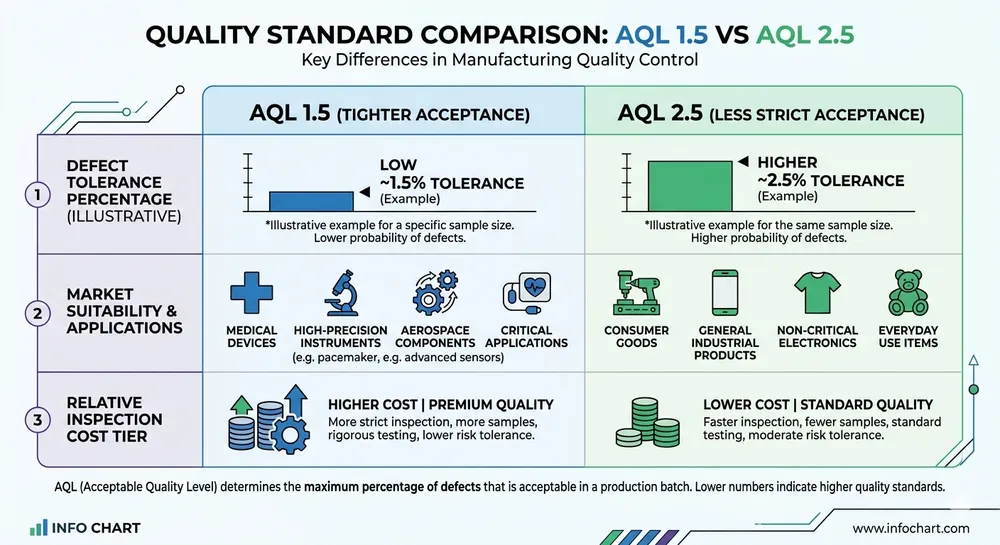
AQL — Acceptable Quality Level — is the statistical sampling standard that determines how many defective gloves are acceptable in a given lot. Most distributors have seen "AQL 1.5" on a spec sheet. Fewer understand what it means at container scale.
AQL 1.5 means that in a lot of 10,000 gloves, the acceptable number of defective units found during sampling is low enough that the statistical probability of the full lot exceeding 1.5% defects is within the defined confidence interval. AQL 2.5 allows roughly double that defect rate.
For medical-grade blue nitrile destined for US hospital or clinical accounts, AQL 1.5 is the standard your buyers expect. For industrial distribution into food processing or janitorial supply, AQL 2.5 is often acceptable — and it affects your landed cost, because tighter inspection means more line time and higher rejection rates at the factory.
| AQL Level | Defect Tolerance | Typical Market | Cost Implication |
|---|---|---|---|
| AQL 1.5 | ~1.5% max defect rate | Medical, dental, food-contact | Higher per-box cost; required for FDA-regulated use |
| AQL 2.5 | ~2.5% max defect rate | Industrial, janitorial, general use | Lower cost; not suitable for medical claims |
We run 100% AQL 1.5 inspection with online pinhole detection across all production lines. That means every glove passes an electronic pinhole test before it's counted into a box — not just a statistical sample pulled at the end of the run. For distributors selling into medical accounts, that's the difference between a clean import and a lot rejection at the hospital's receiving dock.
Certifications That Matter for US Import: FDA, ASTM, and What to Request
Blue nitrile gloves entering the US market for medical or exam use require FDA 510(k) clearance. This is not a factory certification — it's a product-level clearance that applies to a specific glove formulation, thickness range, and manufacturing process. A factory can hold ISO 9001 and still ship you gloves that can't legally be sold as medical exam gloves in the US without 510(k).
Our Blue Nitrile Gloves carry FDA 510(k) clearance alongside CE, EN455, and ASTM D6319 — the ASTM standard specifically written for nitrile exam gloves. When you're evaluating a supplier, ask for the 510(k) number and verify it against the FDA device database. It takes two minutes and eliminates a category of import risk entirely.
The certifications that matter for US distribution, in order of import relevance:
| Certification | What It Covers | Required For |
|---|---|---|
| FDA 510(k) | Medical device clearance for exam gloves | Any medical or exam-grade claim in the US |
| ASTM D6319 | Physical performance standard for nitrile exam gloves | Compliance with US exam glove specifications |
| ISO 9001:2015 | Quality management system | Factory-level process consistency |
| CE / EN455 | European medical glove standard | EU market entry (not required for US, but signals process rigor) |
One thing worth knowing: ASTM D6319 specifies minimum tensile strength, elongation at break, and AQL requirements. A glove that passes ASTM D6319 has been tested against those minimums. A glove that's merely "ASTM-compliant" without test data is a different thing. Ask for the test report, not just the claim.
Blue Color Consistency: A Sourcing Variable Most Buyers Underestimate
Blue is the dominant color in nitrile exam gloves for a reason — it's visually distinct from skin tone and from food, which matters in medical and food-processing environments. But "blue" covers a wide range, and color consistency across a full year of orders is harder to maintain than most buyers expect.
The color comes from pigment added to the nitrile compound during mixing. Batch-to-batch variation in pigment concentration, dipping temperature, and cure time all affect the final shade. A distributor who sources from multiple factories — or even from the same factory across different production runs — can end up with boxes that don't match on the shelf.
We control this through our in-house compounding lab, where we formulate and batch the nitrile compound ourselves rather than buying pre-mixed compound from a third-party supplier. That means we own the pigment ratio, and we can reproduce the same shade across a full year's worth of orders. For distributors who private-label or who supply accounts with strict color-coding protocols (operating rooms, food lines), that consistency is worth specifying explicitly in your purchase order.
(Color tolerance is one of those specs that rarely appears on a standard spec sheet but comes up in almost every complaint we handle. If your accounts care about it, put a Pantone reference or a physical color standard in your PO — don't leave it to interpretation.)
Powder-Free, Accelerator-Free, and Textured: Choosing the Right Variant for Your Market
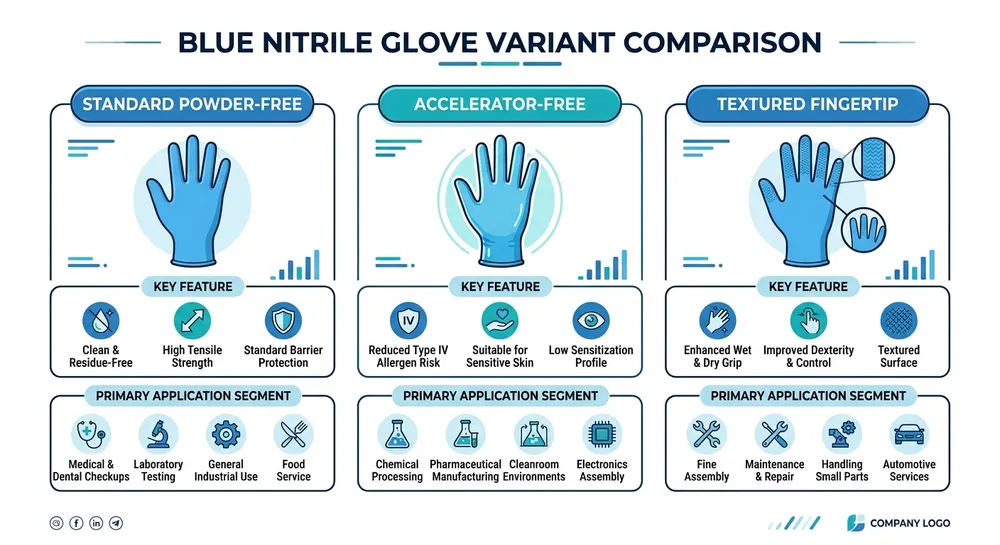
Standard blue nitrile gloves are powder-free — that's been the baseline for medical and food-contact use for years. But within powder-free, there are now three variants that matter for US distribution:
Standard powder-free nitrile covers the majority of medical exam, dental, and general industrial use. If your accounts haven't specified otherwise, this is what they're ordering.
Accelerator-free nitrile is formulated without the chemical accelerators (thiurams, carbamates, dithiocarbamates) that cause Type IV allergic reactions in a subset of users. Demand for accelerator-free has grown steadily in surgical and long-wear applications. We produce accelerator-free variants from the same facility — same dipping lines, different compound formulation. For distributors building out a medical product line, having an accelerator-free SKU alongside standard exam gloves covers the allergy-sensitive segment without needing a second supplier.
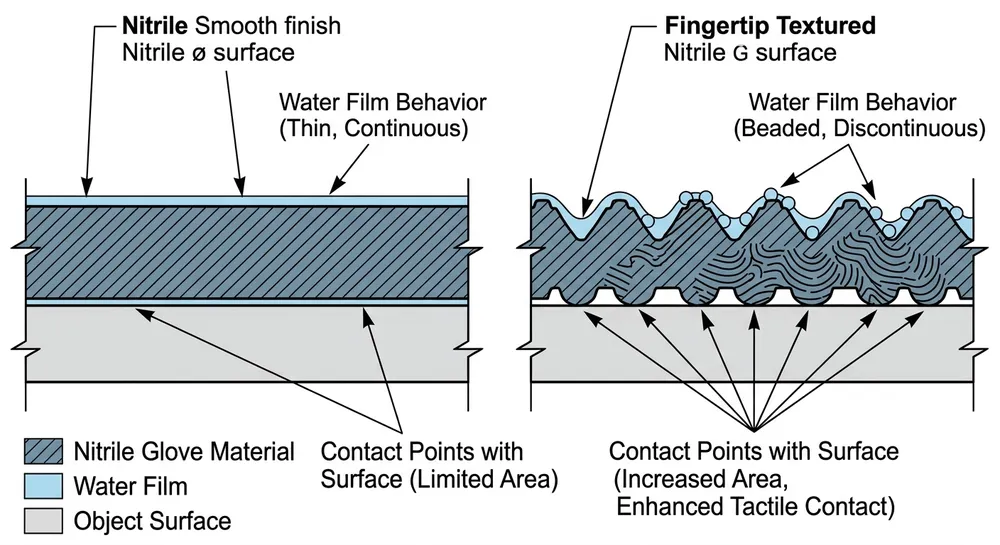
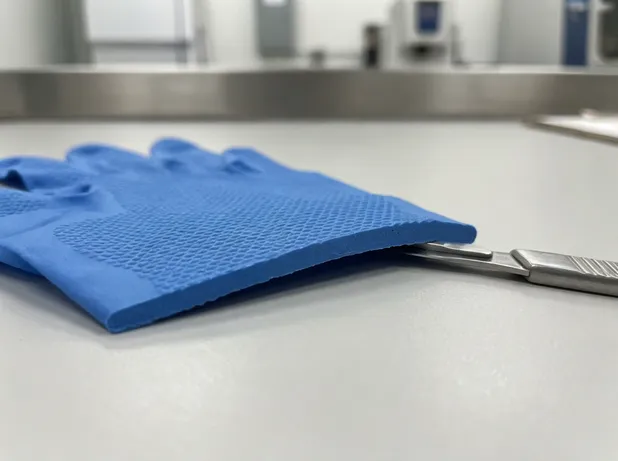
Textured fingertip adds a micro-roughened surface at the fingertip zone during the dipping process. It improves grip on wet or oily surfaces and is the preferred spec for dental, surgical tech, and automotive assembly accounts. The texture is formed during dipping, not applied after — so it doesn't affect thickness uniformity or AQL performance.
All three variants are available from our facility under the same production and inspection standards. For distributors managing multiple SKUs, sourcing all three from one factory simplifies your QC documentation and your reorder process.
The Spec Drift Problem: Why Your Sample and Your Container Can Differ
This is the issue I spend the most time on with new distributor accounts. A buyer receives a sample — thickness checks out, AQL looks good, color is right. They place a 2,000-box container order. The container arrives and the gloves are thinner, or the color is off, or the AQL rejection rate at their customer's incoming inspection is higher than expected.
What happened? In most cases, the sample was produced on a controlled run — sometimes literally a dedicated sample batch — while the container was produced during a standard production run where line speed, compound viscosity, and dipping temperature may have varied. The supplier wasn't necessarily dishonest. The process just wasn't locked.
The way to protect against this is to specify, in writing, that the production run must match the approved sample within defined tolerances, and to request a pre-shipment inspection report that includes:
- Thickness measurements at palm and fingertip (not just palm)
- AQL inspection results with lot size and sample size documented
- Pinhole test pass rate
- Color reference against the approved sample
We provide all of these as standard outgoing documentation on every container. If a supplier can't produce a pre-shipment inspection report with those four data points, that's the sourcing risk — not the price.
For distributors placing their first order with any factory, a third-party pre-shipment inspection (SGS, Bureau Veritas, or equivalent) adds a layer of verification that's worth the cost on the first container. After that, you have a baseline.
MOQ, Lead Time, and Container Planning for US Distributors
Our standard MOQ for blue nitrile gloves is one container — approximately 2,000 boxes for standard exam sizes (S/M/L/XL). That's the practical minimum for factory economics on a dedicated production run, and it's the entry point for most US distributors building a new SKU.
For OEM and private-label orders, the same MOQ applies. We support custom box printing, custom branding, and custom color specifications (within our compound formulation range) from the same facility. Lead time on a standard SKU with existing tooling runs 25–35 days from order confirmation to container loading. Custom box printing adds 7–10 days for artwork approval and print production.
A few things that affect your landed cost calculation that don't always appear in the initial quote:
- Carton configuration: Standard export carton is 10 boxes × 100 gloves per box. Non-standard configurations (50-count boxes, 200-count boxes) require different packaging tooling and affect container loading efficiency.
- Size mix: A container split across S/M/L/XL in equal quantities is straightforward. A container heavily weighted toward one size may require a partial production run on other sizes, which affects scheduling.
- Certification documentation: FDA 510(k) clearance documentation, ASTM test reports, and ISO certificates are included. If your customer requires additional third-party lab testing (e.g., specific chemical resistance tests), that's a separate cost and timeline item.
If you're building out a blue nitrile SKU for the first time, the most efficient path is to start with a standard exam grade in your two highest-volume sizes, confirm the spec against your accounts' requirements, and expand from there. We've seen distributors over-specify on the first order — requesting accelerator-free and textured fingertip simultaneously before they know which segment will move — and end up with slow-moving inventory in one variant.
Frequently Asked Questions
What is the difference between AQL 1.5 and AQL 2.5 for blue nitrile gloves?
AQL 1.5 allows a lower statistical defect rate than AQL 2.5 — roughly half the acceptable defect percentage. For medical exam gloves sold into US clinical accounts, AQL 1.5 is the expected standard. For industrial or general-use distribution, AQL 2.5 is often acceptable and reduces per-unit cost. The difference matters most when your downstream customers run incoming inspection — a lot that passes AQL 2.5 at the factory may fail AQL 1.5 at the hospital's receiving dock.
Do blue nitrile gloves require FDA 510(k) clearance for US sale?
For medical exam use, yes. FDA 510(k) clearance is required for any glove marketed as a medical exam glove in the US. Industrial-grade blue nitrile gloves sold without medical claims do not require 510(k), but they cannot be represented as exam-grade. If your accounts are medical facilities, dental offices, or food-processing operations with FDA-regulated product contact, confirm 510(k) status before ordering.
What causes color variation between blue nitrile glove orders?
Color variation comes from batch-to-batch differences in pigment concentration, compound mixing, and cure temperature. Factories that buy pre-mixed compound from third-party suppliers have less control over pigment consistency than factories with in-house compounding. If color consistency matters for your accounts (color-coded protocols, private-label branding), specify a Pantone reference or physical color standard in your purchase order and request a color confirmation against that standard in the pre-shipment inspection report.
What is the minimum order quantity for blue nitrile gloves from glovemfg?
One container, approximately 2,000 boxes for standard exam sizes. OEM and private-label orders are supported at the same MOQ. For mixed-size containers, the total box count remains the same — the size split is flexible within standard production scheduling.
Can accelerator-free and standard exam blue nitrile gloves be ordered from the same factory?
Yes — we produce both from the same facility on the same dipping lines, using different compound formulations. This means your QC documentation, inspection standards, and supplier relationship are consistent across both SKUs, which simplifies your compliance paperwork and reorder process.
—
Ready to confirm specifications for your next blue nitrile glove order? Request Quote with your target grade, size mix, and volume — we'll send back a detailed quote with full certification documentation and a sample set against your spec.