Buyers get burned on texture more than almost any other glove spec. Not because texture is complicated — it isn't — but because most suppliers describe it in marketing language rather than manufacturing terms. "Enhanced grip" tells you nothing about whether the glove will hold a wet instrument in a food processing line or slip on a dry component in a cleanroom. The texture pattern, its depth, its coverage area, and how it was formed during dipping all determine actual grip performance. Get the wrong variant for your application segment and you're fielding complaints from your downstream customers within weeks of the first shipment.
We've been running textured nitrile on our dipping lines since 2007. Here's what the texture actually does — and what you need to specify before you place a container order.
What grip performance actually measures in a nitrile glove
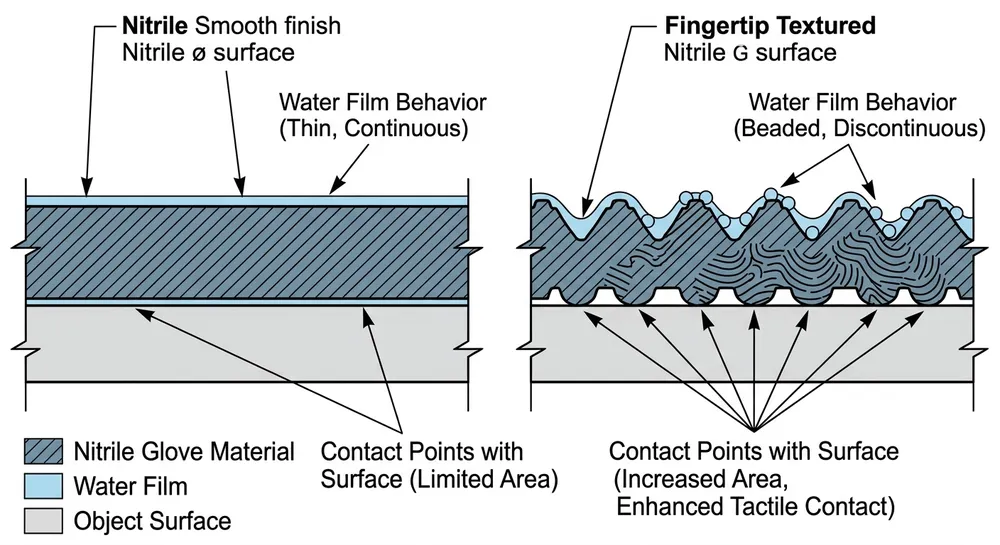
Grip in a nitrile glove is a function of two things: the coefficient of friction between the glove surface and the object being handled, and the tactile feedback that lets the wearer maintain controlled pressure. Smooth-finish nitrile handles reasonably well in dry conditions — the nitrile compound itself has decent natural tack. The problem is wet conditions. Water, blood, cutting fluids, or even hand perspiration create a film between the glove surface and the object. On a smooth glove, that film reduces friction sharply. On a textured surface, the raised pattern breaks the film, maintains contact points, and keeps grip stable.
The practical difference isn't subtle. In food processing environments where gloves are constantly wet, a smooth-finish glove can drop effective grip by 30–40% compared to dry conditions. A well-specified fingertip texture recovers most of that loss.
Texture also affects tactile sensitivity — the ability to feel small objects, detect surface irregularities, or maintain precise grip on instruments. This matters in medical exam and light assembly applications where the wearer needs feedback through the glove, not just friction against it.

Fingertip-textured vs fully textured: the distinction that determines application fit
This is where most sourcing decisions go wrong. "Textured nitrile glove" covers two meaningfully different products, and the wrong choice for your market segment creates real downstream problems.
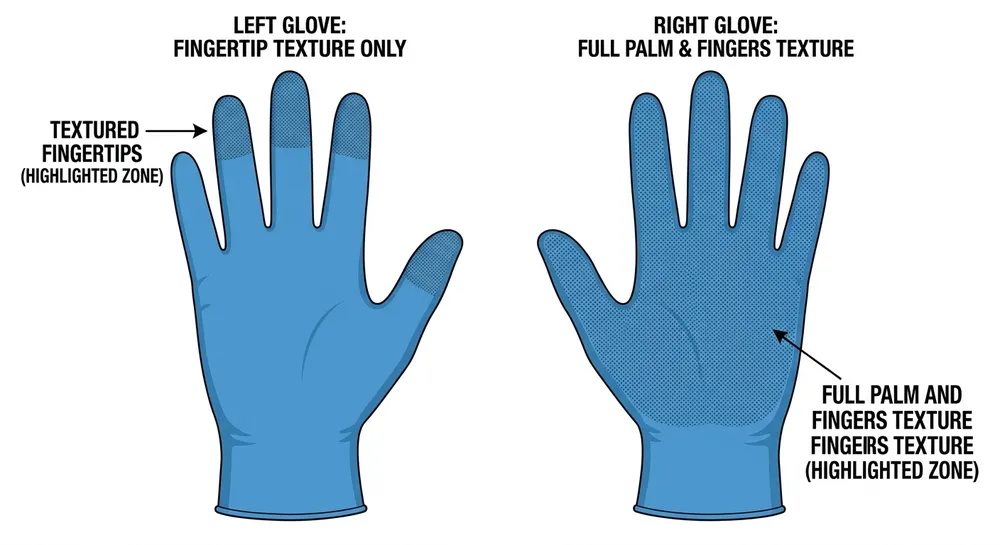
Fingertip-textured gloves have texture applied only to the fingertip zone — roughly from the first knuckle to the fingertip on all four fingers and the thumb. The palm and cuff remain smooth. This configuration is the standard for medical exam, dental, and precision assembly applications. The reasoning is straightforward: most fine-motor grip and tactile feedback happens at the fingertip. Concentrating texture there maximizes grip and sensitivity where it matters without adding bulk or stiffness to the palm. For medical distributors supplying exam rooms or surgical prep environments, fingertip-textured is the default spec.
Fully textured gloves carry the raised pattern across the entire palm and finger surface. This is the right choice for wet industrial environments — food processing, janitorial, automotive assembly, and any application where the wearer is gripping large objects with the full hand rather than manipulating small items with the fingertips. Full-palm texture gives more total contact area against wet surfaces, which translates to better grip on bottles, tools, and containers.
(We see buyers in food distribution occasionally spec fingertip-textured because it's what they know from medical sourcing — then wonder why their customers report slipping on wet packaging. The palm coverage is the missing piece.)
The commercial implication for your sourcing decision: these are different SKUs with different former tooling, different AQL inspection zones, and sometimes different thickness profiles at the palm. They're not interchangeable, and a supplier who treats them as the same product is telling you something about their production controls.
| Variant | Texture Coverage | Primary Applications | Grip Advantage |
|---|---|---|---|
| Fingertip-textured | Fingertips only (first knuckle to tip) | Medical exam, dental, precision assembly | Tactile sensitivity + wet fingertip grip |
| Fully textured | Full palm and fingers | Food processing, janitorial, industrial handling | Whole-hand wet grip on large objects |
| Smooth finish | None | Light dry-environment tasks, cleanroom | Lowest particulate shedding risk |
How texture is formed during dipping — and why the process determines spec consistency
Most content on nitrile glove texture stops at "the surface has a raised pattern." That's not useful if you're sourcing a container order and need to know whether the texture will be consistent across 50,000 pairs.
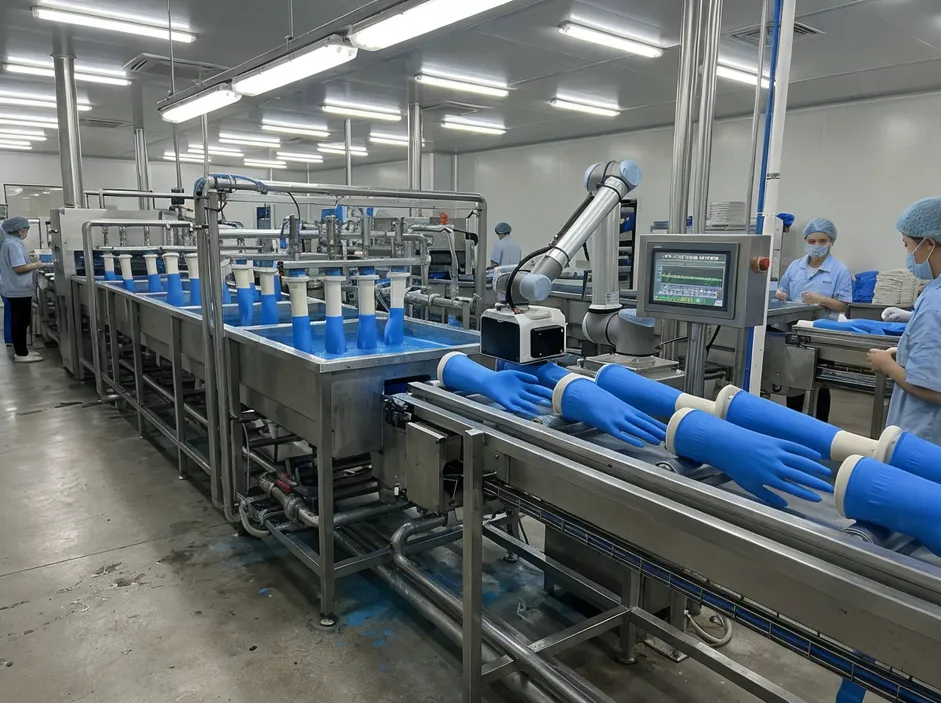
Texture in a dipped nitrile glove is formed by the ceramic former — the hand-shaped mold that the glove is built on during the dipping process. We use embossed ceramic formers where the texture pattern is machined directly into the former surface. When the nitrile compound coats the former and cures, it takes the inverse of that pattern. The texture is part of the glove from the moment it forms, not applied afterward.
This matters for two reasons. First, consistency: because the pattern comes from the former, every glove off that line has the same texture geometry — same depth, same coverage boundary, same surface area. There's no post-process variation. Second, thickness uniformity: the texture geometry affects how the nitrile compound distributes across the former surface during dipping. A well-designed embossed former maintains thickness uniformity within spec even at the raised points. A poorly designed one creates thin spots at the texture peaks, which is where pinhole failures concentrate.
We run our fingertip-textured formers at a texture depth of approximately 0.15–0.20mm above the base surface. That's enough to break a water film and provide tactile feedback without creating stress concentration points that compromise AQL pass rates. Go deeper than that and you start seeing thickness variation at the fingertip that pushes borderline gloves out of ASTM D6319 compliance.
(The other texture application method — post-process chlorination or surface treatment to add micro-roughness — produces a different feel and different grip characteristics. It's common in lower-cost production. The grip improvement is real but shallower, and it doesn't hold up as well after repeated donning and doffing cycles.)
For buyers placing container orders, the practical question is: does your supplier use embossed formers or surface treatment? The answer affects whether the texture spec you approved on the sample will still be there in box 800 of your shipment.
Grip performance by environment: what the texture actually delivers in food processing, medical, and industrial use
Texture doesn't perform the same way across all environments. Here's how the two main variants perform where your buyers actually use them.
Wet conditions (food processing, food service, wet lab work)
This is where texture earns its place. In continuous wet handling — washing produce, processing poultry, handling wet packaging — a fully textured glove maintains grip on smooth, wet surfaces where a smooth glove becomes unreliable. The raised pattern creates drainage channels that push water away from the contact zone, keeping the nitrile in direct contact with the surface. For distributors supplying food processing facilities, fully textured blue nitrile is the standard spec, and the blue color itself serves a compliance function: blue is visually detectable in food if a glove tears, which is why food-contact facilities specify it.
Dry and lightly oily conditions (light industrial, assembly, automotive)
Fully textured gloves also outperform smooth-finish in dry industrial handling — gripping tools, components, and packaging where the wearer needs secure hold without fatigue. In lightly oily environments (machine assembly, parts handling with cutting fluid residue), texture helps but the improvement is less dramatic than in wet conditions. If your buyers are in automotive assembly or light manufacturing, fully textured is still the right call, but the grip advantage over smooth is smaller than in food processing.
Medical exam and precision handling
Fingertip-textured is the right spec here. Medical exam gloves need to balance grip with tactile sensitivity — a doctor palpating a patient or a technician handling a specimen needs to feel through the glove, not just grip with it. Full-palm texture adds surface area that can slightly reduce fine tactile feedback. Fingertip texture gives the grip improvement where it's needed (instrument handling, specimen manipulation) without compromising the sensitivity that makes the glove useful for examination work. Our Textured Blue Nitrile Gloves for medical distribution are fingertip-textured by default for this reason.
The compliance angle matters here too. Medical exam gloves sold in the US market need FDA 510(k) clearance and ASTM D6319 compliance. Texture specification is part of the product definition in the 510(k) submission — you can't swap between fingertip and fully textured on a cleared product without a new submission. If you're sourcing for medical distribution, confirm that the texture variant you're ordering matches the cleared product spec.
How texture affects thickness spec and AQL pass rates — the sourcing angle competitors don't cover
This is the part most distributor-facing content skips entirely, and it's the part that determines whether your container clears inspection at the destination port.
Texture geometry changes the effective thickness measurement at the fingertip. When you measure a textured glove at the fingertip per ASTM D6319, you're measuring through the raised texture points, not the base film. A glove with 0.10mm base film thickness and 0.18mm texture peaks will measure differently depending on where the gauge contacts the surface. This isn't a problem if your supplier understands it and specs accordingly — but it becomes a problem if the supplier quotes you a "0.10mm fingertip thickness" without clarifying whether that's the base film or the peak measurement.
We spec our textured blue nitrile at 0.10mm base film at the fingertip, with the texture peaks adding approximately 0.15–0.20mm above that. The total thickness at the peak is around 0.25–0.30mm at the fingertip zone. That's the number that matters for puncture resistance and barrier integrity. The base film is what matters for tactile sensitivity and donning ease.
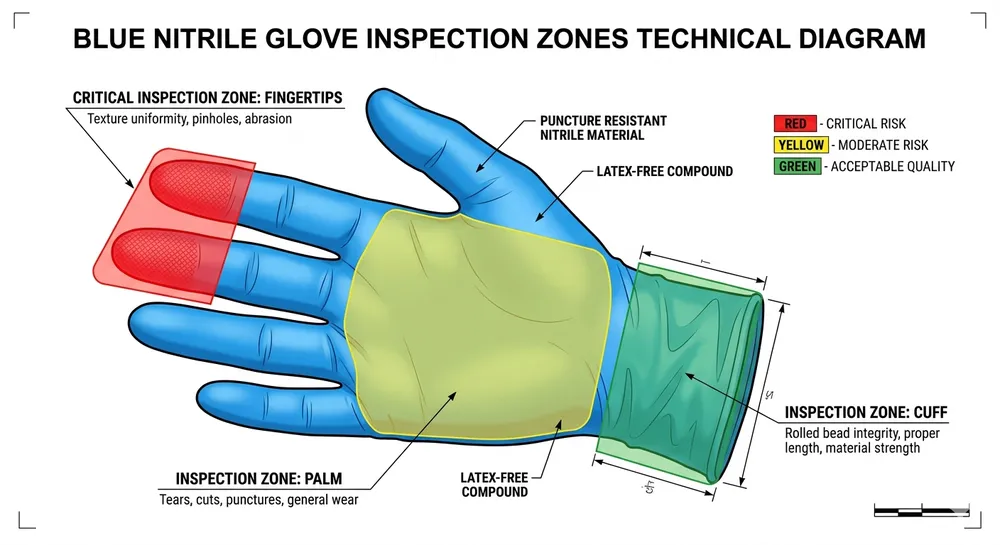
AQL inspection on textured gloves also requires attention to the texture zone specifically. Pinhole defects in nitrile gloves concentrate at stress points — and on a textured glove, the texture peaks are stress points during the curing and stripping process. Our 100% AQL 1.5 online pinhole detection runs every glove through an electrostatic test that catches pinholes regardless of where they occur on the surface, including the texture zone. That's not standard across the industry — some lines run AQL 2.5 sampling inspection, which means a statistically predictable number of defective gloves pass through per container.
For buyers sourcing for medical or food-contact applications, the AQL level is a real commercial risk. A container of gloves with AQL 2.5 inspection going into a hospital supply chain or a food processing facility creates liability exposure that your margin on the order doesn't cover.
| Spec Parameter | What to Verify | Why It Matters |
|---|---|---|
| Texture type | Fingertip or fully textured (not just "textured") | Determines application fit and 510(k) compliance for medical |
| Fingertip thickness | Base film vs peak measurement — clarify which | Affects barrier integrity and ASTM D6319 compliance |
| AQL level | 1.5 or 2.5 — get it in writing | Determines defect rate per container at destination |
| Former type | Embossed ceramic vs surface treatment | Affects texture consistency across a full container order |
| Texture depth | Nominal depth in mm | Affects grip performance and thickness uniformity |
What to specify when placing a container order for textured blue nitrile gloves
Vague specs create container-scale problems. Here's what a complete texture specification looks like for a Blue Nitrile Gloves order.
Texture variant: State fingertip-textured or fully textured explicitly. "Textured" alone is not a spec.
Thickness: Specify base film thickness at fingertip (not peak), palm, and cuff separately. For medical exam grade, fingertip base film of 0.08–0.10mm is typical. For industrial grade, 0.10–0.12mm at the fingertip base is common.
AQL level: For medical and food-contact applications, specify AQL 1.5 with 100% online pinhole detection. Accept nothing less in writing.
Color consistency: Blue nitrile for food-contact use needs consistent color across the container — color variation signals compound batch inconsistency, which can mean other spec variations you haven't caught yet.
Certifications: For US medical distribution, FDA 510(k) clearance is non-negotiable. For European markets, CE marking under EN455 is required. Confirm that the texture variant you're ordering is covered by the specific clearance on file — not just that the manufacturer holds a clearance somewhere.
Sample approval: Before committing to a container, get a production sample from the actual line that will run your order, not a pre-production sample from a different line. Texture consistency can vary between lines if former tooling isn't standardized across the facility. We run the same embossed former spec across all 8 of our dipping lines, so a sample from any line reflects what you'll receive at container scale — but verify this with any supplier you're evaluating.
(One thing we tell buyers who are switching from a previous supplier: bring your old sample and your new sample to the same inspection. Texture depth, coverage boundary, and color can all drift between suppliers even when both are calling the product "fingertip-textured blue nitrile." The spec sheet comparison matters less than the physical comparison.)
Frequently asked questions
Does texture depth affect how quickly a nitrile glove tears?
Texture peaks are thinner than the base film, so they're the first place a tear initiates under stress. A well-designed texture pattern keeps peak thinning within acceptable limits — typically no more than 15–20% below the base film thickness at the peak. If a supplier can't tell you the thickness differential between base film and texture peak, that's a gap in their process control worth probing before you order.
Can I source fingertip-textured and fully textured from the same supplier on the same order?
Yes, if the supplier runs both former types. We produce both variants and can fulfill mixed-SKU container orders. The minimum per SKU applies — you can't split a container 50/50 below the per-SKU MOQ threshold. For buyers building out a product line across medical and food-processing segments, ordering both variants from one facility simplifies your compliance documentation and your incoming inspection process.
Does the blue color in blue nitrile gloves affect grip performance?
No. The blue pigment is added to the nitrile compound during compounding and doesn't affect the surface friction or texture geometry. The color serves a detection function in food-contact environments — blue is visually distinct against most food products, which is why food processing facilities specify it. Grip performance is determined by texture geometry and nitrile compound formulation, not color.
What's the difference between textured nitrile and textured latex grip performance?
In dry conditions, latex has slightly higher natural tack than nitrile, so smooth latex can outperform smooth nitrile on grip. In wet conditions, the difference narrows significantly — a well-textured nitrile performs comparably to textured latex in most food and medical applications. The practical advantage of nitrile is chemical resistance and the absence of latex protein allergens, which is why most food processing and medical facilities have moved to nitrile regardless of the marginal grip difference.
How do I verify texture consistency across a full container order?
Request an incoming inspection protocol that includes fingertip thickness measurement (base film, not peak), visual texture coverage check against an approved sample, and AQL pinhole test results from the outgoing inspection at the factory. If your supplier provides a pre-shipment inspection report with these data points, you have a paper trail. If they can only provide a general COA without texture-specific measurements, you're accepting more risk than the spec sheet suggests. For buyers sourcing at volume, an RFQ that specifies these verification requirements upfront filters out suppliers who can't meet them.