Packaging decisions get made late in the sourcing conversation — usually after price, spec, and lead time are already settled. That's a mistake. The wrong box count locks you into a retail channel you can't serve. The wrong carton configuration adds $0.08–0.15 per box in downstream handling costs. And if you're routing any volume through Amazon FBA, a non-compliant label means your container sits in a receiving queue while your competitors' stock goes live.
I've processed enough export orders to know that most packaging problems aren't factory problems — they're communication problems that happen before the PO is issued. This article covers what you actually need to specify, why each decision matters commercially, and how we handle it on our end.
—
Box Count Options and Which Channels They Serve
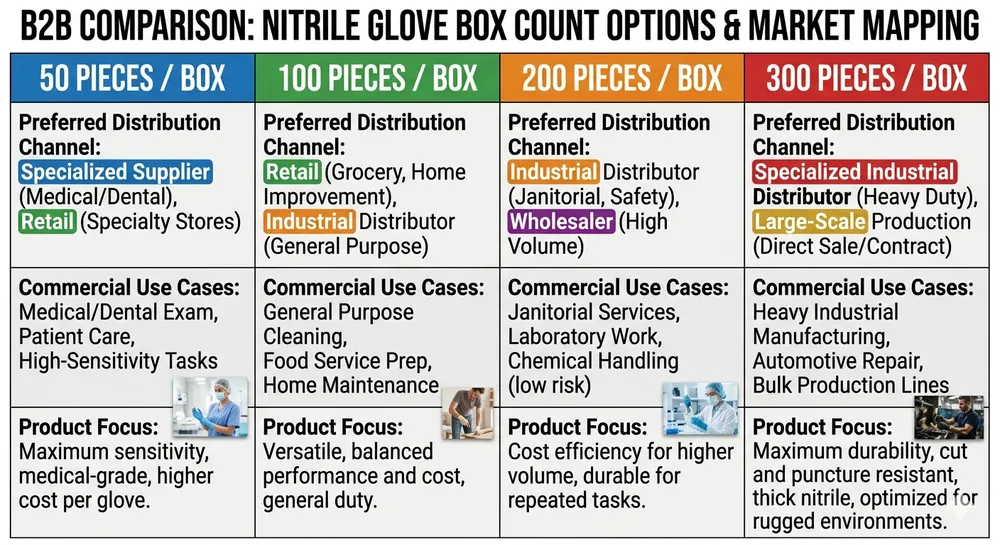
The standard retail box for disposable blue nitrile gloves is 100 pieces. That's the count your end buyers expect to see on a shelf, in a supply cabinet, or in an Amazon listing. It's also the count that most US distributors stock as their baseline SKU.
But 100-count isn't the only option, and for some channels it's not the right one.
| Box Count | Typical Channel | Commercial Logic |
|---|---|---|
| 100 pcs | Retail, medical supply, Amazon FBA | Standard unit for per-box pricing; easy for end buyers to reorder |
| 200 pcs | Industrial / janitorial wholesale | Lower per-glove cost; fewer box changes on high-volume lines |
| 50 pcs | Trial packs, specialty retail | Higher per-unit margin; useful for new SKU launches |
| 300 pcs | Bulk industrial, food processing | Reduces packaging waste and restocking frequency for high-consumption accounts |
We run 100-count as our default. If you're targeting industrial accounts that go through a box a day per workstation, 200-count cuts your customer's restocking labor and gives you a differentiated SKU that's harder to price-compare on Amazon. (We've seen a few distributors use 200-count as their "house brand" configuration specifically because it doesn't map directly to the commodity listings.)
The 50-count format works well for distributors entering a new vertical — dental offices, tattoo studios, aesthetics clinics — where the buyer wants to trial before committing to a full case. Margin per glove is higher, and the lower per-box price point reduces the commitment barrier.

—
Master Carton Configuration: The Number That Drives Your Landed Cost
Box count is what your customer sees. Carton configuration is what determines your freight cost, warehouse handling efficiency, and FBA receiving speed.
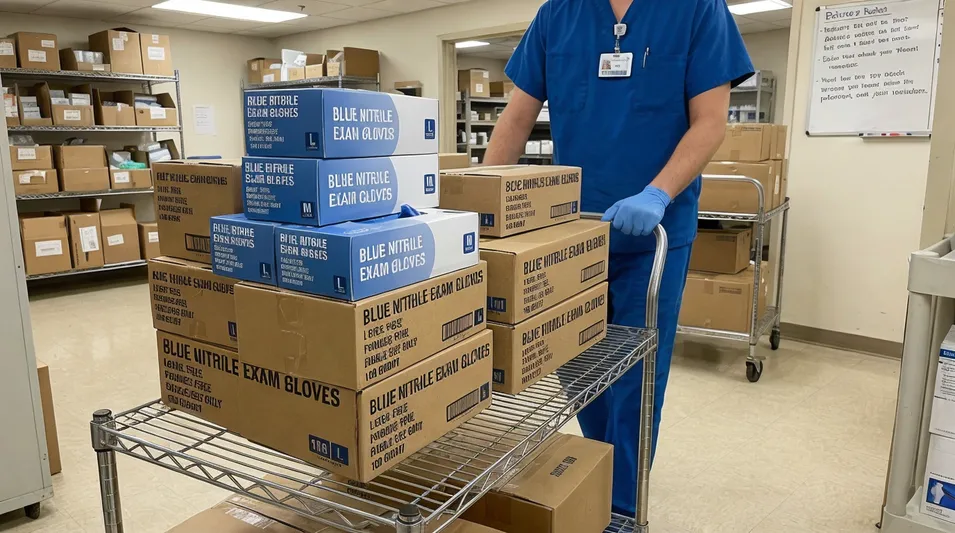
A standard master carton for 100-count boxes holds 10 boxes — 1,000 gloves per carton. That's the configuration most US distributors are set up to receive, palletize, and scan. It's also the configuration Amazon's FBA receiving teams process fastest.
Here's how the common configurations compare:
| Carton Config | Boxes per Carton | Gloves per Carton | Gross Weight (approx.) | Pallet Fit (standard 48"×40") |
|---|---|---|---|---|
| 10×100 pcs | 10 | 1,000 | ~8–9 kg | 40–50 cartons |
| 10×200 pcs | 10 | 2,000 | ~15–16 kg | 40–50 cartons |
| 20×100 pcs | 20 | 2,000 | ~16–18 kg | 20–25 cartons |
| 10×50 pcs | 10 | 500 | ~4–5 kg | 40–50 cartons |
The 10×100 configuration is our most-shipped format for US accounts. It keeps carton weight under 10 kg, which matters for manual handling at distribution centers — anything over 12 kg starts generating ergonomic complaints from receiving staff, and some 3PLs charge a surcharge for heavy cartons.
The 20×100 configuration doubles the glove count per carton and improves container utilization by roughly 15–18%, but the heavier carton weight is a real trade-off. We've had buyers switch back to 10×100 after their 3PL flagged the handling issue. If your warehouse is fully mechanized, 20×100 makes sense. If your DC has manual receiving, stay with 10×100.
One thing worth knowing: carton dimensions affect how tightly a 20-foot or 40-foot container loads. We calculate container utilization for every order before confirming — a configuration change that looks minor on paper can shift your per-box landed cost by $0.05–0.12 depending on how the cartons stack.
—
Inner Pack and Retail Box Specifications
Between the individual glove and the master carton, there's the retail box itself — and the spec decisions here affect both your customer's experience and your compliance exposure.
Standard retail box dimensions for a 100-count nitrile glove box run approximately 230mm × 125mm × 65mm. That's sized to fit standard dispensing box holders in medical and food-service environments. If your customer base includes healthcare facilities or food processors with fixed dispensing hardware, confirm this dimension before you finalize.
Box construction is typically 350–400gsm coated paperboard. We print in CMYK with a matte or gloss finish depending on the order. The box face carries:
- Brand name and logo
- Glove size (XS / S / M / L / XL)
- Piece count
- Material: nitrile, powder-free
- Color: blue
- Certifications: FDA 510(k), CE, EN455, ASTM D6319 (as applicable to the order)
- Lot number and manufacturing date
- Country of origin: China
- Manufacturer name and address
For OEM orders, we replace our branding with yours. The certification marks stay — those are tied to the product, not the brand. (A note here: some buyers ask us to remove the FDA 510(k) reference from the box to simplify the label. We don't do that. If the product is cleared, the clearance should be on the box. Removing it creates downstream liability for your customer.)
—
FBA-Ready Labeling: What Amazon Actually Requires
If any portion of your volume routes through Amazon FBA, packaging compliance isn't optional — it's a receiving condition. Amazon's FBA requirements for PPE and disposable gloves have specific label elements that differ from standard retail labeling, and non-compliance means your shipment gets flagged at the fulfillment center.
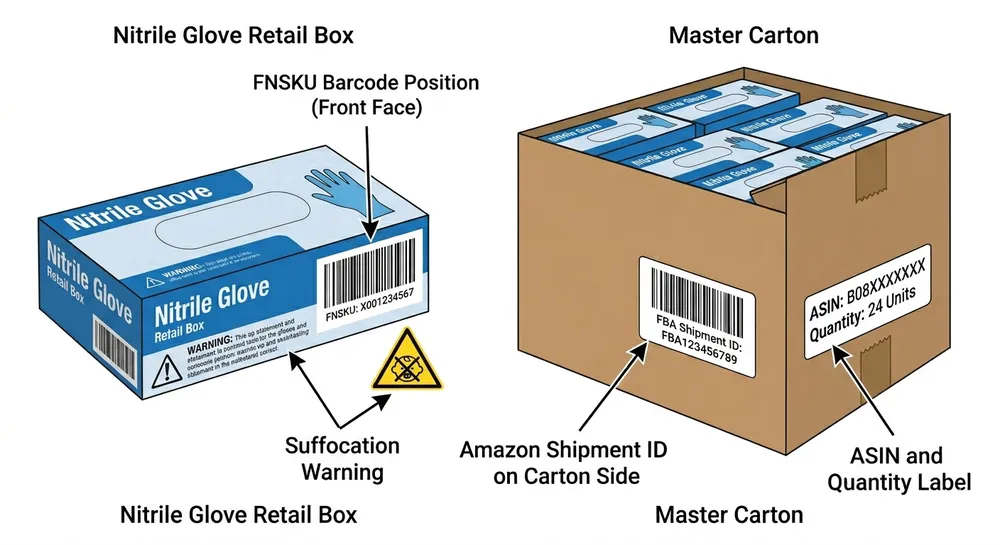
Here's what FBA receiving checks for on nitrile glove cartons:
Unit-level (retail box) requirements:
- FNSKU barcode on each sellable unit (this is Amazon's internal identifier — it replaces or covers the manufacturer barcode)
- Suffocation warning if the product is in a poly bag (standard for individually poly-wrapped boxes)
- Expiration date if the product has one (nitrile gloves typically carry a 3–5 year shelf life; if your listing includes an expiration date, it must match the physical label)
Carton-level requirements:
- Amazon shipment ID label on the outside of each carton
- ASIN and quantity label
- No loose items inside the carton that aren't individually labeled
Pallet-level requirements (for LTL/FTL shipments):
- Amazon pallet label on all four sides
- Pallet height must not exceed 72 inches including pallet
- Stretch-wrapped and stable
We can apply FNSKU labels at the factory before shipment — this is the most cost-effective point to do it, and it avoids the FBA prep service fees that typically run $0.15–0.55 per unit at a US 3PL. For a 10,000-box order, that's $1,500–$5,500 in avoidable cost. You send us the FNSKU barcodes after your Amazon listing is live, and we apply them during packing.
(One thing to confirm before you finalize your FBA configuration: if you're selling under multiple ASINs — say, separate listings for S/M/L — each size needs its own FNSKU. We've had orders arrive with a single FNSKU applied across all sizes, which creates a receiving error. Get the full FNSKU list from Seller Central before the cartons are packed.)
—
Private Label Packaging: What You Can Customize and What You Can't
For distributors building a house brand, the packaging is the product — it's what your customer sees, handles, and reorders by name. We support full OEM packaging on orders from one container (approximately 2,000 boxes for standard SKUs).
What's customizable:
- Brand name, logo, and color scheme on the retail box
- Box copy in English, Spanish, French, or bilingual formats
- Size range and piece count per box
- Certification marks displayed (based on which certifications apply to your order)
- Carton markings and inner pack configuration
What stays fixed regardless of branding:
- Country of origin declaration (required by US Customs)
- Material composition (nitrile, powder-free)
- Manufacturer identification (required for FDA-regulated products)
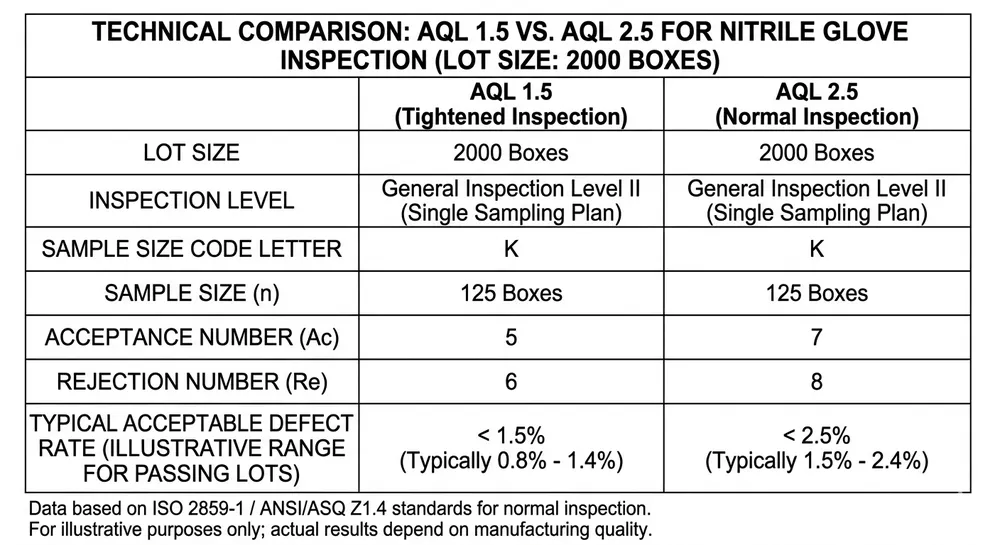
- AQL and inspection standard references if the product is sold into medical channels
The practical constraint most buyers hit is artwork lead time. We need print-ready files — vector format, CMYK color profile, with bleed and safe zones marked. If you send us a JPEG logo and a rough layout, we can work with it, but the back-and-forth adds time. Our standard is to confirm the dieline, send a digital proof, and get written approval before we print. We don't run production boxes without a signed-off proof. (We learned that lesson early — a color mismatch on a 5,000-box run is an expensive conversation.)
For distributors sourcing Disposable Blue Nitrile Gloves for the first time under their own brand, we typically recommend starting with a 1-container trial using our standard box design with your logo applied. It gets product into your warehouse faster, lets you test the market, and gives you real sales data before you invest in a full custom packaging run.
—
Pallet Configuration and Container Loading for US Ports
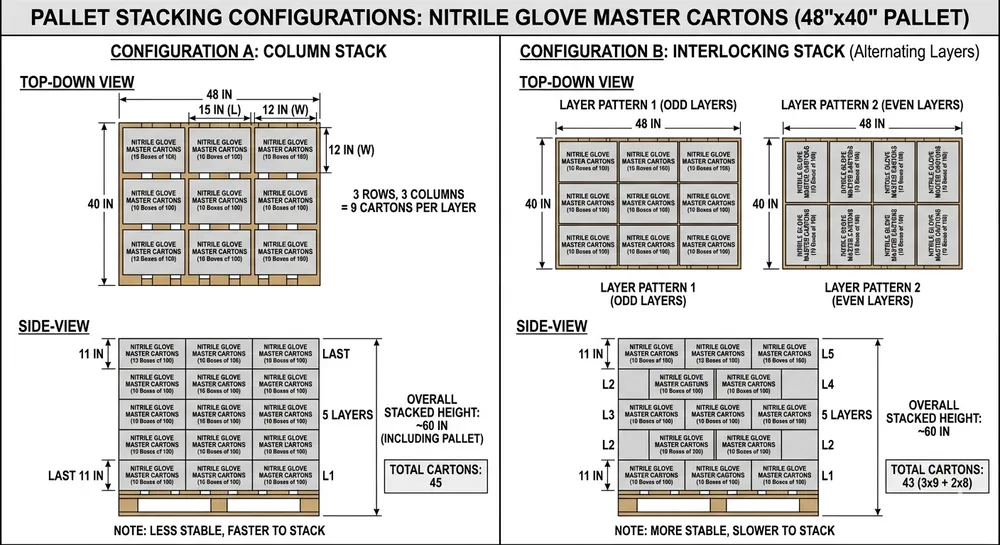
US distribution centers — whether your own warehouse, a 3PL, or an Amazon fulfillment center — operate on standard 48"×40" GMA pallets. If you're importing from China, your container loading needs to account for this from the start, not as an afterthought at the destination port.
We load containers on 48"×40" pallets by default for US-bound orders. Standard pallet height for FTL/LTL delivery to US DCs is 48 inches of product plus the pallet board — total height under 60 inches keeps you clear of most DC height restrictions and allows double-stacking in some warehouse configurations.
For a 40-foot container loaded with 10×100 cartons:
- Approximately 2,400–2,600 cartons per 40' container (depending on carton dimensions and stacking pattern)
- 50–60 pallets at standard pallet height
- Gross container weight well within the 26,000 kg limit for standard containers
If you're splitting a container across multiple SKUs or sizes, we map the loading plan before packing starts. Mixed-SKU containers need clear carton marking so your receiving team can sort without opening cartons — we print size and SKU on all four sides of the master carton as standard.
One configuration question that comes up regularly: floor-loaded vs. palletized. Floor-loading maximizes container utilization by 10–15% but requires your receiving team to palletize on arrival, which adds labor cost and time. For most US distributors, the palletized option is the right call — the container utilization loss is smaller than the receiving labor cost, especially if you're paying 3PL receiving fees by the pallet.
—
Packaging Spec Checklist Before You Issue a PO
Packaging decisions need to be locked before the PO, not after. Here's what to confirm:
| Decision Point | Options | Default |
|---|---|---|
| Box count | 50 / 100 / 200 / 300 pcs | 100 pcs |
| Boxes per master carton | 10 or 20 | 10 |
| Retail box branding | OEM / glovemfg standard | glovemfg standard |
| Certification marks on box | FDA / CE / EN455 / ASTM | Per product spec |
| FNSKU labeling (FBA) | Factory-applied / buyer-applied | Buyer-applied unless specified |
| Pallet configuration | 48"×40" GMA / custom | 48"×40" GMA |
| Loading method | Palletized / floor-loaded | Palletized |
| Language on box | English / bilingual | English |
Send us this list filled out with your PO and we can confirm feasibility and pricing in one round. Missing items default to our standard — which is fine for most orders, but if your channel has specific requirements, it's better to state them upfront.
For questions about spec options or to discuss a custom packaging configuration for your Blue Nitrile Gloves program, Request Quote with your target channel, volume, and any FBA or private-label requirements noted.
—
FAQ
What is the minimum order for custom-printed packaging? One container — approximately 2,000 boxes for standard 100-count SKUs. Below that, the print setup cost doesn't make commercial sense for either side. For smaller trial orders, we ship in our standard glovemfg box with your label applied.
Can you apply FNSKU labels at the factory? Yes. Send us the FNSKU barcodes after your Amazon listing is confirmed, and we apply them during packing. This avoids FBA prep fees at a US 3PL, which typically run $0.15–0.55 per unit.
What certifications appear on the retail box? FDA 510(k), CE, EN455, and ASTM D6319 — depending on which certifications apply to your specific order. Medical-grade orders carry the full set. Industrial-grade orders may carry a subset. We confirm this during order review.
Do you support bilingual (English/Spanish) box printing? Yes. Spanish is the most common second language we print for US distributors serving food processing and agricultural accounts. French is available for Canadian orders. Specify at PO stage.
What happens if my carton dimensions don't match Amazon's FBA requirements? We check carton dimensions against current FBA receiving guidelines before confirming your packaging spec. If there's a conflict, we flag it before production — not after the container ships.
How do you handle size assortments in a single container? Each size ships in its own master cartons, clearly marked on all four sides. We provide a packing list with carton count by size. If you need a specific size ratio (e.g., 20% S, 50% M, 30% L), specify it in the PO and we'll confirm the production allocation.