Vinyl is cheaper per box. That's the whole argument for it, and it's a real one — especially when you're buying at container scale and your margin is already thin. But "cheaper per box" is not the same as "lower cost per case closed, per complaint avoided, per container that clears destination inspection without a rejection event."
We've been manufacturing nitrile gloves since 2007 and shipping to distributors across North America, Europe, and the Middle East. We don't make vinyl. But we do get asked this comparison constantly by buyers who are either switching from vinyl or defending a nitrile spec to a cost-conscious procurement committee. So here's the honest version — barrier data, allergy risk, and total cost logic — without the sales spin.
Quick verdict: For exam-grade applications where barrier integrity and allergy compliance matter, blue nitrile wins on every axis except unit price. Vinyl makes commercial sense only in low-risk, high-volume, cost-constrained segments where barrier failure consequences are limited. If your buyers are in dental, clinical lab, or any regulated medical environment, the cost crossover point arrives faster than the per-box price difference suggests.
—
ASTM D6319 vs ASTM D5250: What the Standards Actually Require
Before the comparison, the baseline. Nitrile exam gloves are governed by ASTM D6319 (Standard Specification for Nitrile Examination Gloves for Medical Application). Vinyl exam gloves fall under ASTM D5250 (Standard Specification for Poly(vinyl chloride) Gloves for Medical Application). These are not equivalent standards — they set different minimum performance thresholds, and the gap matters at the point of use.
| Parameter | Nitrile (ASTM D6319) | Vinyl (ASTM D5250) |
|---|---|---|
| Minimum tensile strength (before aging) | 14 MPa | 11 MPa |
| Minimum elongation at break (before aging) | 500% | 300% |
| Minimum tensile strength (after aging) | 14 MPa | 9 MPa |
| Minimum elongation at break (after aging) | 400% | 200% |
| AQL for pinholes (exam grade) | AQL 1.5 | AQL 1.5 |
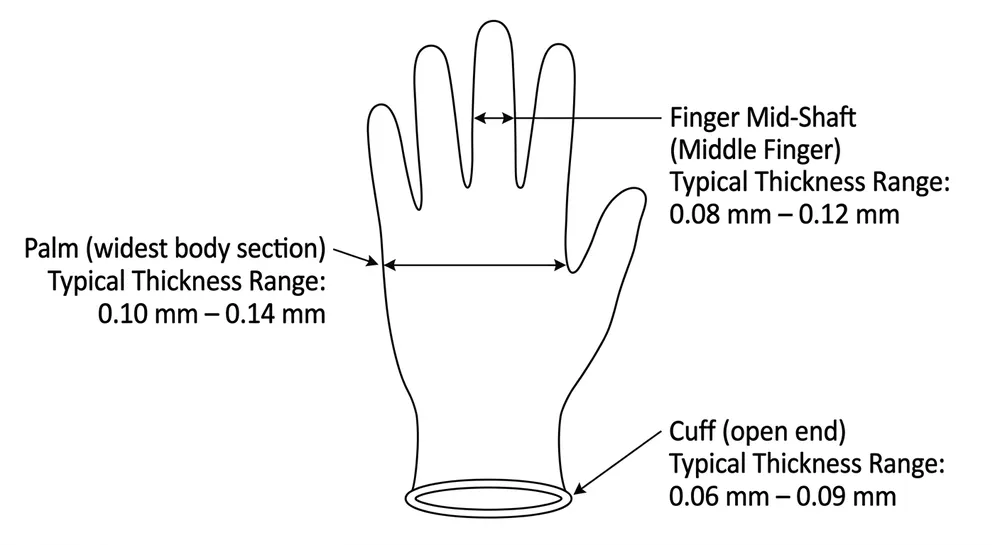
| Typical thickness range | 0.08–0.15 mm | 0.07–0.12 mm |
| FDA 510(k) pathway | Yes | Yes |
The tensile and elongation numbers tell the real story. Nitrile is required to stretch further before breaking and maintain more of that strength after accelerated aging. Vinyl's post-aging elongation floor — 200% — is less than half of nitrile's. In practice, that means a vinyl glove that's been sitting in a warm warehouse or a dental operatory supply cabinet for six months is more likely to tear during donning or snap during a procedure than a nitrile glove stored under the same conditions.
(We run our own aging tests on every production batch — the post-aging elongation drop is where we see the clearest separation between a well-formulated nitrile compound and a marginal one. It's also where cheap nitrile from undisclosed compounders tends to fail first.)
Our Blue Nitrile Exam Gloves are certified to ASTM D6319 and carry FDA 510(k) clearance, so your compliance documentation is already in place when you source from us.

—
Barrier Integrity: Pinhole Rates, AQL Standards, and What Rejection Costs You
Both materials are nominally held to AQL 1.5 at the exam-grade level. But AQL 1.5 is a sampling standard — it defines the acceptable quality level for a lot, not a guarantee that every glove in the box is pinhole-free. The real question is: what's the underlying defect rate before sampling, and how does that translate to rejection events at your destination port or your customer's facility?
Vinyl's manufacturing process — calendering PVC film and heat-sealing or dipping — produces a glove with a fundamentally different microstructure than a dip-formed nitrile glove. PVC film can develop micro-tears at stress points (thumb crotch, fingertip seams) during forming. Nitrile, dipped from a liquid compound onto a ceramic former, forms a continuous polymer film with no seams. That's not a marketing claim — it's why nitrile's pinhole failure rate in independent testing consistently runs lower than vinyl's at equivalent thickness.
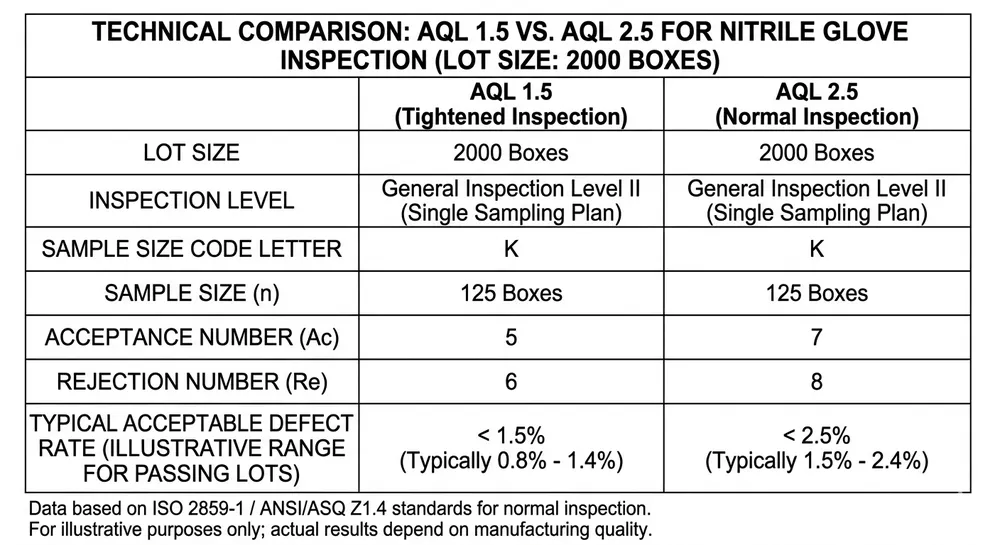
The industry-standard outgoing inspection is AQL 2.5. We run AQL 1.5 on all outgoing shipments. That's a tighter sampling plan — it catches more marginal lots before they ship. For a buyer importing 10 containers a year, the difference between AQL 1.5 and AQL 2.5 outgoing inspection is the difference between one rejection event per year and potentially three or four. A single destination-port rejection — repalletizing, re-inspection, storage fees, delayed delivery to your customer — costs more than the per-box price difference between nitrile and vinyl across an entire container.
| Inspection Factor | glovemfg Nitrile | Typical Vinyl Supplier |
|---|---|---|
| Outgoing AQL standard | AQL 1.5 | AQL 2.5 (industry standard) |
| Pinhole detection method | Online automated detection system | Manual sampling |
| Thickness consistency | In-house compounding, ±0.01mm tolerance | Varies by film supplier |
| Post-aging elongation floor | 400% (ASTM D6319) | 200% (ASTM D5250) |
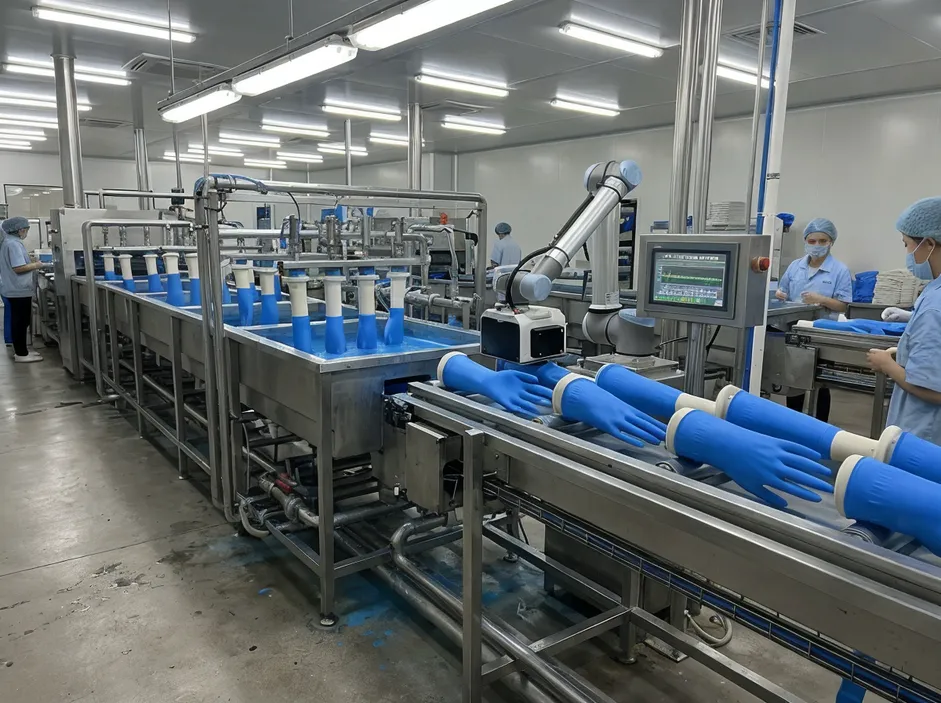
Our 8 automated dipping lines run with in-house compounded nitrile, so thickness consistency across a full container run matches the sample you approved — not just the first 1,000 pairs off the line. (Spec drift between sample and production is the most common complaint we hear from buyers who've switched suppliers. Owning the compound is how we prevent it.)
—
Allergy and Sensitization Risk: Latex-Free Is Not the Same as Allergy-Free
This is the section most comparison articles skip, and it's the one that creates the most downstream liability for distributors.
Both nitrile and vinyl are latex-free. Neither contains natural rubber latex proteins, which are the primary driver of Type I latex allergy — the IgE-mediated hypersensitivity that causes anaphylaxis in sensitized individuals. If your buyer is switching from latex to either material for allergy compliance, both options solve the Type I problem.
But latex-free does not mean allergy-free. Each material carries its own sensitization risk profile:
Nitrile: Accelerator chemical risk (Type IV) Standard nitrile gloves are vulcanized using accelerator chemicals — most commonly thiurams, carbamates, and mercaptobenzothiazole (MBT). These can cause Type IV delayed hypersensitivity reactions (contact dermatitis) in sensitized users. This is not a rare edge case — Type IV reactions to accelerator chemicals are the most commonly reported occupational glove allergy in healthcare settings. For buyers supplying dental clinics, surgical facilities, or any environment with high glove-change frequency, accelerator sensitization is a real compliance and liability concern.
The solution is accelerator-free nitrile — a formulation that eliminates the vulcanization accelerators responsible for Type IV reactions. We manufacture an accelerator-free variant from the same facility. For buyers who need to go beyond "latex-free" labeling, this is the specification to request. See our post on latex-free vs accelerator-free nitrile for the full breakdown.
Vinyl: Plasticizer migration risk PVC gloves require plasticizers — typically DINP (diisononyl phthalate) or DEHP — to achieve the flexibility needed for exam use. These plasticizers migrate out of the glove film over time and with heat exposure. DEHP is a restricted substance under EU REACH and California Prop 65. DINP is under increasing regulatory scrutiny. For buyers supplying European markets or California-based healthcare accounts, plasticizer migration is a compliance risk that doesn't appear on the per-box price tag.
| Allergy/Sensitization Risk | Nitrile (Standard) | Nitrile (Accelerator-Free) | Vinyl |
|---|---|---|---|
| Type I latex protein allergy | None | None | None |
| Type IV accelerator reaction | Present | Eliminated | None |
| Plasticizer migration (DINP/DEHP) | None | None | Present |
| EU REACH / Prop 65 exposure | None | None | DEHP restricted |
The practical implication: if you're supplying regulated healthcare environments in North America or Europe, standard nitrile is the safer default. If your accounts have documented accelerator sensitivity, accelerator-free nitrile is the specification. Vinyl's plasticizer risk is manageable in low-exposure, short-duration applications — but it's a liability you need to disclose to buyers in regulated markets.

—
Total Cost Per Box at Container Scale: Where the Math Actually Lands
Vinyl's price advantage is real. At standard market pricing, vinyl exam gloves typically run 15–30% cheaper per box than comparable nitrile at the same thickness and AQL grade. On a 2,000-box container, that's a meaningful number on the purchase order.
But the per-box price is only one input into landed cost. Here's what the full calculation looks like for a distributor buying at container scale:
Direct cost inputs:
- Unit price per box (vinyl wins)
- Freight cost per box (roughly equivalent — similar weight and cube per box)
- Import duties (equivalent for both materials in most markets)
Indirect cost inputs that vinyl buyers often miss:
- Rejection rate at destination: Vinyl's higher pinhole rate and lower post-aging elongation mean a higher probability of lot rejection at destination inspection. One rejected container — repalletizing, re-inspection, storage, delayed delivery — can cost $3,000–$8,000 depending on port and logistics provider. Spread across a year's volume, this erodes the per-box price advantage.
- Customer complaint handling: A glove that tears during use generates a complaint, a credit, and a potential account loss. Nitrile's superior tensile and elongation properties mean fewer in-use failures, fewer complaints, and lower credit memo volume.
- Regulatory compliance cost: If you're supplying EU or California accounts with vinyl, you need to verify plasticizer compliance on every production lot. That's a testing cost and a documentation burden that doesn't exist with nitrile.
- Shelf life risk: Vinyl's post-aging elongation drops faster than nitrile's. Gloves sitting in a distributor warehouse for 12–18 months before reaching end users are more likely to fail on vinyl than on nitrile. Returns from expired or degraded stock are a real cost.
The crossover point: For buyers supplying regulated medical environments with high complaint sensitivity, the total cost of vinyl typically crosses above nitrile within 2–3 container cycles when rejection and complaint costs are included. For buyers supplying low-risk, high-turnover food service or light industrial accounts where gloves are used briefly and discarded, vinyl's per-box advantage may hold.
| Cost Factor | Blue Nitrile | Vinyl |
|---|---|---|
| Unit price per box | Higher | Lower |
| Destination rejection risk | Lower (AQL 1.5 outgoing) | Higher |
| In-use failure / complaint rate | Lower | Higher |
| Plasticizer compliance cost (EU/CA) | None | Present |
| Shelf life degradation risk | Lower | Higher |
| Total landed cost (regulated medical) | Lower at scale | Higher at scale |
| Total landed cost (food service / light industrial) | Higher | Lower |
—
Buyer Segment Decision Matrix: Which Material Wins Where
Dental Clinics and Oral Surgery Supply
Nitrile wins. Dental procedures involve sharp instruments, chemical exposure (disinfectants, bonding agents), and extended wear time. Vinyl's lower chemical resistance and higher tear risk under mechanical stress make it a liability in this environment. Accelerator-free nitrile is the premium specification for accounts with documented sensitivity concerns. The Blue Nitrile Gloves category page covers the full grade range.
Clinical and Diagnostic Labs
Nitrile wins. Lab environments involve chemical splash risk, extended wear, and regulatory scrutiny. ASTM D6319 certification and FDA 510(k) clearance are typically required for procurement approval. Vinyl's lower chemical resistance to ketones, alcohols, and some solvents is a documented limitation in lab settings.
Food Service and Food Processing
Vinyl is competitive. Food contact applications don't require the same barrier integrity as medical exam use. Glove change frequency is high, chemical exposure is limited, and cost per box is a primary procurement driver. Vinyl's plasticizer migration is regulated under FDA 21 CFR for food contact — verify compliance, but it's manageable. For buyers supplying food processing facilities that also handle allergen-sensitive products, nitrile's cleaner chemical profile may still be preferred.
Industrial Light-Duty (Assembly, Janitorial, General Handling)
Vinyl is competitive for very short-duration, low-risk tasks. For anything involving chemical exposure, sharp edges, or extended wear, nitrile's superior puncture and tear resistance reduces glove change frequency enough to offset the per-box price difference.
Home Health and Long-Term Care
Nitrile wins on risk profile. Home health aides and LTC staff wear gloves for extended periods with variable chemical exposure. The allergy compliance documentation that comes with FDA 510(k)-cleared nitrile also simplifies procurement approval in regulated care settings.

—
What to Specify in Your RFQ: Sourcing Validation for Either Material
Whether you're quoting nitrile or vinyl, the spec sheet you receive and the glove that arrives in your warehouse are only the same thing if you know what to verify before the container ships.
For nitrile exam gloves, specify:
- ASTM D6319 compliance (not just "nitrile exam grade" — require the standard citation)
- FDA 510(k) clearance number (verifiable on the FDA database — don't accept a copy of a certificate without cross-checking)
- AQL standard for outgoing inspection (specify AQL 1.5 if your accounts require it — most suppliers default to AQL 2.5)
- Thickness range and tolerance (specify ±0.01mm or tighter — vague "0.10mm nominal" specs allow significant variation)
- Accelerator-free formulation if required (this must be explicitly specified — standard nitrile contains accelerators by default)
- Color consistency standard if blue color-coding matters for your facility protocols
For vinyl exam gloves, specify:
- ASTM D5250 compliance
- Plasticizer type and compliance documentation (DINP vs DEHP — require a material safety data sheet and, for EU/CA accounts, REACH/Prop 65 compliance letter)
- Post-aging elongation test results (request the actual test data, not just a certificate — this is where vinyl quality varies most)
- AQL standard for outgoing inspection
Red flags in either material:
- Supplier cannot provide the actual FDA 510(k) clearance number for independent verification
- Test certificates reference a different product name or SKU than what you're ordering
- Thickness specification given as a single number with no tolerance range
- AQL standard not specified on the quality certificate
For ASTM D6319 compliance requirements in detail, we've covered the full standard interpretation separately — including what the aging test protocol actually requires and how to read a certificate of conformance.
—
FAQ: Nitrile vs Vinyl Exam Gloves for B2B Procurement
Are vinyl exam gloves latex-free? Yes. Vinyl gloves contain no natural rubber latex proteins. They are appropriate for facilities with latex allergy policies. However, they contain plasticizers (typically DINP or DEHP) that migrate from the glove film — a separate compliance consideration for EU and California markets.
Can nitrile gloves cause allergic reactions if they're latex-free? Standard nitrile gloves are latex-free but contain vulcanization accelerator chemicals (thiurams, carbamates, MBT) that can cause Type IV contact dermatitis in sensitized individuals. This is the most common occupational glove allergy in healthcare. Accelerator-free nitrile eliminates this risk — it requires explicit specification at the sourcing stage.
What does AQL 1.5 mean compared to AQL 2.5 for exam gloves? AQL (Acceptable Quality Level) defines the maximum acceptable defect rate in a sampled lot. AQL 1.5 is a tighter standard than AQL 2.5 — it requires a larger sample size and rejects lots with fewer defects per thousand. For exam-grade gloves, both standards are used in the industry, but AQL 1.5 outgoing inspection reduces the probability of a defective lot reaching your customer. We run AQL 1.5 on all outgoing shipments; most suppliers default to AQL 2.5.
Is vinyl or nitrile better for food service procurement? For high-turnover, short-duration food handling, vinyl is cost-competitive and FDA-compliant for food contact under 21 CFR. For food processing environments with chemical exposure, extended wear, or allergen-sensitive product lines, nitrile's superior barrier and chemical resistance justify the price premium.
What thickness should I specify for exam-grade nitrile gloves? For standard exam use, 0.10–0.12mm palm thickness is the working range. Below 0.08mm, you're at the edge of ASTM D6319 compliance and pinhole risk increases. Above 0.13mm, tactile sensitivity drops — relevant for dental and surgical-adjacent applications. We run 0.08–0.15mm across our lines; the right spec depends on your end-use environment.
Does FDA 510(k) clearance apply to both nitrile and vinyl exam gloves? Yes — both nitrile and vinyl exam gloves can carry FDA 510(k) clearance as Class II medical devices. The clearance is product-specific, not material-specific. Always verify the clearance number against the FDA database for the exact SKU you're sourcing, not just the manufacturer's product line.
—