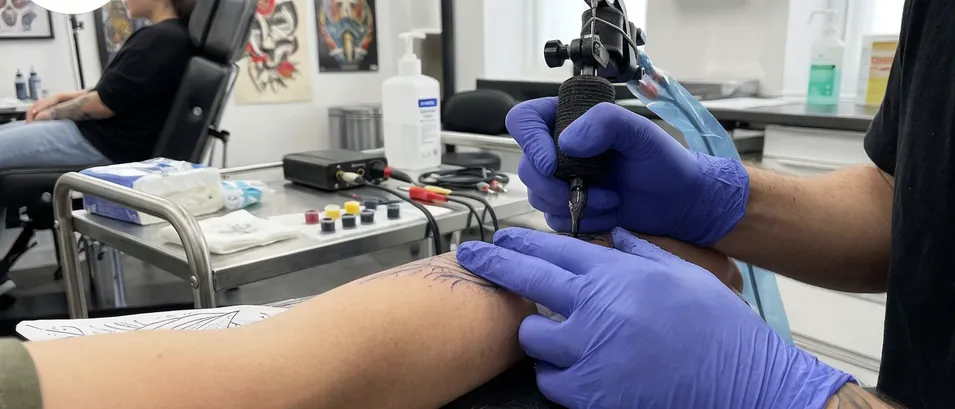
Most sourcing problems with exam-grade nitrile gloves don't start at the factory. They start when a buyer accepts a supplier's "ASTM D6319 compliant" claim without knowing what that actually requires — and then discovers the problem at destination inspection, or worse, after the gloves are already in a customer's warehouse.
ASTM D6319 is the US standard for nitrile rubber examination gloves. It sets minimum physical property thresholds, defines acceptable defect rates, and specifies the test methods used to verify both. If you're importing Blue Nitrile Exam Gloves for US healthcare, dental, or industrial distribution, this standard is the baseline your supplier must meet — and the document trail they must be able to produce.
This article walks through what the standard actually requires, what the test numbers mean in practice, and how to read a supplier's COA against those requirements before you commit to a container.
—
What ASTM D6319 Covers — and What It Doesn't
ASTM D6319 applies specifically to nitrile rubber gloves intended for medical examination and diagnostic procedures. It covers single-use, ambidextrous gloves in both powdered (Type B) and powder-free (Type A) configurations.
In practice, Type A dominates procurement. Powdered gloves have been effectively banned from US surgical and examination use since the FDA's 2016 rule prohibiting powdered surgeon's gloves and powdered patient examination gloves in healthcare settings. If your buyers are hospital groups, dental chains, or any regulated healthcare facility, they need Type A — powder-free. Type B still appears in some industrial and non-medical procurement specs, but for healthcare distribution, it's a non-starter.
The standard does not cover latex or vinyl examination gloves. It does not cover surgical gloves (those fall under ASTM D3577 for latex and ASTM D6977 for nitrile surgical). And it does not, by itself, constitute FDA clearance — a point worth understanding clearly before you evaluate a supplier's documentation.
—
Physical Property Minimums: The Numbers That Actually Matter
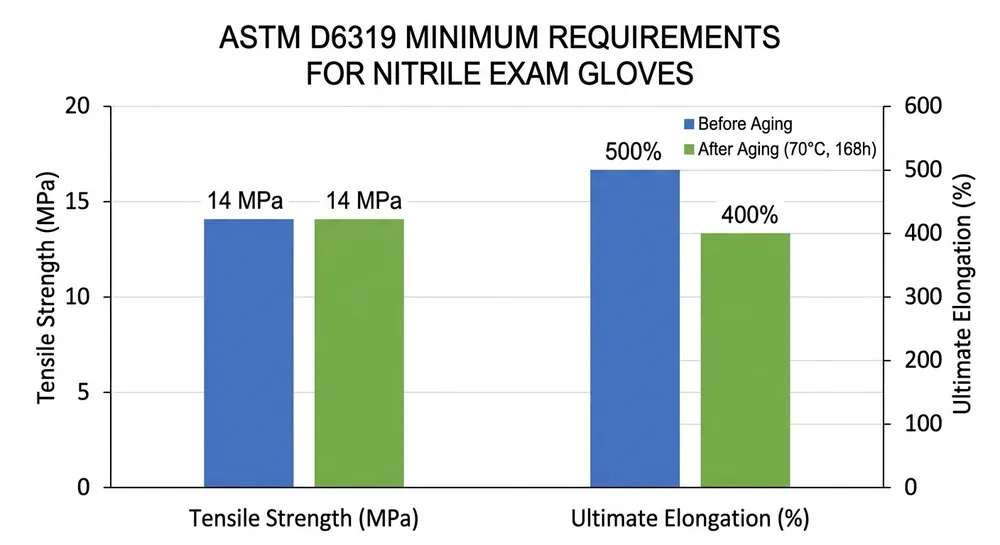
ASTM D6319 sets minimum performance thresholds for three physical properties: tensile strength, elongation at break, and thickness. These are tested before and after artificial aging (oven aging at 70°C for 166 hours), which simulates shelf-life degradation. A glove that passes before aging but fails after is not compliant — and that's a failure mode that shows up more often than buyers expect when a factory's compound formulation isn't stable.
| Property | Before Aging (min) | After Aging (min) | Test Method |
|---|---|---|---|
| Tensile strength | 14 MPa | 11 MPa | ASTM D412 |
| Elongation at break | 500% | 400% | ASTM D412 |
| Thickness — single wall (palm) | 0.05 mm | — | ASTM D3767 |
| Thickness — single wall (finger) | 0.08 mm | — | ASTM D3767 |
| Thickness — single wall (cuff) | 0.05 mm | — | ASTM D3767 |
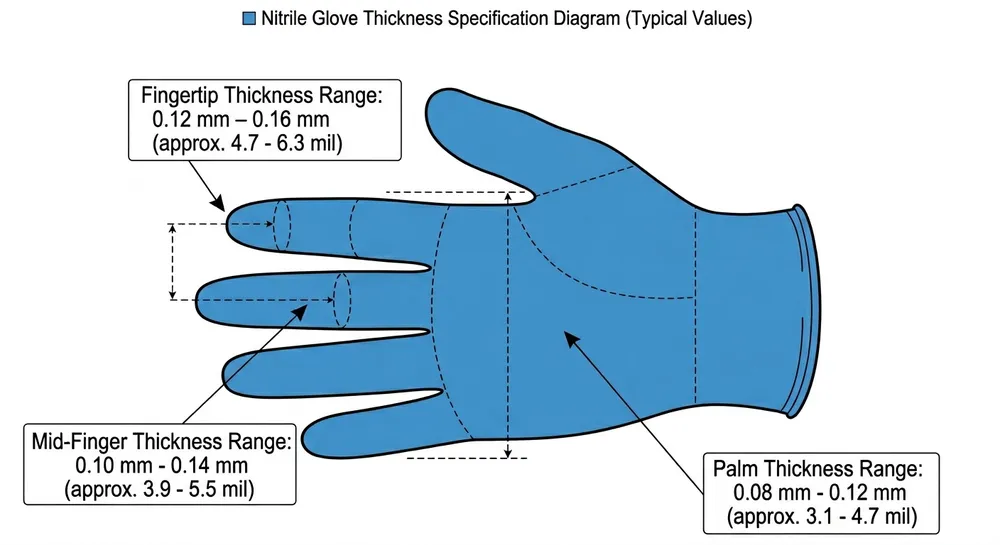
A few things worth noting about these numbers. The tensile and elongation minimums are not generous — a factory running thin compound or inconsistent cure temperatures will drift below them across production lots even if the first sample passes. The thickness minimums are floors, not targets; most exam-grade gloves run 0.08–0.12mm at the palm in practice, because buyers and end users expect a glove that doesn't feel like tissue paper.
The aging test is where formulation stability shows up. We run our compound through accelerated aging on every new lot qualification, not just at initial certification. The in-house compounding lab gives us direct control over the cure system — if a batch shows elongation drop after aging, we trace it back to the compound, not the dipping line. Factories that buy pre-mixed compound from third-party suppliers often can't do that diagnosis.

—
AQL Requirements Under ASTM D6319
ASTM D6319 mandates acceptance quality limit (AQL) testing for defects. The standard specifies AQL 1.5 for critical defects (holes, tears, and other integrity failures) using sampling procedures from ANSI/ASQ Z1.4.
AQL 1.5 means that in a statistically valid sample from a production lot, the acceptable defect rate is 1.5% or lower. In practice, what this means for your incoming inspection: if you're receiving a lot of 10,000 boxes and sampling per the Z1.4 table at inspection level II, you'd pull a sample of around 200 units. If more than a defined number of those units show critical defects, the lot fails.
The distinction between AQL 1.5 and AQL 2.5 matters commercially. Many factories default to AQL 2.5 for outgoing inspection — it's a less stringent standard that allows roughly 67% more defective units per lot before rejection. If your supplier's COA shows AQL 2.5, they are not meeting the ASTM D6319 inspection requirement for critical defects. We run 100% of our outgoing lots at AQL 1.5, which is why our containers arrive with clean inspection records rather than borderline ones.
For a deeper look at how AQL levels translate to real defect rates at container scale, see our guide to AQL standards for blue nitrile gloves.
(One thing buyers often miss: AQL testing is a sampling protocol, not a 100% inspection. The online pinhole detection we run on every glove before packing is a separate, 100% electrical leak test — it catches integrity failures that AQL sampling might statistically miss in a borderline lot.)
—
ASTM D6319 vs EN 455: What Changes When You Source for Both Markets
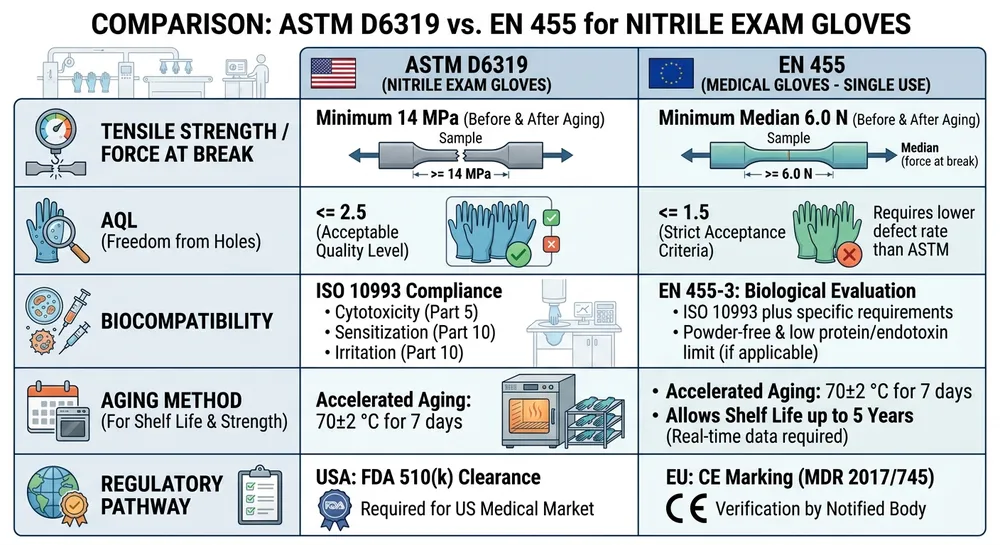
If you're distributing into both the US and European markets — or if you're building a private-label line that needs to move in either direction — you'll be dealing with both ASTM D6319 and EN 455. They're not the same standard, and the differences matter for how you specify and verify product.
| Requirement | ASTM D6319 (US) | EN 455 (Europe) |
|---|---|---|
| Governing body | ASTM International | CEN (European Committee for Standardization) |
| Tensile strength (before aging) | ≥ 14 MPa | ≥ 6 N (force-based, not stress-based) |
| Elongation at break (before aging) | ≥ 500% | ≥ 500% |
| AQL for holes | AQL 1.5 | AQL 1.5 |
| Thickness measurement | ASTM D3767 | EN 455-1 method |
| Biocompatibility | Not specified in standard | EN 455-3 (extractable proteins, chemical residues) |
| Shelf life / aging | Accelerated aging per ASTM D573 | Real-time and accelerated aging per EN 455-4 |
| Regulatory pathway | ASTM conformance + FDA 510(k) for US market | CE marking under EU MDR |
The tensile strength comparison looks dramatic on paper — 14 MPa vs 6 N — but they're measuring different things. ASTM D6319 uses stress (force per unit area), while EN 455 uses force directly on a dumbbell specimen. A glove that passes ASTM D6319's 14 MPa threshold will generally pass EN 455's force requirement, but you can't directly convert the numbers without knowing the specimen cross-section.
The more practically significant difference is EN 455-3, which covers biocompatibility and chemical residues. This is where accelerator content becomes a compliance issue for European medical procurement — EN 455-3 requires testing for extractable proteins and, increasingly, procurement specifications from European hospital groups require accelerator-free gloves to avoid Type IV sensitization risk. ASTM D6319 doesn't address accelerator content at all.
For importers sourcing for dual markets, the practical answer is: specify a glove that holds both certifications, and verify both COAs. Our Blue Nitrile Gloves carry both ASTM D6319 and EN 455 certification, so the same SKU ships to either market without reformulation.
—
FDA 510(k) Clearance and ASTM D6319: Related but Not the Same
This is the distinction that trips up more buyers than any other in US healthcare distribution. ASTM D6319 conformance and FDA 510(k) clearance are separate requirements, and having one does not automatically mean you have the other.
ASTM D6319 is a performance standard. It defines what physical properties a nitrile exam glove must meet and how to test them. A factory can test their gloves against ASTM D6319 and issue a conformance declaration without any FDA involvement.
FDA 510(k) clearance is a regulatory authorization. It means the FDA has reviewed the device — including its intended use, labeling, and performance data — and determined it is substantially equivalent to a legally marketed predicate device. For patient examination gloves sold in the US healthcare market, 510(k) clearance is required. Without it, the gloves cannot legally be marketed as medical examination gloves in the United States, regardless of whether they pass ASTM D6319 testing.
In practice, a compliant supplier for US healthcare distribution needs both: ASTM D6319 test data demonstrating physical property conformance, and an active FDA 510(k) clearance number. When you're evaluating a supplier, ask for both documents separately. A COA showing ASTM D6319 test results is not a substitute for a 510(k) clearance letter, and a 510(k) number without current test data doesn't tell you whether the production lot you're buying actually meets the physical property thresholds.
We hold both — ASTM D6319 certification and FDA 510(k) clearance — and both are available in the documentation package that ships with samples.
—
How to Read a Supplier COA Against ASTM D6319
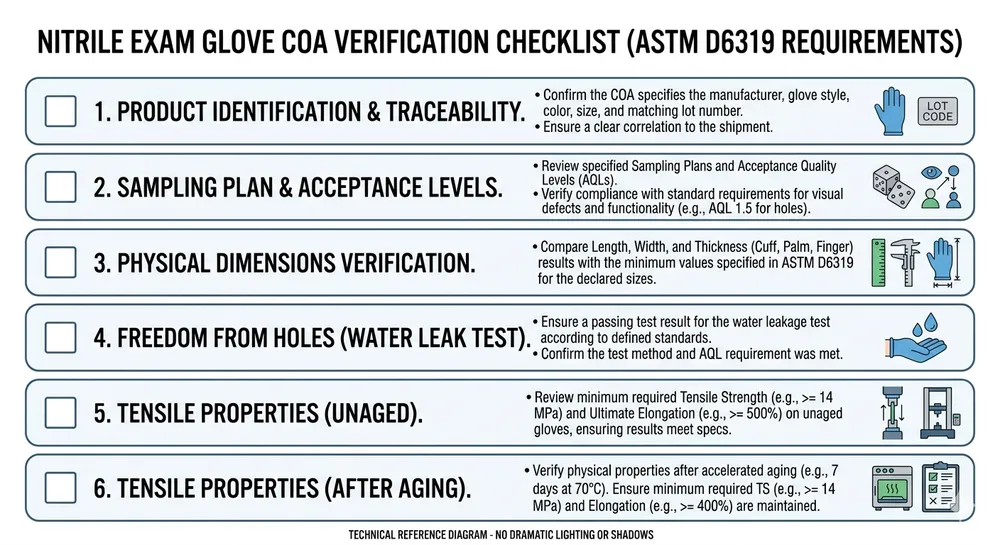
A certificate of analysis is only useful if you know what to check. Most COAs from Chinese glove factories include the right column headers — tensile strength, elongation, thickness, AQL — but the values and test conditions vary significantly, and some of what gets reported doesn't actually confirm ASTM D6319 compliance.
Here's what to verify line by line:
Tensile strength and elongation — check both before-aging and after-aging values. A COA that only reports pre-aging results is incomplete. ASTM D6319 requires both. If the after-aging column is blank or missing, ask for it explicitly. A supplier who can't produce post-aging data either hasn't run the test or doesn't want you to see the results.
Thickness — check which zone was measured. ASTM D6319 specifies different minimums for palm (0.05mm), finger (0.08mm), and cuff (0.05mm). A COA that reports a single thickness value without specifying the measurement zone is ambiguous. The finger zone is the most demanding — that's where most gloves are thinnest and where integrity failures are most likely. Make sure the reported value is for the finger, not the palm.
AQL level — confirm it's 1.5, not 2.5. This is the most common shortcut. AQL 2.5 is easier to pass and cheaper to run. If the COA shows AQL 2.5, the supplier is not meeting the ASTM D6319 inspection requirement.
Test method references — confirm ASTM D412 and ASTM D3767. Some factories test to ISO methods and report the results against ASTM thresholds. The methods are similar but not identical, and the results are not directly interchangeable. If the COA cites ISO 37 instead of ASTM D412, ask whether the testing was actually conducted per ASTM D412 or whether the values were converted.
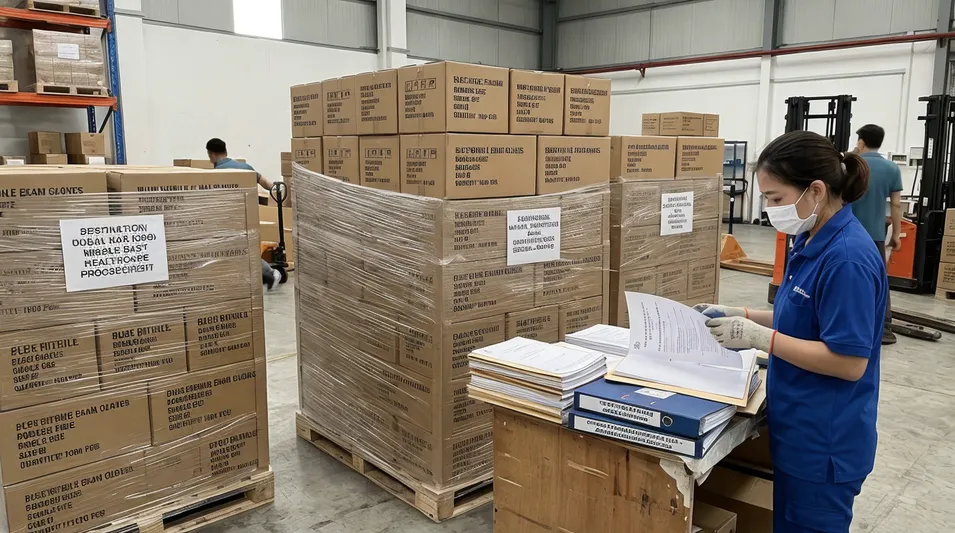
Lot number and test date — confirm they match your order. A COA from a different production lot is not documentation for your shipment. The lot number on the COA should match the lot number on your carton labels. If a supplier sends you a generic COA without a lot number, it's a template, not a test record.
For reference on how thickness specifications map to real-world performance and what to specify in your RFQ, see our article on blue nitrile exam gloves thickness specifications.
—
How Consistent Formulation Drives Consistent Test Results
The physical property requirements in ASTM D6319 — tensile strength, elongation, post-aging retention — are ultimately a function of compound formulation and cure consistency. A factory that buys pre-mixed nitrile compound from a third-party supplier is dependent on that supplier's batch-to-batch consistency. When the compound changes, the test results change. The factory may not even know until a lot fails outgoing inspection or, worse, until a COA from a third-party lab comes back below threshold.
We've run our own compounding lab since the early years of the operation, and it's the reason our test results are stable across production lots rather than variable. The formulation team controls acrylonitrile content, sulfur-donor cure system ratios, and vulcanization temperature profile as a single integrated system. When we see elongation drift in post-aging results — which happens occasionally when raw material batches shift — we can trace it to the compound and correct it before the lot ships. That traceability is what makes the COA meaningful rather than just a piece of paper.
For buyers running annual volume contracts, this matters more than it might seem at the sample stage. The sample you approve was made on a specific compound batch. The question is whether the 10th container you receive was made on the same formulation. With in-house compounding, we can answer that question with batch records. With a factory that buys compound externally, the answer is often "we used the same supplier" — which is not the same thing.
—
Frequently Asked Questions
Does ASTM D6319 apply to industrial nitrile gloves, or only medical exam gloves?
ASTM D6319 is specifically for nitrile rubber examination gloves intended for medical examination and diagnostic procedures. Industrial nitrile gloves typically reference different standards — ASTM D6978 for chemotherapy drug resistance, EN 374 for chemical protection, or ANSI/ISEA 105 for cut and puncture resistance. If your buyers are in industrial safety rather than healthcare, the applicable standard depends on the end use. That said, many industrial buyers specify ASTM D6319 as a baseline quality floor even when the end use isn't strictly medical, because the physical property thresholds are well-understood and the test methods are widely used.
Can a supplier self-certify ASTM D6319 compliance, or does it require third-party testing?
ASTM D6319 itself does not mandate third-party testing — a manufacturer can self-declare conformance based on their own test data. However, for US healthcare distribution, FDA 510(k) clearance requires submission of performance data to the FDA, which effectively means the testing has been reviewed by a regulatory body. For your own sourcing verification, a COA from an accredited third-party lab (SGS, Intertek, Bureau Veritas) carries more weight than a factory's internal test report, particularly for tensile and elongation values where the test setup affects results.
What's the difference between ASTM D6319 and ASTM D6978?
ASTM D6978 covers nitrile gloves used during chemotherapy drug preparation and administration — it adds a permeation resistance requirement for specific antineoplastic drugs that ASTM D6319 doesn't include. A glove certified to ASTM D6978 will generally also meet ASTM D6319 physical property requirements, but the reverse isn't true. If your buyers are oncology pharmacies or infusion centers, they need D6978, not just D6319.
How often should a supplier's ASTM D6319 test data be updated?
There's no fixed interval in the standard itself, but for active production, annual re-testing is the practical minimum. More importantly, test data should be lot-specific for any shipment you're receiving. A COA dated two years ago doesn't tell you anything about the lot in your container. Ask for current lot-specific test reports, not just a standing certification document.
If a supplier holds FDA 510(k) clearance, do I still need to check their ASTM D6319 test data?
Yes. The 510(k) clearance establishes that the device type is authorized for US marketing — it doesn't guarantee that every production lot meets the physical property thresholds. Lot-to-lot variation is real, and a clearance number doesn't update when a factory's compound or process changes. Current test data for the specific lot you're buying is the only way to confirm the gloves in your container meet the standard.
—
If you're sourcing Blue Nitrile Exam Gloves for US distribution and want to verify our ASTM D6319 test data and FDA 510(k) documentation before committing to a container, we can send the full certification package with your sample shipment. Request a quote with your target size range, annual volume, and AQL requirement — we'll confirm the documentation and spec sheet in the same response.