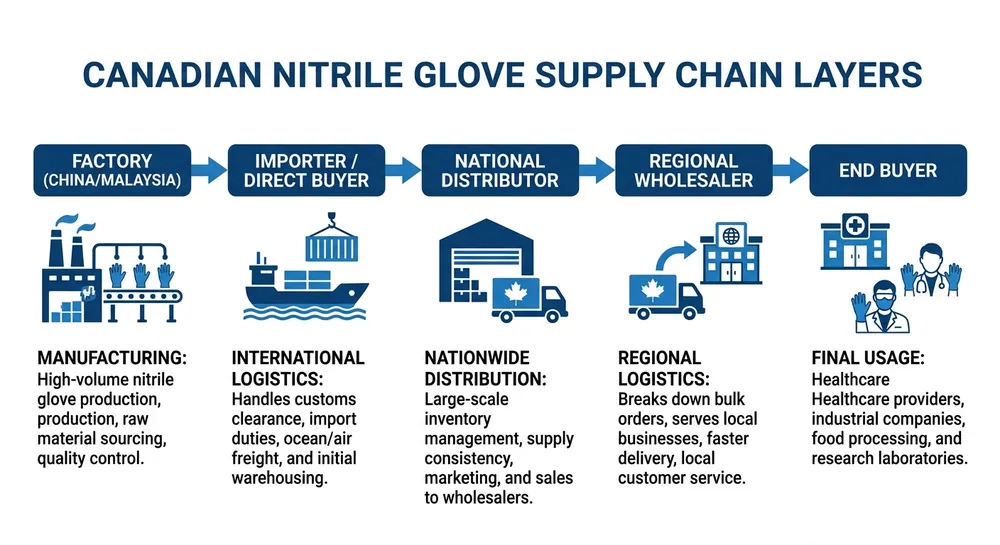
The Canadian market for blue nitrile gloves runs through a layered supply chain — national distributors, regional safety wholesalers, medical supply companies, and a handful of importers who buy direct from overseas factories. If you're screening suppliers right now, you're probably looking at a mix of all four. The question isn't just who has stock. It's who can hold spec across a full year of orders, what the landed cost actually looks like at container scale, and whether the convenience premium you're paying to a local distributor is still worth it at your current volume.
This guide maps the real supplier landscape for blue nitrile gloves in Canada, explains what to verify before you commit, and lays out the honest trade-off between local sourcing and factory-direct import.

What Serious Buyers Verify Before Signing a Supply Agreement
Before the supplier list, the criteria. Most sourcing problems with nitrile gloves don't show up in the first order — they show up in the third or fourth, when the spec drifts and you're holding a container of gloves your customers are rejecting.
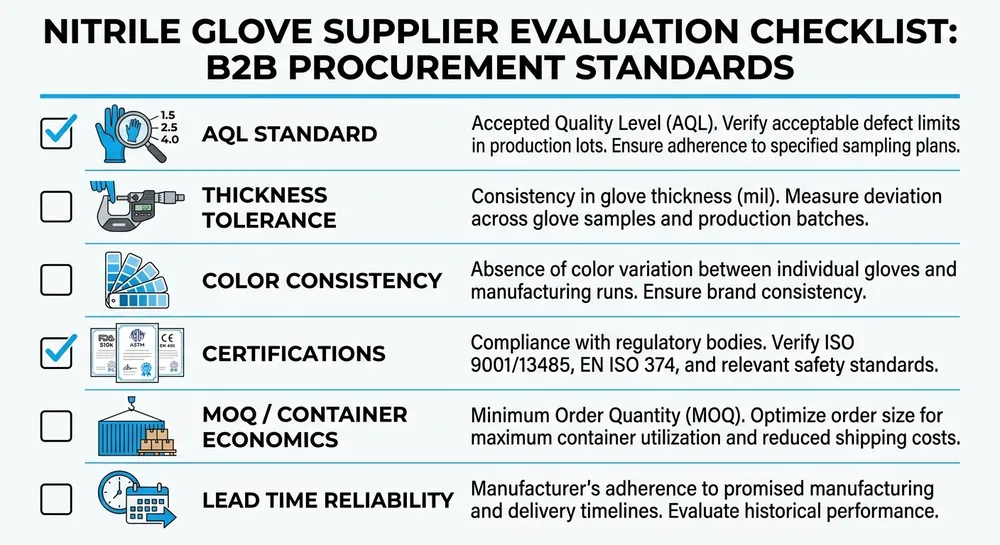
The variables that matter at commercial scale:
AQL standard and inspection method. AQL 1.5 and AQL 2.5 are not interchangeable. At AQL 2.5, a 5,000-box shipment can contain roughly twice the defect rate that AQL 1.5 allows before it triggers rejection. For medical and food-contact applications, that difference lands directly on your liability exposure. Ask every supplier which AQL standard their outgoing inspection runs to — and whether it's 100% online inspection or batch sampling only.
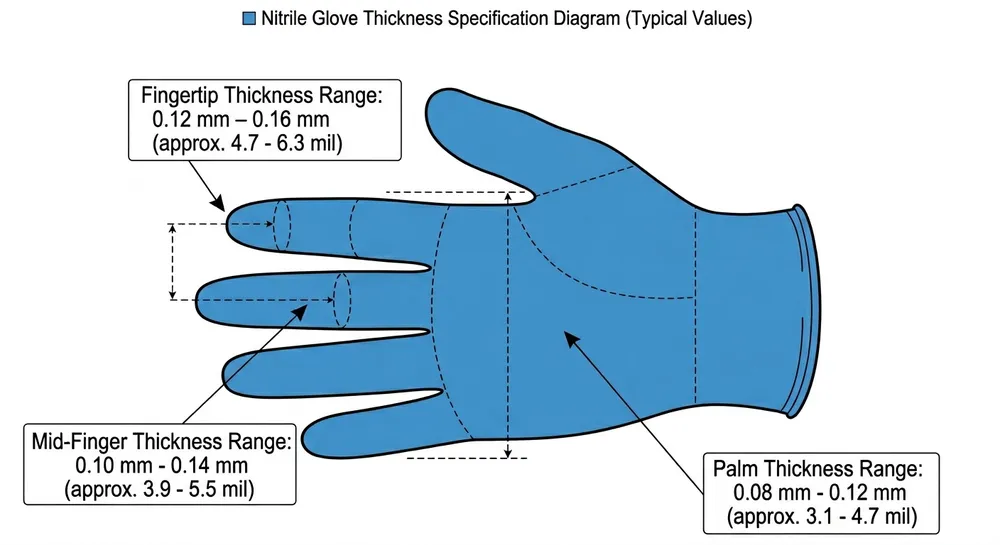
Thickness tolerance and consistency. A glove spec sheet that says 0.10mm means nothing if the actual production tolerance is ±0.04mm. A glove measuring 0.06mm at the fingertip fails at the destination port, and that's a container you can't sell. The spec you need to ask for is the tolerance band, not just the nominal thickness.
Color consistency across batches. Blue nitrile gloves are used in food processing and medical environments specifically because the color signals contamination. If your supplier's blue shifts between batches — even slightly — your downstream customers notice. Ask for a color standard reference (Pantone or equivalent) and confirm it's held across production runs.
Certifications that match your end market. For Canadian medical distribution, FDA 510(k) clearance and CE marking under EN455 are the baseline. ISO 9001:2015 covers the quality management system. If you're supplying into food processing, confirm food-contact compliance separately — not all medical-grade certifications cover food contact.
MOQ and container economics. Most factory-direct suppliers work in full-container minimums — typically one 20-foot container, which runs approximately 2,000 boxes of 100-count gloves. If your volume is below that threshold, a local distributor's smaller MOQ is a real operational advantage, not just a convenience.
Lead time reliability, not just quoted lead time. Ask for the last three shipment records, not the sales team's estimate. A supplier who quotes 30 days but consistently ships at 45 is a cash-flow problem for your business.
The Local Supplier Landscape: Who's Actually Selling Blue Nitrile Gloves in Canada
The Canadian market has a well-established distribution layer. These are the companies your competitors are likely already buying from — and understanding their model helps you evaluate whether the pricing you're seeing is competitive or inflated.
1. Staples Canada / Business Depot (staples.ca) — Primarily an office and facilities supply channel. Carries nitrile gloves for light-duty and general-purpose use. Convenient for small top-up orders but not structured for container-scale procurement or medical-grade sourcing.
2. Grainger Canada (grainger.ca) — One of the largest industrial MRO distributors in Canada. Carries a broad range of nitrile gloves across grades, including blue nitrile for industrial and food-contact applications. Strong on stock depth and national logistics. Pricing reflects the full distribution margin stack.
3. Uline Canada (uline.ca) — A major packaging and industrial supply distributor with significant glove inventory. Blue nitrile gloves are a core SKU. Reliable for mid-volume orders with fast fulfillment. Not a manufacturer — all product is sourced and resold, so spec verification requires going back to the original factory.
4. Levitt-Safety (levitt-safety.com) — A Canadian safety equipment distributor with branches across Ontario, Quebec, and Western Canada. Carries PPE including nitrile gloves for industrial and construction applications. Regional service strength is a genuine advantage for buyers who need local account support.
5. Acklands-Grainger (acklandsgrainger.com) — The Canadian industrial safety arm of the Grainger network. Broad PPE catalog including nitrile gloves. National branch network supports regional procurement. Same margin-stack pricing model as the parent.
6. Direct Safety Canada — Regional safety supply distributor serving industrial and construction sectors. Carries disposable gloves including blue nitrile. Useful for buyers who need regional account relationships and flexible order sizes.
7. Medline Canada (medline.com/canada) — A major medical supply distributor with a dedicated Canadian operation. Carries medical-grade nitrile gloves including blue variants. Strong in healthcare procurement channels — hospitals, long-term care, dental. Less relevant for industrial or food-processing distribution.
8. McKesson Canada (mckesson.ca) — One of Canada's largest healthcare distributors. Nitrile gloves are a core product line for their medical and pharmacy supply channels. Primarily serves healthcare institutions rather than independent distributors.
9. Bunzl Canada (bunzl.com/ca) — A redistribution specialist operating across food processing, healthcare, and industrial sectors in Canada. Carries disposable gloves including blue nitrile. Bunzl's model is redistribution at scale — they aggregate from multiple manufacturers and resell to end-use sectors.
10. Kimberly-Clark Professional Canada (kcprofessional.com) — A manufacturer-brand distributor selling through Canadian channels. Their purple nitrile line (Kleenguard) is well-known, but blue nitrile variants are available through their professional distribution network. Brand-name pricing applies.
(Worth noting: several of these companies source from the same pool of Asian manufacturers — the brand on the box and the factory behind it are often different entities. If spec consistency matters to your customers, knowing the actual production source is more useful than the distributor's catalog description.)
Where Local Distribution Adds Real Value
Local distributors earn their margin in specific situations, and it's worth being clear about when that margin is justified.
Emergency replenishment. If a production line goes down and you need 50 boxes of blue nitrile gloves by Thursday, a local distributor with regional warehouse stock is the right answer. No factory-direct arrangement can match that response time.
Small and irregular orders. Below roughly 500 boxes, the economics of a direct import order don't work. Freight cost per unit climbs, and the administrative overhead of customs clearance, duty management, and container coordination isn't worth it at that volume.
Regulatory timing. If you're entering a new product category and need to move quickly before your import certifications are fully in place, buying from a local distributor who already holds the compliance documentation is a practical bridge.
Relationship-dependent accounts. Some end customers — particularly in healthcare — have approved vendor lists that include specific distributors. If your customer requires you to source through a named local supplier, that's a real constraint, not a preference.
These are legitimate reasons to pay the local premium. The question is whether those reasons still apply at your current volume and procurement cadence.
The Cost of the Distribution Layer at Repeat Volume
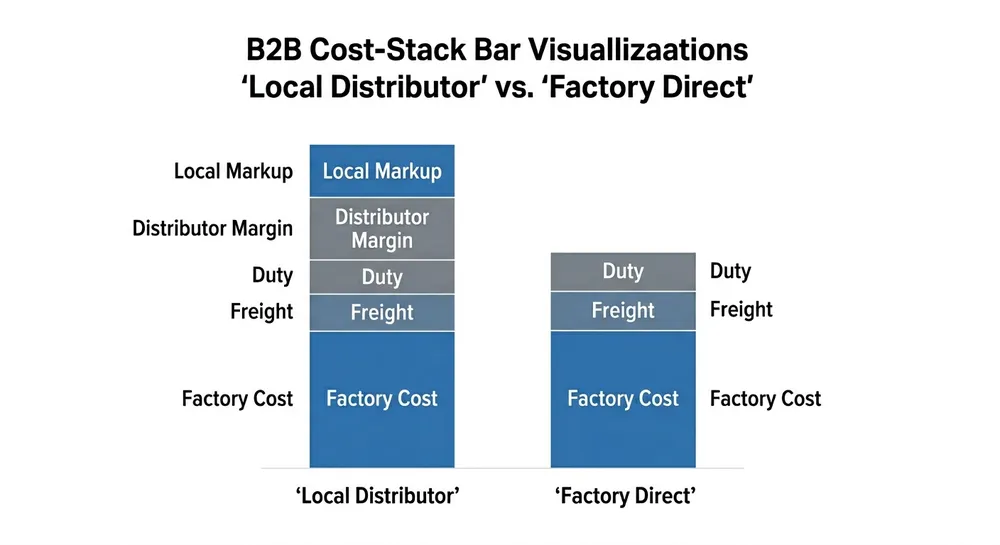
Here's where the math changes. A national distributor buying from a Chinese or Malaysian factory at FOB pricing, adding freight, duty, warehousing, and their own margin, then selling to you — that's typically three to four margin layers between the factory gate and your warehouse. At low volume, that's the cost of convenience. At container scale, it's a structural drag on your margin.
A rough illustration: blue nitrile gloves at factory-direct pricing (FOB Qingdao or similar) typically run in the range of USD $3.50–$5.50 per box of 100 for standard medical-grade product, depending on thickness, AQL standard, and order volume. By the time that product moves through a North American distributor's pricing model, the same box is often landing at CAD $8–$14 at the distributor's sell price — sometimes higher for branded product.
The gap between those numbers is the distribution layer's operating cost plus margin. For a buyer purchasing 10 containers a year, that gap is a significant annual number. For a buyer purchasing two containers a year, the operational simplicity of local sourcing may still be worth it.
(We've had Canadian distributors come to us after years of buying through local channels — the trigger is usually a combination of margin pressure from their own customers and a quality inconsistency that finally pushed them to trace the product back to the source.)
Factory-Direct Sourcing as a Structural Alternative
Factory-direct import makes commercial sense when three conditions align: your volume is at or above one container per order, your procurement cadence is regular enough to plan ahead, and your quality requirements are specific enough that you need to control the spec at the source.
We run 8 fully automated dipping lines at our Qingdao facility, producing 1.2 billion pieces annually. That capacity means your container order doesn't compete with someone else's for line time — a problem that's more common than most distributors will tell you. When a factory is running at 95% utilization and a large order comes in, smaller buyers get pushed. We've structured our lines specifically to avoid that.
Our blue nitrile gloves run at 0.08–0.15mm thickness tolerance, held by automated dipping control rather than manual adjustment. The difference matters at AQL inspection: consistent thickness means consistent pinhole test results, and our 100% online pinhole detection catches defects before they reach the packing stage rather than at the destination port. For Canadian distributors supplying medical or food-processing accounts, that's the difference between a clean container and a rejection claim.
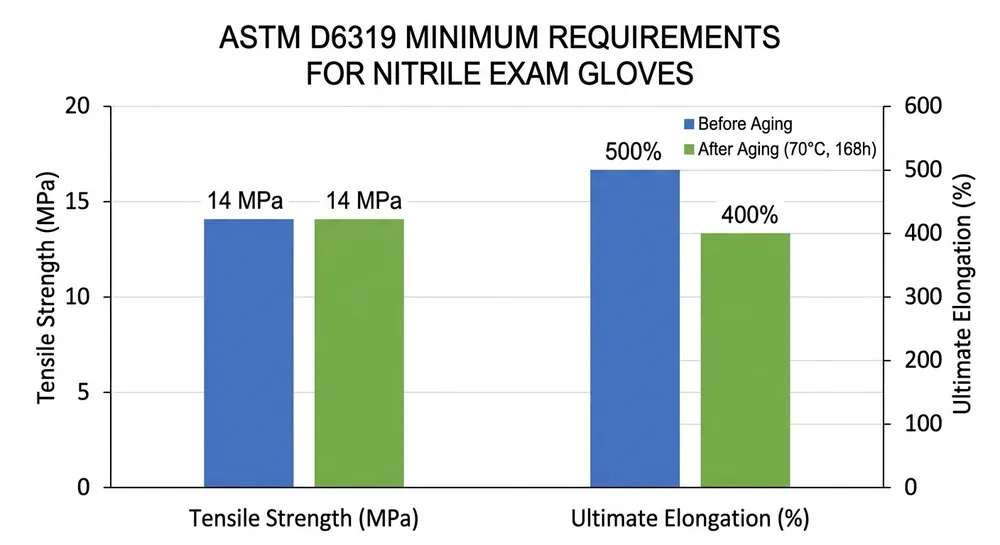
On certifications: FDA 510(k) clearance, CE marking under EN455, ISO 9001:2015, and ASTM D6319 compliance cover the standard requirements for both US and Canadian medical distribution. If your accounts require specific documentation packages — test reports, batch certificates, country-of-origin declarations — we produce those as standard, not on request.
The MOQ for standard blue nitrile SKUs is one 20-foot container, approximately 2,000 boxes. OEM and private-label runs are supported from the same facility — same lines, same QC standard, your brand on the box. (Most of our Canadian private-label buyers start with a standard SKU trial order before committing to a branded run — that's a reasonable way to verify the spec before you put your name on it.)
For buyers evaluating our Blue Nitrile Gloves against what they're currently sourcing locally, the most useful comparison is a side-by-side spec sheet review against your current supplier's documentation. We can provide full technical data sheets, AQL inspection records, and sample shipments for that evaluation.
Deciding Which Sourcing Route Fits Your Business
The honest answer is that both models have a place — the question is which one fits your current situation.
| Scenario | Better Sourcing Route |
|---|---|
| Urgent order, need stock within 1–2 weeks | Local distributor |
| Order below 500 boxes | Local distributor |
| Regular volume, 1+ containers per quarter | Factory-direct |
| Private label or OEM requirement | Factory-direct |
| Spec-critical medical or food-contact supply | Factory-direct (verify AQL at source) |
| New market entry, compliance timing uncertain | Local distributor as bridge |
| Margin pressure from downstream customers | Factory-direct |
| Need to trace product to original manufacturer | Factory-direct |
The buyers who get the most value from factory-direct sourcing are typically running repeat volume on a predictable cadence — quarterly or semi-annual container orders — where the planning horizon is long enough to absorb the lead time and the volume is large enough to make the freight economics work. If that describes your procurement pattern, the cost difference between local and direct is worth calculating precisely, not estimating.
If you're at the point where you want to run that comparison with real numbers — your current per-box cost against a factory-direct landed cost for your specific volume and destination — the Request Quote page is the right starting point. Provide your target grade, size mix, and annual volume, and we'll return a landed cost estimate with full documentation.