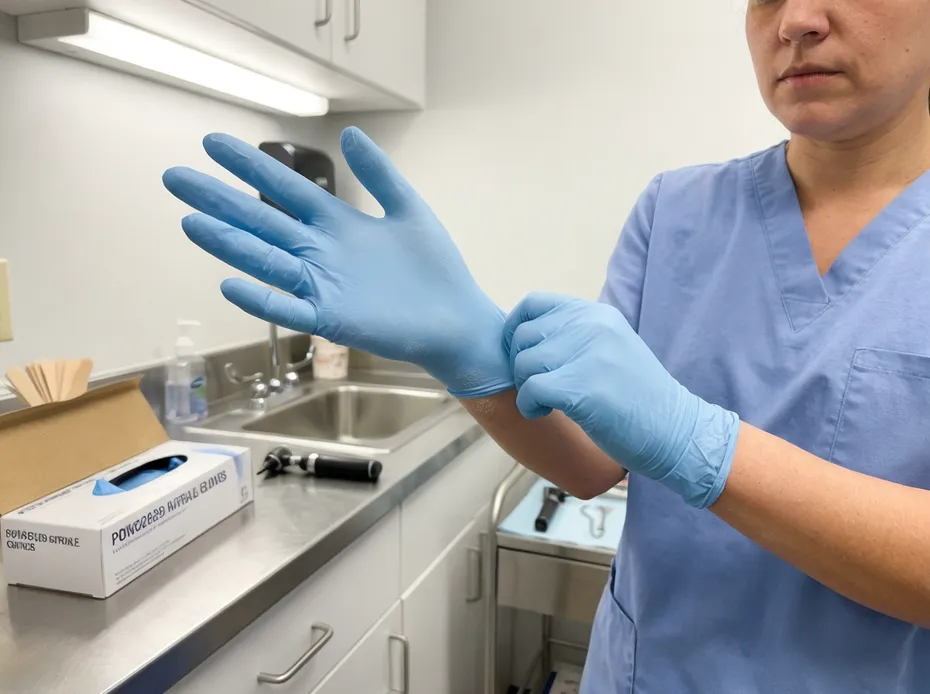
Hospital procurement teams in Germany, France, and the Netherlands have been quietly tightening their glove specifications for the past several years. The change doesn't show up as a headline — it shows up as a line item in tender documents: accelerator-free formulation required. If your current supplier can't meet that line item, you lose the bid.
This article explains what accelerator-free nitrile gloves actually are at the formulation level, which standards govern them, and what you need to verify before committing to a container order. If you're sourcing Medical Nitrile Gloves for hospital or clinic distribution, this is the compliance layer that's increasingly separating approved vendors from rejected ones.
—
What "Accelerator-Free" Actually Means at the Compound Level
Standard nitrile gloves are vulcanized — the raw nitrile latex is cross-linked using sulfur-based chemical accelerators, most commonly thiurams, dithiocarbamates, and mercaptobenzothiazole (MBT). These accelerators make the curing process faster and more controllable, and they've been the industry standard for decades.
The problem is residue. Even after curing, trace amounts of these accelerators remain in the finished glove. For most wearers, that's irrelevant. For a subset of healthcare workers — estimates in European occupational health literature typically run between 5% and 17% of regular glove users — those residues trigger a delayed hypersensitivity reaction known as Type IV contact dermatitis.
Type IV is not the same as latex allergy (which is a Type I IgE-mediated response). It's a T-cell-mediated reaction that develops over 24–72 hours after exposure: redness, vesicles, cracking skin, sometimes progressing to chronic eczema. It's occupational, cumulative, and in severe cases career-ending for clinical staff.
Accelerator-free nitrile eliminates the trigger. The compound is cross-linked using alternative chemistry — typically sulfur donor systems at very low concentrations, or carbamate-free formulations — that achieve the same mechanical performance without leaving sensitizing residue at detectable levels.
(We've been running accelerator-free compound in our in-house lab since the European hospital tender requirements started tightening around 2018. The formulation work took longer than we expected — getting the tensile and elongation numbers to match conventional nitrile without the standard accelerator package required about a year of iteration.)

—
The Standards That Define Compliance — and What They Actually Test
"Accelerator-free" is not a self-certified marketing claim in regulated markets. There are specific test methods and thresholds that determine whether a glove qualifies.
| Standard / Test | What It Covers | Threshold / Requirement |
|---|---|---|
| EN 455-4 | Shelf life and degradation for medical gloves | Framework standard; accelerator-free claims tested under EN ISO 21420 annex |
| EN ISO 21420:2020 Annex C | Chemical sensitizers in protective gloves | Thiurams, dithiocarbamates, MBT below detection limits |
| ASTM D6319 | Nitrile examination gloves — physical performance | Tensile strength, elongation, AQL — does not address accelerator content |
| EN 420 (superseded by EN ISO 21420) | General requirements for protective gloves | Predecessor standard; still referenced in some older tenders |
| German TRGS 401 | Occupational skin protection guidance | Recommends accelerator-free gloves for sensitized workers |
The test that matters most for European hospital tenders is EN ISO 21420 Annex C. It uses extraction and chromatographic analysis (typically HPLC or GC-MS) to quantify residual accelerator content. A glove that passes has accelerator levels below the method's detection threshold — not just "low," but undetectable by the specified method.
ASTM D6319, which governs the US market, does not include an accelerator content requirement. FDA 510(k) clearance for examination gloves covers physical performance and biocompatibility under ISO 10993, but accelerator-free status is a separate specification layer. US hospital systems that require accelerator-free gloves are typically specifying it as an additional procurement criterion beyond the base FDA clearance.
This distinction matters when you're sourcing for mixed markets. A glove with FDA 510(k) clearance is not automatically EN ISO 21420 Annex C compliant, and vice versa. If your distribution covers both US and European hospital accounts, you need to confirm both documentation sets from your supplier.

—
Where Type IV Allergy Compliance Is Showing Up in Procurement
The shift toward mandatory accelerator-free specification started in Northern and Western Europe. German hospital procurement frameworks began referencing TRGS 401 guidance in tender language around 2015–2017. French public hospital tenders (through the UGAP and regional groupements d'achats) started including accelerator-free as a scored criterion, then as a pass/fail requirement, over the following years. The Netherlands, Scandinavia, and the UK NHS have followed similar trajectories.
The commercial implication for distributors is straightforward: if you're supplying European hospital accounts and your glove line doesn't include an accelerator-free SKU with current EN ISO 21420 Annex C documentation, you're excluded from a growing share of the tender universe. That's not a niche segment — European public hospital procurement represents significant contracted volume, and the contracts run multi-year.
North America is moving more slowly, but the direction is the same. Several large US health systems have added accelerator-free preference language to their GPO specifications. Canadian hospital procurement in Ontario and Quebec has seen similar movement. The driver is occupational health liability: hospitals that document glove-related dermatitis cases among clinical staff face workers' compensation exposure, and switching to accelerator-free is the documented mitigation.
For distributors building a hospital-focused product line, the practical question isn't whether to carry accelerator-free — it's which SKUs, what documentation package, and whether your supplier can hold the spec consistently across reorders.
—
The Specification Details That Separate Compliant Gloves from Marketing Claims
Not every glove labeled "accelerator-free" has the documentation to back it up. Here's what the spec sheet and compliance package should contain for a genuinely compliant product.
Physical performance should meet or exceed standard nitrile examination glove requirements. Accelerator-free formulations that sacrifice tensile strength or elongation to achieve the chemistry are not fit for clinical use. Typical benchmarks for a compliant medical-grade accelerator-free nitrile glove:
| Property | Typical Range | Standard Reference |
|---|---|---|
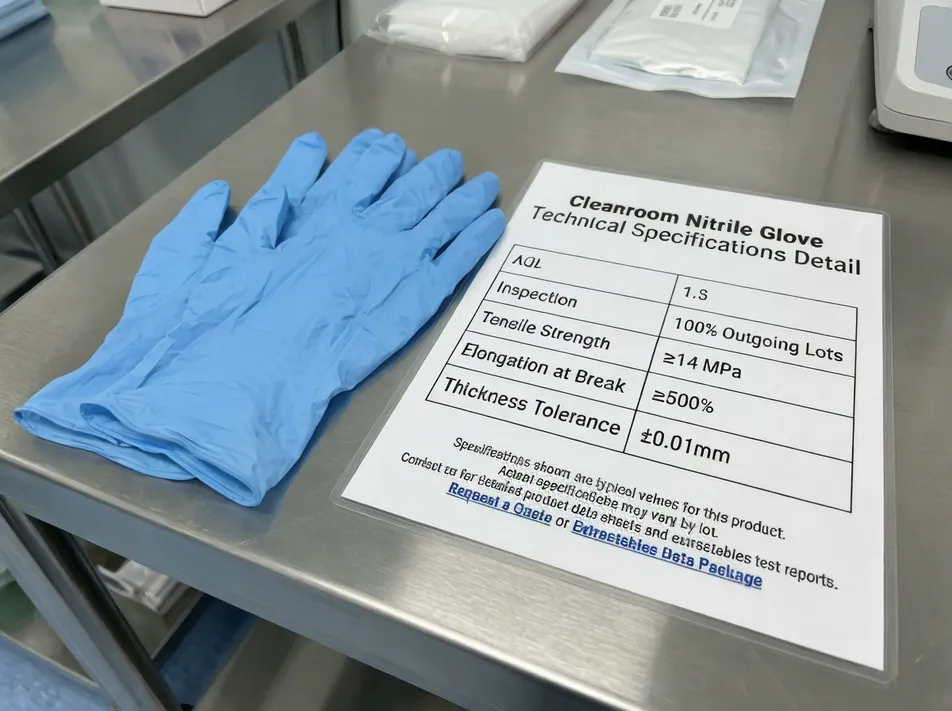
| Tensile strength (before aging) | ≥ 14 MPa | EN 455-2 / ASTM D6319 |
| Elongation at break (before aging) | ≥ 500% | EN 455-2 / ASTM D6319 |
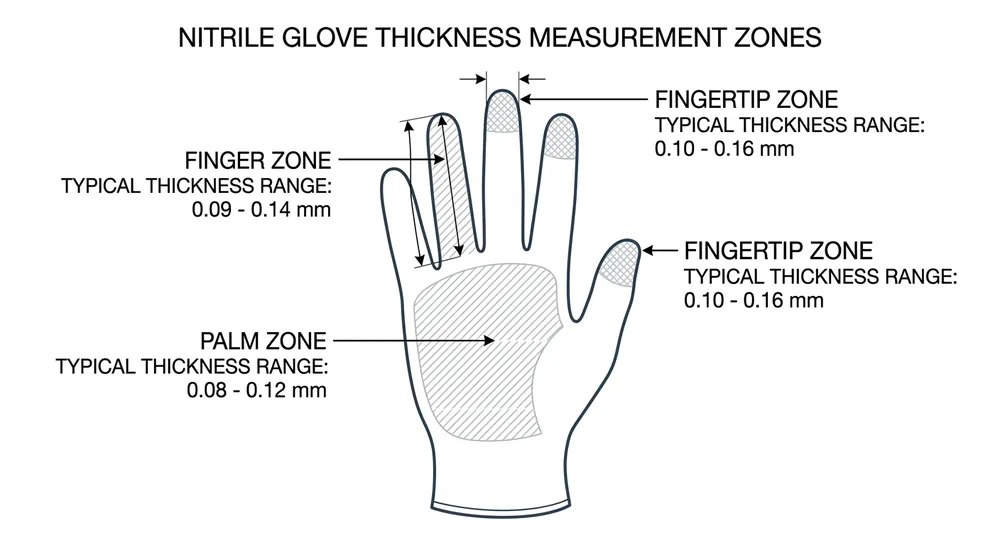
| Thickness (palm, single wall) | 0.08–0.12 mm | EN 455-2 |
| AQL | ≤ 1.5 | EN 455-2 / ISO 2859-1 |
| Accelerator residue | Below detection limit | EN ISO 21420 Annex C |
Our accelerator-free line runs at 0.10 mm palm thickness with tensile strength consistently above 16 MPa in pre-shipment testing — the formulation work we did to eliminate the accelerator package didn't require thinning the glove to compensate.
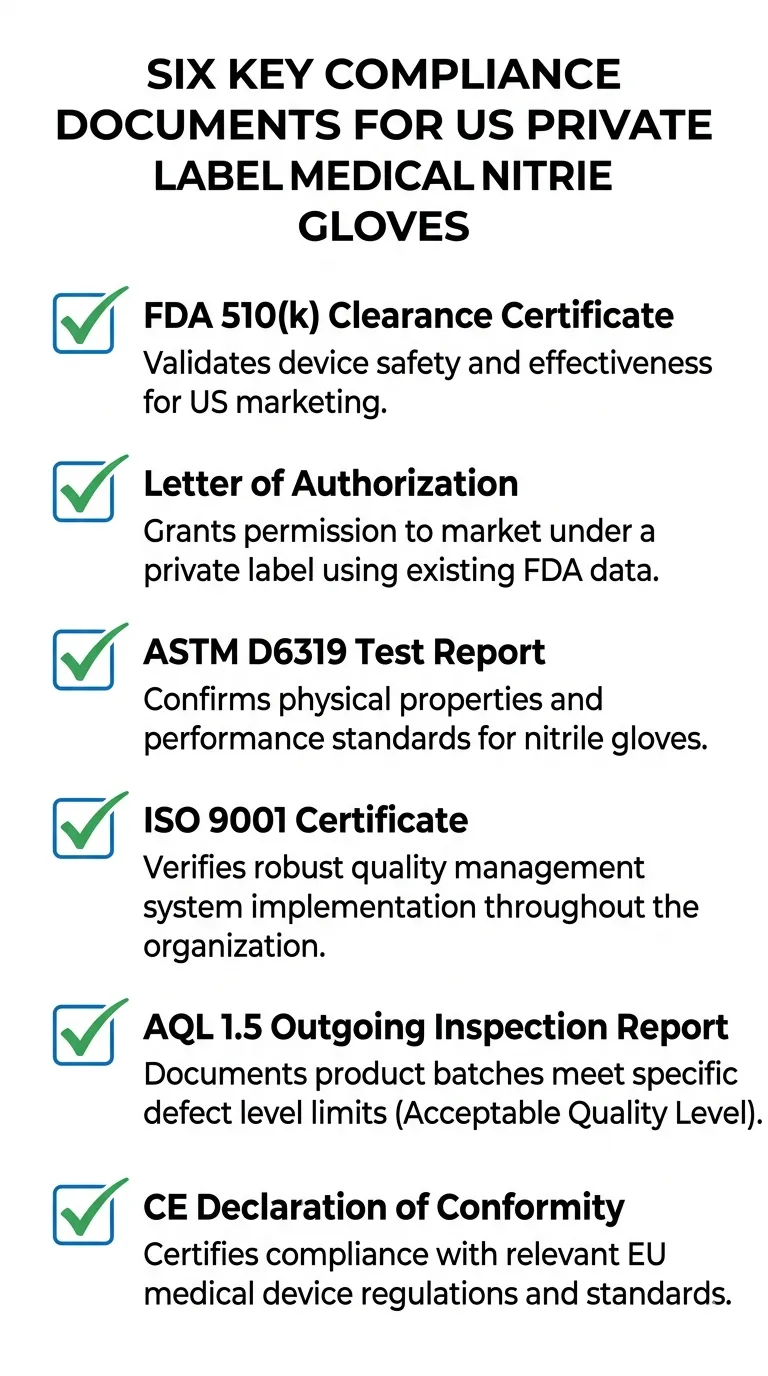
The documentation package for a hospital-grade accelerator-free nitrile glove should include:
- EN 455 Parts 1–4 certificate (current, not expired)
- EN ISO 21420 Annex C test report with actual chromatographic data, not just a pass/fail statement
- FDA 510(k) clearance number (for US market distribution)
- ISO 10993 biocompatibility report if required by the account
- AQL 1.5 inspection records — lot-level, not just type-approval
The Annex C test report is the one most often missing or outdated. Some suppliers provide a certificate of conformity that references EN ISO 21420 without attaching the actual test data. In a hospital tender, that's usually insufficient — procurement teams increasingly require the underlying chromatographic report, not just the declaration.
(We've seen this catch distributors off guard at the tender submission stage. The certificate looks complete until the hospital's technical committee asks for the raw test data and the supplier can't produce it. Request the actual Annex C report, not just the conformity declaration, before you commit to a product line.)
—
What Consistent Supply Actually Requires from the Manufacturer
Passing an accelerator-free test on a type-approval sample is one thing. Holding that specification across 12 months of production orders is another.
The accelerator-free compound is more sensitive to process variation than standard nitrile. The alternative cross-linking chemistry has a narrower processing window — temperature control during dipping and curing matters more, and compound batch consistency is tighter. A manufacturer running accelerator-free on a line that wasn't designed for it will see more lot-to-lot variation in residual chemistry, even if the physical properties stay within spec.
What to look for in a supplier:
- In-house compounding: If the manufacturer buys pre-mixed compound from a third-party supplier, they have limited control over batch-to-batch accelerator content. In-house compounding means the formulation is controlled at the source.
- Dedicated line or validated changeover protocol: Cross-contamination from conventional nitrile production is a real risk. A supplier running accelerator-free on the same line as standard nitrile needs a validated cleaning and changeover procedure, with documentation.
- Lot-level testing, not just type approval: The EN ISO 21420 Annex C type-approval test is done once on a sample. For hospital supply, you want a supplier who runs periodic lot-level verification — either in-house or through a third-party lab — to confirm the production compound hasn't drifted.
We run our accelerator-free compound in our own compounding lab, which means we control the formulation from raw material through finished glove. Our 8 automated dipping lines include dedicated configurations for accelerator-free production, and we run periodic third-party Annex C verification on production lots — not just on the type-approval sample. That documentation is available to distributors as part of the pre-shipment package.
If you're evaluating suppliers for a hospital account that requires accelerator-free, ask specifically: Is your compound mixed in-house or purchased? Do you have lot-level Annex C test data from the past 12 months? The answers tell you more than the certificate.

—
Sourcing Accelerator-Free for Hospital Distribution: The Practical Checklist
When you're building or refreshing a hospital-focused glove line, accelerator-free specification touches several sourcing decisions at once.
SKU selection: Accelerator-free is available in standard examination weight (0.08–0.10 mm) and slightly heavier surgical-adjacent weights. For most hospital examination and procedural use, standard weight is appropriate. If your accounts include surgical or high-risk procedure applications, confirm the thickness and AQL specification matches the clinical requirement.
MOQ and reorder structure: Accelerator-free SKUs typically carry a slightly higher unit cost than standard nitrile — the compound cost is higher and the processing is more controlled. For distributors new to the category, starting with a single-container trial order (approximately 2,000 boxes for standard examination sizes) is a reasonable way to validate the documentation package and physical quality before committing to annual contracted volume.
Private label considerations: If you're building a private-label hospital line, the OEM specification needs to explicitly call out accelerator-free formulation, the EN ISO 21420 Annex C requirement, and the documentation deliverables. Don't assume it's included because the supplier offers accelerator-free as a product line — get it written into the spec sheet and confirmed in the pre-production sample approval.
Documentation timing: Hospital tenders often have tight submission windows. The Annex C test report, EN 455 certificate, and FDA 510(k) documentation need to be current (typically within 3–5 years for type approval, depending on the tender requirements) and available before you submit. Build documentation verification into your supplier qualification process, not your tender preparation process.
For distributors ready to specify or Request Quote on accelerator-free medical nitrile gloves, having the compliance documentation conversation early — before the tender deadline — is the difference between a smooth submission and a last-minute scramble.
—
FAQ: Accelerator-Free Nitrile Gloves for Hospital Procurement
What is the difference between accelerator-free nitrile and latex-free nitrile?
All nitrile gloves are latex-free — nitrile is a synthetic rubber with no natural latex protein. Latex-free addresses Type I latex allergy (IgE-mediated, immediate hypersensitivity). Accelerator-free addresses Type IV contact dermatitis (T-cell-mediated, delayed hypersensitivity) caused by chemical accelerator residues in the glove compound. A glove can be latex-free but still cause Type IV reactions if it contains thiuram or dithiocarbamate accelerators. Hospital procurement that specifies "latex-free" only is not covering the Type IV risk.
Does FDA 510(k) clearance confirm a glove is accelerator-free?
No. FDA 510(k) clearance for examination gloves covers physical performance (tensile, elongation, AQL) and biocompatibility under ISO 10993. It does not test for or certify accelerator content. Accelerator-free status requires separate chemical testing under EN ISO 21420 Annex C or equivalent. For US hospital accounts that require accelerator-free, the specification needs to be confirmed through the supplier's compound documentation and test reports, not inferred from the 510(k) number.
Can a standard nitrile glove line be reformulated to accelerator-free, or does it require a different production setup?
It requires a different compound formulation and, ideally, a controlled production setup. The alternative cross-linking chemistry used in accelerator-free nitrile has a narrower processing window than standard thiuram/dithiocarbamate systems. Manufacturers who simply reduce accelerator concentration rather than eliminating it may still fail EN ISO 21420 Annex C testing. A genuine accelerator-free product requires a reformulated compound and validated production parameters — not just a label change.
How often should accelerator-free certification be renewed for hospital tender purposes?
EN 455 type approval certificates are typically valid for 5 years, but individual hospital tenders may require more recent test data — some specify reports within 3 years, others within 12 months for the Annex C chemical test specifically. Check the tender's documentation requirements before assuming your existing certificates are sufficient. For ongoing supply contracts, ask your supplier about their lot-level verification frequency.
What MOQ is realistic for a first accelerator-free order?
For standard examination sizes (S/M/L in 100-piece boxes), one container — approximately 2,000 boxes — is a workable starting point for distributors entering the hospital segment. This gives you enough volume to validate the documentation package, run your own incoming inspection, and test the product with a pilot account before scaling to annual contracted volume.