How to Verify Medical Nitrile Glove Certifications Before Your Container Ships — and Avoid Costly Port Rejections
A container of medical nitrile gloves held at a US port of entry costs you roughly $3,000–$8,000 in demurrage before you've resolved anything. If the FDA detains the shipment for examination, add 2–6 weeks of delay and the real possibility of refusal of admission. The gloves go back to the factory or get destroyed. Your customer doesn't get their order. You absorb the loss.
Most of these rejections aren't caused by defective gloves. They're caused by documentation that doesn't match the product in the container — a 510(k) clearance number that covers a different glove model, a CE certificate that expired six months before shipment, or an AQL test report that references a lot number nobody can trace to the actual production run.
We've handled pre-shipment compliance documentation for US, Canadian, and European healthcare distributors for over a decade. The failures we see aren't random. They follow predictable patterns, and most of them are preventable if you know what to check before the container is sealed.
Why certification scope mismatches cause most port rejections
FDA 510(k) clearance is product-specific. The clearance number on your supplier's documentation covers the exact device described in the 510(k) submission — specific material formulation, thickness range, intended use, and labeling claims. When a factory changes its nitrile compound, adjusts the thickness spec, or starts producing a new SKU under the same brand name, that new product may not be covered by the original clearance.
This is where importers get caught. The factory sends you a 510(k) number — K-prefix, six digits — and it looks legitimate because it is legitimate. It just doesn't cover what's in your container.
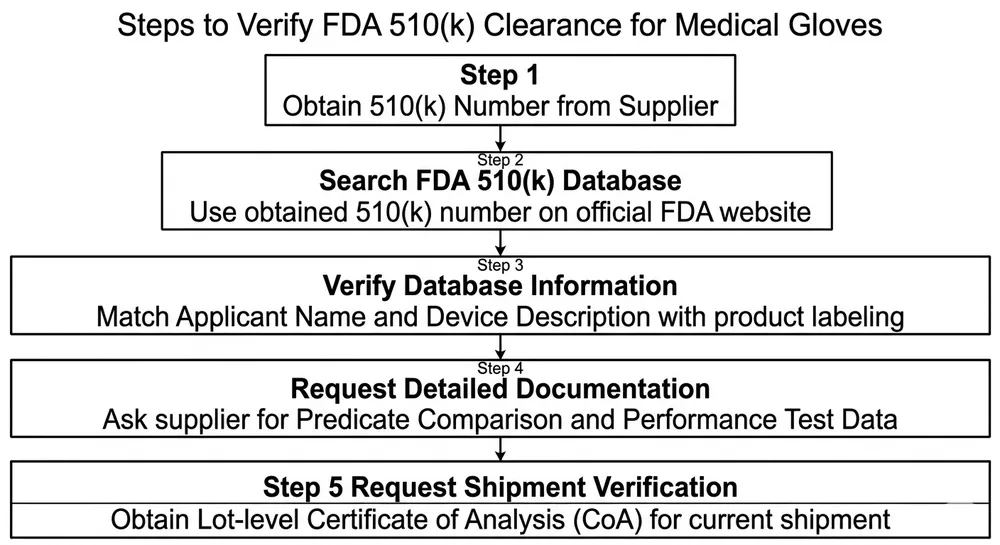
The FDA's 510(k) database is public. Before your container ships, pull up the clearance record at accessdata.fda.gov and confirm:
- The device name in the clearance record matches the product description on your invoice and labeling
- The applicant or owner matches your supplier (or that a valid transfer of ownership is documented)
- The intended use covers medical examination — not just industrial or food-contact use
- The clearance is not subject to a Class I or Class II recall (check the FDA recall database separately)
(We've seen factories list a 510(k) number on their spec sheet that was cleared for a different glove line entirely — same brand, different product. The FDA doesn't care that it was an honest mistake.)
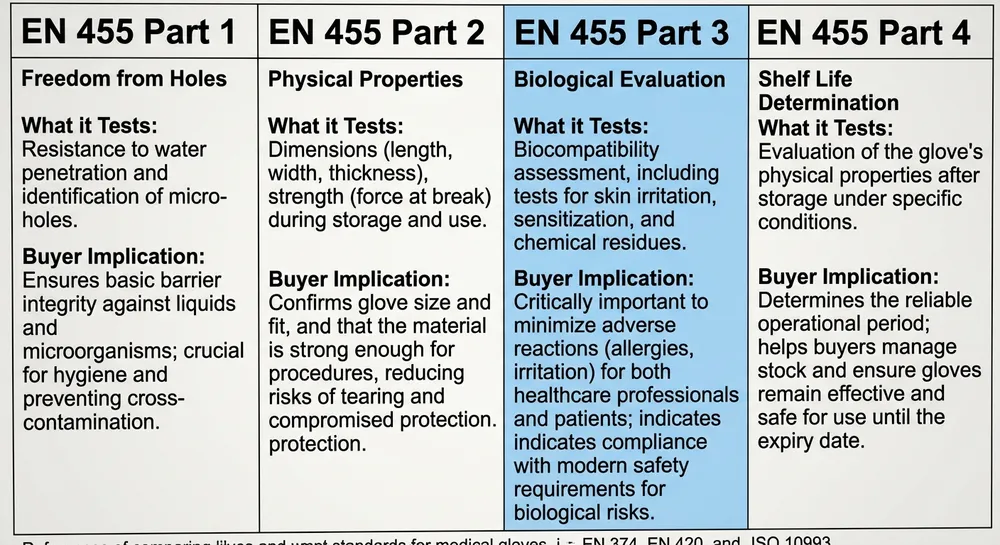
For the EU market, CE marking under the Medical Devices Regulation (MDR 2017/745) requires a Notified Body certificate for Class I medical devices. EN 455 is the harmonized standard — four parts covering dimensions, penetration resistance, biological evaluation, and shelf life. Ask your supplier for the full EN 455 test report, not just the CE declaration of conformity. The declaration tells you the manufacturer claims compliance. The test report tells you whether the gloves actually passed.
The five documents you need before the container is sealed
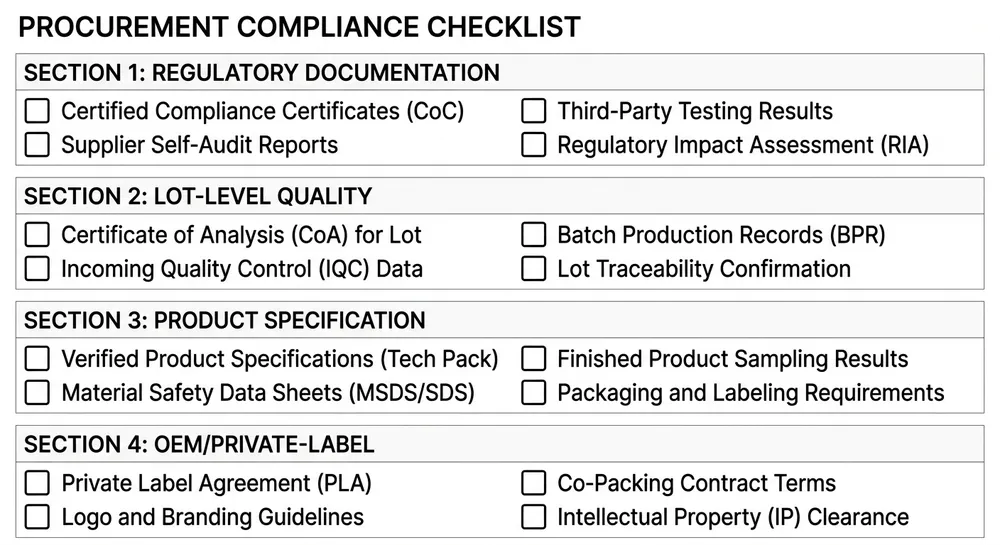
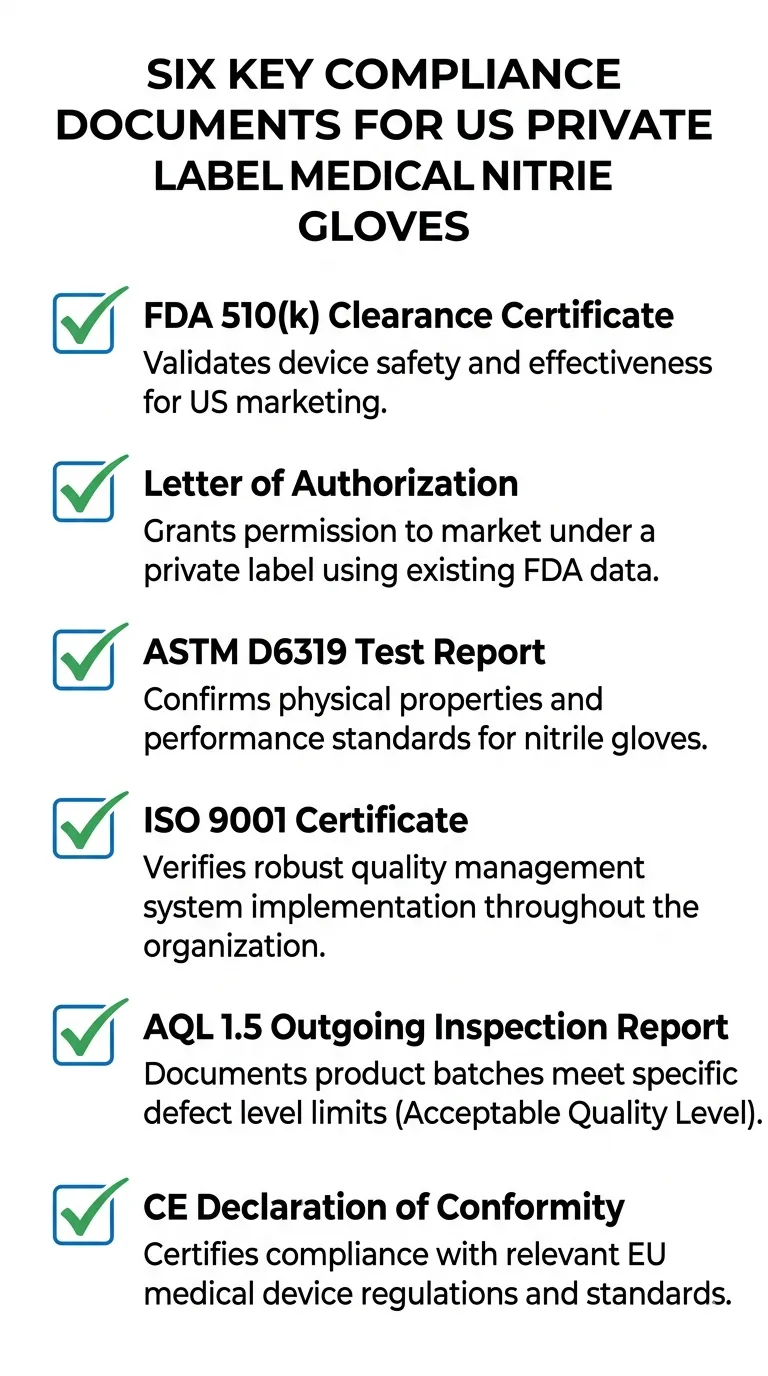
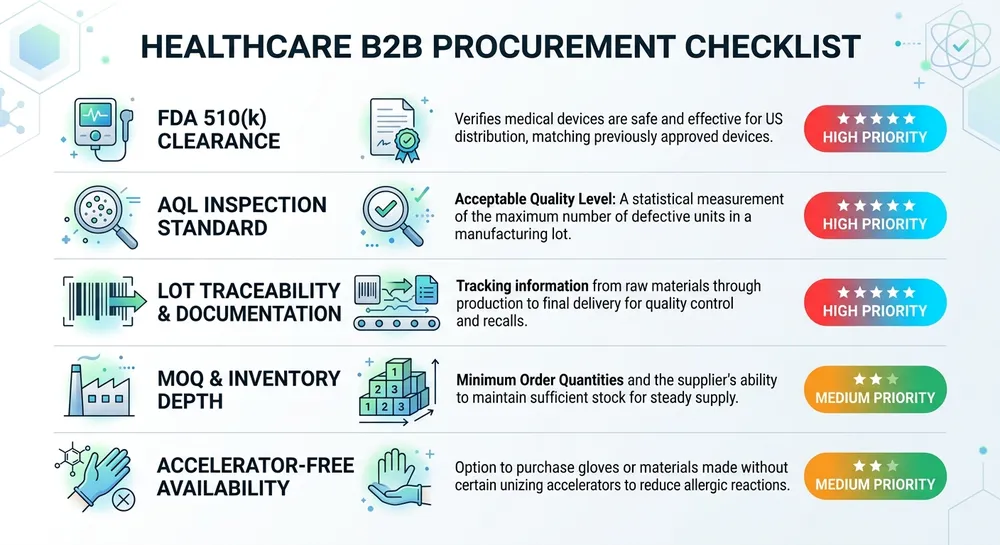
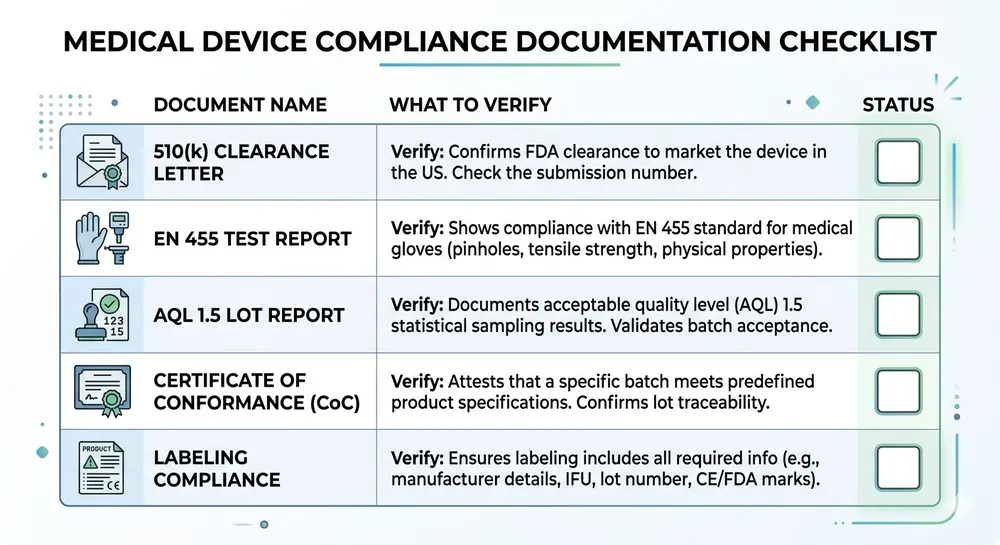
This is the minimum documentation set for a medical nitrile glove shipment into the US or EU. Missing any one of these creates a gap that customs or port health authorities can use to hold or reject the shipment.
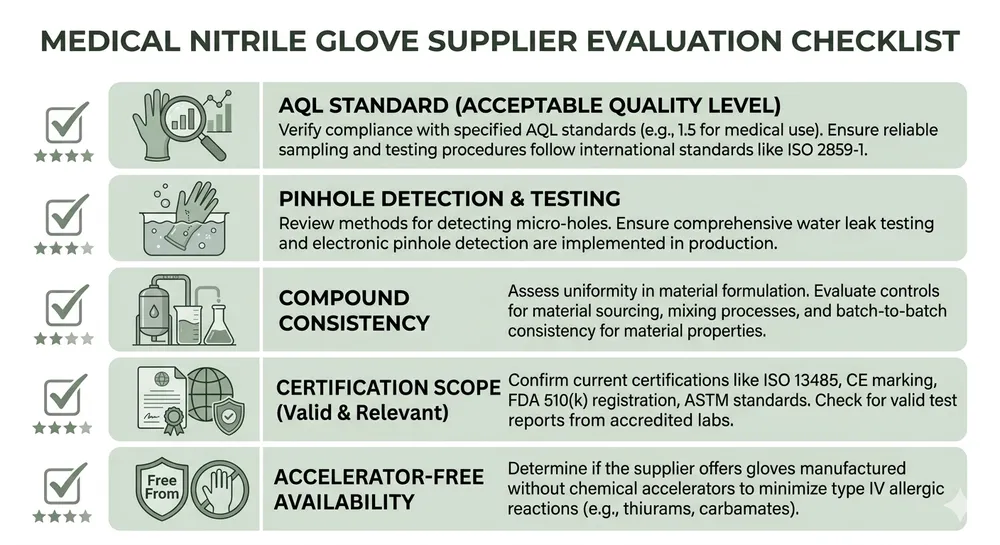
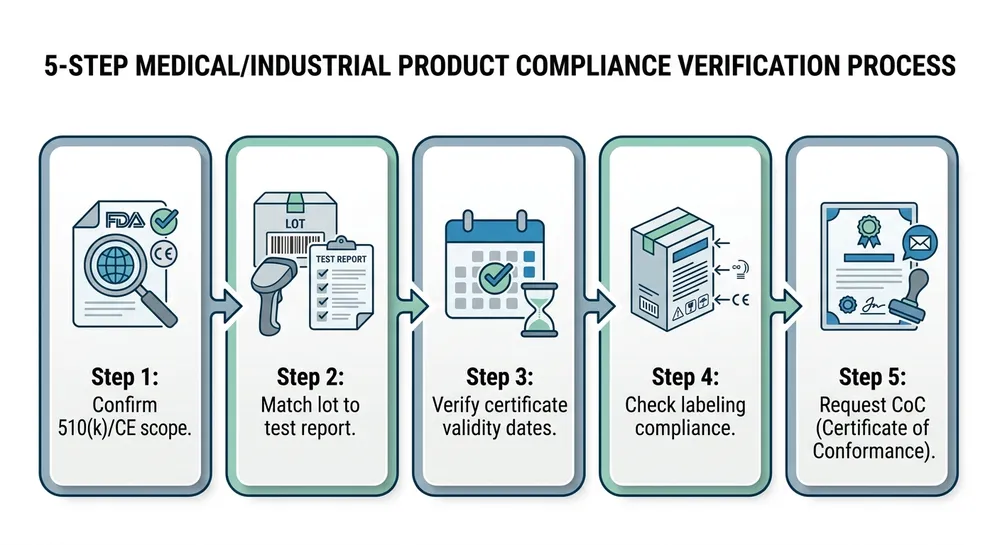
1. FDA 510(k) clearance letter (US market) The original clearance letter, not a summary page. Confirm the K-number, device description, and that the clearance is current (not withdrawn). Cross-reference against the FDA database — don't rely solely on what the factory provides.
2. EN 455 test report + CE certificate (EU/UK market) The test report must cover all four parts of EN 455. The CE certificate must be issued by an accredited Notified Body, not self-declared. Check the certificate expiry date — EN 455 certificates typically run 3–5 years, and factories don't always proactively notify buyers when they're approaching renewal.
3. AQL 1.5 inspection report tied to the production lot The AQL report must reference the specific lot number being shipped. A generic AQL report from a previous production run doesn't satisfy FDA or EU import requirements for lot traceability. The report should show sample size, acceptance number, rejection number, and actual defects found — not just a pass/fail stamp.
4. Certificate of Conformance (CoC) Issued by the factory for the specific shipment, referencing lot number, quantity, product specification, and the certifications the product is manufactured under. This is the document that ties everything together at customs.
5. Labeling compliance confirmation For FDA-regulated medical gloves, labeling must comply with 21 CFR Part 801. For EU, labeling must meet MDR Annex I requirements. Ask the factory to provide a labeling sample or proof before production is finalized — not after the container is packed.
How to verify AQL reports aren't recycled from a previous lot
This is the most common documentation fraud we encounter — not forged certificates, but legitimate test reports from a real inspection that get reused across multiple shipments. The factory ran AQL 1.5 on a production lot six months ago, passed, and now attaches that same report to every container regardless of when the gloves were actually made.
Here's how to catch it:
- Match the lot number on the AQL report to the lot number on the packing list and CoC. If they don't match, stop. Ask for the report that corresponds to the actual lot being shipped.
- Check the inspection date against the production date. The inspection should follow production, not precede it by months.
- Ask who conducted the inspection. Factory self-inspection is acceptable for routine production monitoring, but for first orders or after any production change, request a third-party AQL report from SGS, Bureau Veritas, Intertek, or equivalent.
- Look at the sample size. For a standard 2,000-box container (approximately 200,000 gloves), AQL 1.5 at inspection level II requires a sample size of around 200 units minimum. If the report shows a sample of 32 units for a full container, the inspection level doesn't match the shipment volume.
We run 100% online pinhole detection on our dipping lines and conduct AQL 1.5 on every production lot before it leaves the floor. When a buyer asks for the lot-specific report, we pull it from the same batch record that tracks compound formulation, line number, and production date. That traceability is what makes the document useful — a report without a traceable lot number is just paper.
Accelerator-free certification: what EU hospital buyers are actually asking for
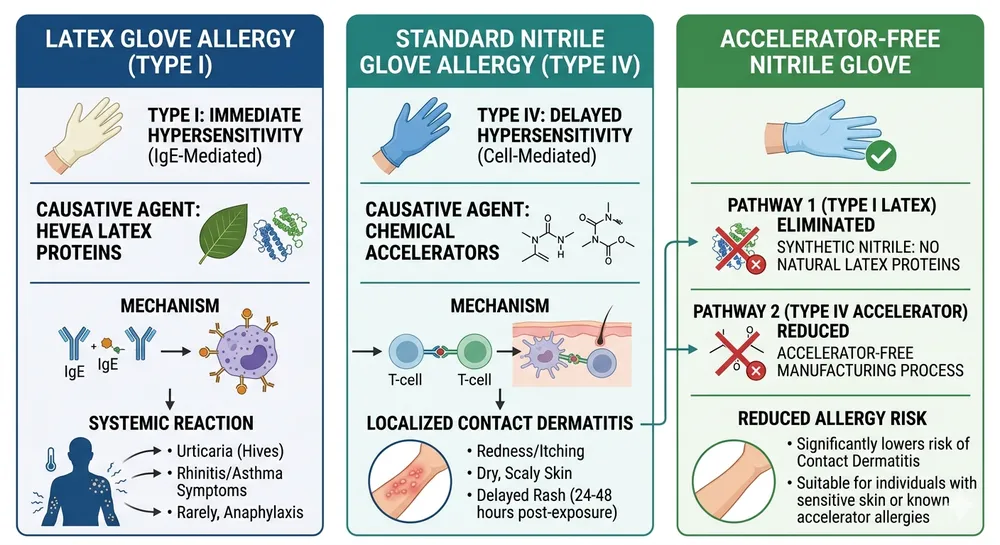
If you're supplying European hospital procurement or any healthcare account with sensitization protocols, you'll encounter requests for accelerator-free certification. This is separate from EN 455 and CE marking — it's a formulation claim, not a device classification.
Standard nitrile gloves use thiuram and carbamate accelerators in the vulcanization process. These compounds are associated with Type IV (delayed) hypersensitivity reactions in healthcare workers. EU hospital procurement increasingly specifies accelerator-free nitrile as a condition of supply, particularly in Scandinavia, Germany, and France.
What to verify:
- Ask for the compound specification sheet confirming the glove is manufactured without thiuram, carbamate, and mercaptobenzothiazole (MBT) accelerators
- Ask whether the accelerator-free claim is supported by a chemical analysis report (HPLC or equivalent) — not just a factory declaration
- Confirm the claim covers the specific SKU being ordered, not just the factory's accelerator-free product line in general
(We developed our accelerator-free compound in-house specifically for European hospital accounts. The formulation is tested by third-party lab before each production campaign — not just once at initial development. That matters because compound batches can vary, and a single historical test doesn't guarantee the current production run is clean.)
What ASTM D6319 covers — and what it doesn't
For US distributors supplying industrial or food-processing accounts alongside medical accounts, ASTM D6319 comes up regularly. It's the standard specification for nitrile examination gloves for medical application — tensile strength, elongation, force at break, and dimensional requirements.
ASTM D6319 compliance is not the same as FDA 510(k) clearance. A glove can pass ASTM D6319 testing and still not be FDA-cleared as a medical device. The distinction matters when your customer is a hospital or clinic that requires FDA-cleared examination gloves — ASTM compliance alone won't satisfy their procurement requirements.
Conversely, a 510(k)-cleared glove will typically have ASTM D6319 test data as part of its technical file, so if you have the 510(k) clearance letter, the ASTM compliance is generally implied. Ask for the test data anyway — it gives you the actual tensile and elongation numbers, which matter if your customer has specific performance specs.
| Standard | Market | What it covers | What it doesn't cover |
|---|---|---|---|
| FDA 510(k) | US | Medical device clearance | Specific lot quality |
| EN 455 (Parts 1–4) | EU/UK | Dimensions, penetration, biocompatibility, shelf life | Accelerator content |
| ASTM D6319 | US | Tensile, elongation, dimensions | Device regulatory status |
| CE (MDR) | EU | Device classification and conformity | Lot-level inspection |
| ISO 9001:2015 | Global | Quality management system | Product performance |
The labeling trap that holds containers at EU ports
EU customs authorities check labeling before they check test reports. A container of medical nitrile gloves with non-compliant labeling gets flagged before anyone looks at your EN 455 certificate.
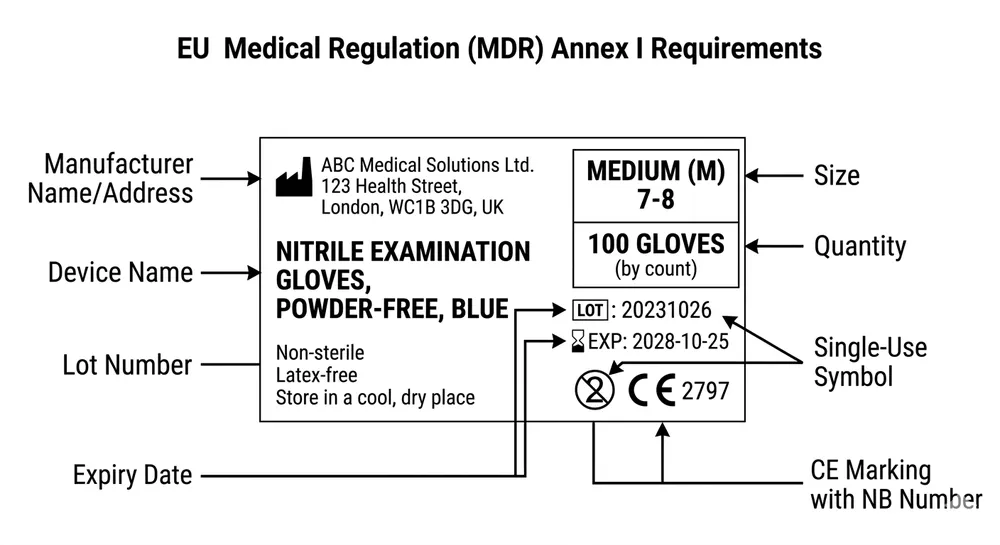
MDR Annex I requires, at minimum:
- Manufacturer name and address
- Device name and intended purpose
- "Sterile" designation if applicable (most examination gloves are non-sterile — confirm this is stated)
- Lot or batch number
- Expiry date (EN 455-4 requires shelf-life validation — the date on the box must be supported by real aging data)
- Size designation
- Quantity per box
- Single-use designation (symbol or text)
- CE marking with Notified Body number
The expiry date requirement catches buyers off guard. A factory can print any date on the box. What matters is whether that date is supported by EN 455-4 shelf-life testing — accelerated aging or real-time aging data showing the gloves maintain performance through the stated shelf life. Ask for the aging test report. If the factory can't produce it, the expiry date on the box is unsubstantiated, and that's a labeling non-compliance.
For US labeling under 21 CFR Part 801, the requirements are similar but not identical. The FDA requires the intended use to be stated, the manufacturer or distributor name and address, and adequate directions for use (or an exemption). Latex-free claims require supporting test data — if your gloves are labeled "latex-free," the factory needs to show the test.
Upstream prevention: what to lock in before production starts
Port rejections are downstream events. The decisions that cause them happen weeks earlier — at the point of order confirmation, specification sign-off, and production scheduling.
Before production begins, confirm in writing:
- Which 510(k) clearance number covers this specific SKU — not the factory's general product line, this exact product
- Which EN 455 certificate covers this SKU — and its expiry date
- The compound formulation — standard accelerator or accelerator-free, and which third-party test supports the claim
- The AQL inspection plan — who conducts it, at what level, and that the report will reference the production lot number
- The labeling artwork — reviewed and approved before printing, not after the boxes are packed
We require labeling artwork sign-off before we schedule production. It adds a step, but it eliminates the scenario where 50,000 boxes are packed with a label error that requires reprinting or relabeling at destination — which is expensive and sometimes triggers a customs query about why the labeling was changed post-production.
The other thing worth locking in early: shelf-life alignment. If you're ordering for a customer who needs 24 months of remaining shelf life at delivery, confirm the production date and the stated expiry date before the order is placed. A factory that prints a 3-year expiry on gloves produced in January needs EN 455-4 data supporting that claim through January three years out. If the aging data only supports 2 years, the 3-year date is non-compliant regardless of what's printed on the box.
Common mistakes that cause rejections — and how to prevent them
Relying on a factory's certification summary sheet instead of the source documents Summary sheets are marketing materials. Pull the actual 510(k) clearance letter from the FDA database. Request the full EN 455 test report, not the one-page certificate. The details that matter — device scope, test parameters, lot traceability — are in the source documents.
Not checking certificate expiry dates EN 455 certificates expire. CE certificates expire. A certificate that was valid when you first qualified the supplier may have lapsed by the time your third or fourth container ships. Build a simple expiry tracking sheet for every supplier's certifications and check it before each order.
Accepting AQL reports without lot traceability If the AQL report doesn't reference the specific lot being shipped, it's not useful for import compliance. Require lot-specific documentation as a condition of shipment release.
Assuming FDA clearance covers all sizes and colors Some 510(k) clearances are size-specific or cover only certain configurations. If you're ordering a new size or a new color variant from a supplier, confirm the clearance covers that variant before the order is placed.
Not verifying the 510(k) transfer when a factory changes ownership or brand 510(k) clearances are transferable, but the transfer must be documented with the FDA. If your supplier was acquired, rebranded, or changed its legal entity, verify that the clearance was properly transferred. An undocumented transfer means the clearance technically belongs to the previous entity.
Practical FAQ
Can a factory's ISO 9001 certification substitute for FDA 510(k) or EN 455? No. ISO 9001 certifies the quality management system — the processes the factory uses to control production. It says nothing about whether the product itself meets medical device performance requirements. FDA 510(k) and EN 455 are product certifications. You need both: a quality system that produces consistent output, and product certifications that confirm the output meets the required standard.
What's the difference between a CE Declaration of Conformity and a Notified Body certificate? A Declaration of Conformity is a self-declaration by the manufacturer that the product meets applicable EU requirements. For Class I medical devices (which includes most non-sterile examination gloves), a Notified Body is not required for the conformity assessment itself — but EN 455 testing must still be conducted and documented. If your supplier claims CE marking without any EN 455 test reports, that's a red flag. Ask for the technical file summary and the test reports.
How do I verify a 510(k) clearance number is legitimate? Go to accessdata.fda.gov/scripts/cdrh/cfdocs/cfpmn/pmn.cfm and search by the K-number. The database is public and updated in real time. If the number doesn't appear, or the device description doesn't match your product, the clearance doesn't cover what you're buying.
What should I do if a supplier can't provide lot-specific AQL documentation? Arrange a third-party pre-shipment inspection through SGS, Bureau Veritas, or Intertek before the container is sealed. The cost — typically $300–$600 for a standard container inspection — is a fraction of the demurrage and delay cost if the shipment is held at port.
—
If you're sourcing medical nitrile gloves and want to confirm that the documentation package covers your target market — US, EU, or both — send us your requirements. We'll walk through the certification scope, lot documentation, and labeling requirements for your specific SKU before production is scheduled. Request a quote or documentation review and we'll respond with the relevant compliance documentation for your market.