A rejection at US Customs is not a customs problem. By the time CBP flags your container, the compliance failure already happened — at the factory, during compounding, or in the documentation package that left with the shipment. We've seen it from the factory side for nearly two decades, and the pattern is consistent: importers who get burned are almost never buying from outright fraudulent suppliers. They're buying from factories that cut corners on test documentation, or they're buying gloves that passed a sample inspection but weren't manufactured to the same spec at production volume.
This article walks through what FDA 510(k) clearance and ASTM D6319 actually require, where the gaps between "certified" and "compliant" show up in practice, and what documents you should be holding before you release payment on a container.
—
What FDA 510(k) Clearance Actually Covers — and What It Doesn't
FDA 510(k) clearance means the FDA has reviewed the device and determined it is substantially equivalent to a legally marketed predicate device. For disposable nitrile examination gloves, this is the regulatory pathway that allows the product to be sold as a medical-grade examination glove in the US market.
What it does not mean: it does not mean the FDA inspected your specific production run. It does not mean every box in your container meets the cleared specification. The 510(k) number belongs to the device as described in the submission — the formulation, the manufacturing process, the facility. If the factory changes its nitrile compound, shifts production to a different line, or subcontracts manufacturing without updating the submission, the clearance no longer covers what you're importing.
This is where importers get into trouble. They see a 510(k) number on the spec sheet and assume the compliance work is done. The number is a starting point, not a finish line.
What to verify on the 510(k):
- The 510(k) number is searchable in the FDA's public 510(k) database — confirm it exists and matches the device description
- The cleared device description matches the product you're ordering (powder-free, nitrile, examination grade, the specific size range)
- The manufacturer listed in the clearance matches the factory you're sourcing from — not a trading company, not a parent entity
- The clearance has not been recalled or withdrawn (check the FDA's recall database separately)
We maintain our FDA 510(k) clearance documentation at the SKU level, and we can provide the clearance number with the corresponding device description for any medical-grade order. If a supplier can't give you the clearance number to verify yourself, that's a problem worth taking seriously before the container ships.
—
ASTM D6319: The Standard Behind the Spec Sheet
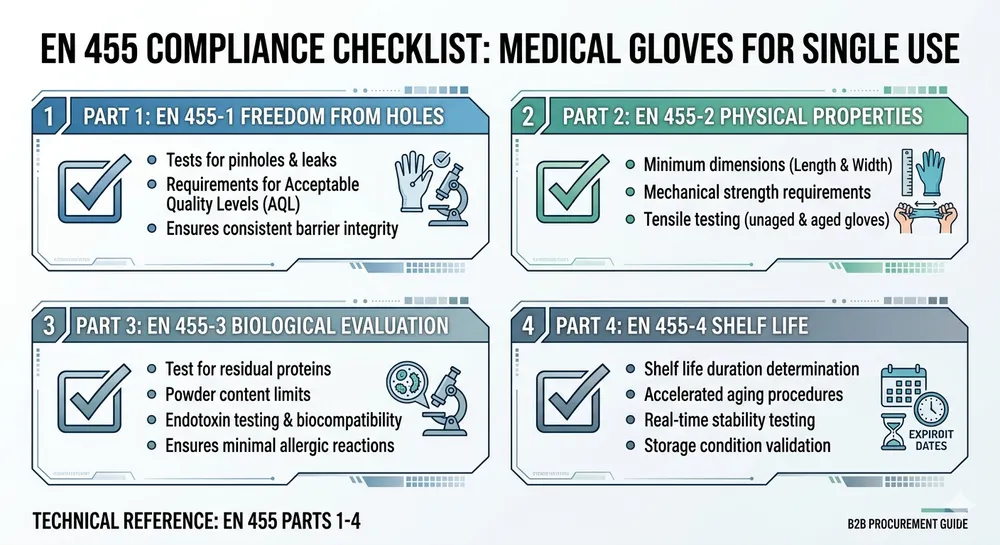
ASTM D6319 is the standard specification for nitrile examination gloves for single use. It defines the minimum physical performance requirements that a disposable nitrile examination glove must meet to be sold in the US medical market. The FDA references ASTM D6319 as the applicable consensus standard for 510(k) submissions in this category.
The standard covers several test parameters that matter directly to product performance and import compliance:

| Test Parameter | ASTM D6319 Minimum | Notes |
|---|---|---|
| Tensile strength (before aging) | ≥ 14 MPa | Measured per ASTM D412 |
| Tensile strength (after aging) | ≥ 11 MPa | After 70°C / 168-hour oven aging |
| Ultimate elongation (before aging) | ≥ 500% | Indicates elasticity and fit |
| Ultimate elongation (after aging) | ≥ 400% | Shelf-life performance indicator |
| Pinhole AQL | AQL 1.5 | Per ASTM D5151 water leak test |
| Thickness (single wall) | ≥ 0.05 mm at palm | Minimum — not a target |
A few things worth understanding about how these numbers work in practice.
The tensile and elongation values are tested on dumbbell-shaped specimens cut from the glove body. The results depend heavily on the nitrile compound formulation — specifically the ratio of acrylonitrile to butadiene, the sulfur-based or sulfur-free cure system, and the accelerator package. We run our own compounding lab, which means we control these variables directly rather than buying pre-mixed compound from a third party. That matters for consistency across production runs, not just for the first batch that gets tested.
The aging test (70°C for 168 hours) simulates shelf aging. A glove that passes tensile before aging but drops below 11 MPa after aging has a shelf-life problem — it will degrade before your customer uses it. This is one of the more commonly skipped tests in supplier documentation packages, because it requires holding samples in an oven for a week before you can report results. Ask for it specifically.
The AQL 1.5 pinhole standard means that in a statistically sampled lot, the acceptable quality level for defective gloves (those that fail the water leak test) is 1.5%. We run 100% online pinhole detection on our dipping lines — every glove passes through an automated electrical leak test before it's counted into a box. The AQL 1.5 sampling at final inspection is a second gate, not the only gate. (Most factories run AQL sampling only. The difference shows up in your defect rate at the destination.)
—
The Gap Between "Certified" and "Compliant at Volume"
Here's the sourcing reality that doesn't appear on any spec sheet: a factory can hold valid FDA 510(k) clearance and ASTM D6319 test reports and still ship you a container that fails incoming inspection at your warehouse.
How? Because test reports are point-in-time documents. They reflect the performance of a specific lot, tested at a specific time, under controlled conditions. Production at volume introduces variables that sample testing doesn't capture — compound batch variation, line speed changes, dipping tank temperature drift, and the simple fact that a factory running at 80% capacity for a sample order behaves differently than one running at full capacity to fill your 5-million-piece order.
We've seen this from the other side too. When we audit our own production data, the lots that show the most thickness variation are the ones produced during line transitions — when a dipping line is ramping up after maintenance or switching between SKUs. That's when the compound viscosity isn't fully stabilized and the film build is inconsistent. We track this in our process control logs and hold those lots for additional sampling before they're released to packing.
The documents that actually tell you something:
- Third-party test report (current): Not older than 12 months, issued by an accredited lab (SGS, Intertek, Bureau Veritas, or equivalent), covering the specific SKU you're ordering. Ask for the full report, not a summary certificate.
- Lot-specific CoA (Certificate of Analysis): Issued by the factory for your production lot, showing actual measured values — not just "pass/fail" against the standard.
- AQL inspection report: Either your own third-party pre-shipment inspection or the factory's internal AQL report with lot numbers traceable to your order.
- FDA establishment registration: The manufacturing facility must be registered with the FDA as a medical device establishment. This is separate from the 510(k) clearance and is searchable in the FDA's FURLS database.
The FDA establishment registration is one that importers frequently overlook. A factory can have a valid 510(k) number but an expired or lapsed facility registration — and that makes the product misbranded under 21 CFR Part 820. Check both.

—
Thickness, Mil Rating, and Why the Minimum Isn't Your Target
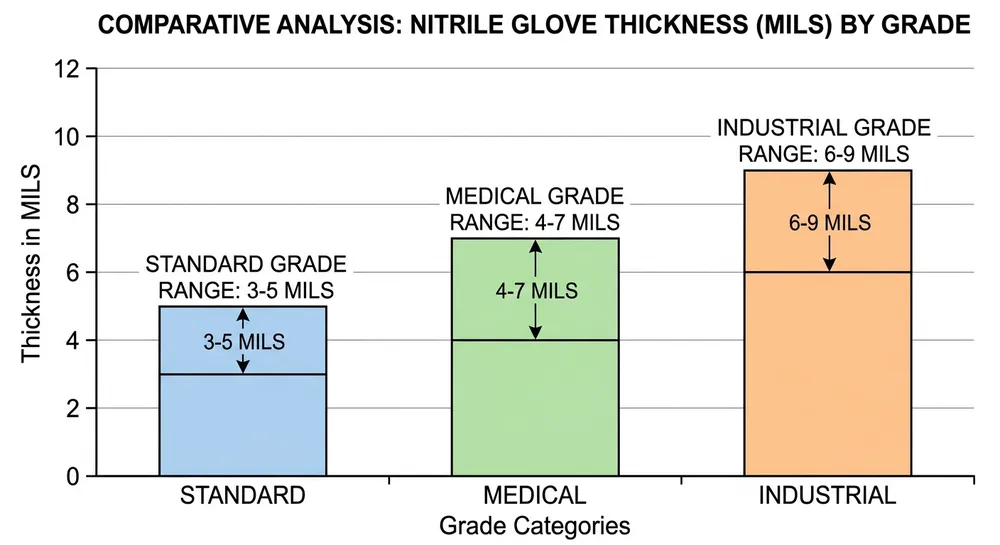
ASTM D6319 sets a minimum single-wall thickness of 0.05 mm at the palm. That's 2 mil in the unit system most US buyers use. It's a floor, not a specification.
The practical thickness range for examination-grade nitrile gloves in the US market runs from about 3 mil (0.076 mm) for thin exam gloves used in clinical settings where tactile sensitivity matters, up to 5–6 mil (0.127–0.152 mm) for heavier exam gloves used in procedural or higher-risk environments. Industrial-grade nitrile gloves — which fall under different standards and are not covered by ASTM D6319 — typically run 4–8 mil depending on the application.
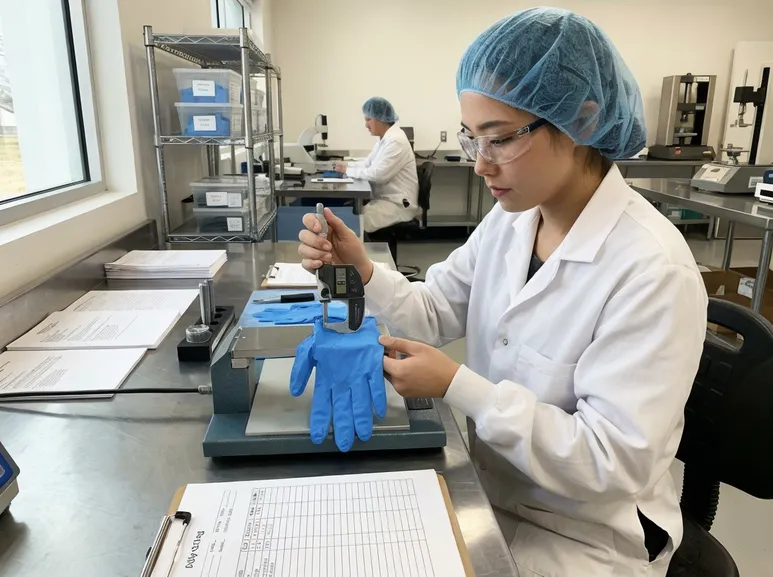
Where importers make expensive mistakes: ordering to a nominal thickness without specifying the measurement point and the tolerance. A glove labeled "4 mil" might measure 4 mil at the palm and 2.8 mil at the fingertip — which is where most punctures and chemical exposures happen. Our dipping lines run with a controlled thickness tolerance of 0.08–0.15 mm across the glove body, and we measure at three points (palm, finger, cuff) on every production lot. If a supplier can't tell you their fingertip thickness separately from their palm thickness, that's a specification gap worth closing before you commit to volume.
The thickness also affects your landed cost calculation in ways that aren't obvious. A 0.5 mil increase across a 5-million-piece order adds meaningful weight to the container — which affects freight cost per box. We can model this for you if you're comparing specifications across suppliers. The right thickness for your market isn't always the thickest option; it's the one that passes the performance standard, meets your end-customer's application requirements, and lands at a freight-adjusted cost that protects your margin.
—
Powder-Free, Accelerator-Free, and the Regulatory Distinctions That Matter for Your Market
Two product variants create compliance questions that come up regularly in import discussions.
Powder-free vs. powdered: The FDA banned powdered surgeon's gloves, powdered patient examination gloves, and absorbable powder for lubricating surgeon's gloves in January 2017 (21 CFR Part 895). If you're importing examination gloves for the US medical market, they must be powder-free. This isn't a preference — it's a regulatory requirement. Any supplier offering powdered examination gloves for the US market is either selling into a non-medical channel or is out of compliance.
Accelerator-free (Type IV allergy): Standard nitrile gloves use thiuram or carbamate accelerators in the vulcanization process. These accelerators are the primary cause of Type IV (delayed) allergic reactions in healthcare workers — a documented occupational health issue that has driven significant demand for accelerator-free nitrile in hospital and clinical procurement. Accelerator-free gloves require a modified cure system (typically using alternative crosslinkers) and must be tested and documented separately from standard nitrile. They carry a price premium, but for healthcare distributors supplying hospital systems, the ability to offer an accelerator-free option is a real commercial differentiator.
We produce both standard powder-free and accelerator-free variants from the same facility. The accelerator-free line uses a different compound formulation developed in our in-house compounding lab — it's not a third-party product we rebrand. If your distribution channel includes hospital group purchasing organizations or occupational health accounts, this is worth discussing before you finalize your SKU mix.
—
What a Pre-Shipment Inspection Should Actually Cover
A lot of importers commission a pre-shipment inspection and receive a report that says "AQL 1.5 — Pass" and consider the compliance work done. That's necessary but not sufficient.
A thorough pre-shipment inspection for FDA-regulated nitrile examination gloves should cover:
Labeling compliance (21 CFR Part 801):
- "Sterile" or "non-sterile" designation (examination gloves are non-sterile)
- Latex-free or nitrile material declaration
- Single-use designation
- Lot number and expiration date (if applicable)
- Manufacturer name and address
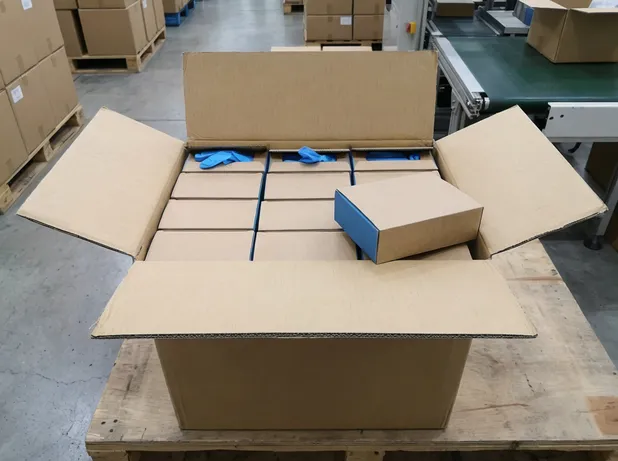
- Quantity per box
- The 510(k) number is not required on labeling but the device must be covered by a valid clearance
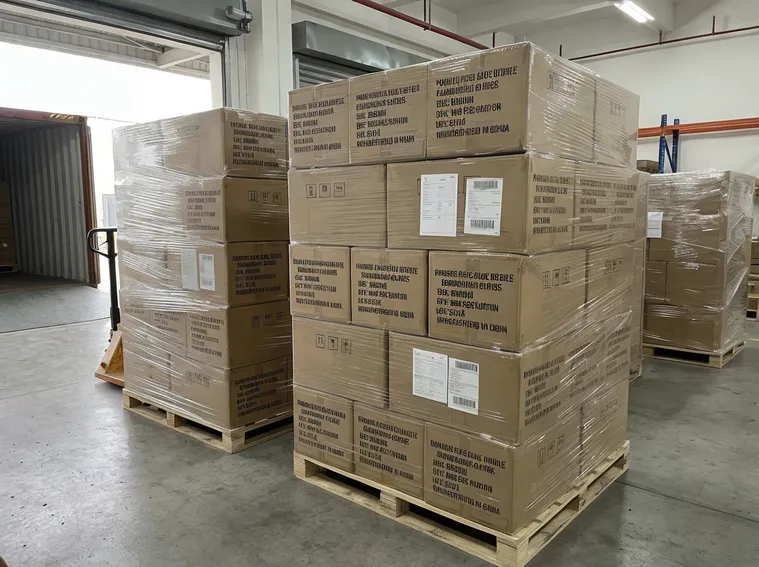
Labeling failures are one of the most common reasons FDA detains shipments at the border. We've seen containers held for missing lot numbers, incorrect quantity declarations, and labeling that references a 510(k) number that doesn't match the actual product. These are fixable problems — but only before the container ships.
Physical inspection:
- AQL 1.5 sampling per ASTM D5151 (water leak test)
- Dimensional check against the ordered specification (length, width, thickness at palm and finger)
- Visual inspection for surface defects, color consistency, and packaging integrity
Documentation package review:
- Confirm 510(k) number matches FDA database
- Confirm facility registration is current
- Confirm test report covers the specific SKU and is within validity period
- Confirm CoA lot numbers match the production lot being shipped
(We provide a complete documentation package with every medical-grade shipment — 510(k) reference, facility registration confirmation, third-party test report, and lot-specific CoA. If you want to review a sample package before placing an order, that's a reasonable request and we're happy to share one.)
—
The Sourcing Decision: Medical Grade vs. Industrial Grade for US Import
Not every nitrile glove order requires FDA 510(k) clearance. The compliance requirement depends on the intended use and the channel you're selling into.
| Use Channel | Required Standard | FDA Clearance Required? |
|---|---|---|
| Medical examination (hospitals, clinics, dental) | ASTM D6319 | Yes — 510(k) |
| Food handling / food service | FDA 21 CFR 177.2600 (food contact) | No 510(k), but food-contact compliance required |
| Industrial / general purpose | ASTM D6319 or EN 374 (chemical) | No — but channel-specific standards apply |
| Cleanroom / semiconductor | ASTM D6319 + particle count specs | Depends on end-use claim |
The mistake we see most often: importers sourcing industrial-grade nitrile at industrial pricing and then selling into medical channels because the gloves "look the same." They don't perform the same — industrial-grade gloves are not manufactured to the same AQL standard, may not meet ASTM D6319 tensile and elongation minimums, and are not covered by a 510(k) clearance. If your downstream customer is a hospital, a dental practice, or any FDA-regulated facility, the gloves need to be medical grade, full stop.
The reverse also happens: buyers over-specify by ordering medical-grade gloves for purely industrial applications, paying a 15–25% premium for certification they don't need. If your end-use is food processing, automotive assembly, or general warehouse work, industrial-grade nitrile at the right thickness specification will serve your customers and protect your margin better than medical-grade at medical-grade pricing.
We supply both grades from the same facility. The production lines, the QC process, and the compound quality are consistent — the difference is in the certification documentation and the AQL standard applied. If you're not sure which grade fits your channel, tell us where the gloves are going and we'll give you a direct answer.
—
FAQ: Compliance Questions US Importers Ask Before Committing to Volume
Can I use one 510(k) clearance number across multiple glove sizes?
Yes, a single 510(k) clearance typically covers a device family — meaning the same glove in multiple sizes (XS through XL) can be covered under one clearance if the sizes were included in the original submission. What it cannot cover is a different product — a different thickness specification, a different compound formulation, or a different manufacturing facility. If you're ordering a new SKU that wasn't part of the original submission, the factory needs to either file a new 510(k) or a substantial equivalence determination. Ask the factory directly which SKUs are covered under their clearance number.
What's the difference between an ASTM D6319 test report and a Certificate of Conformance?
A test report is a document from an accredited third-party laboratory showing actual measured test results — tensile strength values, elongation percentages, AQL defect counts. A Certificate of Conformance (CoC) is a factory-issued declaration that the product meets the standard. The CoC is only as reliable as the factory's internal QC. For US import, you want the third-party test report, not just the CoC. The CoC can accompany the shipment as a supplementary document, but it doesn't replace independent test data.
How often should test reports be renewed?
FDA guidance and most import compliance frameworks treat test reports as valid for 12 months from the test date, assuming no changes to the product formulation, manufacturing process, or facility. If the factory changes its nitrile compound or moves production to a new line, the existing test report no longer covers the current product. We retest annually and after any compound or process change — and we can provide the test date with any report we share.
Does ASTM D6319 cover chemical resistance?
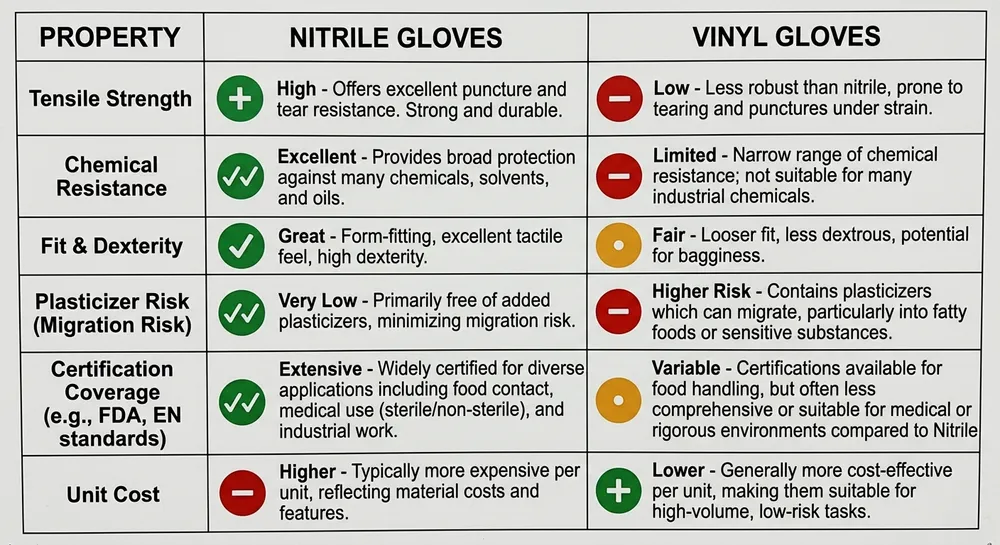
No. ASTM D6319 covers physical performance — tensile strength, elongation, and pinhole integrity. Chemical resistance for nitrile gloves is covered by separate standards: ASTM F739 (permeation testing) and EN 374 (European standard for chemical protective gloves). If your buyers are in environments with chemical exposure — laboratory work, pharmaceutical handling, certain industrial applications — you need to specify chemical resistance separately and request the appropriate test data. Examination-grade nitrile provides a baseline barrier, but it is not rated for chemical protection without additional testing.
What happens if my container is detained by FDA at the port of entry?
FDA detention triggers an import alert process. The importer of record receives a Notice of FDA Action and has the opportunity to provide documentation to demonstrate compliance. If the issue is documentation (missing or expired test reports, labeling deficiencies), it can sometimes be resolved without physical destruction of the goods — but it requires time, legal costs, and storage fees while the goods sit at the port. If the issue is a product failure (the gloves don't meet ASTM D6319 minimums), the options are re-export or destruction. The cost of a thorough pre-shipment documentation review is a fraction of the cost of a detained container.
—
Verifying Compliance Before the Container Leaves
The verification sequence that protects your import is straightforward, but it has to happen before the goods ship — not after.
- Confirm the 510(k) number in the FDA's public database and match it to the specific product you're ordering
- Confirm the manufacturing facility's FDA establishment registration is current in FURLS
- Request a current (within 12 months) third-party ASTM D6319 test report covering your specific SKU
- Request a lot-specific CoA for your production order with actual measured values
- Commission or conduct an AQL pre-shipment inspection covering physical sampling, dimensional verification, and labeling compliance
For Disposable Nitrile Gloves sourced from our facility, we provide the complete documentation package as standard — not on request, not as an add-on. The 510(k) clearance, facility registration, third-party test reports, and lot CoA ship with every medical-grade order.
If you're ready to verify compliance on a specific SKU or want to review our documentation package before committing to volume, Request Quote with your grade, size, and quantity requirements and we'll send back the full compliance documentation alongside the pricing.