Disposable Nitrile Glove Thickness Explained: How Mil Rating Affects Protection, Dexterity, and Cost
Thickness is the spec that causes the most confusion at the RFQ stage — and the most expensive mistakes at the port. Buyers order 3 mil when their end market needs 4 mil, or over-specify 6 mil for a food-service account that would have been fine with 4 mil and saved 18% on landed cost. The mil number looks simple. What it actually controls is more layered than most product listings explain.
This guide covers what the mil rating means in production terms, how it maps to protection and dexterity trade-offs, what the relevant standards actually require, and where sourcing decisions go wrong.
—
What "mil" actually measures — and where the confusion starts
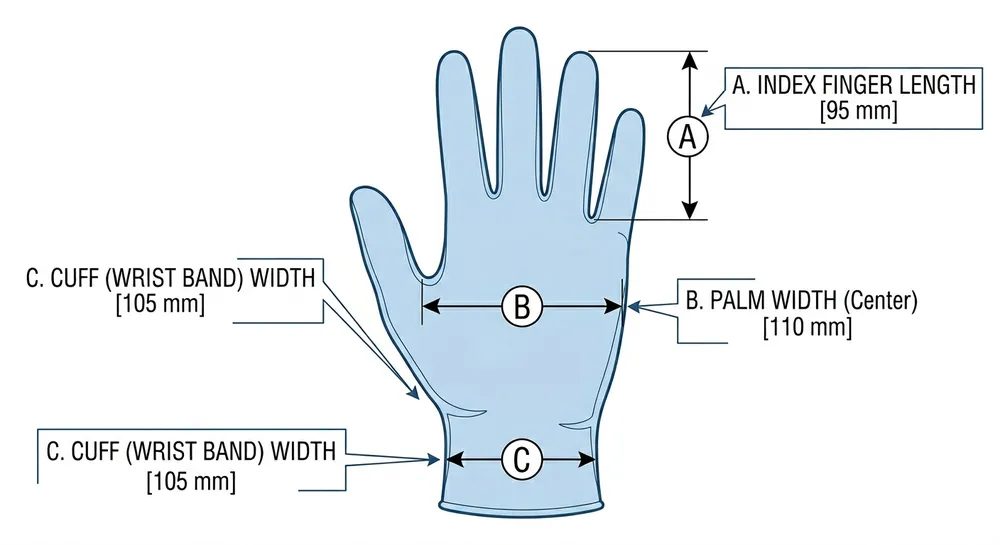
One mil is one-thousandth of an inch (0.0254 mm). For nitrile gloves, thickness is typically measured at three points: the palm, the finger, and the cuff. The number on a product listing — "3 mil," "4 mil," "6 mil" — is almost always the palm measurement, which is the thickest point on the glove.
The problem: finger thickness on a nominally "4 mil" glove can run 2.8–3.2 mil depending on the dipping line calibration and the nitrile compound viscosity. That gap matters because fingers are where punctures happen.
We measure at all three points on every production run. The finger measurement is the one that tells you whether the glove will actually perform — the palm number is what gets printed on the box.
(ASTM D6319 requires thickness measurement at the palm, finger, and cuff — but the minimum values differ by position. A glove can pass the standard while having a finger thickness meaningfully below the palm spec.)
—
The mil-to-performance table: what each thickness tier actually delivers
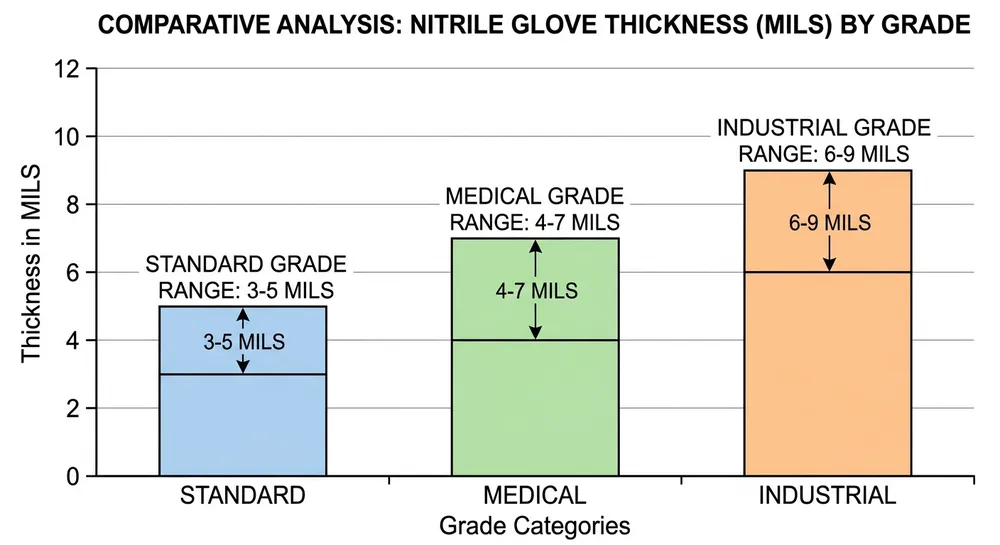
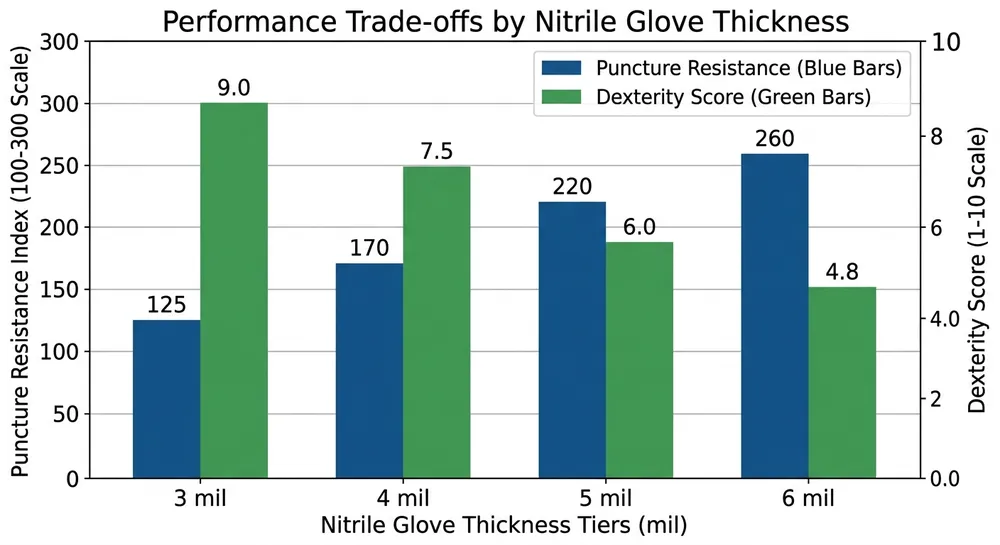
Nitrile gloves sold into B2B channels cluster into four practical thickness tiers. Here's how they map to protection, dexterity, and the markets where they move:
| Thickness (palm) | Typical finger thickness | Protection level | Dexterity | Primary markets |
|---|---|---|---|---|
| 2.5–3 mil | 2.0–2.5 mil | Light barrier only | Highest | Food service, light assembly, clean-room |
| 3.5–4 mil | 2.8–3.2 mil | General-purpose | Good | Medical exam, dental, general industrial |
| 4.5–5 mil | 3.5–4.0 mil | Enhanced puncture resistance | Moderate | Automotive, tattoo, lab work |
| 6 mil+ | 4.5–5.5 mil | Heavy-duty | Reduced | Chemical handling, law enforcement, hazmat |
A few things this table doesn't show: the 3.5–4 mil tier is where the highest volume moves globally. It's the sweet spot for medical exam gloves under FDA 510(k) and ASTM D6319, and it's what most distributors stock as their core SKU. The 6 mil tier has real demand in specific verticals, but it's a smaller, more specialized market — don't over-index on it when building a starter product line.
—
What ASTM D6319 and EN 455 actually require on thickness
These are the two standards that matter for most export markets. They don't specify a single required thickness — they specify minimum values at each measurement point, and they require that the glove pass physical performance tests (elongation, tensile strength, puncture resistance) regardless of thickness.
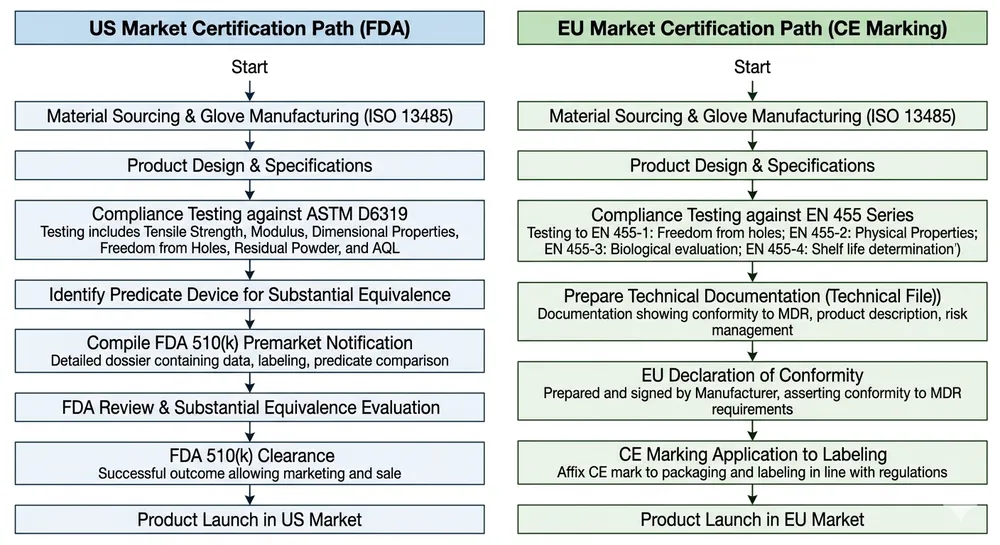
ASTM D6319 (US market, FDA 510(k) pathway for medical exam gloves):
- Minimum palm thickness: 0.05 mm (approximately 2.0 mil)
- Minimum finger thickness: 0.08 mm (approximately 3.1 mil)
- Minimum cuff thickness: 0.05 mm (approximately 2.0 mil)
- Physical performance: minimum tensile strength and elongation at break per the standard
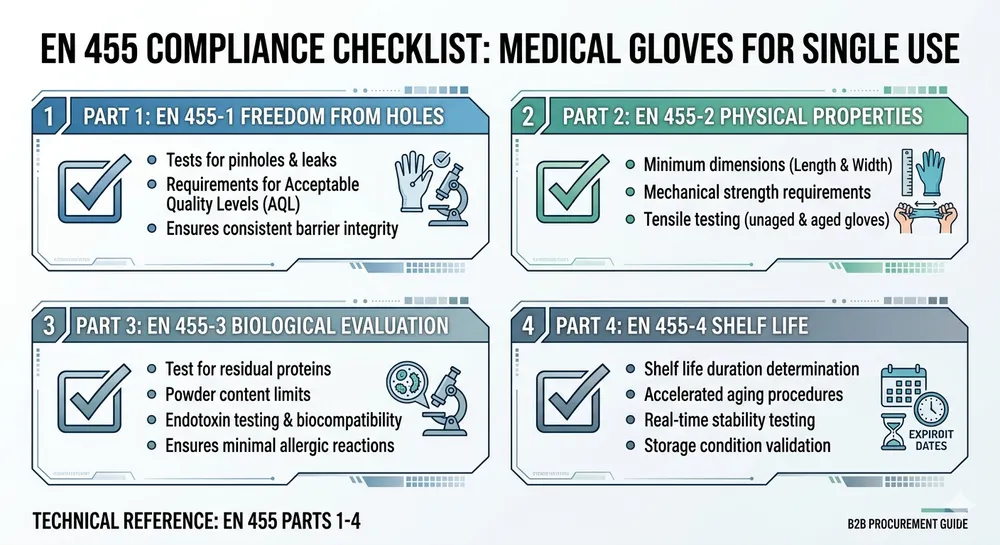
EN 455 (European market, CE marking for medical gloves):
- Part 1: freedom from holes (AQL requirements)
- Part 2: physical properties including thickness, tensile strength, elongation
- Minimum thickness: 0.05 mm at any point
- EN 455-2 requires thickness measurement at palm, finger, and cuff with documented results
The practical implication: a 3 mil glove can pass both standards if the compound and dipping process are controlled. The standard doesn't mandate 4 mil. What it mandates is that the glove performs. Thickness is one input to performance — compound quality and dipping consistency are the others.
We've seen 4 mil gloves from poorly controlled lines fail AQL at the finger because the compound was under-vulcanized. The number on the box doesn't tell you whether the line was running well that day.
—
How thickness affects your landed cost — the math buyers miss
Thickness is a direct multiplier on raw material consumption. Nitrile compound is the largest cost input in glove manufacturing. A 4 mil glove uses roughly 30–35% more compound than a 3 mil glove of the same size. That difference flows through to FOB price, freight weight, and ultimately your margin per box.
A rough cost index across tiers (indexed to 3 mil = 100):
| Thickness | Relative compound cost | Typical FOB price index | Carton weight impact |
|---|---|---|---|
| 3 mil | 100 | 100 | Baseline |
| 4 mil | 130–135 | 118–125 | +8–10% |
| 5 mil | 160–170 | 140–150 | +15–18% |
| 6 mil | 195–210 | 165–180 | +22–25% |
The carton weight impact matters for air freight and for container utilization. A 40-foot container of 3 mil gloves holds more boxes than the same container loaded with 6 mil — so your per-unit landed cost gap widens beyond the FOB price difference once you add freight.
(This is why we always ask buyers about their target market before quoting. A distributor selling into food service at thin margins needs a different spec conversation than one selling into industrial safety where the end buyer is less price-sensitive.)
For buyers building a multi-SKU line, the 3.5–4 mil tier typically delivers the best margin-to-compliance ratio for medical and general industrial accounts. The 5–6 mil tier is worth stocking if you have confirmed demand in automotive or chemical handling — but it's a harder sell as a speculative SKU.
—
The sourcing trap: what "4 mil" on a spec sheet doesn't guarantee
This is where import rejections happen. A supplier quotes "4 mil nitrile exam gloves, ASTM D6319 compliant." The buyer places a container order. At the US port, FDA sampling finds finger thickness averaging 2.6 mil and AQL failures on pinhole testing. The container is detained.
The spec sheet said 4 mil. The gloves didn't deliver it.
Three things cause this gap:
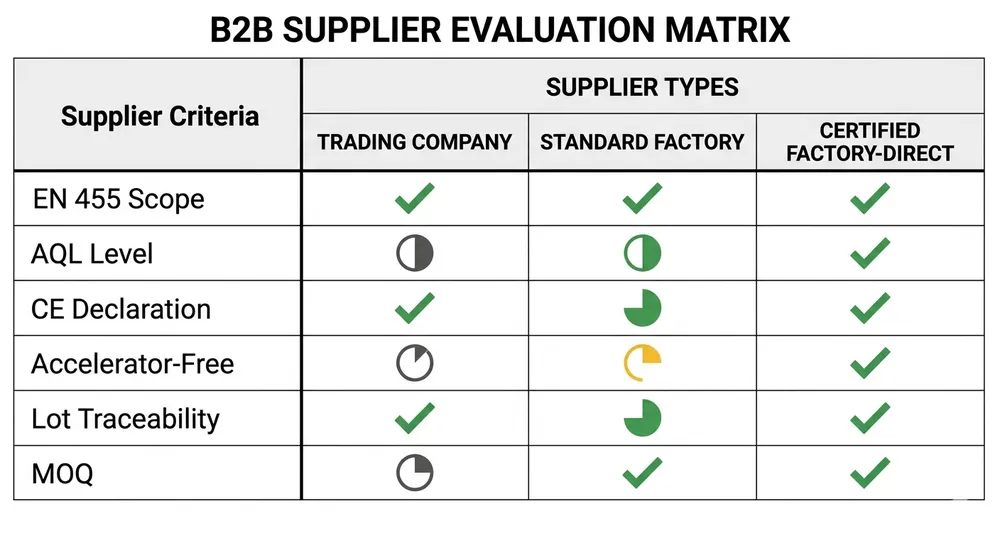
1. Palm-only measurement on the spec sheet. The supplier measured at the palm, which was 4 mil. The finger — where the standard's minimum is most critical — was never reported separately. Always request a thickness report showing all three measurement points, not just palm.
2. No AQL documentation. ASTM D6319 requires AQL 1.5 for critical defects (pinholes). If the supplier can't provide an AQL inspection report from the production lot, you don't know whether that batch passed. A certificate of conformance is not a substitute for a lot-level AQL report.
3. Compound inconsistency between sample and production. The sample glove was made on a calibrated run. The production lot ran at higher line speed with a slightly thinner compound batch. Without in-line thickness monitoring, the deviation isn't caught until inspection — or until your customer's customer finds a hole.
We run 100% AQL 1.5 inspection with online pinhole detection on all eight dipping lines. Every production lot ships with a thickness report covering palm, finger, and cuff measurements, plus the AQL inspection record. When a buyer asks for documentation before releasing payment, that's the right instinct — not an inconvenience.
—
Thickness selection by market segment: where each tier actually sells
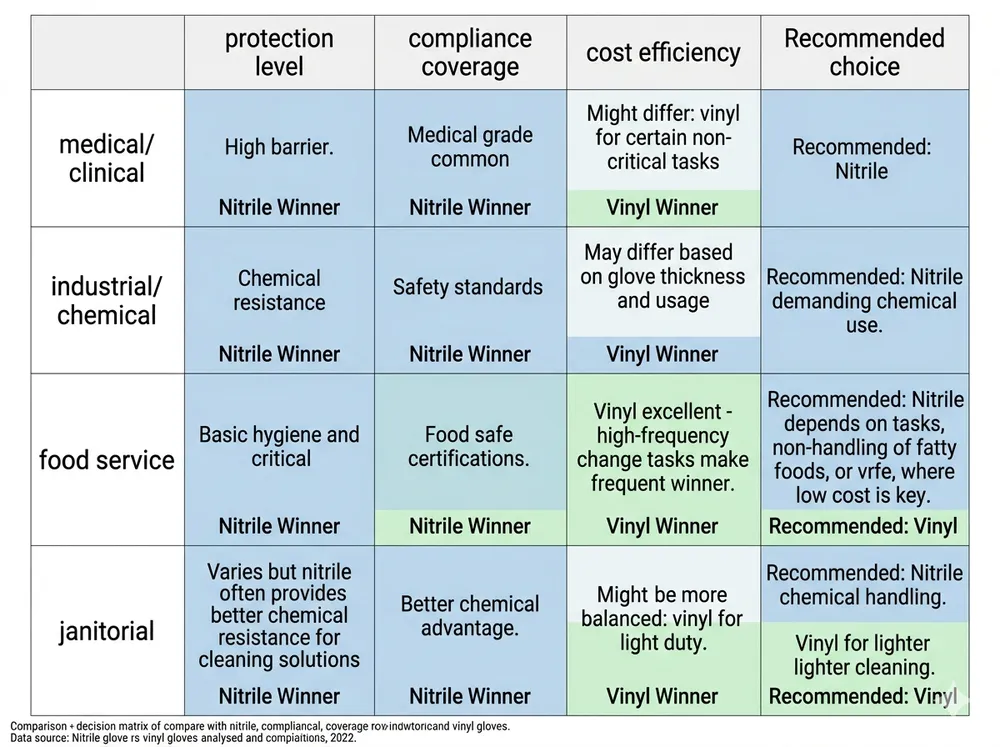
The right thickness spec depends on what your downstream buyers are selling into. Here's how the tiers map to the segments where Disposable Nitrile Gloves move at volume:
Medical and dental (3.5–4 mil): FDA 510(k) clearance is required for medical exam gloves in the US market. The 3.5–4 mil range is the standard for this segment — thick enough to pass ASTM D6319 physical requirements, thin enough for the tactile sensitivity that clinical users expect. This is the highest-volume segment globally and the most documentation-intensive.
Food service and light industrial (3–3.5 mil): These accounts buy on price. The 3 mil tier delivers the barrier protection food-contact applications need at the lowest landed cost. FDA food-contact compliance (21 CFR) applies here, not 510(k). Margins are thinner, but reorder frequency is high and SKU complexity is low.
Automotive and mechanical (4.5–5 mil): Technicians working with oils, solvents, and sharp components need the extra puncture resistance. The 4.5–5 mil range is the practical standard for this segment. Dexterity is still acceptable for most tasks; protection is meaningfully better than the 4 mil tier for abrasion and puncture scenarios.
Chemical handling and law enforcement (6 mil+): Smaller volume, higher per-unit value. Buyers in this segment are less price-sensitive and more specification-driven. EN 374 chemical resistance testing becomes relevant here alongside the standard thickness and AQL requirements.
Tattoo and body art (4–5 mil): A growing segment with specific requirements — black color is the dominant SKU, powder-free is mandatory, and the 4–5 mil range is standard. Reorder patterns are predictable and the segment is underserved by mainstream distributors in many markets.
(The tattoo segment has grown significantly for us over the past few years. If you're building a product line for beauty and personal care distribution, it's worth a dedicated SKU rather than routing buyers to a generic industrial glove.)
—
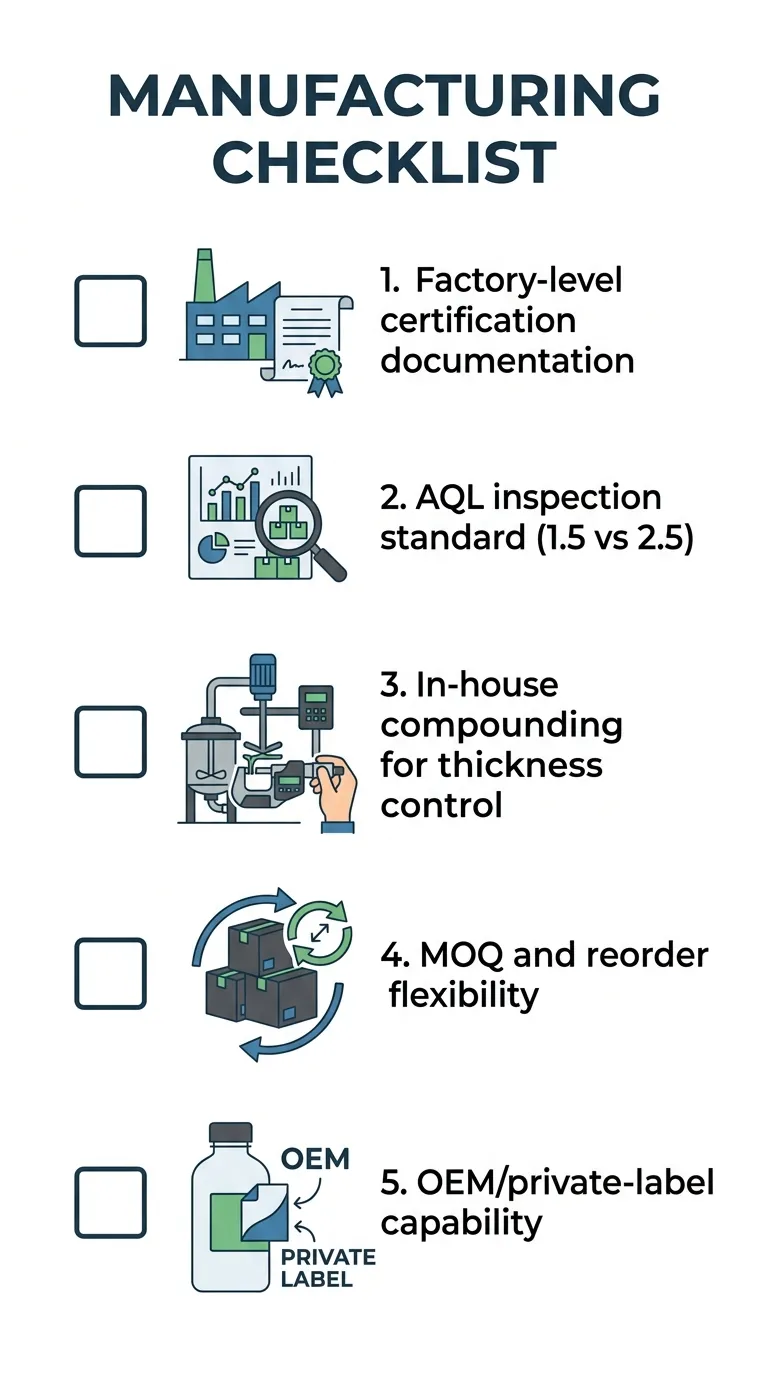
What to verify before you place a container order
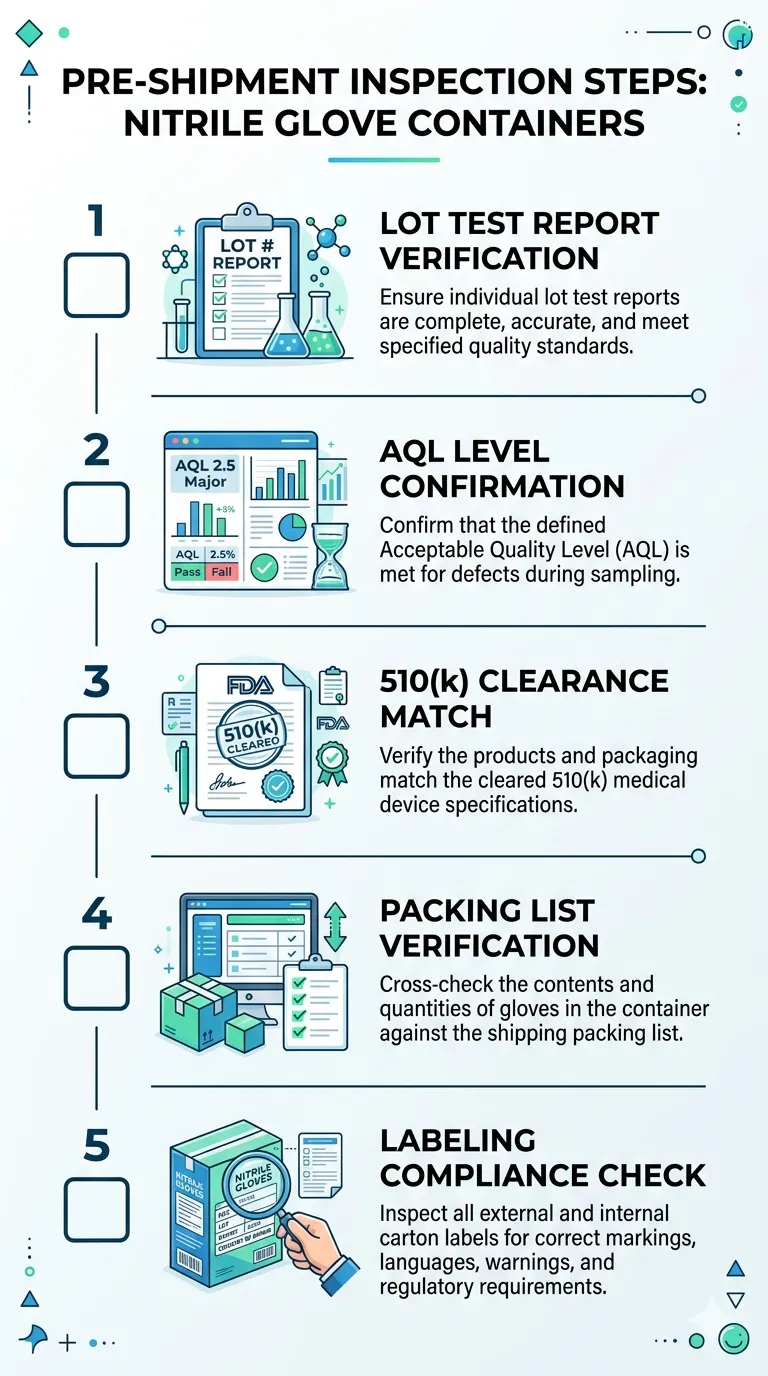
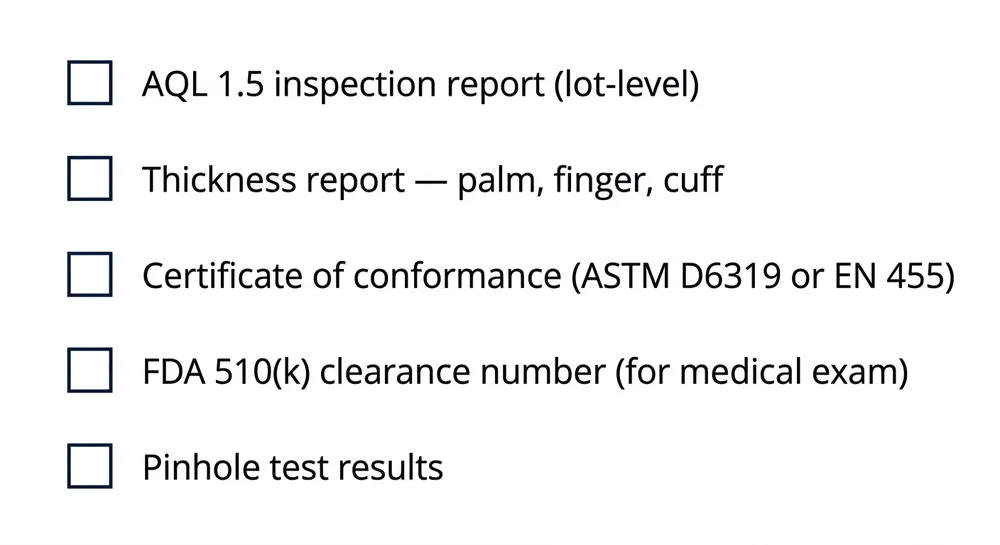
Thickness spec is the starting point, not the finish line. Before committing to a production order, request:
- Thickness report showing palm, finger, and cuff measurements from a recent production lot — not just the sample
- AQL 1.5 inspection report at lot level, covering pinhole and visual defects
- Certificate of conformance referencing the specific standard (ASTM D6319, EN 455, or both)
- FDA 510(k) clearance number if the gloves are destined for medical exam use in the US market
- Compound batch records or in-line QC data if you're ordering at high volume and need consistency across multiple production runs
A supplier who can't produce these documents on request is telling you something about how their QC is actually run. The documentation isn't bureaucracy — it's the evidence that the spec on the box matches what's in the carton.
If you're evaluating suppliers and want to understand how our documentation package is structured, contact us with your target spec and market — we'll send the relevant compliance documents alongside the quote.
—
FAQ
What is the standard thickness for disposable nitrile exam gloves?
For medical exam gloves under ASTM D6319, the practical standard is 3.5–4 mil at the palm. The standard itself sets minimum values at each measurement point rather than a single required thickness, but 3.5–4 mil is where the market has settled for FDA 510(k)-cleared exam gloves. Thinner gloves can pass the standard if the compound and process are controlled, but most buyers and end users expect the 4 mil range for medical use.
Does a higher mil rating always mean better protection?
For puncture and abrasion resistance, yes — within the same compound formulation. A 6 mil glove from a well-controlled line will outperform a 4 mil glove on puncture resistance. But a 4 mil glove from a quality-controlled line will outperform a 6 mil glove from a poorly controlled one, because compound consistency and vulcanization quality affect performance independently of thickness. Mil rating is one variable, not the whole story.
What's the difference between 3 mil and 4 mil nitrile gloves for industrial use?
For light industrial tasks — assembly, packaging, general handling — 3 mil is adequate and costs less. For tasks involving sharp edges, tools, or chemical exposure, 4 mil provides meaningfully better puncture resistance and a longer wear life per glove. The cost difference at FOB is roughly 18–25% per box; the question is whether your end buyer's application justifies the premium. Most industrial safety distributors stock both and let the end buyer's application drive the spec.
Can I use the same nitrile glove SKU for both medical and food-service accounts?
Only if the glove carries both FDA 510(k) clearance and FDA food-contact compliance (21 CFR). Some gloves are cleared for both; many are not. A medical exam glove cleared under 510(k) is not automatically compliant for food contact, and vice versa. If you're consolidating SKUs across both segments, verify that the specific product holds both clearances — don't assume the certifications overlap.
What AQL level should I require for nitrile glove orders?
AQL 1.5 for critical defects (pinholes) is the requirement under ASTM D6319 for medical exam gloves, and it's the standard we apply across all production. For industrial gloves where medical-grade compliance isn't required, some suppliers run AQL 2.5 — which means a higher acceptable defect rate. If your downstream accounts include any medical, dental, or food-service use, specify AQL 1.5 in your purchase order and request the lot-level inspection report before shipment.
How do I confirm that the production lot matches the approved sample?
Request a pre-shipment inspection report that includes thickness measurements at palm, finger, and cuff from the actual production lot — not the sample. Compare the finger thickness specifically; that's where production drift shows up first. If the supplier can't provide lot-level thickness data, that's a red flag regardless of what the sample showed.
—
For orders where thickness spec, compliance documentation, or multi-SKU sourcing is part of the conversation, send us your requirements — grade, target market, annual volume, and any certification requirements — and we'll respond with a detailed quote and the relevant documentation package.