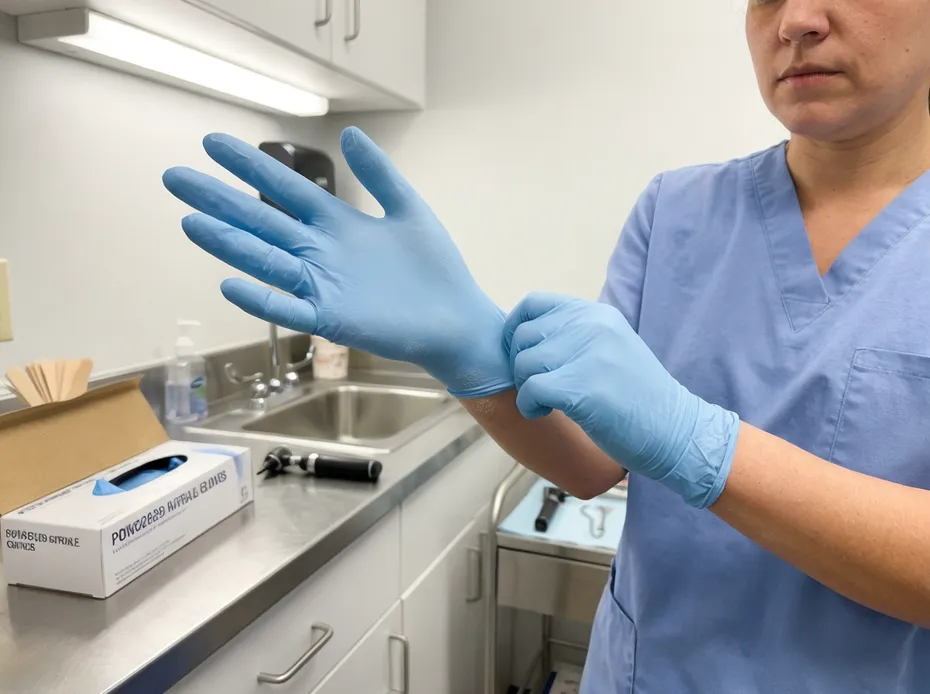
Corn-starch powdered medical nitrile gloves — EN 455 and ASTM D6319 compliant, built for markets where powdered examination gloves remain in active clinical procurement.
Same nitrile compound, same AQL 1.5 inspection standard, same 8-line automated production — with a controlled corn-starch dusting step for donning ease in high-volume clinical environments.
Powdered medical nitrile gloves are a specific procurement SKU, not a legacy holdover you should quietly phase out. Corn-starch powder applied to the inner surface reduces donning friction in high-throughput clinical settings — emergency departments, outpatient clinics, and nursing wards where staff are gloving and degloving dozens of times per shift. In markets where this specification remains compliant and actively procured, it's a real line item with real demand.
The regulatory picture is the first thing to get straight before you stock this SKU. The FDA banned powdered surgeon's gloves and powdered patient examination gloves for the US market effective January 2017 — if your distribution is primarily North American, this product is not for you. The EU has similarly restricted powdered gloves under the Medical Device Regulation for most clinical applications.
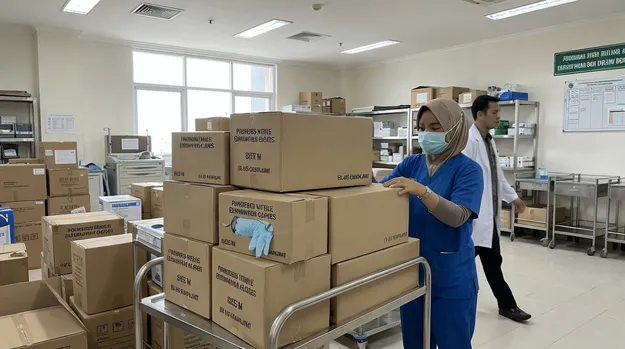
Where powdered medical nitrile gloves remain in active procurement is Southeast Asia — Indonesia, the Philippines, Vietnam, Thailand — and parts of the Middle East, where certain hospital systems and government health procurement bodies still specify powdered examination gloves for donning ease and cost reasons. If those are your markets, this SKU belongs in your catalog. If they're not, the powder-free examination gloves are the right starting point.
We produce this variant on the same automated dipping lines as our powder-free range, with a corn-starch dusting step added after stripping. The nitrile compound is identical — same formulation, same thickness profile, same cure process. The powder application is controlled by weight per glove to stay within EN 455 Part 1 requirements for powder quantity. EN 455-1 sets a maximum of 2 mg absorbable powder per glove — we run below that threshold and verify by lot.
Specifications shown are industry-standard values for this product type. Actual specifications may vary by production lot. Contact us for detailed product data sheets and lot-specific test reports.
Get lot-specific test reports, detailed product data sheets, or arrange a sample order for evaluation.
Request Spec Sheet / SampleMost quality variables in a powdered glove are identical to any nitrile examination glove. The one variable unique to this SKU is powder application — and it's where powdered gloves most commonly create downstream problems.
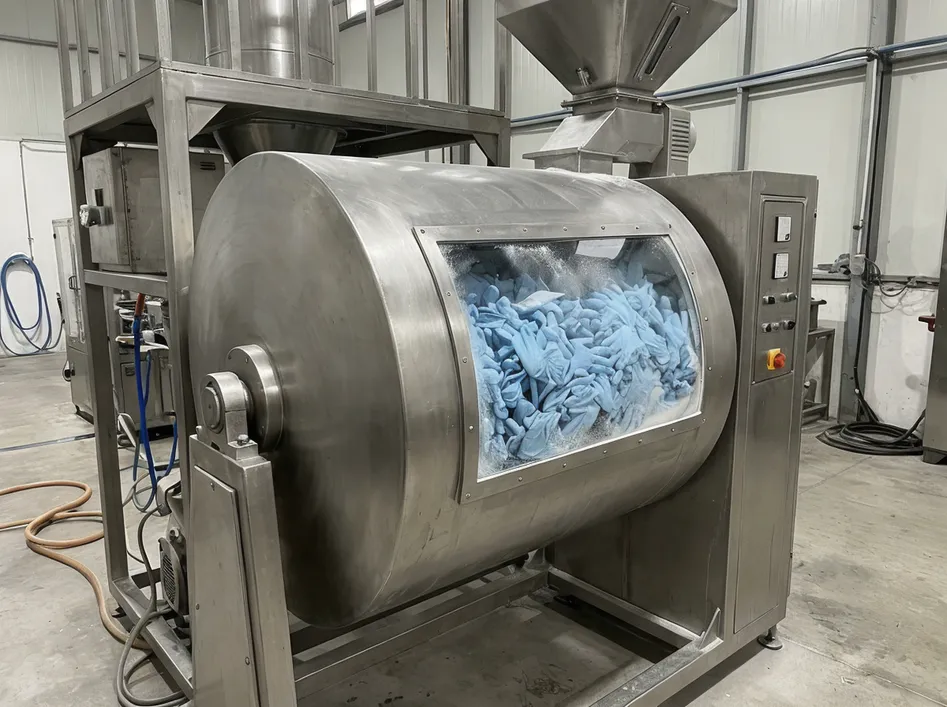
After stripping from the former, gloves pass through a tumble-dusting chamber where corn-starch powder is applied by controlled airflow. The chamber is calibrated to deliver a consistent powder weight per glove.
We check powder quantity by sampling finished gloves from each lot and weighing them against undusted control samples. The target is uniform coverage at the minimum effective quantity — enough to reduce donning friction, not so much that powder accumulates visibly in packaging or exceeds the EN 455-1 limit.
The corn starch we use is USP-grade absorbable powder — the same specification required for surgical glove dusting historically, and the grade that meets EN 455 requirements for absorbable powder in medical gloves. We don't use talc or non-absorbable powder.
This matters for markets where customs or health authority inspectors check powder type — USP corn starch is the only absorbable powder specification that clears EN 455 and most Southeast Asian import requirements without additional documentation.
Every glove passes the electrical leak test on the production line
Gloves proceed to the dusting chamber only after passing integrity check
The dusting process itself introduces no variable into the barrier integrity result
Pinhole detection runs the same way as on our powder-free lines. The powder step happens after the integrity check.
Powdered examination gloves are a shrinking global market, but "shrinking globally" and "unavailable in your target segment" are different things. The buyers who source this SKU profitably are the ones who understand exactly which markets still specify it and why.
Government hospital systems in Indonesia, the Philippines, and Vietnam have historically specified powdered examination gloves in public health tenders, partly for cost reasons and partly because donning ease in high-volume ward environments is a real operational concern.
These tenders run on annual cycles with large volume commitments — a distributor with an established relationship in this segment moves significant carton volume on predictable reorder schedules.
Required Certification
EN 455 compliance for import clearance
Certain GCC and broader Middle Eastern hospital procurement systems still carry powdered examination gloves as a line item alongside powder-free. The split varies by country and by institution type — private hospitals in the UAE have largely moved to powder-free, while some government procurement in other GCC markets still includes powdered variants.
If you're building a Middle Eastern medical distribution catalog, carrying both specifications gives you coverage across the full tender landscape without leaving line items on the table.
In markets where healthcare infrastructure is expanding rapidly and cost-per-procedure is a primary procurement driver, powdered gloves remain competitive on price and donning efficiency.
A distributor supplying private clinic chains in these markets can position powdered nitrile as the cost-effective examination glove for high-volume, lower-acuity settings — with powder-free variants available for procedure rooms where the clinical environment warrants it.
If you're adding this SKU to an existing powder-free catalog, we'd suggest starting with a single container to test sell-through in your specific market before committing to larger stock positions. The regulatory trajectory in most markets is toward powder-free, and the right inventory posture is responsive rather than speculative.
This is the section that determines whether this product belongs in your sourcing plan.
FDA banned powdered patient examination gloves and powdered surgeon's gloves effective January 18, 2017 (21 CFR 880.6250 and 878.4460).
This product cannot be legally sold as a medical examination glove in the US market.
Our FDA 510(k) clearance covers our powder-free examination glove line; it does not extend to this powdered variant for US distribution.
Under EU MDR 2017/745, powdered gloves intended to be used as medical devices are subject to restrictions.
CE marking and EN 455 compliance are maintained for this product, but EU distribution requires verification of applicable national regulations in your target country.
We recommend confirming current import status with your regulatory counsel before placing an order for EU distribution.
EN 455 compliance is the primary import requirement in most of these markets, and this product holds that certification.
ASTM D6319 compliance covers North American-aligned procurement specifications that some Southeast Asian buyers reference.
We've shipped this SKU into Southeast Asian and Middle Eastern markets routinely — the paperwork requirements are familiar to us.
We can provide the full certification documentation package — CE declaration of conformity, EN 455 test reports, lot-specific AQL records — to support your import clearance process. Country-specific import requirements vary; send us the destination country and we'll tell you what documentation we can provide.
If you're distributing into markets where both specifications are in active procurement, your downstream buyers will ask you to explain the difference. Here's the commercial framing.
Powdered gloves offer faster donning — relevant in high-throughput clinical environments where staff glove and deglove repeatedly throughout a shift. The corn-starch powder reduces the friction of pulling a nitrile glove over a slightly damp hand, which matters in ward environments without consistent access to glove-donning stations or talc dispensers.
Best Fit
Powder-free gloves eliminate the risk of powder contamination in the clinical environment — relevant in procedure rooms, surgical settings, and any environment where airborne particulate is a concern. They're also the specification required in markets with regulatory restrictions on powdered gloves.
Best Fit
The barrier performance — tensile strength, elongation, pinhole integrity — is equivalent between the two variants. The nitrile compound and dipping process are identical; the only difference is the post-stripping dusting step.
For a distributor, the practical implication is SKU positioning: powdered for high-volume ward and clinic environments in compliant markets, powder-free for procedure rooms, surgical settings, and any market with regulatory restrictions. Carrying both gives you coverage across the full clinical procurement landscape in markets where both remain legal.
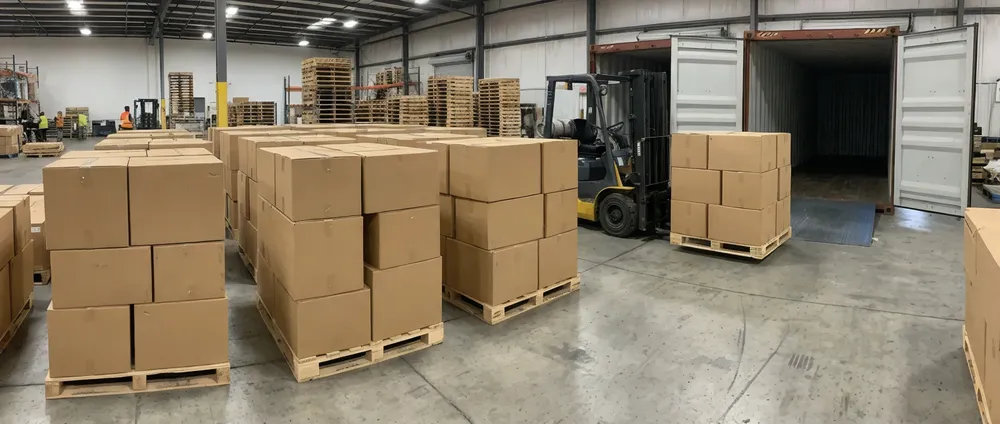
Standard pack configuration: 100 gloves per box, 10 boxes per carton. A properly loaded 40HQ container carries approximately 2,000 cartons — 2 million gloves. Carton dimensions are the same as our powder-free examination glove line, so container loading efficiency is identical.
100 gloves per box · 10 boxes per carton · ~2,000 cartons per 40HQ container (2 million gloves).
Configurable to your distributor DC requirements or private-label specifications. Country-of-origin documentation, packing lists, and commercial invoices are standard.
We coordinate with SGS and Bureau Veritas for markets requiring pre-shipment inspection — routine on Southeast Asian and Middle Eastern orders.
25–35 days from order confirmation. Powdered production runs on a scheduled basis rather than continuously — lead time confirmation at order time depends on line scheduling.
Contact us with your target ship date and we'll confirm availability.
Ship within 5–7 business days and include the full certification documentation package for the specific production lot.
MOQ for standard SKUs: one 40HQ container (approximately 2,000 boxes). MOQ for OEM/private-label runs: one 40HQ container. Custom formulation requests — contact us to discuss feasibility and development lead time.
| Option | Available | Notes |
|---|---|---|
| Color | Yes | Blue (standard), white on OEM runs. Custom color available on OEM runs ≥1 × 40HQ. |
| Private-label packaging | Yes | Box and carton design under your brand name. |
| Custom box count | On request | Non-standard pack configurations available for OEM. |
| Accelerator-free formulation | Not standard | Not standard for this SKU. Available on request — contact us to discuss. |
| Size range | Full range | XS, S, M, L, XL — all sizes available in standard production. |
Custom formulation or OEM run?
Contact us to discuss feasibility, development lead time, and minimum order requirements for this SKU.
It depends on the destination. The US FDA banned powdered patient examination gloves effective January 2017 — they cannot be sold as medical gloves in the US. The EU has restrictions under MDR 2017/745. Southeast Asian markets (Indonesia, Philippines, Vietnam, Thailand) and most Middle Eastern markets generally permit powdered examination gloves under EN 455 compliance. If you're uncertain about your specific destination, send us the country and we'll confirm what documentation we can provide to support import clearance.
USP-grade corn starch — absorbable powder, the specification required under EN 455-1 for powdered medical gloves. Powder quantity is controlled to ≤2 mg per glove per EN 455-1 limits, verified by lot sampling. We do not use talc or non-absorbable powder.
No. Pinhole detection runs before the dusting step — every glove passes the electrical leak test before powder is applied. The dusting process does not introduce a barrier integrity variable. Outgoing AQL 1.5 inspection covers the finished powdered gloves, so the AQL standard is the same as our powder-free line.
ISO 9001:2015, CE marking, EN 455 (Parts 1–4), and ASTM D6319. FDA 510(k) clearance is held for our powder-free examination glove line; the FDA ban on powdered examination gloves means 510(k) is not the relevant certification for this SKU in US distribution. Full documentation — CE declaration of conformity, EN 455 test reports, lot-specific AQL records — ships with every order.
One 40HQ container for standard SKUs — approximately 2,000 boxes (200,000 gloves) at standard pack configuration. Sample orders are available before full container commitment; samples ship within 5–7 business days with the full certification documentation package.
Yes. Mixed-SKU container orders are supported for buyers who want to carry both specifications for their market. Contact us with your target SKU mix and volumes and we'll confirm loading configuration and lead time.
glovemfg ships to Southeast Asia, the Middle East, and other markets where powdered medical examination gloves remain in active procurement. If you're evaluating this SKU for your distribution catalog, the fastest path is a sample order — samples ship within 5–7 business days with the full EN 455 and ASTM D6319 documentation package for the specific production lot.
If you already know your volume and target market, send us the details and we'll turn around a quote with confirmed lead time and a clear statement of what certification documentation we can provide for your destination.
Phone
+86 155 3755 6387