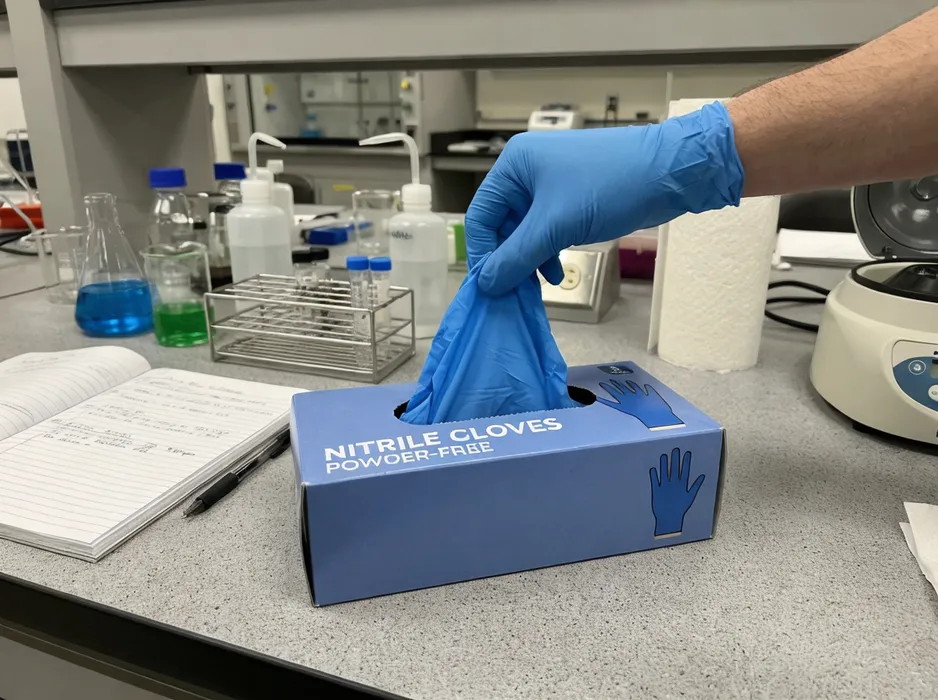
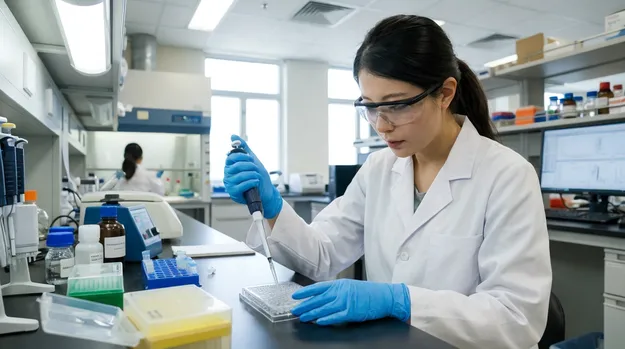
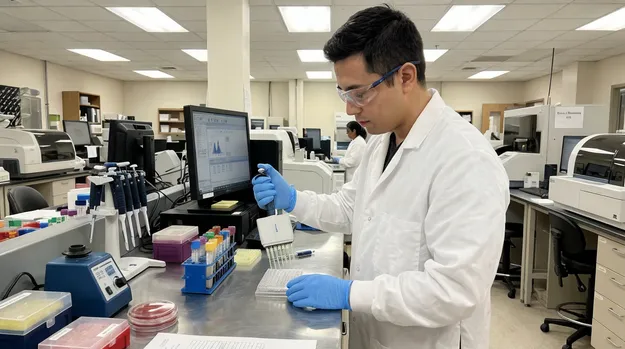
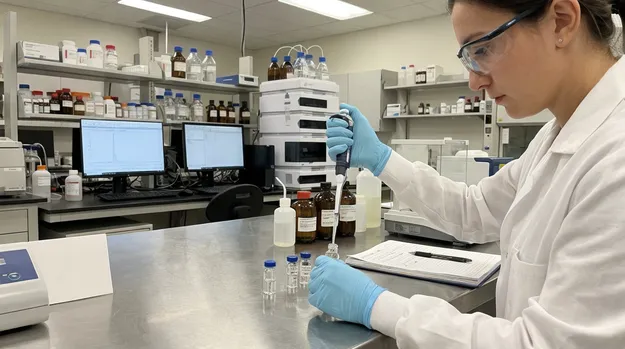
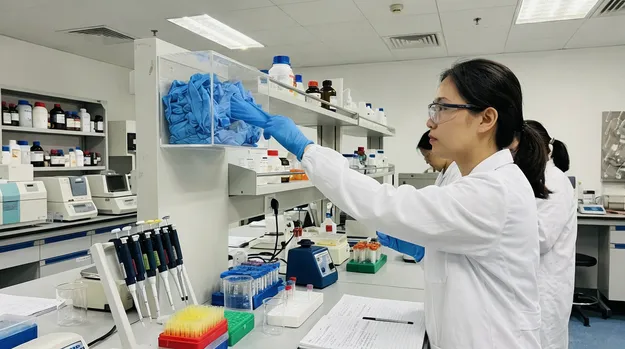
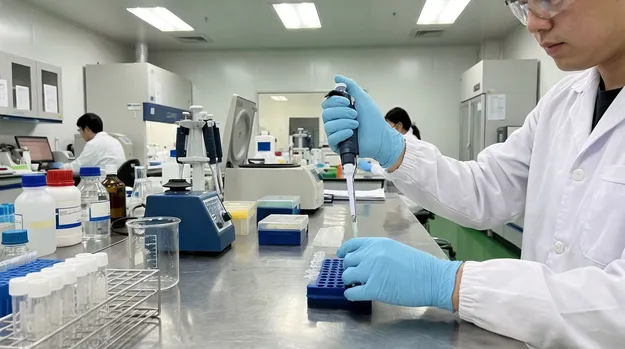
Powder-free laboratory nitrile gloves — mid-weight, textured, certified, and built for the reorder cycles that make lab consumable distribution profitable.
0.10–0.12mm palm thickness · 100% AQL 1.5 outgoing inspection · EN 455 and ASTM D6319 compliant · One 40HQ container minimum · OEM packaging supported.
Laboratory nitrile gloves occupy a specific position in the medical nitrile line — not the thinnest examination weight, not the heavier procedure weight. The 0.10–0.12mm palm thickness is deliberate. Lab work involves chemical splash exposure, repeated contact with solvents and reagents, and extended wear during sample processing. A standard 0.08mm examination glove passes EN 455 barrier integrity requirements but offers less chemical splash resistance and wears through faster under lab conditions. The mid-weight spec is what lab procurement managers actually specify, and it's what we produce for this SKU.
The other distinction is sterility — or rather, the absence of it. Laboratory nitrile gloves are non-sterile. Clinical labs, research institutions, and university science departments don't need sterile gloves for the vast majority of their work. Sterile packaging adds cost and changes the procurement category entirely. This SKU is the workhorse: high volume, predictable reorder, non-sterile, powder-free, mid-weight. If your buyers are running PCR labs, analytical chemistry departments, or hospital lab benches, this is the specification they're ordering against.
For distributors, the commercial logic is straightforward. Lab consumable procurement runs on annual contracts or standing purchase orders. A research university with 40 active labs doesn't renegotiate its glove supplier every quarter — it qualifies a product, approves the vendor, and reorders. Getting onto that approved vendor list is the work; staying on it is a function of consistent quality and reliable lead times. Both are things we can document.
A research university with 40 active labs doesn't renegotiate its glove supplier every quarter — it qualifies a product, approves the vendor, and reorders. Getting onto that approved vendor list is the work; staying on it is a function of consistent quality and reliable lead times.
| Parameter | Specification |
|---|---|
| Material | 100% synthetic nitrile butadiene rubber (NBR), powder-free |
| Palm thickness | 0.10–0.12mm (typical) |
| Finger thickness | 0.12–0.14mm (typical) |
| Thickness tolerance | ±0.01mm across production run |
| Tensile strength | ≥14 MPa (EN 455-2 / ASTM D6319) |
| Elongation at break | ≥500% pre-aging |
| Surface finish | Textured fingertip for grip on labware and sample tubes |
| Sterility | Non-sterile |
| Accelerator status | Standard thiuram/carbamate cure; accelerator-free available on request |
| Sizes | XS, S, M, L, XL |
| Colors | Blue, black, white (standard); custom color on OEM runs |
| Standard packaging | 100 pcs/box, 10 boxes/carton |
| Certifications | ISO 9001:2015, CE, EN 455, ASTM D6319, FDA 510(k) |
| AQL standard | 1.5 (100% of outgoing lots) |
| Pinhole detection | Online electrical leak test, every glove |
Specifications shown are industry-standard values for this product type. Contact us for lot-specific data sheets and test reports.
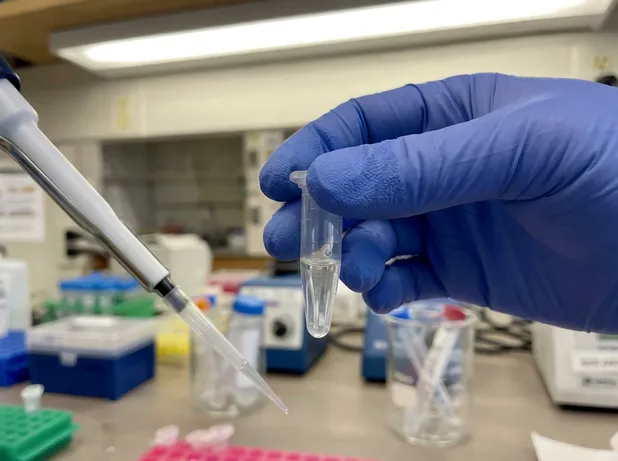
Lab work involves handling small-diameter sample tubes, pipettes, and microplates — smooth-finish gloves lose grip on wet labware. We run a micro-roughened fingertip texture on this SKU as standard. It's not a premium option; it's the baseline spec because smooth-finish lab gloves generate complaints from end users and, eventually, from your buyers.
Pinhole detection runs on every unit, not sampled lots. Combined with AQL 1.5 outgoing inspection on 100% of lots, this is the quality infrastructure that supports approved-vendor qualification at institutional buyers.
Need lot-specific test reports or accelerator-free formulation data? We can provide full documentation to support your vendor qualification process.
Request Sample + Cert DocsThe category page covers the full thickness range across the medical line — see the thickness selection guide. For laboratory gloves specifically, the 0.10–0.12mm range is the result of a practical trade-off that lab procurement has settled on over time.
Go thinner (0.08–0.10mm examination weight) and you gain tactile sensitivity but lose chemical splash resistance and wear duration. In a clinical lab running 200 sample accessions per shift, gloves that degrade faster mean more frequent changes, more glove consumption per shift, and more complaints from lab staff. Go thicker (0.13mm+) and you're into procedure-weight territory — the glove works, but the added material cost isn't justified for bench work that doesn't involve sharps or high-risk biological material.
The 0.10–0.12mm range is where the cost-per-shift economics land correctly for most lab environments. It's also the range where our dipping process runs most consistently — we've been producing this weight class since the early years of the facility, and the process parameters are dialed in.
Thinner
Higher tactile sensitivity. Lower chemical splash resistance and shorter wear duration. Higher per-shift glove consumption in high-accession labs.
Optimal range
Cost-per-shift economics correct for most lab environments. Consistent dipping process with ±0.01mm tolerance across a full container run. In-house compound mixing.
Thicker
Suitable for sharps or high-risk biological material. Added material cost not justified for standard bench work.
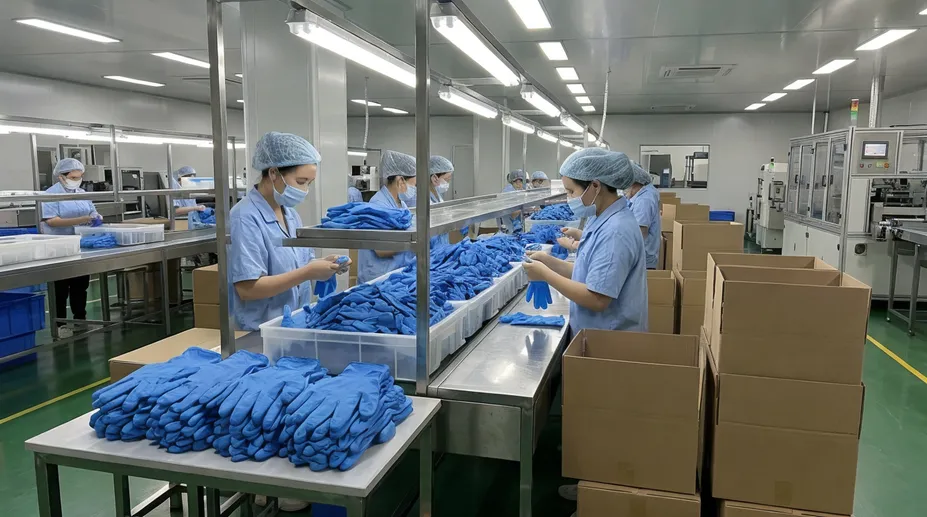
Thickness variation is the defect mode that causes the most downstream problems in lab glove supply. A glove that measures 0.10mm on the sample set and 0.08mm on carton 40 of a production run is a formulation control failure. We mix our own compound in-house, which is how we hold ±0.01mm tolerance across a full container run.
Lab gloves are a consumable with predictable demand patterns. The segments below are where our distributor accounts build durable, recurring revenue — not one-time orders.
A mid-sized research university with active science departments runs through significant glove volume annually. Procurement typically runs through a central purchasing office on annual contracts or approved vendor catalogs. Once you're on the approved vendor list, reorders are automatic.
The qualification process requires documentation — EN 455 test reports, safety data sheets, lot traceability — which we provide as standard.
Reference labs, hospital lab departments, and independent diagnostic labs are consistent high-volume buyers. These buyers run on standing purchase orders with quarterly or annual review cycles.
The switching cost once a vendor is qualified is real — lab managers don't want to re-qualify a glove supplier mid-contract. Consistency of specification across orders is the retention mechanism.
QC and analytical labs in pharmaceutical facilities use lab-grade nitrile gloves for sample handling, instrument operation, and documentation work — not cleanroom-grade, but a step above standard examination weight.
This segment often requires lot traceability documentation and may request extractables data; we can provide both.
Distributors who supply lab consumables — pipette tips, reagents, sample tubes — often carry gloves as a complementary SKU. Lab gloves fit naturally into an existing sales relationship with lab managers, and the reorder cycle aligns with other consumable categories.
This segment has been a consistent growth area for our distributor accounts in North America and Europe — worth considering if you're building a lab consumables line.
Public health labs, environmental testing facilities, and forensic labs run on government procurement cycles — slower qualification, but once approved, the supply relationship is stable and volume is predictable.
Each segment has distinct qualification requirements, order cycles, and volume profiles. Let us match you with the right pricing tier and documentation package.
Request Segment PricingThe certification stack for this SKU is the same as the broader medical nitrile line — EN 455, ASTM D6319, FDA 510(k), ISO 9001:2015, CE marking. The full compliance coverage by market is on the category page. For laboratory-specific procurement, the relevant points are:
Parts 1–4 cover freedom from holes, physical properties, biological evaluation, and shelf life. Required as a baseline for lab procurement in European institutions and hospital networks. Test reports ship with every production lot.
The US standard for nitrile examination gloves. Required for FDA-regulated laboratory environments and standard for North American lab consumable distribution. Our FDA 510(k) clearance covers the US market.
Not a certification, but a procurement specification that matters. Many institutional lab contracts specify AQL 1.5 for incoming inspection. We inspect 100% of outgoing lots to AQL 1.5 — tighter than the AQL 2.5 default at most factories. Our outgoing standard matches your buyers' incoming standard, which means fewer rejection events and fewer supply disruptions.
For buyers supplying pharmaceutical manufacturing QC labs, we can provide extractables test data and lot traceability records on request. These are not standard documents for the lab glove SKU, but we have the production records to support them.
EN 455 test reports are available with sample orders and ship with every production lot. Extractables data and lot traceability records available on request for pharmaceutical QC lab supply chains.
The most common complaint we hear from distributors who've switched to us from other factories is thickness drift — the first container matches the sample, and by the third or fourth container, the gloves are running thin.
The root cause is almost always third-party compound with batch-to-batch viscosity variation. When the compound changes, the dipping thickness changes, and a factory that doesn't own its formulation can't correct it.
For a lab consumable distributor running annual contracts with institutional buyers, this matters commercially. Your buyers' incoming inspection will catch thickness drift. A rejection event mid-contract creates a supply disruption, a credibility problem with your buyer, and a logistics cost to resolve.
Learn About Our Manufacturing ProcessThird-party compound with batch-to-batch viscosity variation is the root cause. A factory that doesn't own its formulation cannot correct for it. The in-house compounding is the mechanism that prevents drift — not a marketing claim, but a process control decision made specifically because third-party compound was the failure mode we kept seeing.
Tolerance: ±0.01mm. If a line drifts outside this tolerance, it stops. The cause is identified and production resumes only when parameters are back in range. We do not run out-of-spec product and sort it later.
Custom packaging under your brand name is available from one 40HQ container. Standard pack configuration is 100 pcs/box, 10 boxes/carton — we can adjust box count, carton configuration, and label design to your specification. If you're building a branded lab consumables line, the glove SKU is typically the highest-volume item in the catalog, and having it under your own label strengthens the product line's identity.
Color options beyond the standard blue, black, and white are available on OEM runs — custom color matching from Pantone reference. Some lab consumable brands use color coding by size or application; we can accommodate that in the packaging and glove color simultaneously.
Accelerator-free formulation is available for OEM runs at one 40HQ container MOQ. If you're supplying European institutional buyers where Type IV allergy documentation is part of the tender specification, accelerator-free under your brand name is a defensible product position. The number of suppliers who can produce accelerator-free lab gloves with EN 455 documentation is smaller than the standard market — it's a real differentiation point if your distribution territory includes Scandinavia, Germany, or the UK.
A note on sizing: if you're building a private-label line for a specific institutional buyer, we can adjust the size distribution in a container — more M and L, fewer XS — without changing the MOQ. Most of our OEM buyers figure this out after the first container and adjust on the second order.
Discuss OEM Specifications and Packaging100 pcs/box, 10 boxes/carton. Box count, carton config, and label design adjustable to your specification.
Beyond standard blue, black, and white — Pantone-matched glove and packaging colors available on OEM runs for size or application coding.
Available at 1×40HQ MOQ with EN 455 documentation. Fewer suppliers can deliver this — a real advantage for tenders in Scandinavia, Germany, and the UK where Type IV allergy documentation is required.
Adjust size ratios per container (e.g. more M and L, fewer XS) for institutional buyers — no MOQ change required.
~2,000 cartons per properly loaded 40HQ container. Pallet configuration is pre-worked — not improvised per order.
Standard: 100 pcs/box, 10 boxes/carton. Configurable for DC requirements, Amazon FBA, or private-label design.
From order confirmation for standard SKUs. Repeat orders on established SKUs ship on a rolling production schedule with confirmed dates at order time.
Sample orders include the full certification documentation package for the specific production lot.
Pre-shipment inspection coordination with SGS or Bureau Veritas available on request — routine for our North American and European accounts.
For repeat orders on established SKUs, ship dates are confirmed at order time — not after production planning.
The primary difference is thickness and intended use environment. Standard examination gloves run 0.08–0.10mm palm thickness — optimized for tactile sensitivity in clinical examination. Laboratory nitrile gloves run 0.10–0.12mm — the mid-weight range that balances chemical splash resistance with dexterity for bench work. Lab gloves also typically feature a textured fingertip for grip on labware. Both are non-sterile and powder-free; the distinction is in the thickness profile and the use environment they're specified for.
EN 455 is the relevant standard for medical gloves for single use in European markets, and it applies to laboratory gloves used in clinical and medical laboratory settings. For purely research or industrial lab environments, EN 374 (chemical protective gloves) may be the applicable standard depending on the chemicals involved. Our laboratory nitrile gloves are produced to EN 455 specification. If your buyers require EN 374 chemical resistance testing for specific reagents, contact us — we can provide test data or discuss formulation options depending on the chemical class.
AQL 1.5 is the standard we recommend specifying, and it's what we inspect to on 100% of outgoing lots. Many institutional lab procurement contracts — particularly hospital networks and pharmaceutical manufacturers — specify AQL 1.5 as the incoming inspection standard. Specifying AQL 1.5 in your supply contracts and sourcing from a factory that inspects to AQL 1.5 outgoing means your incoming inspection results will be clean, which protects your supply relationship with institutional buyers.
Yes — accelerator-free formulation is available on OEM runs at one 40HQ container MOQ. It matters when your buyers operate in procurement environments where Type IV allergy documentation is part of the specification — increasingly common in European hospital lab and pharmaceutical manufacturing procurement. Standard nitrile doesn't fail those specifications; it simply doesn't qualify for accelerator-free line items, which are increasingly carved out separately in European institutional tenders.
MOQ is one 40HQ container for standard SKUs — approximately 2,000 boxes (200,000 gloves) at standard pack configuration. Sample orders are available before full container commitment and ship within 5–7 business days with the full certification documentation package for the specific production lot.
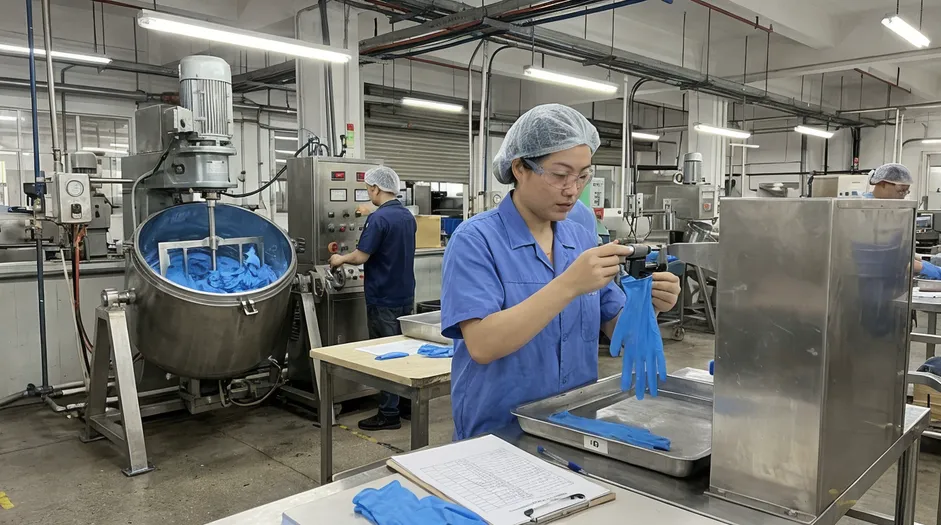
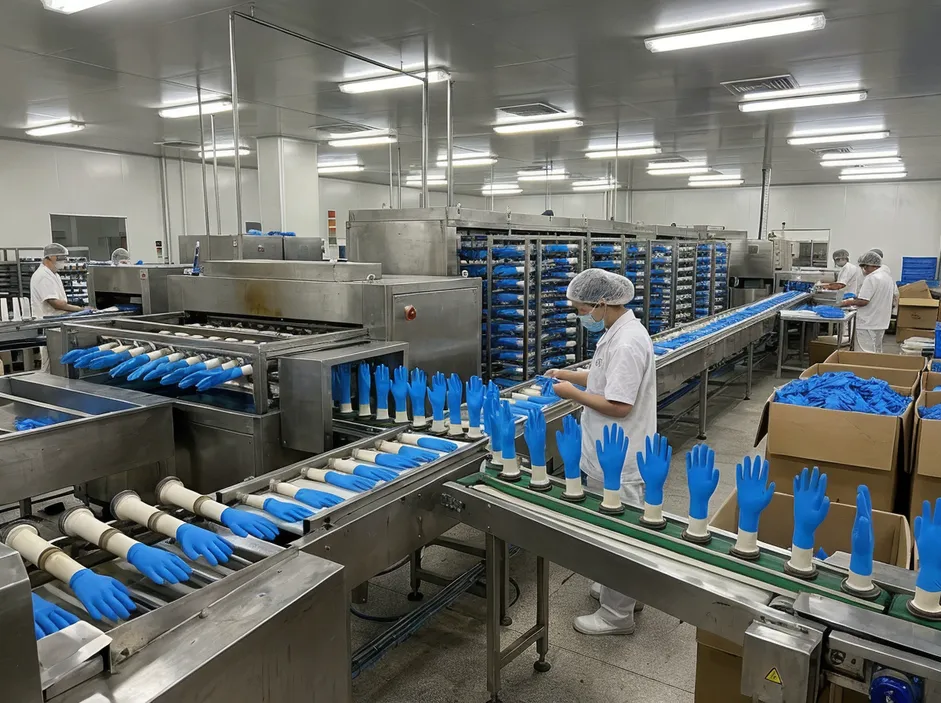
We mix our own nitrile compound in-house, which gives us control over batch-to-batch viscosity. Bath viscosity is monitored continuously on every line. Thickness is checked at palm, finger, and cuff every two hours per line per shift. If a line drifts outside ±0.01mm tolerance, it stops. Online electrical pinhole detection runs on every glove before stripping — gloves that fail the leak test are pulled automatically and never reach packing. The result is that the 40th carton in a container matches the specification of the first.
glovemfg ships to North America, Europe, the Middle East, Southeast Asia, and Australia. If you're evaluating us as a supplier for a lab consumable distribution line, the fastest path is a sample order — samples ship within 5–7 business days with the full certification documentation package, so you can run your own incoming inspection before committing to a container.
If you already know your specification and volume, send us the details and we'll turn around a quote with confirmed lead time and ship date.