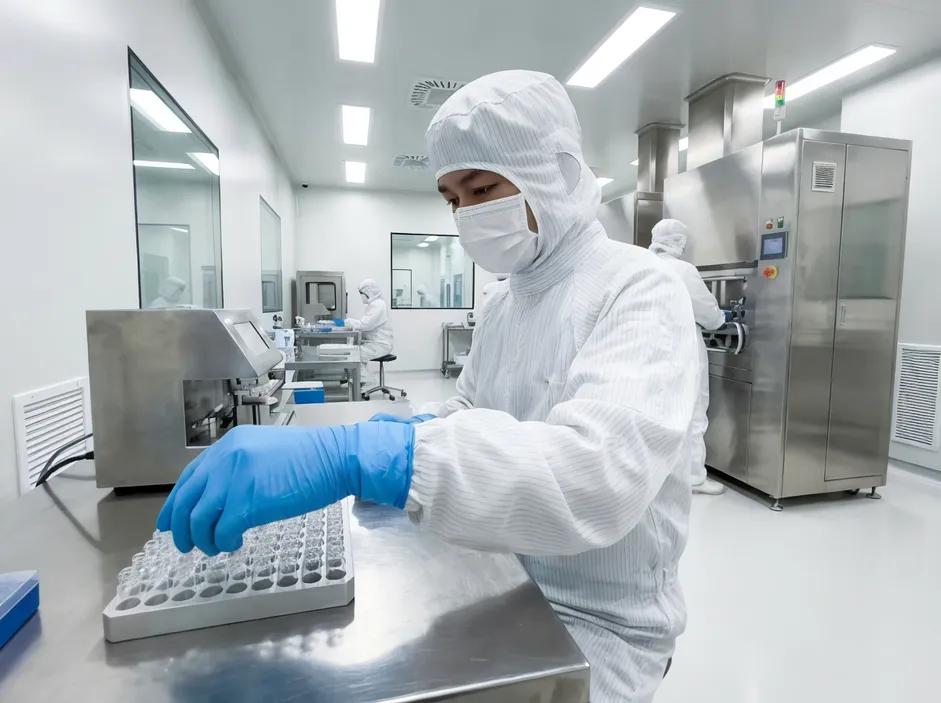
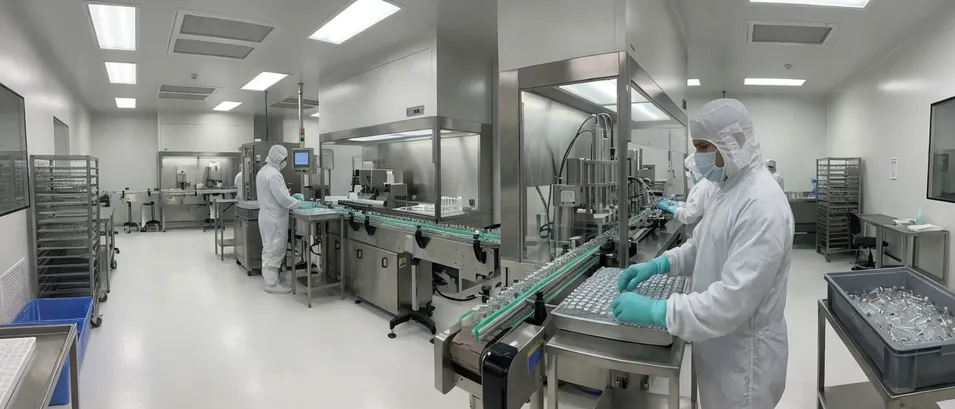
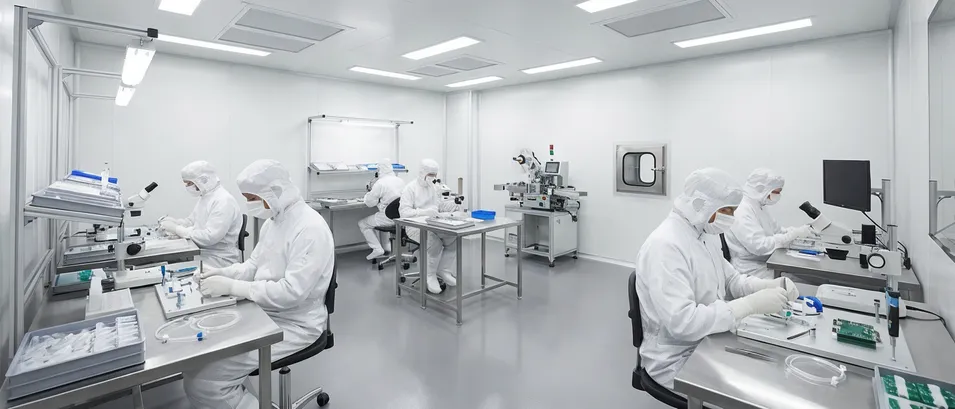
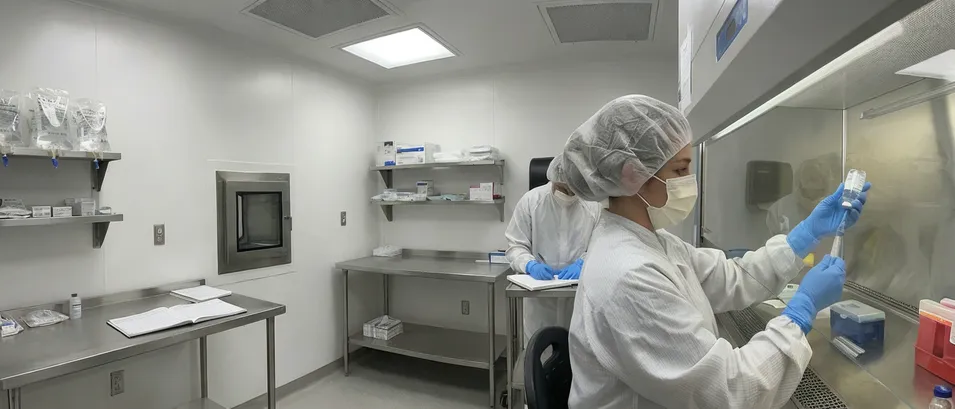
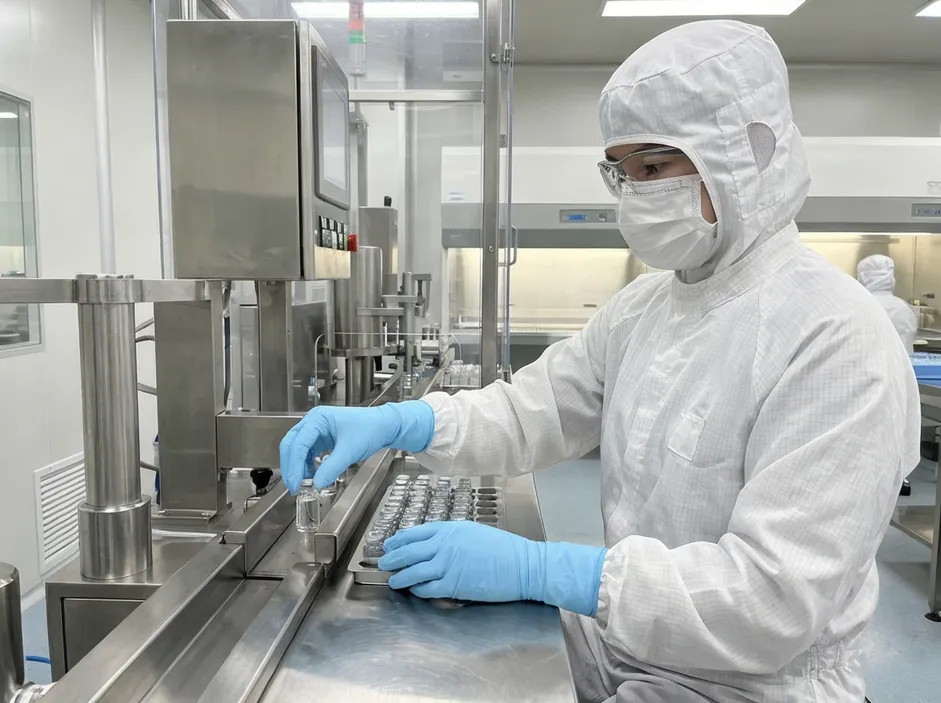
Low-particulate, low-extractables nitrile gloves produced on a dedicated line — built for pharmaceutical manufacturing, medical device assembly, and precision lab environments.
Packed in cleanroom-compatible double-bag packaging. Extractables test data available on request. EN 455 certified, AQL 1.5 outgoing inspection.
A standard examination nitrile glove and a cleanroom nitrile glove can look identical in the box. The difference is in what's on the surface and what leaches out of the material — and in a pharmaceutical fill-finish line or a medical device assembly cell, those differences determine whether your buyer's product passes contamination testing or triggers a batch rejection.
Cleanroom nitrile gloves are produced and packed under controlled conditions to minimize two contamination vectors: particulate (physical particles shed from the glove surface) and extractables (chemical compounds that migrate out of the glove material into the work environment or onto the product being handled). Standard examination gloves are manufactured to barrier integrity and biocompatibility standards — EN 455 covers that. Cleanroom gloves carry those same requirements and add a layer of process and packaging discipline that standard gloves don't address.
For your buyers — pharmaceutical manufacturers, medical device assemblers, semiconductor-adjacent operations — the approved vendor list qualification process asks for extractables data, particulate counts, and packaging integrity documentation. If you're supplying into those procurement environments without cleanroom-grade product, you're not in the conversation. If you're carrying cleanroom-grade product with the documentation to back it up, you're in a smaller competitive set with better margin and stickier supply relationships.
View All Medical Nitrile Gloves
Physical particles shed from glove surfaces — controlled through dedicated line production and cleanroom-compatible packaging protocols.
Chemical compounds that migrate from glove material — minimized through low-extractables compound formulation and sulfur-donor cure system.
Approved vendor list qualification asks for extractables data, particulate counts, and packaging integrity documentation. Cleanroom-grade product with documentation puts you in a smaller competitive set — with better margin and stickier supply relationships.
This is the part most buyers don't ask about until they've had a problem.
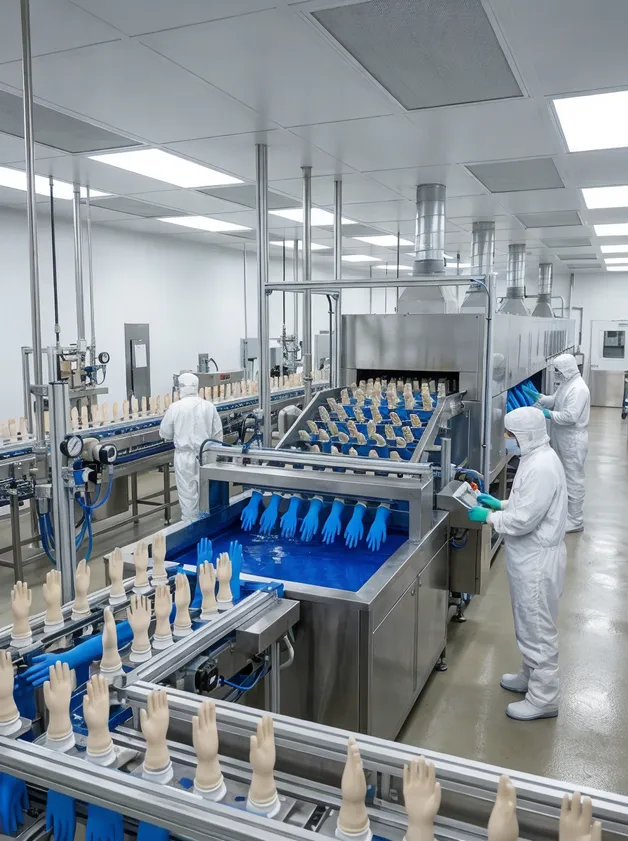
We produce cleanroom nitrile gloves on a dedicated dipping line — not a standard examination line that gets cleaned between runs. The reason is cross-contamination risk from compound residue, release agents, and processing aids that accumulate on line surfaces over time.
A standard examination line runs thiuram/carbamate-accelerated compound as its baseline. Even after a thorough line flush, trace accelerator residue can persist in bath fittings, pump seals, and former surfaces. For a cleanroom glove where extractables are a documented specification parameter, that residue is a contamination source.
The dedicated line runs our low-extractables compound formulation exclusively. Bath chemistry, former cleaning protocols, and curing parameters are set for cleanroom production and don't change between runs. This is what allows us to provide consistent extractables data across production lots — not just a one-time test result from a sample batch, but lot-to-lot consistency that your buyers' QA teams can rely on when reviewing incoming material documentation.
A buyer in the medical device space ran their own extractables testing on gloves from a competitor who claimed cleanroom-grade production on shared lines. The results were inconsistent across lots. That's the kind of incoming inspection failure that gets a supplier removed from an approved vendor list — and it's preventable with the right production setup.
Sulfur-donor cure system with a reduced accelerator package, tuned to minimize leachable thiuram and carbamate content.
Ionic contamination, non-volatile residue, and specific chemical extractables test data provided on request for qualification purposes.
Fixed bath chemistry and curing parameters on the dedicated line deliver the lot-to-lot consistency your buyers' incoming QA process requires.
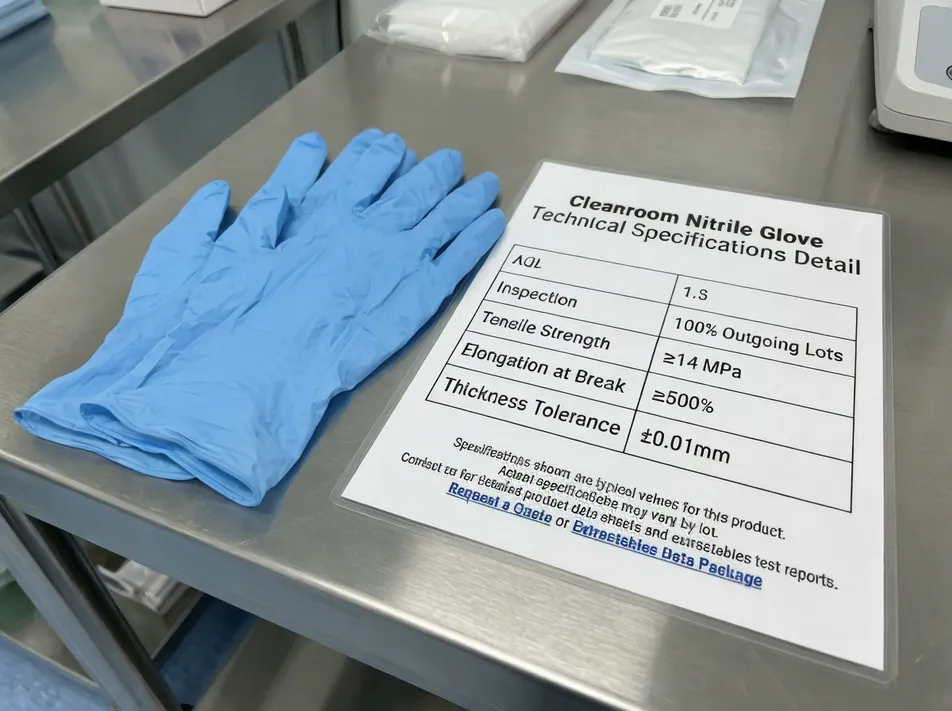
| Parameter | Specification |
|---|---|
| Material | 100% synthetic nitrile butadiene rubber (NBR) |
| Thickness — palm | 0.10–0.12mm (typical) |
| Thickness — finger | 0.12–0.14mm (typical) |
| Thickness tolerance | ±0.01mm across production run |
| Tensile strength | ≥14 MPa (EN 455-2) |
| Elongation at break | ≥500% (pre-aging) |
| Powder status | Powder-free |
| Accelerator content | Reduced accelerator formulation; accelerator-free variant available |
| Particulate control | Produced and packed in controlled environment |
| Extractables | Low-extractables formulation; test data available on request |
| Sterility | Non-sterile (standard); sterile variant available on request |
| AQL inspection | 1.5 (100% of outgoing lots) |
| Pinhole detection | Online electrical leak test, every glove |
| Sizes | XS, S, M, L, XL |
| Colors | White (standard); blue available |
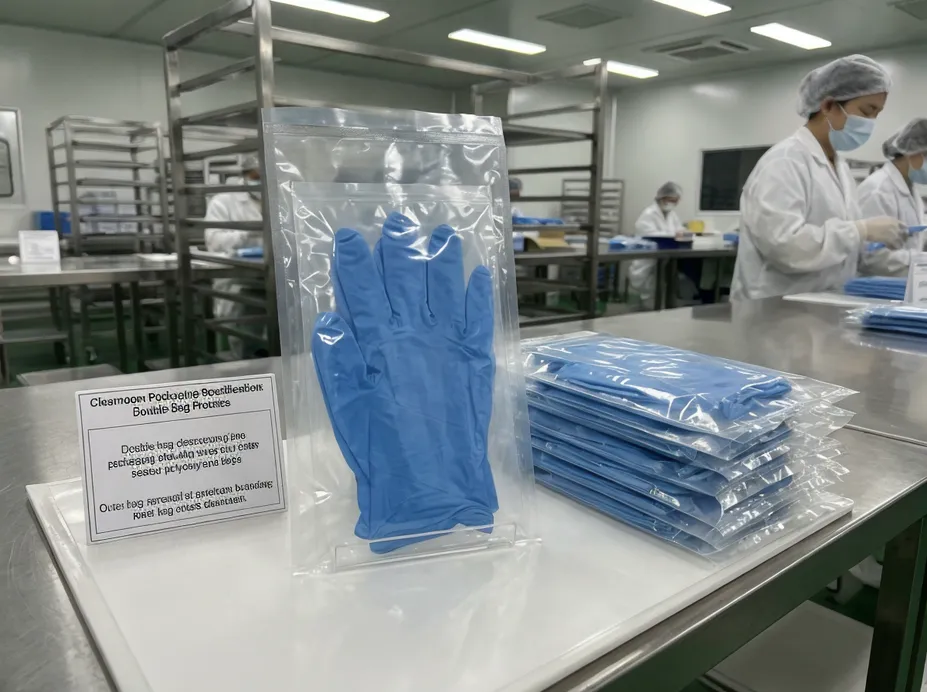
| Packaging | 100 pcs/inner bag, double-bagged, cleanroom-compatible outer packaging |
| Carton | 10 inner bags/carton |
| Certifications | ISO 9001:2015, CE, EN 455, ASTM D6319, FDA 510(k) |
Specifications shown are typical values for this product. Actual specifications may vary by lot. Contact us for detailed product data sheets and extractables test reports.
Request a Quote or Extractables Data PackageCleanroom gloves are used across a range of controlled environment classifications, and the specification requirements differ by application. Here's how our cleanroom nitrile glove fits the common procurement environments.
Class 10,000–100,000
Pharmaceutical secondary packaging, medical device assembly.
Particulate and extractables requirements at this level are manageable with a properly produced powder-free nitrile glove. Our standard cleanroom SKU is designed for this range.
Class 1,000–10,000
Pharmaceutical fill-finish, aseptic processing.
More demanding particulate requirements. Buyers often specify double-gloving protocols — an outer cleanroom nitrile over an inner sterile glove — and the outer glove's particulate contribution matters.
Semiconductor & Electronics-Adjacent
Semiconductor fabrication, electronics-adjacent controlled environments.
Ionic contamination — sodium, potassium, chloride — is the primary concern, not just particulate. Our low-ionic-contamination formulation addresses this.
Not all cleanroom gloves are specified to the same level. The documentation your buyers require will tell you which tier they're operating in. We can provide the data package for each tier — the question is which one your buyers are asking for.
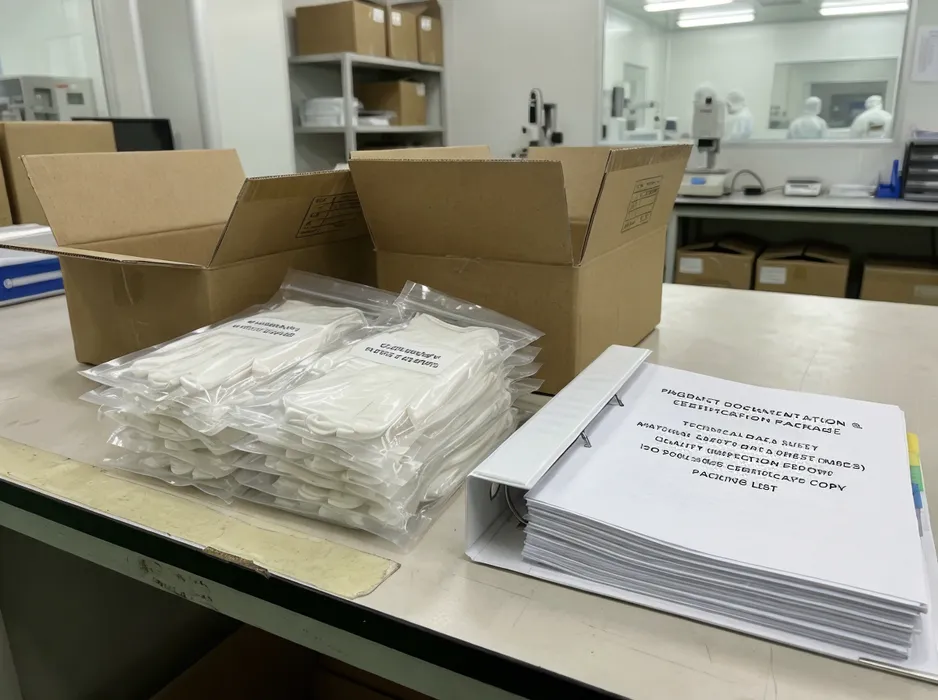
Standard examination gloves ship in a single poly bag inside a cardboard box. Cleanroom gloves ship double-bagged — an inner sealed bag containing the gloves, inside a second sealed outer bag — with the outer bag clean enough to be introduced into the anteroom of a controlled environment without contaminating the space.
The reason this matters commercially: your buyers' incoming material handling procedures for cleanroom consumables typically require that packaging be wipeable or removable at the anteroom boundary. A single-bag product requires an extra handling step — or gets used in violation of the facility's contamination control SOP. Double-bag packaging eliminates that friction. It's not a premium feature; it's a procurement requirement for buyers operating ISO Class 7 and above environments.
Private-label buyers: Inner bag label, outer bag label, and carton label are all configurable with your brand name and logo. MOQ for custom-labeled cleanroom packaging is one 40HQ container.
Single-bag
Requires extra handling step at anteroom boundary — or violates contamination control SOP
Double-bag
Outer bag introduced into anteroom, inner bag passes through — zero extra handling, full SOP compliance
Cleanroom gloves are not a commodity consumable. The procurement process is documentation-intensive, the qualification cycle is longer than standard examination gloves, and the switching cost for a buyer who has qualified a supplier is real. That's the commercial structure that makes this segment worth building into your distribution line.
High-volume, specification-driven procurement. A mid-sized CMO running multiple production suites can move significant glove volume on quarterly or annual contracts. Once you're on their approved vendor list — which requires extractables data, lot traceability, and consistent AQL results — the reorder cycle is predictable and the relationship is sticky.
This is the segment where the documentation investment pays off most clearly.
ISO 13485-regulated environments where glove extractables can affect device biocompatibility testing. Procurement teams in this segment are thorough — they'll ask for extractables data, material safety data sheets, and sometimes request retained samples from production lots.
The qualification process takes time, but the supply relationships that result are multi-year. We've had medical device accounts reorder the same SKU for four or five consecutive years without a specification change — that's the kind of revenue stability that makes cleanroom gloves worth the initial qualification investment.
USP 797/800 compliance in the US requires appropriate glove selection for sterile and hazardous drug compounding. Cleanroom-grade nitrile is the standard specification for this environment.
Hospital pharmacy procurement runs on annual contracts through GPOs or direct purchasing agreements — volume per account is moderate, but the reorder frequency is high and the compliance requirement makes switching suppliers a deliberate decision rather than a price-driven one.
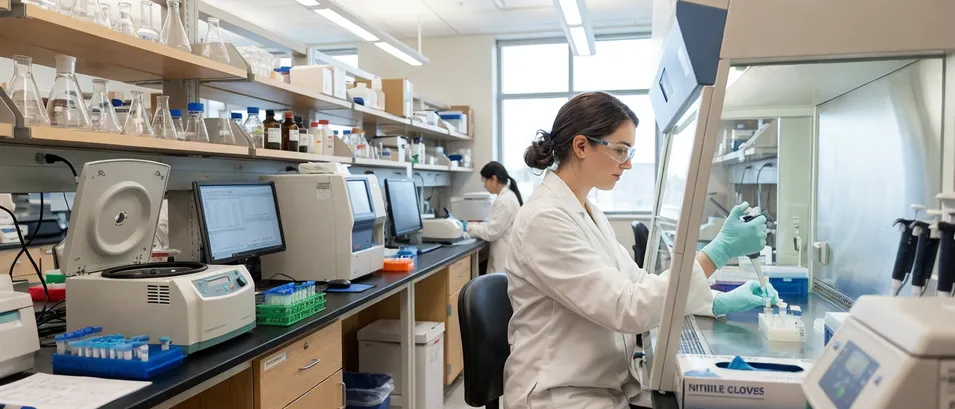
Not a cleanroom environment in the ISO classification sense, but research labs handling sensitive biological or chemical samples often specify low-extractables gloves to avoid sample contamination.
Procurement is less documentation-intensive than pharmaceutical or medical device, but the volume per institution can be substantial and the purchasing cycle is predictable around academic budget calendars.
Quarterly
Pharma CMO reorder cycle once on approved vendor list
4–5 Years
Typical medical device account reorder tenure without specification change
Annual
Hospital pharmacy contract cycle via GPO or direct purchasing agreement
The accelerator-free variant deserves specific attention for cleanroom applications, because the reasons to specify it in a cleanroom environment are different from the reasons in standard medical procurement.
Standard Medical Procurement
Accelerator-free is primarily about Type IV allergy risk for healthcare workers.
Cleanroom / Fill-Finish
Accelerator compounds — thiuram, carbamate, and their degradation products — are chemical extractables and potential contaminants.
In a fill-finish environment where the glove is in contact with drug product or drug contact surfaces, those extractables are potential contaminants. Regulatory guidance from the FDA and EMA on extractables and leachables in pharmaceutical manufacturing increasingly scrutinizes glove materials as a contamination source.
We produce accelerator-free cleanroom nitrile on the same dedicated line, using a sulfur-donor cure system. The resulting glove has no detectable thiuram or carbamate residue — which means the extractables profile is cleaner, and the documentation package for regulatory submissions is simpler.
Buyer Advantage
For buyers supplying European pharmaceutical manufacturers or US FDA-regulated fill-finish operations, this is the specification that removes a potential objection from the qualification review.
MOQ: One 40HQ Container
If you're building a pharmaceutical distribution line and your buyers are operating in regulated fill-finish environments, this is the conversation to have before a competitor gets to your accounts first.
The documentation your buyers need to add you to their approved vendor list is the same documentation we provide as standard. Here's what ships with every cleanroom nitrile glove order.
Certificate of Conformance
Lot-specific, signed by QC manager
EN 455 Test Report Reference
FDA 510(k) Clearance Reference Number
ISO 9001:2015 Certification
CE Declaration of Conformity
AQL Inspection Record
For the specific production lot
Material Safety Data Sheet (MSDS/SDS)
Extractables Test Data
Ionic contamination, non-volatile residue, specific chemical extractables
Lot Traceability Records
Raw material batch, production date, line number
Retained Sample Availability Confirmation
Third-Party Pre-Shipment Inspection Report
SGS or Bureau Veritas, coordinated on request
Qualification Timeline Insight
Having the full documentation package ready before the buyer asks for it shortens the qualification timeline significantly — most of our pharmaceutical accounts completed vendor qualification within 6–8 weeks of receiving samples, which is fast for this segment.
For sample orders: the complete documentation package goes out with the samples. You're not waiting for a separate documentation request to be fulfilled after the samples arrive.
Technical and procurement questions from distributors and B2B buyers evaluating cleanroom nitrile gloves.
We provide ionic contamination data (sodium, potassium, chloride, ammonium), non-volatile residue (NVR) per glove, and specific chemical extractables including thiuram and carbamate compounds. For the accelerator-free variant, thiuram and carbamate extractables are below detection limits. Data is lot-specific and available as part of the standard documentation package for pharmaceutical and medical device accounts. Contact us with your specific extractables requirements and we'll confirm what's available for your qualification process.
Our standard cleanroom nitrile glove is designed for ISO Class 5–8 environments (equivalent to Class 1,000–100,000). For ISO Class 5 and above (fill-finish, aseptic processing), we recommend the accelerator-free variant and can provide particulate count data for your qualification review. For semiconductor applications at ISO Class 4–5, contact us to discuss the ionic extractables data package — the specification requirements at that level are more demanding and we'll confirm suitability for your specific application before you commit to a qualification run.
Three differences: production line (dedicated vs. shared), formulation (low-extractables compound vs. standard examination compound), and packaging (double-bag cleanroom-compatible vs. single-bag standard). The barrier integrity and physical properties — tensile strength, elongation, thickness — are comparable.
The cleanroom variant is not a thicker or stronger glove; it's a cleaner glove, produced and packed to minimize particulate and chemical contamination. If your buyers are operating in ISO-classified environments or regulated pharmaceutical/medical device manufacturing, the cleanroom variant is the correct specification. If they're in general clinical or laboratory use, the standard examination or laboratory glove is sufficient and more cost-effective.
One 40HQ container for standard cleanroom SKUs — approximately 2,000 boxes at standard pack configuration (100 pcs/inner bag, 10 inner bags/carton). For accelerator-free cleanroom variants or custom-labeled packaging, MOQ is also one 40HQ container. Sample orders are available before full container commitment and ship within 5–7 business days with the full documentation package.
Yes. Inner bag label, outer bag label, and carton label are all configurable with your brand name, logo, and specification details. The certification documentation — CE Declaration of Conformity, FDA 510(k) reference, EN 455 test reports — can reference your private-label product name. MOQ for custom-labeled cleanroom packaging is one 40HQ container. Contact us with your packaging specifications and we'll confirm feasibility and lead time.
USP 797 and 800 specify glove requirements for sterile and hazardous drug compounding environments — powder-free nitrile is the standard specification, and our cleanroom nitrile glove meets those requirements. For USP 800 hazardous drug compounding, double-gloving with chemotherapy-rated outer gloves is the standard protocol; our cleanroom nitrile is appropriate as the inner glove in that configuration. We can provide the documentation your pharmacy buyers need for their USP compliance records.
If you're evaluating us for a pharmaceutical, medical device, or precision manufacturing account, the fastest path is a sample order with the full documentation package. We'll ship samples within 5–7 business days — enough for your buyer to run incoming inspection and begin their vendor qualification process before you've committed to a container.
If you already have a specification and volume in hand, send us the details and we'll turn around a quote with confirmed lead time and the documentation checklist for your buyer's qualification process.