The question lands in procurement inboxes constantly: nitrile or latex? On the surface it looks like a material preference. In practice, it's a liability decision, a compliance decision, and a landed-cost decision rolled into one — and the wrong call costs more than the price difference on the invoice.
Latex has been the default in medical settings for decades. It's elastic, tactile, and well-understood. Nitrile displaced it in most high-volume healthcare markets not because it's cheaper per pair, but because the downstream cost of latex allergy incidents — staff replacement, incident documentation, legal exposure — made latex the more expensive option at scale. That shift happened in North America and Western Europe over the past 20 years. It's still happening in Southeast Asia and parts of the Middle East.
Quick verdict: For any distributor supplying hospitals, clinics, or dental practices in regulated markets, nitrile is the defensible default. Latex still wins in specific surgical and high-dexterity applications where its elastic properties are genuinely irreplaceable — but those are narrowing use cases, not growth segments.
—
Allergy Risk: The Liability That Doesn't Show Up on the Price Sheet
This is where the comparison starts, because it's where the hidden cost lives.
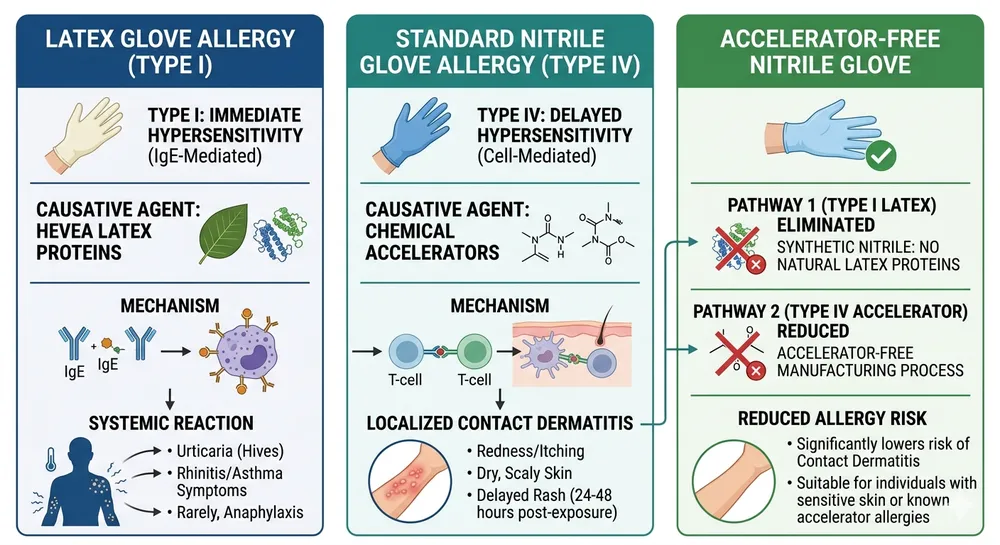
Natural rubber latex contains proteins — specifically Hevea brasiliensis proteins — that trigger Type I IgE-mediated hypersensitivity in sensitized individuals. Type I latex allergy is not a rash. It's systemic: urticaria, bronchospasm, anaphylaxis. In a clinical setting, a Type I reaction during a procedure is a medical emergency and a liability event. The prevalence of latex sensitization in healthcare workers runs between 8–17% in studies across the US and Europe (higher in populations with repeated exposure). Your hospital buyer's occupational health department knows this number. Their legal team knows it too.
Nitrile is synthetic. No Hevea proteins, no Type I allergy pathway. That's the clean answer for most buyers.
The complication is Type IV — delayed hypersensitivity to chemical accelerators used in the vulcanization process. Thiurams, carbamates, and mercaptobenzothiazole are the common culprits. Type IV reactions present as contact dermatitis: localized, delayed, not life-threatening, but chronic and disruptive for clinical staff. Standard nitrile gloves contain these accelerators. Accelerator-free nitrile eliminates the Type IV pathway entirely — it uses a different crosslinking chemistry (typically sulfur-free or carbamate-free formulations) that produces a glove with no detectable accelerator residue.
We've been producing accelerator-free nitrile since European hospital procurement started specifying it seriously — roughly 2018 onward in the French and German markets. The compound formulation is different, the cure cycle is longer, and the cost is higher. But for buyers supplying dermatology units, surgical teams, or any facility with documented accelerator sensitivity cases, it's not optional.
(Note: if your target accounts include European public hospital tenders, accelerator-free compliance is increasingly a bid requirement, not a differentiator. Verify before you quote.)

—
Head-to-Head: Barrier Performance, Physical Properties, and Compliance Specs
| Property | Medical Nitrile | Natural Rubber Latex |
|---|---|---|
| Allergy profile | No Type I; Type IV if accelerators present | Type I (Hevea proteins); Type IV possible |
| Accelerator-free option | Yes — available from specialized manufacturers | No — latex vulcanization requires accelerators |
| Tensile strength | High — typically 14–18 MPa | Very high — typically 18–24 MPa |
| Elongation at break | 500–600% | 700–800% |
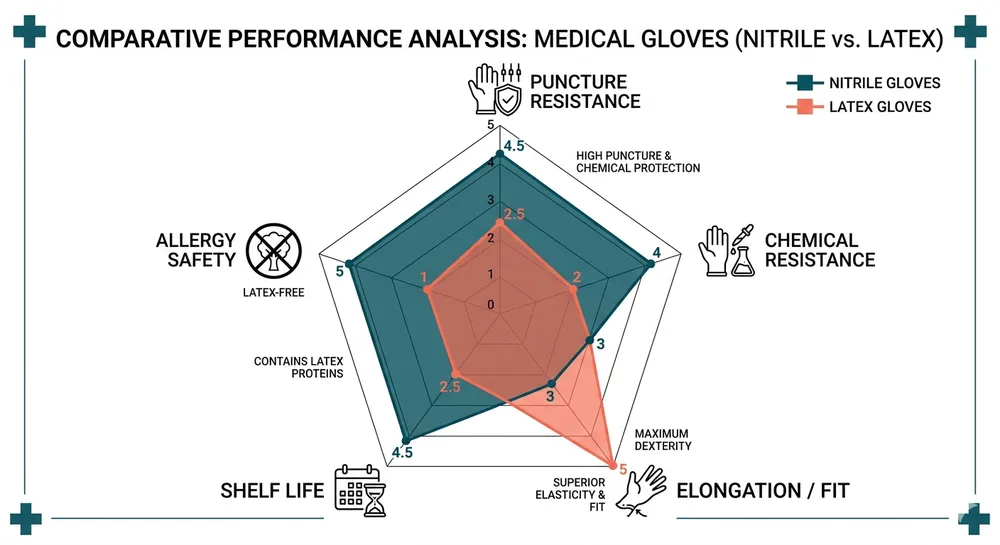
| Puncture resistance | Superior — 3–4× higher than latex at equivalent thickness | Lower — thinner walls puncture more easily |
| Chemical resistance | Excellent — oils, solvents, many chemotherapy agents | Moderate — degrades with oils and many solvents |
| Fit and tactile feel | Good — improves with thinner formulations | Excellent — natural elasticity conforms closely |
| Shelf life | 5 years (standard) | 3 years (degrades faster) |
| Regulatory compliance | FDA 510(k), CE, EN 455, ASTM D6319 | FDA 510(k), CE, EN 455 available |
| Powder-free availability | Standard — all medical grade | Available but less common |
| Relative unit cost | Moderate — stable synthetic feedstock | Variable — natural rubber commodity pricing |
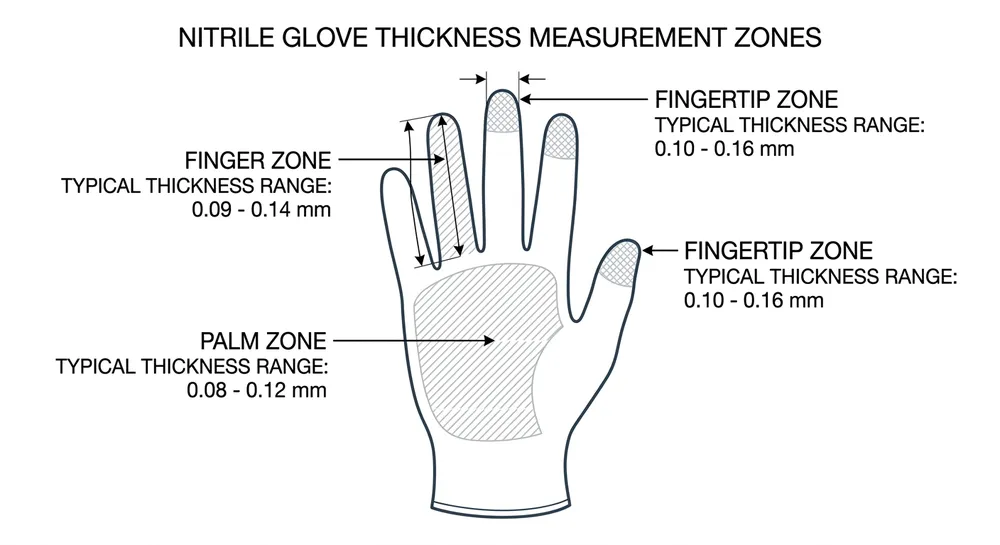
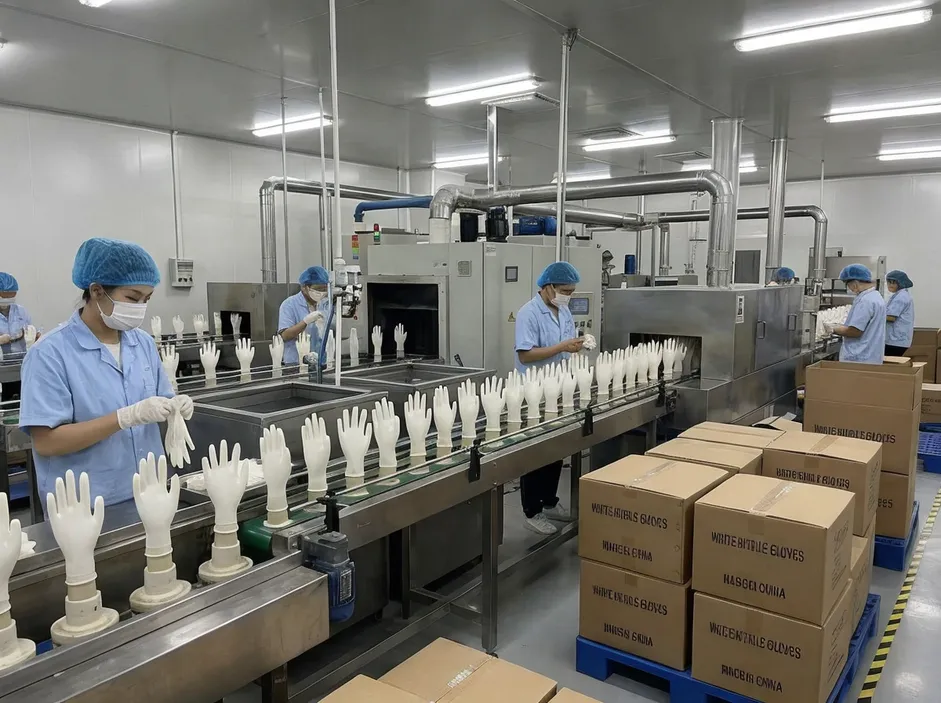
The tensile and elongation numbers favor latex on paper. In practice, the puncture resistance gap is what matters in clinical settings — a nitrile glove at 0.10mm holds up better against needle sticks and sharp instrument contact than a latex glove at the same nominal thickness. We run our medical-grade nitrile at 0.08–0.12mm palm thickness with online pinhole detection on every line. A glove that passes AQL 1.5 at our facility has been tested more rigorously than most of what's moving through spot-buy channels.
The shelf life difference is commercially meaningful for distributors managing warehouse inventory. Latex degrades faster — the natural rubber oxidizes, and you'll see tensile loss and surface tackiness in older stock. Nitrile holds spec for five years under standard storage conditions, so your slow-moving SKUs don't become a write-off problem.
—
The Hidden Cost Analysis: What the Per-Box Price Doesn't Tell You
Latex looks cheaper on a per-box basis in many sourcing markets — particularly when natural rubber prices are low. That comparison breaks down the moment you account for downstream costs.
Allergy incident cost: A documented Type I latex reaction in a clinical setting triggers incident reporting, potential worker's compensation, possible legal action, and staff reassignment. The direct cost of a single serious incident can run into five figures. Multiply that across a hospital system with 500 clinical staff and a 10% sensitization rate, and the risk premium on latex is not theoretical.
Compliance cost in regulated markets: FDA-cleared latex gloves exist, but the regulatory trend in North America and Europe has moved toward nitrile as the default medical-grade material. Some hospital procurement frameworks now require documented latex-free supply chains. If your buyer operates in a system with that requirement, latex isn't a cost-saving option — it's a disqualification.
Inventory write-off risk: Latex's 3-year shelf life versus nitrile's 5-year shelf life is a real inventory management difference. A distributor holding 12 months of safety stock in latex is carrying a product that ages out faster. In the COVID-era supply disruptions, we saw buyers who had over-ordered latex end up with out-of-spec stock they couldn't move. Nitrile held spec through extended storage.
Chemical resistance in procedure-specific use: Latex degrades on contact with oils and many solvents. In any procedure involving lubricants, certain disinfectants, or chemotherapy drug handling, latex gloves lose barrier integrity faster. A glove failure during chemo drug preparation is a serious exposure event. Nitrile's chemical resistance profile eliminates that failure mode.
(We've had buyers come to us after a latex-related incident at a customer facility. The conversation is always the same: the per-box savings weren't worth it. The switch to nitrile happened immediately after.)
—
Application Showdown: Which Option Wins in Real Procurement Scenarios
Scenario 1: Hospital System Supply Contract — High Volume, Regulated Market
Winner: Medical nitrile, accelerator-free specification for surgical and procedure units.
A hospital system in North America or Western Europe running 50,000–200,000 gloves per month needs a supply chain that won't generate incident reports. The allergy liability alone makes latex the wrong default. Accelerator-free nitrile covers both Type I and Type IV exposure, satisfies occupational health requirements, and holds spec in warehouse inventory for five years. The per-box premium over standard nitrile is real but small relative to the compliance value. Our FDA 510(k) clearance and EN 455 certification cover both markets from a single SKU.
Scenario 2: Dental Practice Distribution — Mid-Volume, Price-Sensitive
Winner: Standard medical nitrile.
Dental distributors serving independent practices are price-sensitive but can't afford allergy incidents with staff or patients. Standard powder-free nitrile at AQL 1.5 is the right spec — it eliminates latex allergy risk, passes FDA requirements, and lands at a price point that works for the practice's supply budget. Accelerator-free is available as an upsell for practices that have documented sensitivity cases, but it's not the default SKU for this segment.
Scenario 3: Emerging Market Healthcare Distribution — Cost-Driven, Less Regulated
Winner: Nitrile, but the case requires more explanation.
In markets where latex is still the incumbent and price pressure is high, the switch to nitrile requires a commercial argument, not just a compliance argument. The shelf life advantage, the puncture resistance data, and the long-term staff sensitization risk are the right levers. Latex may still move in this segment, but distributors building a durable business in healthcare supply are better positioned with nitrile — the regulatory direction is clear, and the allergy liability doesn't disappear just because local enforcement is lighter.
—
What to Verify Before You Source Either Option
The certification on the box and the quality in the container are two different things. This is the part of the conversation that most sourcing guides skip.
For nitrile: Verify that the FDA 510(k) clearance number on the packaging matches the actual cleared device. 510(k) clearance is product-specific — a manufacturer can't apply one clearance number to a different formulation or thickness. Ask for the 510(k) summary document and cross-reference the device description. If the glove thickness or formulation in the summary doesn't match what you're buying, the clearance doesn't apply.
For accelerator-free nitrile: Ask for the test report, not just the claim. Accelerator-free is a formulation specification — it should be supported by chemical analysis (typically EN ISO 17075 or equivalent) showing non-detectable levels of the relevant accelerators. A label that says "accelerator-free" without a test report is a marketing claim, not a compliance document.
For latex: Verify the protein content testing. EN 455-3 requires protein content testing for latex medical gloves. Low-protein latex reduces (but does not eliminate) Type I sensitization risk. Ask for the lot-specific test results, not just the product certification.
AQL standard: Medical-grade gloves should be inspected to AQL 1.5. AQL 2.5 is the industrial standard — it allows more defects per lot. If a supplier quotes you "medical grade" at AQL 2.5, that's a mismatch. We run 100% AQL 1.5 with online pinhole detection on all eight lines. Every lot that ships has a corresponding inspection report.
RFQ language that protects you: When you send an RFQ for medical nitrile, specify: powder-free, AQL 1.5, FDA 510(k) cleared (provide the clearance number), EN 455 certified, and — if required — accelerator-free with supporting chemical analysis. That specification language filters out suppliers who can't actually deliver compliant product.
—
Scenario-Based Selection Guide
| Your situation | Recommended option |
|---|---|
| Hospital/clinic supply in US or EU | Accelerator-free medical nitrile |
| Dental distribution, standard spec | Powder-free medical nitrile, AQL 1.5 |
| Surgical glove replacement (high dexterity required) | Latex (nitrile improving but not equivalent) |
| Chemo drug handling / chemical exposure | Nitrile — latex degrades with solvents |
| Long-term warehouse inventory | Nitrile — 5-year shelf life vs 3-year latex |
| Emerging market, price-sensitive, no latex mandate | Nitrile — allergy liability exists regardless of regulation |
| Documented accelerator sensitivity in end-user facility | Accelerator-free nitrile — standard nitrile doesn't solve this |
For most distributors reading this, the answer is nitrile — the question is which specification. If you're supplying Medical Nitrile Gloves into regulated healthcare markets, the compliance documentation matters as much as the glove itself. If you're not sure which spec fits your accounts, send us your target market and volume — we'll match the formulation to your compliance requirements and send back a quote with the relevant certification documents included.