Powder-free industrial nitrile gloves manufactured on 8 automated dipping lines — consistent spec, container-ready inventory, full certification coverage.
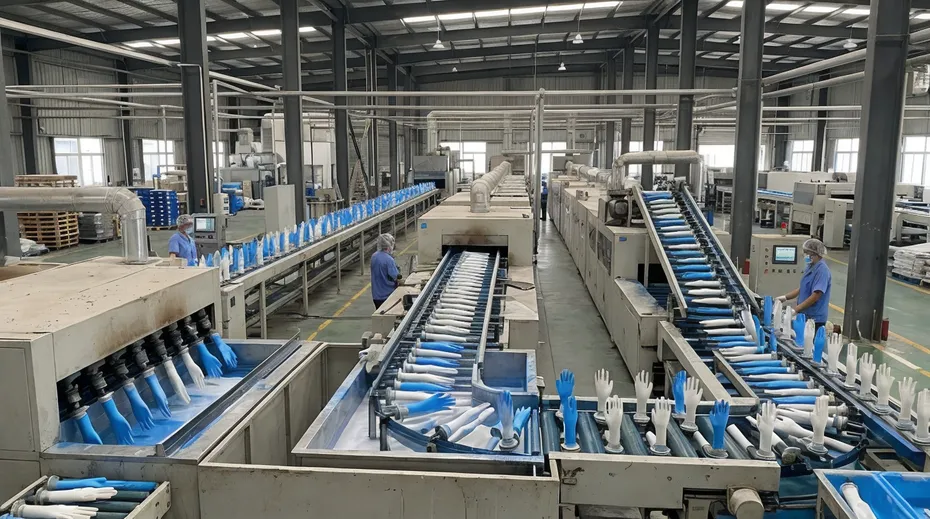
glovemfg has produced nitrile gloves exclusively since 2007. One category, one facility, 1.2 billion pieces per year — your industrial volume fits without competing for line time.
Industrial nitrile gloves cover a wide range of end-use environments — automotive workshops, chemical handling, food processing lines, janitorial supply, construction site safety — and the buyers sourcing them are distributors, safety wholesalers, and private-label brands who need consistent product across multiple container orders, not just a clean first sample.
We manufacture industrial nitrile gloves at Weifang Glovemfg Medical Products Co., Ltd., a facility that does nothing but nitrile gloves. No latex, no vinyl, no mixed PPE catalog. That single-category focus means every process decision — compound formulation, dipping speed, cure temperature, AQL threshold — has been optimized specifically for nitrile, not adapted from a broader production setup.
The industrial grade sits within our broader nitrile line alongside medical and food-contact grades, all produced on the same 8 automated dipping lines under the same in-house compound. What changes between grades is the specification target: wall thickness, surface texture, chemical resistance profile, and the certification package that ships with the carton. Your industrial SKU is built on the same manufacturing infrastructure that holds EN 455 and FDA 510(k) for our medical line — the process discipline doesn't get dialed back because the end use is industrial.
We produce industrial nitrile gloves across several configurations. The variants below represent the standard SKU range available from stock or short-run production. All are powder-free, all run through online pinhole detection, and all ship with AQL 1.5 outgoing inspection records.
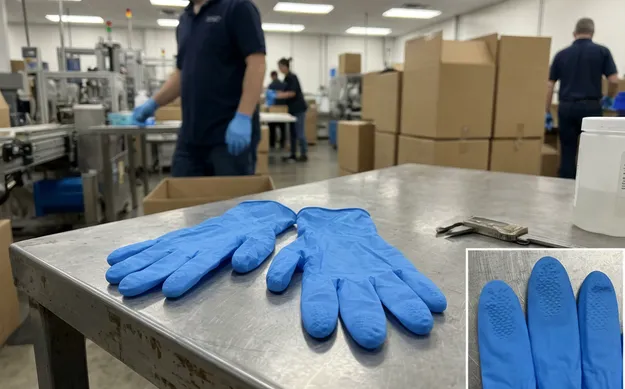
The workhorse SKU. Powder-free, lightly textured fingertips, available in sizes XS through XL. Covers automotive, janitorial, light chemical handling, and general assembly without over-engineering the spec. Blue and black colorways kept in standard rotation.
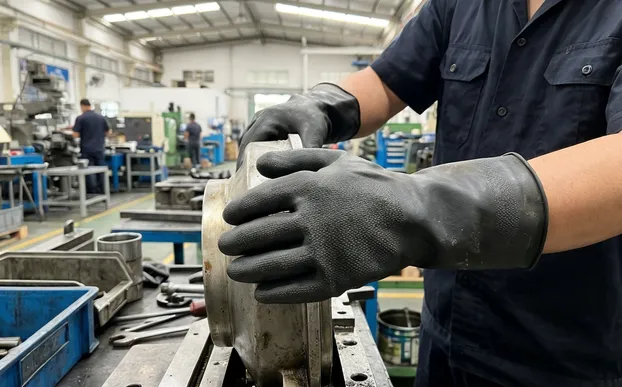
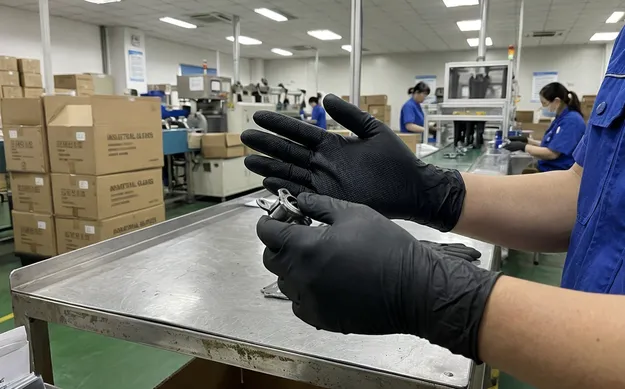
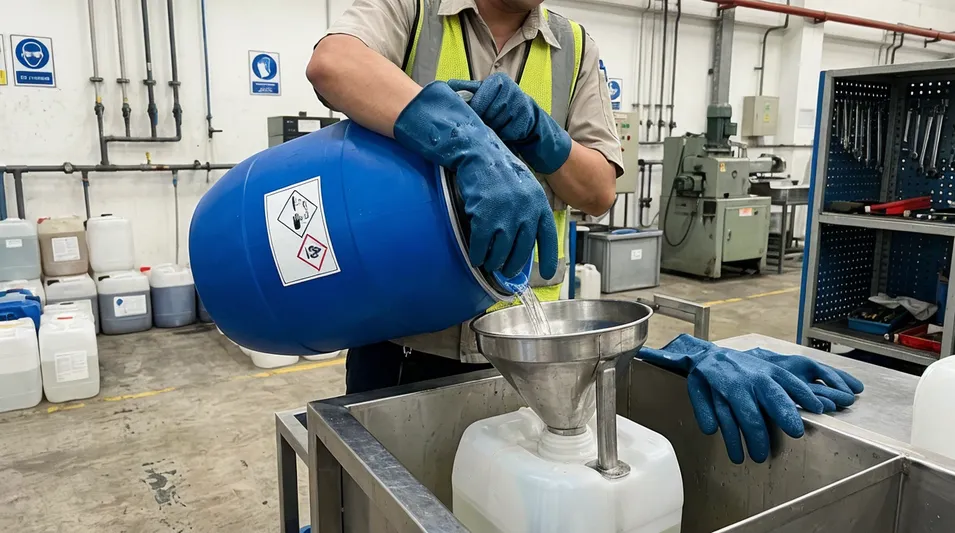
Thicker wall with full-hand micro-texture for grip in wet or oily conditions. Designed for environments where puncture resistance and tactile grip matter more than dexterity: chemical drum handling, metalworking, waste management.
Landed cost note: The heavier gauge adds roughly 15% to per-unit weight — factor this into your margin model on high-volume orders.
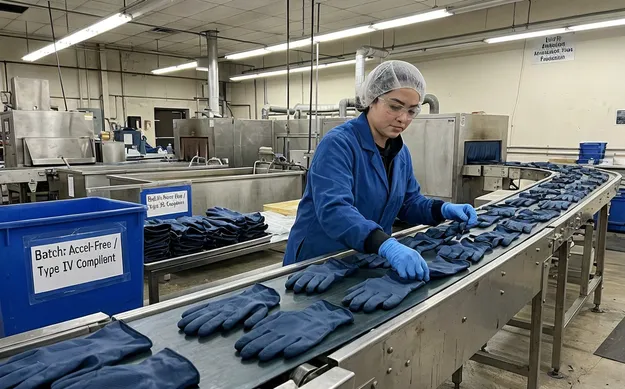
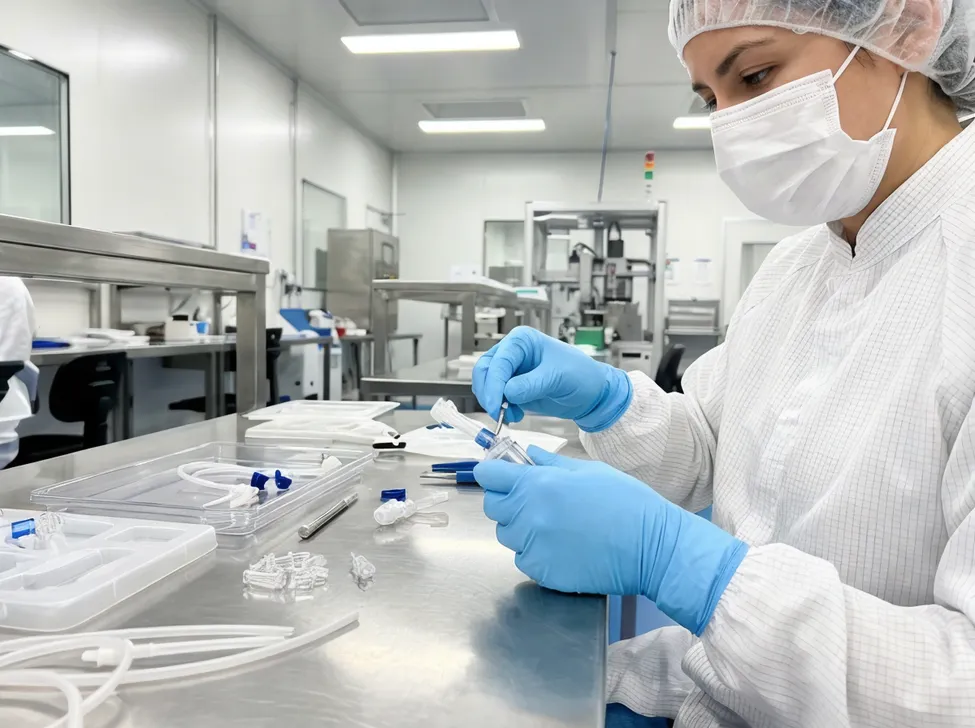
Same industrial-grade construction, formulated without thiuram or carbamate accelerators. Primary market: industrial buyers supplying healthcare-adjacent environments — dental labs, pharmaceutical manufacturing, medical device assembly — where Type IV sensitization compliance is a procurement requirement.
Run on a dedicated line using a sulfur-donor cure system — no cross-contamination risk with standard compound.
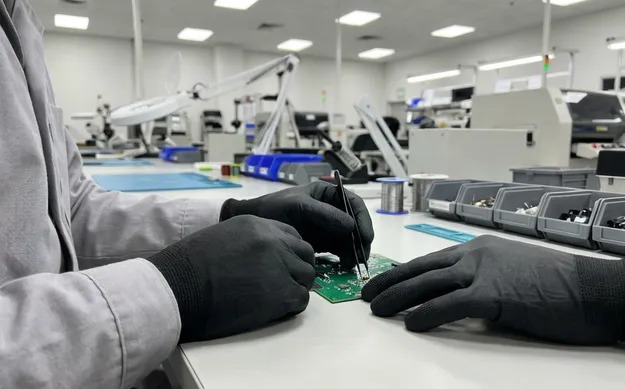
Full-hand smooth finish with enhanced micro-texture concentrated at the fingertips. For precision assembly, electronics handling, and quality inspection work where fingertip sensitivity matters. Thinner wall trades some puncture resistance for tactile feedback.
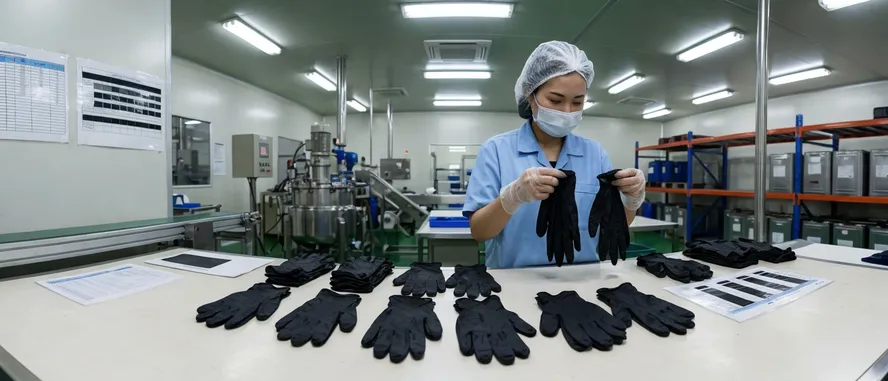
Standard industrial construction in black colorway, available in both standard and heavy-duty wall thickness. Black has become a default specification in automotive and tattooing supply channels — the color masks grease and ink, which matters to end-user brand presentation.
Produced using carbon-black compound dispersion stable across production runs. Color consistency batch-to-batch is tracked — inconsistent black is a visible defect your customers will notice.
Request samples or a full product catalog with spec sheets, AQL records, and certification documentation for any variant in the industrial line.
Explore Specific Variants
Exact tensile strength, elongation-at-break, and force-at-break values are available in our product test reports. Contact us for the full technical data sheet for any variant.
| Parameter | Standard | Heavy-Duty | Accelerator-Free | Textured Fingertip |
|---|---|---|---|---|
| Wall Thickness (palm) | 0.10–0.12mm | 0.13–0.15mm | 0.10–0.12mm | 0.08–0.10mm |
| Surface Texture | Fingertip micro-texture | Full-hand micro-texture | Fingertip micro-texture | Enhanced fingertip texture |
| Powder | Powder-free | Powder-free | Powder-free | Powder-free |
| Accelerator | Standard | Standard | Accelerator-free | Standard |
| AQL Standard | 1.5 | 1.5 | 1.5 | 1.5 |
| Pinhole Detection | Online, 100% | Online, 100% | Online, 100% | Online, 100% |
| Available Colors | Blue, Black, White | Black, Blue | Blue, White | Blue, White |
| Sizes | XS–XL | S–XL | XS–XL | XS–XL |
| Certifications | ISO 9001, CE, ASTM D6319 | ISO 9001, CE | ISO 9001, CE, EN 455 | ISO 9001, CE, ASTM D6319 |
This is the part that matters most to buyers who've had consistency problems with other suppliers. A glove that passes AQL on the first sample shipment but drifts on the third container is a supply chain problem, not a product problem — and it almost always traces back to compound inconsistency or dipping process variation.
We mix nitrile compound in-house rather than buying pre-mixed from a third-party supplier. We control viscosity, acrylonitrile content, and cure chemistry as variables we can adjust — not as fixed inputs we accept from a supplier's batch.
When a line starts showing thickness drift — and every dipping line drifts over time as bath chemistry depletes — our compounding team adjusts the formulation rather than waiting for the next supplier delivery. Most factories that use third-party compound don't realize their AQL variance is a compounding problem.
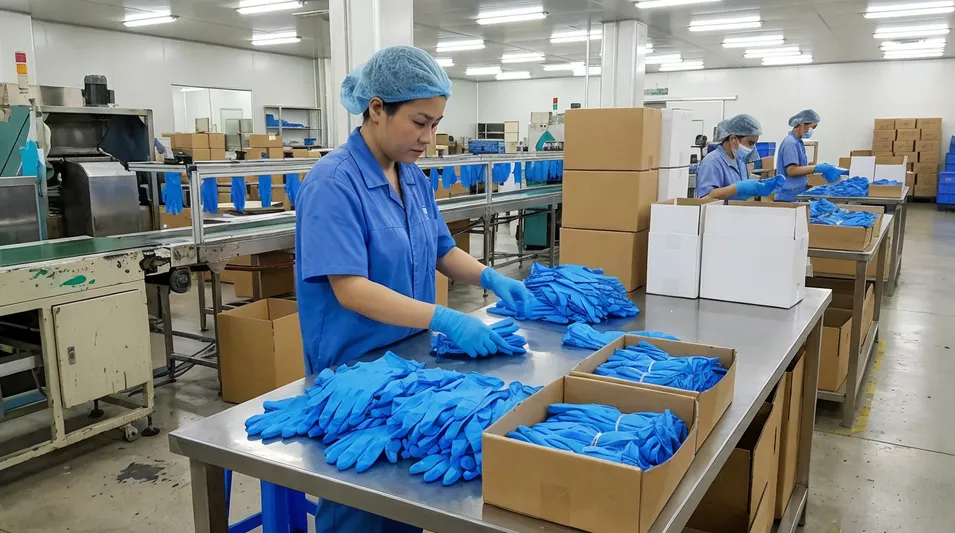
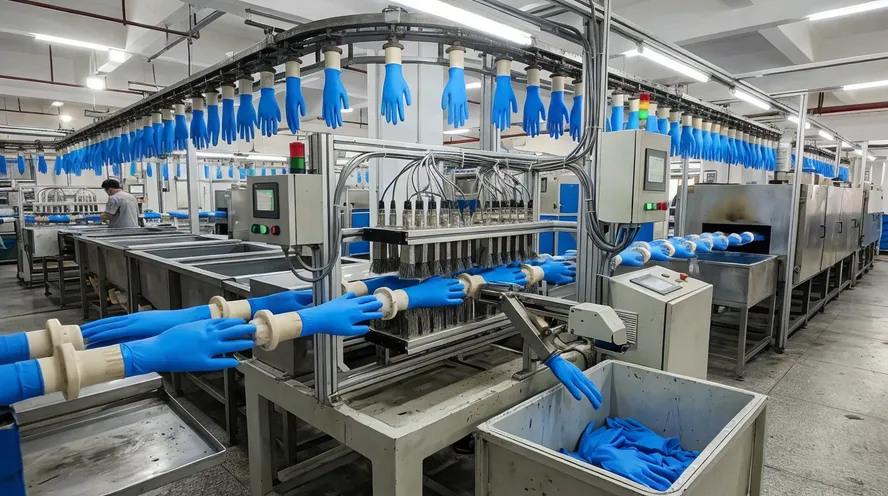
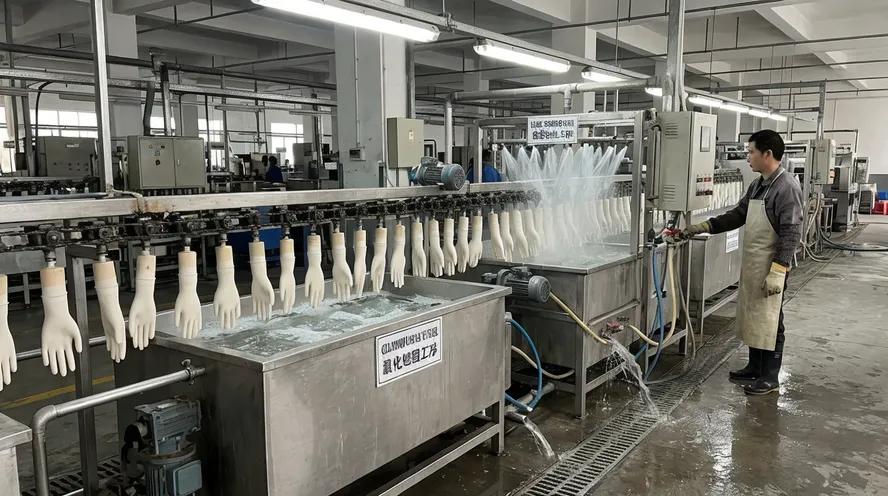
Each of the 8 dipping lines runs ceramic hand formers through the compound bath at a controlled speed, with bath temperature held to ±1°C and compound viscosity monitored continuously.
That's how we hold the 0.08–0.15mm thickness tolerance across a full production run — not just across a sample set pulled for your approval. The automated conveyor system eliminates operator-dependent variation; there's no manual dipping, no shift-to-shift inconsistency from different operators pulling formers at different speeds.
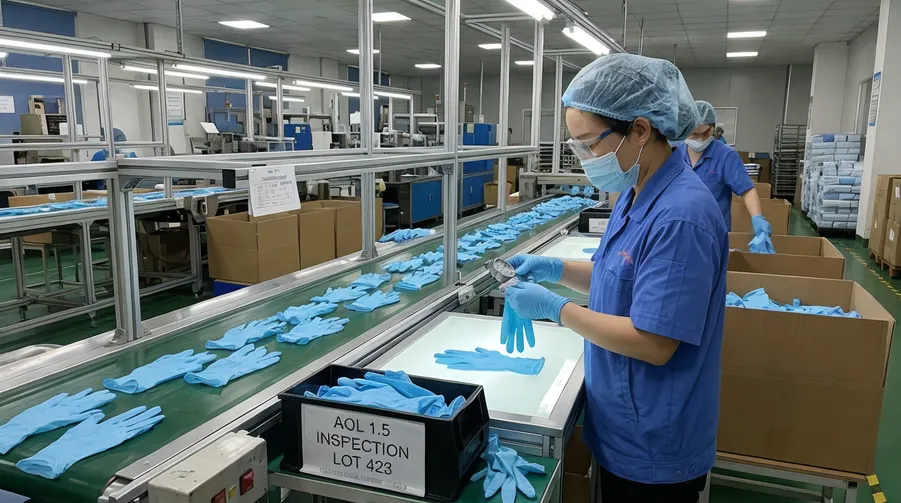
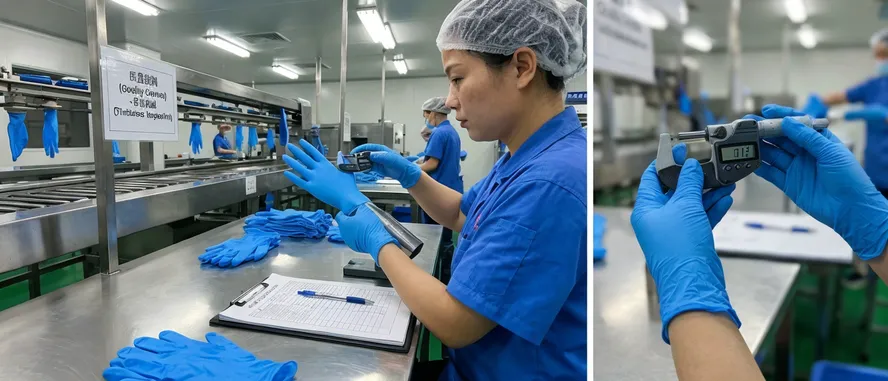
Online pinhole detection runs on every line. Each glove passes through an electrical leak test before it reaches the stripping station. Gloves that fail are pulled automatically — they don't reach counting and packing.
Outgoing inspection follows AQL 1.5 across 100% of production lots — tighter than the AQL 2.5 that many factories use as their default. Every finished carton is sampled before palletization. The inspection records ship with the container documentation.
AQL 1.5 means fewer defective units reach your warehouse, and fewer complaints reach your downstream customers. It's not a marketing claim — it's a sampling plan with a defined acceptance number that we apply to every outgoing lot, not just to shipments going to audited accounts.
Request Technical Data Sheet
Full certification documentation ships with every container. Third-party pre-shipment inspection through SGS or Bureau Veritas is available if your procurement process requires it.
| Certification | Scope | Market Relevance |
|---|---|---|
| ISO 9001:2015 | Quality management system | Universal — required by most institutional procurement processes |
| CE Marking | European conformity | EU import and distribution |
| EN 455 | Medical gloves for single use | European medical and healthcare-adjacent procurement |
| ASTM D6319 | Nitrile examination gloves | North American industrial and healthcare distribution |
| FDA 510(k) | Medical device clearance | US healthcare and regulated industrial supply |
ASTM D6319 is the standard your buyers reference for industrial and healthcare distribution. FDA 510(k) clearance covers regulated industrial supply and healthcare-adjacent accounts.
CE marking covers the import requirement for EU safety distributors. EN 455 opens healthcare-adjacent procurement — pharmaceutical manufacturing, dental labs, medical device assembly.
CE declaration of conformity, FDA 510(k) reference number, ISO 9001 certificate, and internal test reports for the specific production lot ship with every container.
If your customers include healthcare-adjacent industrial accounts — pharmaceutical manufacturing, dental labs, medical device assembly — EN 455 and FDA 510(k) are already in place. You don't need to qualify a separate medical supplier for those accounts; the same factory and the same production infrastructure covers both.
Industrial nitrile gloves distribute across several distinct market segments, each with different volume patterns and specification requirements. Understanding which segments your buyers serve helps you build the right SKU mix.
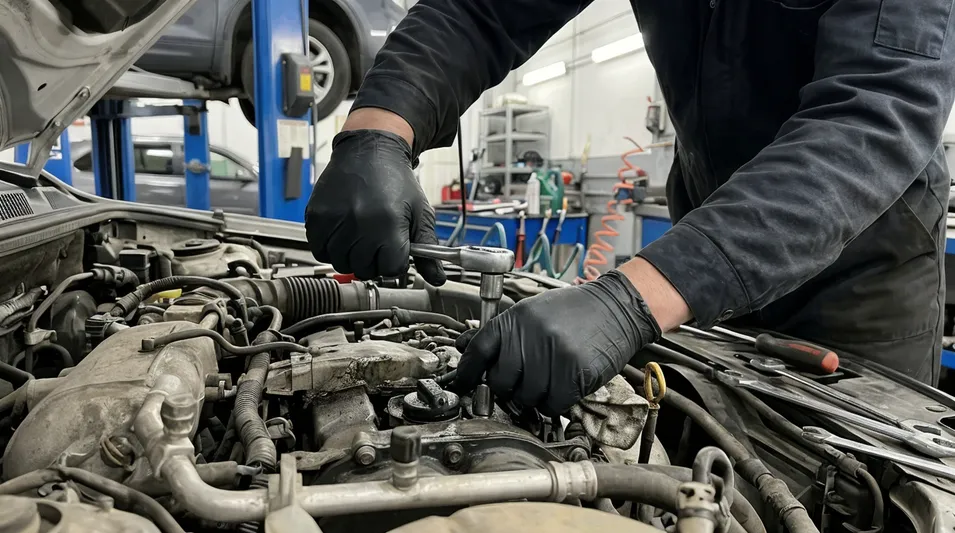
Auto shops, dealership service departments, and fleet maintenance operations consume black nitrile gloves at high rates. The black colorway is a category standard, and the spec requirement is straightforward: puncture resistance, grip in oily conditions, powder-free.
Our heavy-duty and standard black variants cover this segment without over-speccing.
Black Industrial Nitrile
Requires heavier gauge and, in some cases, specific chemical resistance documentation. Our heavy-duty variant at 0.13–0.15mm handles the puncture and chemical permeation requirements for most light-to-medium chemical exposure applications.
For buyers supplying chemical distribution or industrial cleaning accounts, this is the SKU that reduces warranty exposure.
Chemical Resistant Nitrile
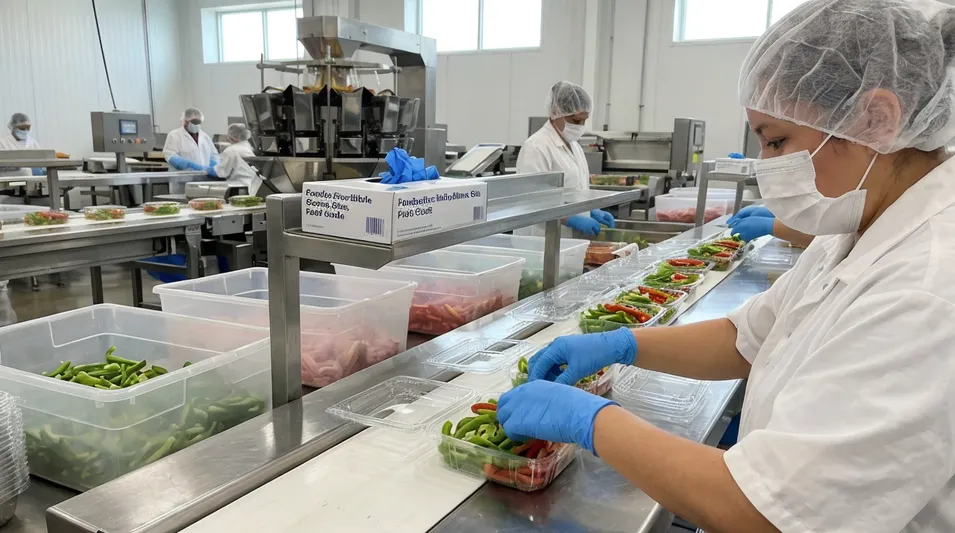
A growing segment for nitrile, driven by latex allergy concerns in commercial kitchen environments. Powder-free nitrile is the standard specification for food-contact applications.
Our standard variant meets food-contact requirements; we can provide food-contact compliance documentation for buyers supplying food processing facilities or food service distributors.
Food Nitrile Gloves
A high-frequency reorder segment — facilities management contracts run on annual or multi-year terms, and the glove specification is typically standardized across a facility portfolio. Once you're in the spec, the reorder pattern is predictable.
Standard industrial nitrile in blue or white covers most janitorial supply requirements.
Blue Industrial NitrileThis is the segment where accelerator-free specification opens doors that standard nitrile can't enter. European hospital procurement increasingly requires accelerator-free documentation; US pharmaceutical manufacturing facilities are moving in the same direction.
If you're building a distribution line that serves both industrial and healthcare-adjacent accounts, carrying the accelerator-free variant alongside standard industrial gives you coverage across both procurement requirements from a single supplier. This segment has grown steadily since 2019 — worth building into your SKU mix if you're targeting European healthcare distribution.
View Heavy Duty Variant
The most common sourcing mistake is defaulting to a single specification across all industrial accounts. Getting it wrong in either direction costs margin — over-speccing adds landed cost, under-speccing generates complaints.
Fingertip texture handles grip requirements. Black or blue colorway depending on account preference. This is the highest-volume, most competitive segment — your margin comes from supply chain reliability and MOQ flexibility, not from spec differentiation.
Full-hand texture handles wet and oily conditions. The extra wall thickness reduces puncture-related complaints. Buyers in these segments are less price-sensitive than automotive because the cost of a glove failure is higher — the spec is defensible.
Opens procurement categories that standard nitrile can't enter. The price premium is supportable because the alternative for your buyer is a separate supplier qualification process. One factory, two specifications, broader market coverage.
Thinner wall, enhanced fingertip sensitivity, clean-room compatible. This segment is smaller by volume but less price-competitive — buyers here are specifying on performance, not on price per box.
Not sure which configuration fits your current accounts?
Send us your target market and volume expectations — we'll suggest a starter SKU mix based on what's moving for our existing distributors in your region.
Industrial nitrile gloves fail in predictable ways. The failures that generate distributor complaints and returned containers are almost always traceable to specific manufacturing shortcuts.
A glove that measures 0.10mm at the palm and 0.07mm at the fingertip fails AQL at the destination port — a container your customer can't sell. The root cause is compound inconsistency: the nitrile bath depletes during a production run, viscosity drops, and gloves get thinner as the shift progresses. Factories buying pre-mixed compound from third-party suppliers can't adjust for this in real time.
We mix in-house, monitor viscosity continuously, and adjust formulation during the run. Our thickness tolerance is 0.08–0.15mm across the full production lot, not just the sample set.
A glove that passes visual inspection but fails the water-leak test at the buyer's warehouse is a manufacturing process failure, not a sampling failure. The cause is micro-defects in the dipping film — bubbles, thin spots, contamination on the former surface.
Our online electrical pinhole detection catches defects before the glove reaches the stripping station — every glove on every line, not a statistical sample. Gloves that fail are pulled automatically. This is why our AQL results at destination are consistent with our outgoing inspection records.
A less common but high-consequence failure, particularly for buyers supplying food processing or healthcare-adjacent accounts. If the chlorination or polymer-coating process is inconsistent, residual powder or coating agent can remain on the glove surface.
We run a dedicated powder-free process with post-stripping chlorination and a final rinse stage. Our powder-free documentation is available for buyers who need to demonstrate compliance to food-contact or healthcare procurement standards.
A visible defect that generates end-user complaints. Black nitrile gets its color from carbon-black dispersion in the compound — if the dispersion isn't stable, you get batch-to-batch color variation that's obvious when a customer opens two boxes from the same order.
We track color consistency as a production parameter, not just a cosmetic check. Our carbon-black dispersion protocol is part of the compounding process, not an afterthought.
If you're building a private-label line, the same manufacturing infrastructure that produces our standard SKUs handles OEM and ODM projects. We don't subcontract custom work — it runs on our lines, with our compound, under our QC process.
Custom formulation projects are handled through the in-house compounding lab. If you need a specific elongation-at-break target, a particular chemical resistance profile, or a color match from a Pantone reference, our formulation team develops the compound and runs validation production before the first commercial order. The specification sheet and test reports carry your brand name.
Packaging customization covers carton printing, box labeling, and inner bag branding. We can match your existing packaging format or develop a new one. Regulatory documentation — CE declaration of conformity, FDA 510(k) reference, country-of-origin certificates — is prepared under your brand name for markets where you hold the import registration.
MOQ for standard SKUs starts at one 40HQ container, approximately 2,000 boxes for standard examination-format industrial gloves. Custom formulation projects carry the same MOQ — one container is the minimum that makes the compound development and line setup cost-effective for both sides. Below that threshold, the per-unit economics don't work for a custom project; we'll tell you that upfront rather than after you've committed to development.
Custom compound development, private-label packaging, and regulatory documentation — all under your brand.
Standard industrial nitrile gloves pack at 10 boxes per carton, 100 gloves per box. Carton dimensions are optimized for 40HQ loading — a properly loaded 40HQ carries approximately 2,000 boxes without wasted cubic space.
Carton labeling can be configured to Amazon FBA requirements, distributor DC barcode standards, or your own warehouse receiving format. The label setup is a checklist item, not a special request.
Pre-shipment inspection through SGS or Bureau Veritas is available on request. We coordinate the inspection scheduling as part of the shipment process — it doesn't add lead time if confirmed at order placement.
Lead time for standard SKUs runs 25–35 days from order confirmation. For repeat orders on established SKUs, we maintain a rolling production schedule that allows us to confirm ship dates at order placement — not after production planning.
If you're managing a distribution business with predictable reorder cycles, that scheduling visibility matters for your inventory planning. Confirmed ship dates at order placement — not after production planning — is a meaningful operational difference.
One 40HQ container for standard SKUs — approximately 2,000 boxes at 100 gloves per box. This is the MOQ that makes container-rate freight economics work for both sides. For buyers who want to test a new SKU before committing to a full container, we support sample orders that ship within 5–7 business days with full certification documentation included.
ISO 9001:2015, CE marking, ASTM D6319, and FDA 510(k) are standard across the industrial line. EN 455 applies to the accelerator-free variant and medical-grade SKUs. For buyers supplying North American industrial distribution, ASTM D6319 is the relevant standard. For European distribution, CE covers the import requirement. Full documentation ships with every container; third-party test reports are available on request.
For general-purpose industrial use — automotive, janitorial, light assembly — 0.10–0.12mm palm thickness is the standard specification. It covers the application without over-speccing. For heavy industrial use — chemical handling, metalworking, waste management — specify 0.13–0.15mm with full-hand texture. The heavier gauge reduces puncture-related complaints in high-abuse environments. If you're unsure which spec fits your accounts, send us a description of the end-use environment and we'll recommend the configuration.
Standard nitrile uses thiuram and carbamate accelerators in the vulcanization process. These accelerators are the primary cause of Type IV allergic reactions — a compliance concern in healthcare-adjacent industrial environments. Accelerator-free nitrile uses a sulfur-donor cure system instead, producing a glove with no detectable accelerator residue. For most general industrial applications, standard nitrile is the right specification. For buyers supplying pharmaceutical manufacturing, dental labs, or European healthcare-adjacent accounts, accelerator-free is the specification that satisfies procurement requirements that standard nitrile can't meet.
We mix nitrile compound in-house and monitor bath viscosity continuously during production. When the compound bath depletes and viscosity drops — which happens on every dipping line over the course of a shift — our compounding team adjusts the formulation in real time rather than waiting for the next supplier delivery. Combined with automated conveyor speed control and bath temperature held to ±1°C, this is how we hold the 0.08–0.15mm thickness tolerance across a full production run. The AQL 1.5 outgoing inspection records that ship with your container reflect the full lot, not a pre-selected sample.
Yes. OEM and private-label projects run on our production lines with our compound and QC process — no subcontracting. Custom formulation, color matching, and packaging design are handled through our in-house compounding lab and packaging team. MOQ for OEM projects is one 40HQ container. Regulatory documentation — CE declaration, FDA 510(k) reference, test reports — is prepared under your brand name. Contact us to discuss your project requirements.
glovemfg has manufactured nitrile gloves since 2007. The 18,000 m² facility in Weifang runs 8 automated dipping lines with 1.2 billion pieces annual capacity. Every certification, every process, every formulation in the compounding lab has been built around nitrile gloves specifically — not adapted from a broader PPE operation.
For industrial distributors and private-label brands, that single-category focus translates directly into supply chain reliability: consistent spec across your full year of orders, documentation that satisfies your buyers' procurement requirements, and a manufacturer who can tell you exactly what's in the compound and why.
If you're evaluating suppliers for your industrial nitrile line, send us your current specification and target volume. We'll respond with a detailed quote, the relevant certification documentation, and a sample shipment if you want to test the product before committing to a container.
Email
sales@glovemfg.com
Phone
+86 155 3755 6387
Address
South Side of the Road, 500 Meters West of Heng'er Road, Zhilan No. 3 Village, Gaomi Economic Development Zone, Gaomi, Weifang, Shandong, China