Industrial Nitrile Glove Suppliers for Mexican Manufacturing Buyers: Pricing and Import Review
Mexico's manufacturing sector runs on nitrile gloves. Automotive assembly in Monterrey, food processing in Guadalajara, chemical handling in Altamira, electronics in Tijuana — every one of those environments burns through industrial nitrile at volume. The question isn't whether you need a reliable supply. The question is whether your current sourcing route is costing you more than it should.
This review covers the real supplier landscape: who the serious local distributors and importers are, what they're good for, where their model compresses your margin, and when a direct factory relationship starts making financial sense at your order volumes.

How the Mexican Industrial Glove Market Is Actually Structured
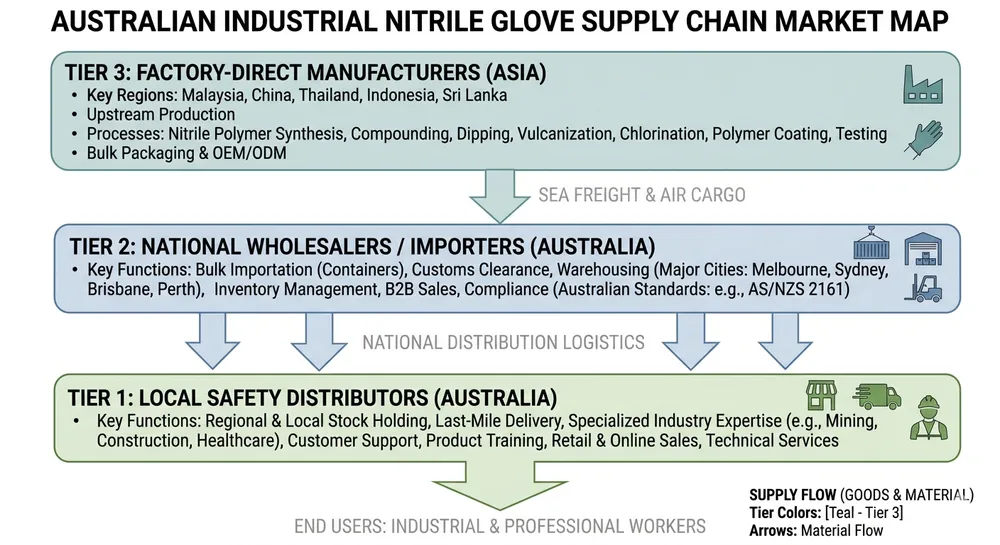
Before evaluating any supplier, it helps to understand the three layers this market operates on.
National safety distributors carry broad PPE catalogs — gloves, eyewear, footwear, respiratory protection — and serve large industrial accounts with warehoused inventory. Their value is availability: you can place an order Monday and have product on-site by Wednesday. Their limitation is that nitrile gloves are a commodity line item in a wide catalog, not a specialty. Spec consistency across production runs is rarely their priority.
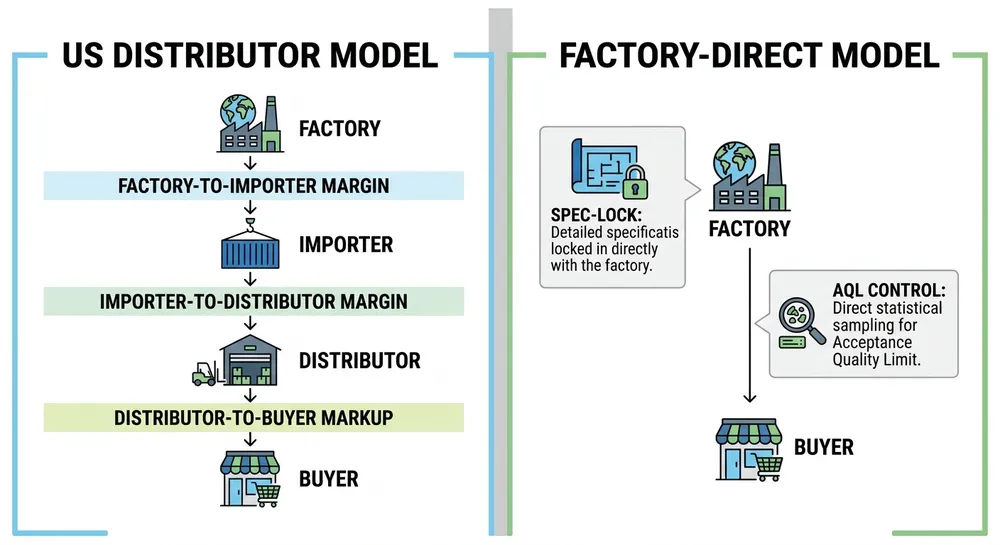
Regional importers and trading companies sit between the factory and the end buyer. They source from Asian manufacturers, hold inventory in Mexican bonded warehouses or free-trade zones, and sell at a markup that covers their logistics, financing, and local service costs. For mid-volume buyers, they offer a reasonable middle ground — better pricing than national distributors, faster replenishment than direct import.
Direct factory import is the third route. You source directly from the manufacturer, ship by container, and handle your own import logistics (or use a customs broker). The economics only work above a certain volume threshold — typically one full container or more per order — but when they do work, the landed cost difference is meaningful.
Most Mexican industrial buyers use all three layers depending on urgency and order size. The mistake is defaulting to the most expensive layer for your repeat, predictable volume.
What Separates a Serious Industrial Glove Supplier from a Catalog Filler
I've seen buyers get burned by the same sourcing mistakes repeatedly. A supplier quotes a competitive price on 4-mil powder-free nitrile, the first shipment passes incoming inspection, and then the third or fourth order comes in 20% thinner with pinhole rates that fail AQL. By then you've already committed the product to your production line.
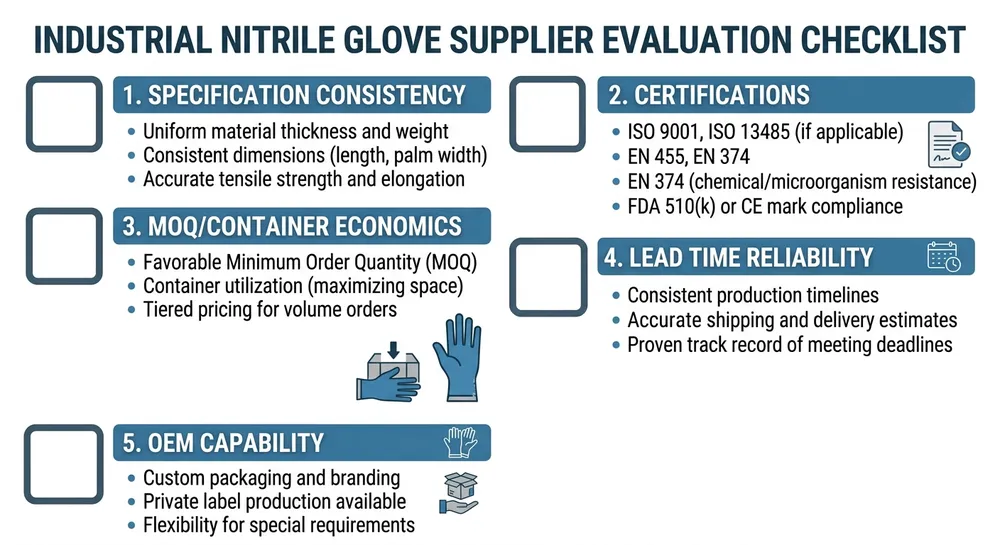
The criteria that actually matter for industrial nitrile procurement:
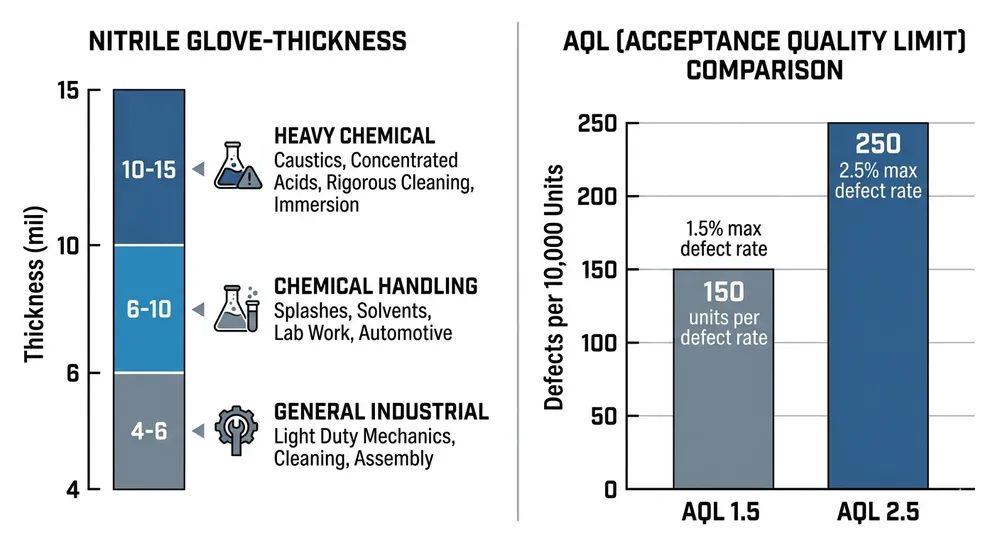
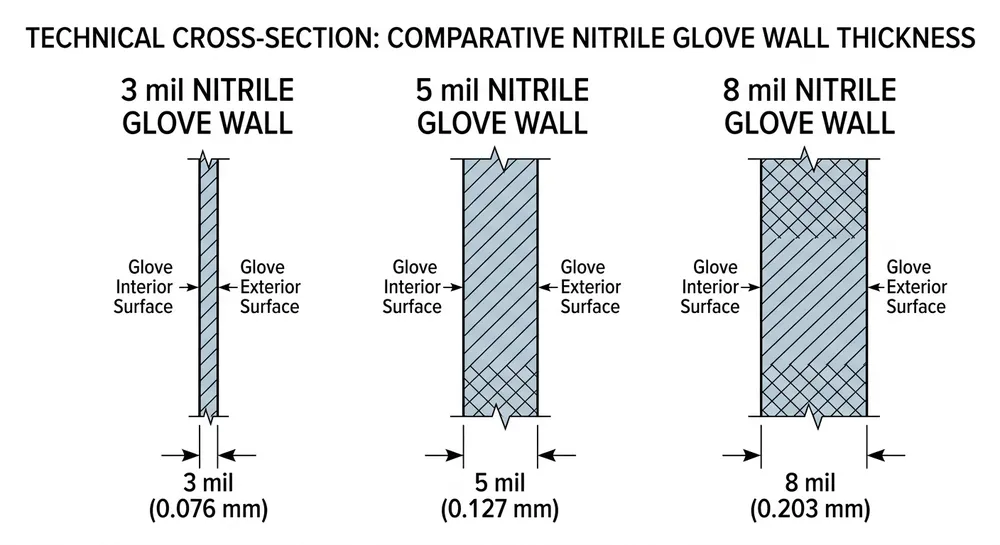
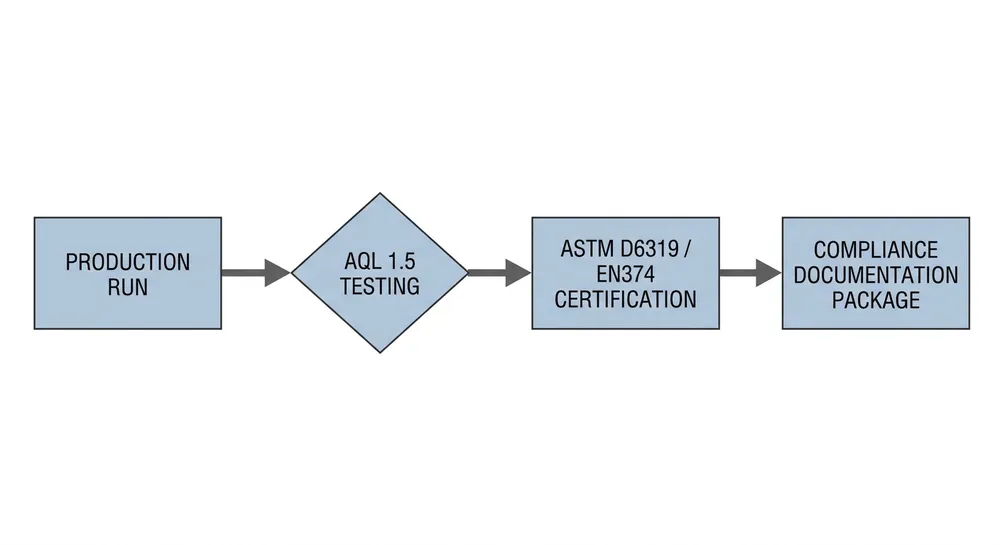
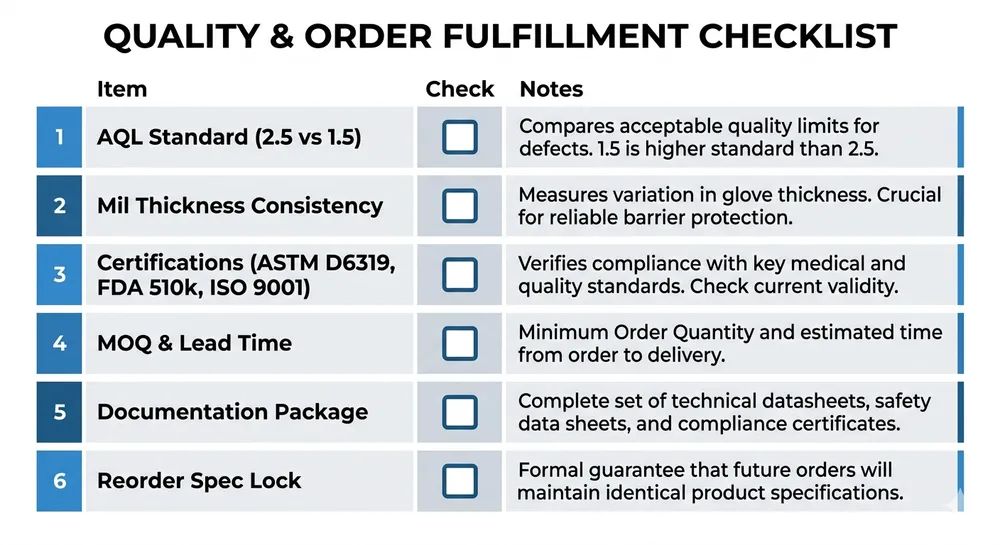
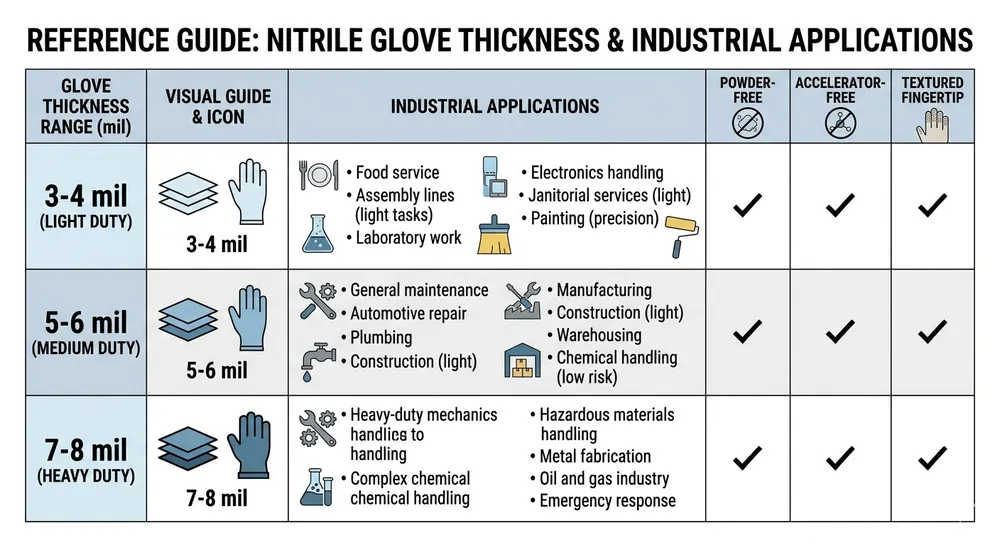
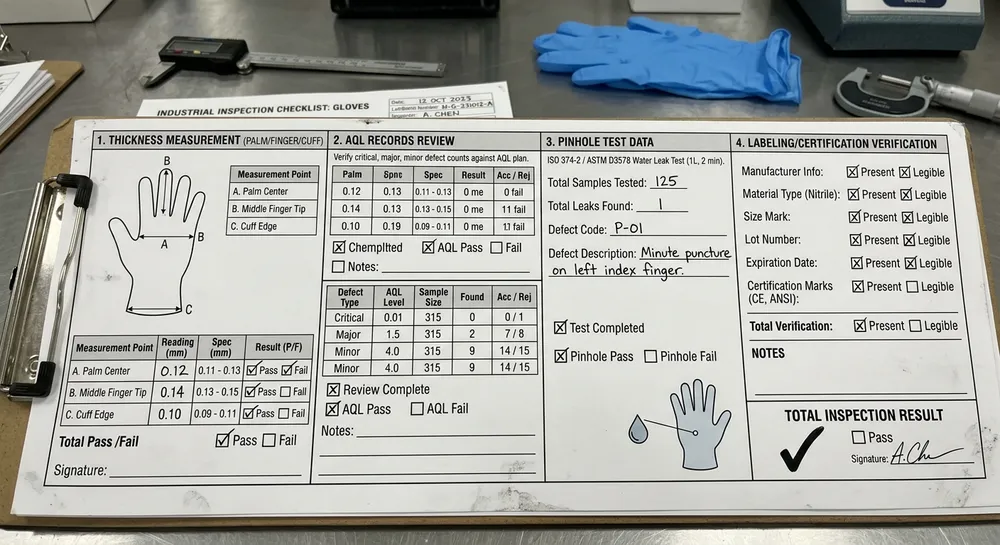
Mil thickness consistency across production runs — not just on the sample. Industrial applications from automotive assembly to chemical handling have minimum thickness requirements. A glove that measures 4 mil on the sample and 3.2 mil on the production run is a different product. Ask for AQL inspection reports from multiple production lots, not just the first.
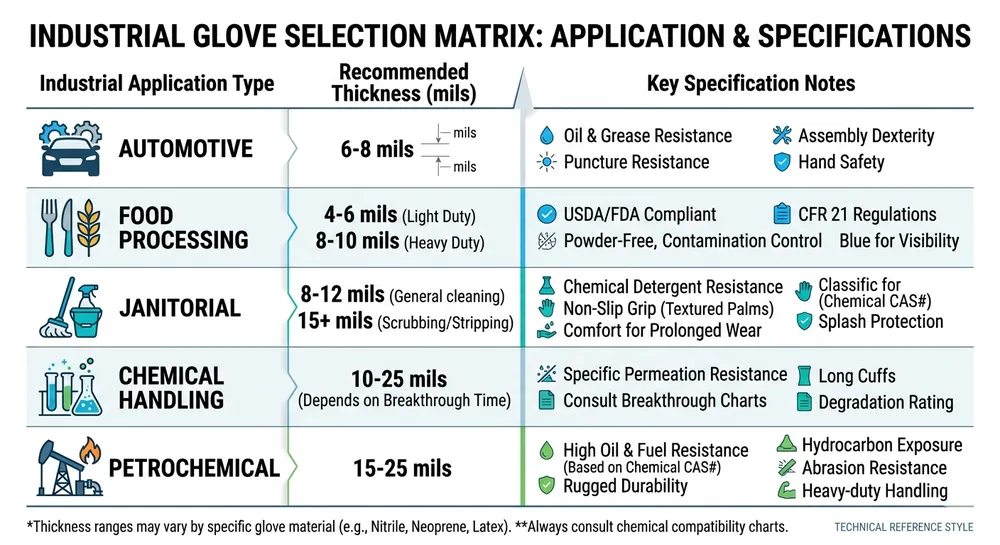
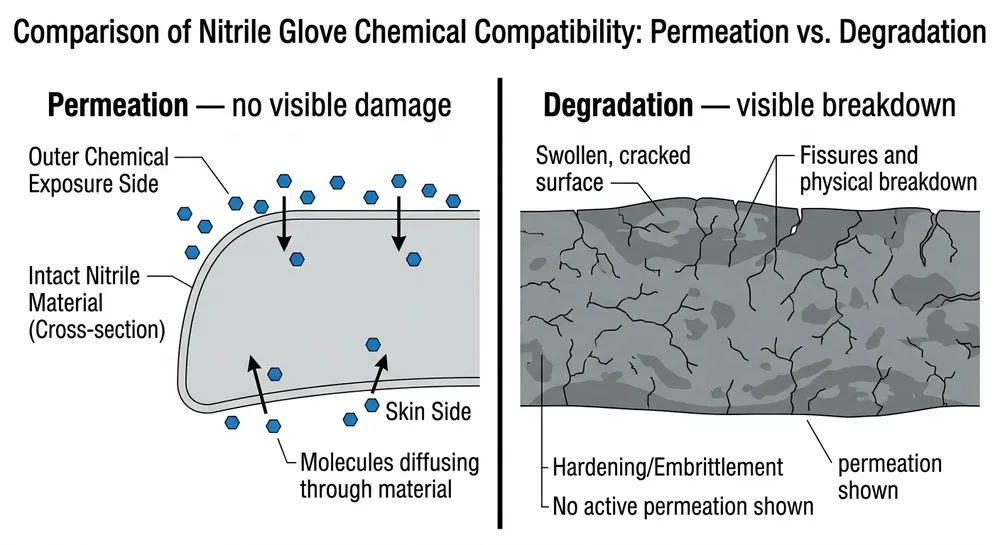
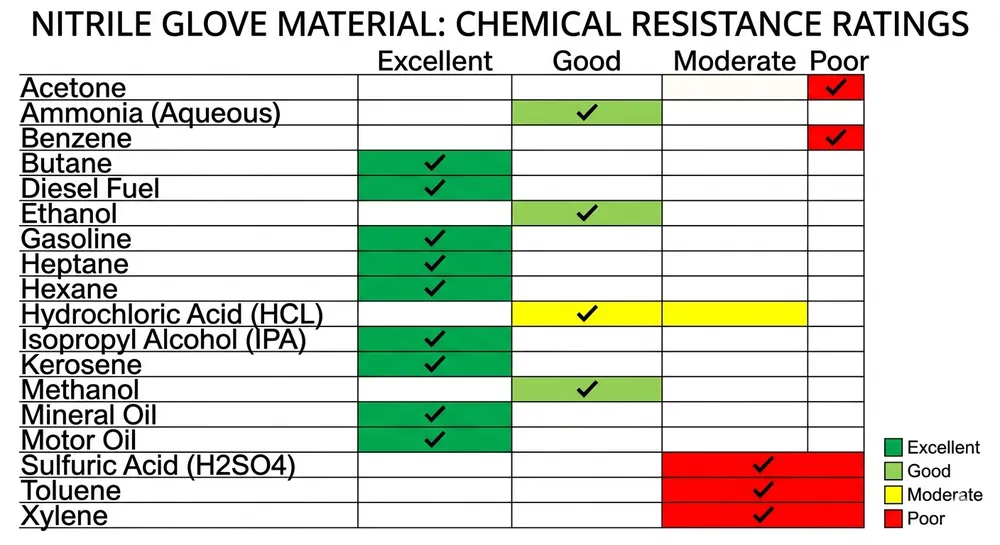
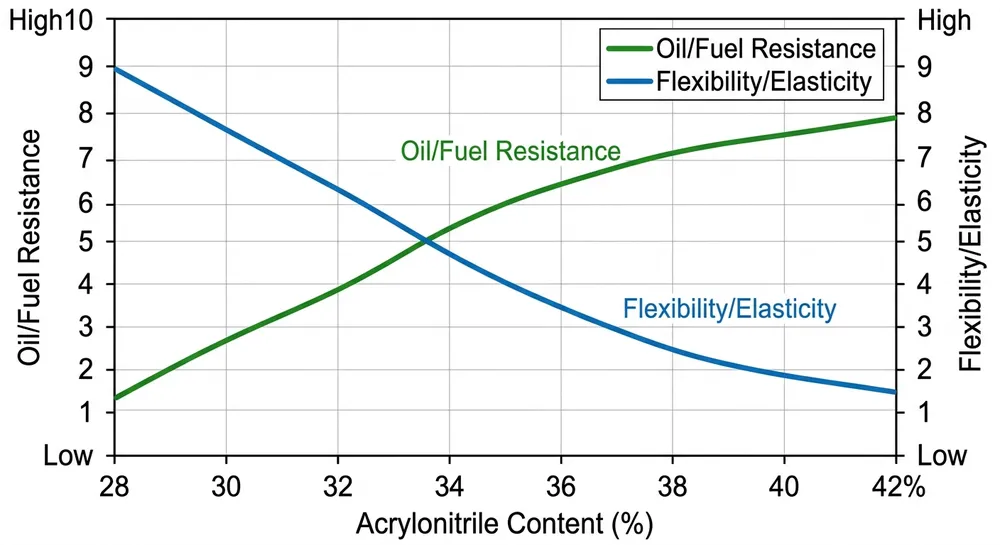
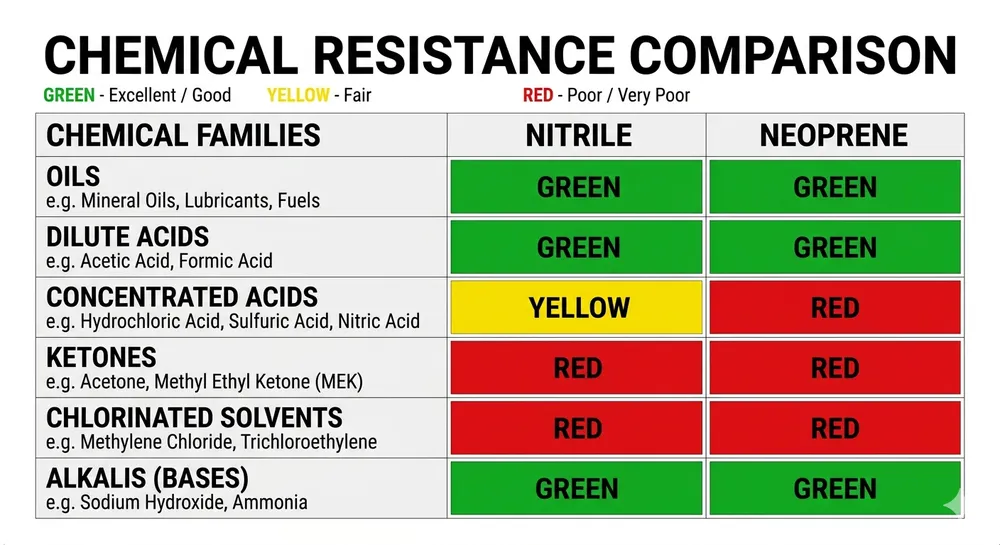
Chemical resistance grade — this is where generic catalog sourcing fails most often. Standard industrial nitrile (0.10–0.12mm, 4–5 mil) handles oils, greases, and mild solvents adequately. For ketones, aldehydes, or concentrated acids, you need a heavier gauge with a verified permeation resistance profile. A distributor selling from a catalog can't tell you the compound formulation. A manufacturer can.
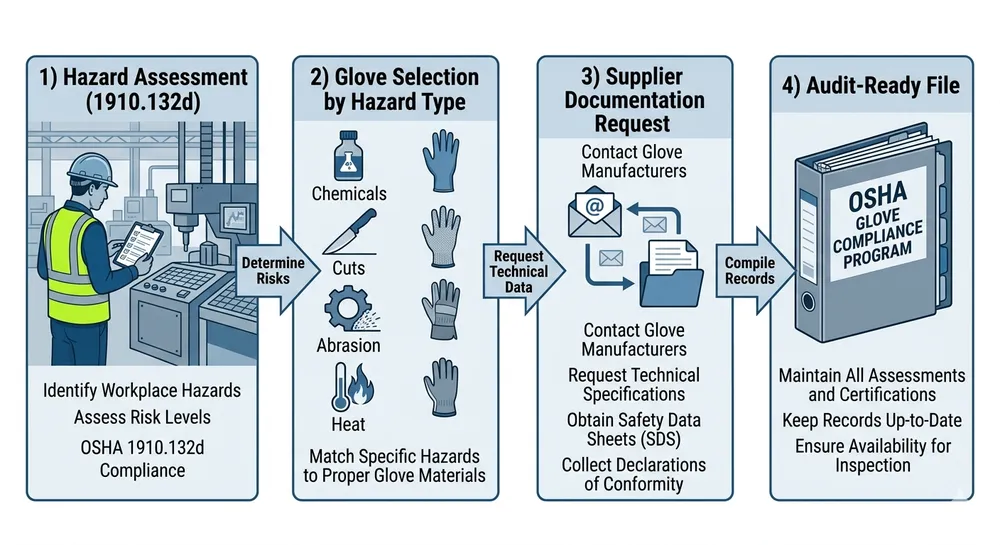
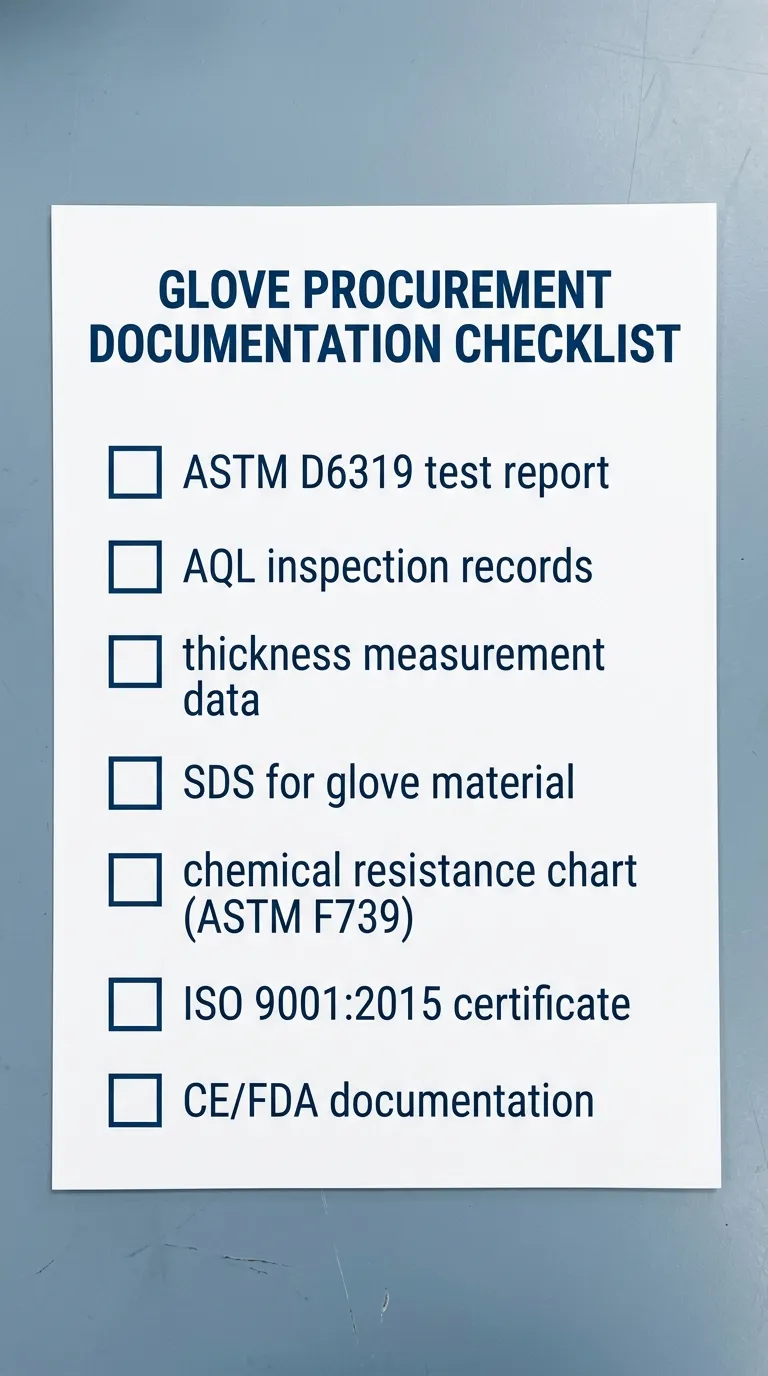
Certifications relevant to your end market — if your gloves are going into food processing, FDA compliance matters. If they're going into a facility with IMSS safety audits, EN455 or ASTM D6319 documentation gives your safety manager something to file. Not every supplier in this market carries both.
MOQ and reorder flexibility — national distributors will sell you a case. Factory-direct suppliers typically require a container minimum. The right answer depends on your consumption rate. If you're burning through 50,000 boxes a year, the container math works. If you're at 5,000 boxes, a regional importer is probably your better route.
Landed cost transparency — the quoted price per box means nothing without knowing the full landed cost: freight, import duties (Mexico's MFN tariff on nitrile gloves from China runs in the 10–15% range depending on HS code classification), customs brokerage, and local delivery. A supplier who helps you model this is more useful than one who just quotes FOB Qingdao.

10 Suppliers and Importers Serving the Mexican Industrial Glove Market
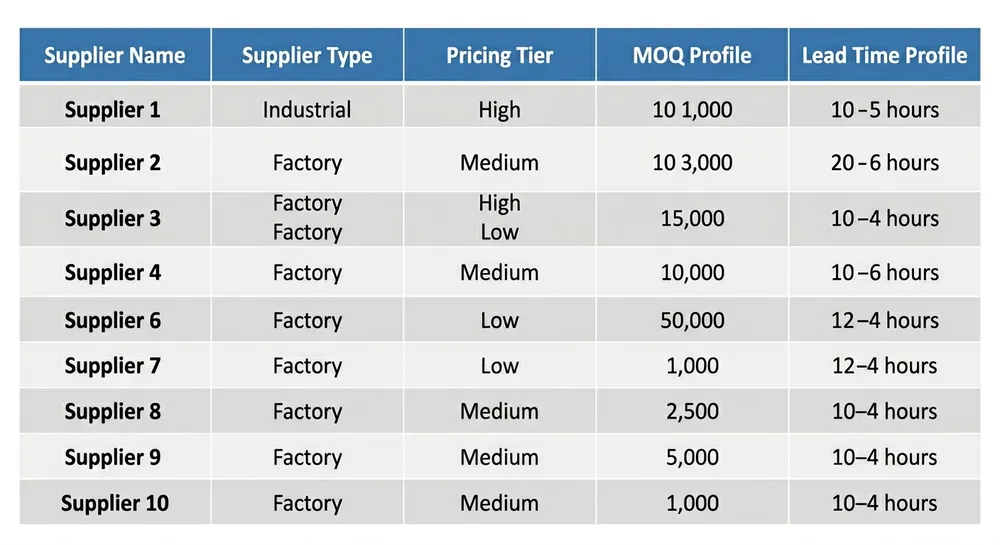
The following companies represent the real sourcing landscape for industrial nitrile gloves in Mexico — national distributors, regional importers, and international manufacturers with established Mexican market presence. This is not a ranked list. It's a map of the options your procurement team is likely already evaluating or will encounter.
—
1. Grupo Industrial Deltagen — Mexico City
Type: National PPE distributor Website: deltagen.com.mx
Deltagen is one of the larger national safety distributors operating across Mexico, with catalog coverage spanning nitrile, latex, and vinyl gloves alongside broader PPE lines. Their strength is warehoused inventory and same-week delivery to major industrial zones. For urgent replenishment orders, they're a reliable option. For buyers sourcing at container scale with specific mil thickness requirements, their catalog model offers limited spec control.
—
2. Seguridad Industrial Lozano — Monterrey
Type: Regional safety distributor, northern Mexico focus Website: silozano.com.mx
Lozano serves the Monterrey industrial corridor — automotive, steel, and manufacturing — with a regional distribution model that gives them faster response times in Nuevo León and Tamaulipas than national players. Their nitrile glove range covers standard industrial grades. Buyers in the northern manufacturing belt often use them for emergency replenishment alongside a primary import supplier.
—
3. 3M Mexico — Mexico City
Type: Multinational PPE manufacturer with local distribution Website: 3m.com/mx
3M's Mexican operation covers the full PPE spectrum including nitrile examination and industrial gloves. Their brand carries compliance documentation that satisfies most IMSS and ISO 45001 audit requirements without additional paperwork. The trade-off is price: 3M nitrile gloves carry a significant brand premium over equivalent-spec products from dedicated glove manufacturers. For buyers where brand recognition matters to their downstream customers, that premium may be justified. For internal industrial use at volume, it usually isn't.
—
4. Ansell Mexico — Mexico City
Type: Multinational specialty glove manufacturer Website: ansell.com
Ansell is the benchmark for chemical-resistant industrial gloves in the Mexican market. Their HyFlex and AlphaTec lines are specified by name in many chemical plant and pharmaceutical facility safety programs. If your application involves aggressive chemical exposure — chlorinated solvents, concentrated acids, or reactive compounds — Ansell's chemical resistance data is among the most thoroughly documented available. Their pricing reflects that positioning: expect to pay 40–80% more per unit than standard industrial nitrile from a dedicated manufacturer. For standard assembly, food processing, or general industrial use, that premium buys you documentation you don't need.
—
5. Kimberly-Clark Professional Mexico — Mexico City
Type: Multinational PPE brand with local distribution Website: kcprofessional.com/mx
Kimberly-Clark's professional division covers nitrile gloves under the Kleenguard brand, distributed through industrial supply channels across Mexico. Their positioning is mid-market: better documentation than generic importers, lower price point than Ansell or 3M. For buyers supplying facilities that require a recognized brand name on the glove box without paying specialty-chemical pricing, Kleenguard is a common choice. Spec consistency is generally reliable within their standard SKU range.
—
6. Supermax Healthcare — Regional importer presence
Type: Malaysian glove manufacturer with Latin American distribution Website: supermax.com.my
Supermax is one of the larger Malaysian nitrile glove manufacturers with distribution reach into Latin American markets. Their industrial nitrile range covers standard examination and light industrial grades. For Mexican importers and trading companies sourcing from Southeast Asia, Supermax is a known name. Direct procurement from their export division is possible for container-volume buyers, though their primary Latin American channel runs through regional distributors rather than direct factory relationships.
—
7. Top Glove — Regional importer presence
Type: Malaysian glove manufacturer, world's largest by volume Website: topglove.com
Top Glove's scale means competitive pricing on standard nitrile SKUs. Their industrial nitrile range is broad, and their export documentation for FDA, CE, and EN455 is well-established. Mexican importers and trading companies regularly source from Top Glove for standard industrial grades. The limitation for direct buyers is MOQ and lead time: Top Glove's production scheduling favors large-volume orders, and smaller container buyers often find themselves lower in the queue during high-demand periods. (We've seen this pattern repeatedly with buyers who switched to Top Glove during the 2020–2021 shortage period and then struggled to maintain consistent allocation afterward.)
—
8. Hartalega — Regional importer presence
Type: Malaysian nitrile glove specialist Website: hartalega.com.my
Hartalega focuses specifically on nitrile gloves — no latex, no vinyl — which means their production consistency on nitrile formulation is tighter than mixed-product manufacturers. Their NEXT-generation nitrile technology produces thinner, higher-sensitivity gloves that are well-suited to electronics assembly and precision manufacturing applications. For Mexican buyers in those segments, Hartalega is worth evaluating. Their direct export channel is accessible for container-volume procurement.
—
9. Showa Group — Mexico City / regional presence
Type: Japanese specialty glove manufacturer Website: showagroup.com
Showa's industrial glove line covers nitrile, neoprene, and cut-resistant categories. Their positioning in Mexico is similar to Ansell — premium pricing, strong chemical resistance documentation, specified by name in high-compliance industrial environments. For general industrial nitrile procurement at volume, their price point is difficult to justify. For chemical handling, pharmaceutical, or high-compliance manufacturing environments where the glove spec is written into the safety program, Showa's documentation package is thorough.
—
10. Glovemfg (Qingdao Glovemfg Medical Products Co., Ltd.) — Factory-direct from Qingdao, China
Type: Dedicated nitrile glove manufacturer, factory-direct export Website: glovemfg.com
We manufacture exclusively nitrile gloves — no mixed PPE catalog, no trading company markup. Our facility in Qingdao runs 8 fully automated dipping lines across 18,000 square meters, with annual output at 1.2 billion pieces. For Mexican buyers sourcing at container scale, that capacity means your order runs on a dedicated line without competing for production time.
The spec range relevant to Mexican industrial buyers: powder-free industrial nitrile from 0.08mm to 0.15mm thickness, with 100% AQL 1.5 online inspection including pinhole detection on every production run — not just on samples. We hold ISO 9001:2015, CE, EN455, ASTM D6319, and FDA 510(k), which covers the documentation requirements for food processing, pharmaceutical, and general industrial applications in Mexico.
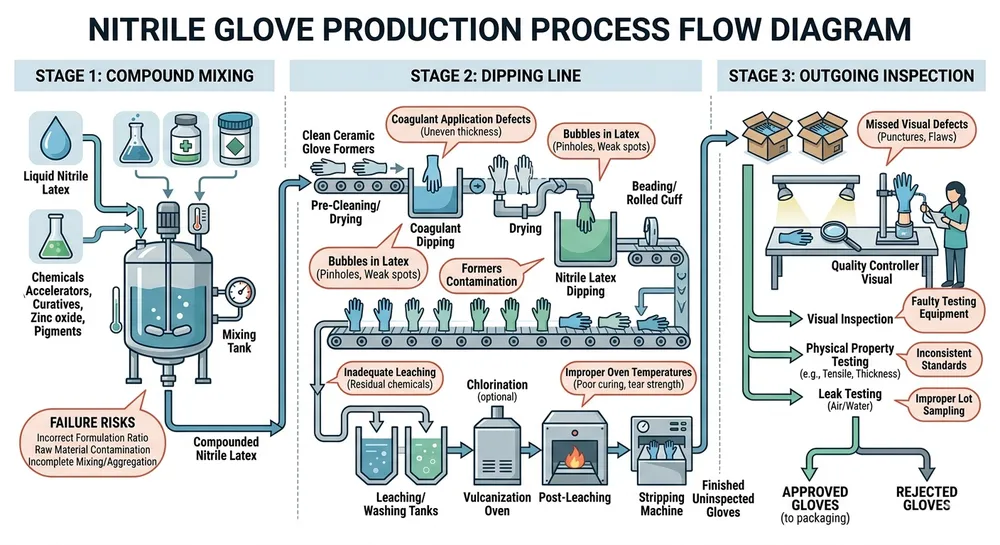
We've been running since 2007. The consistency problem — gloves that pass the first sample and drift on the third production run — is something we solved by building our own compounding lab and controlling the nitrile formulation in-house. Once you own the compound, you control the thickness. Our 0.08–0.15mm tolerance holds across production runs, not just on the sample shipment.
For Mexican buyers, the landed cost calculation typically works out favorably at one container (approximately 2,000 boxes) or more per order. We can help you model the full landed cost including freight, Mexican import duties, and customs brokerage so you're comparing apples to apples against your current local supplier pricing.
—

The Real Cost of Local Convenience
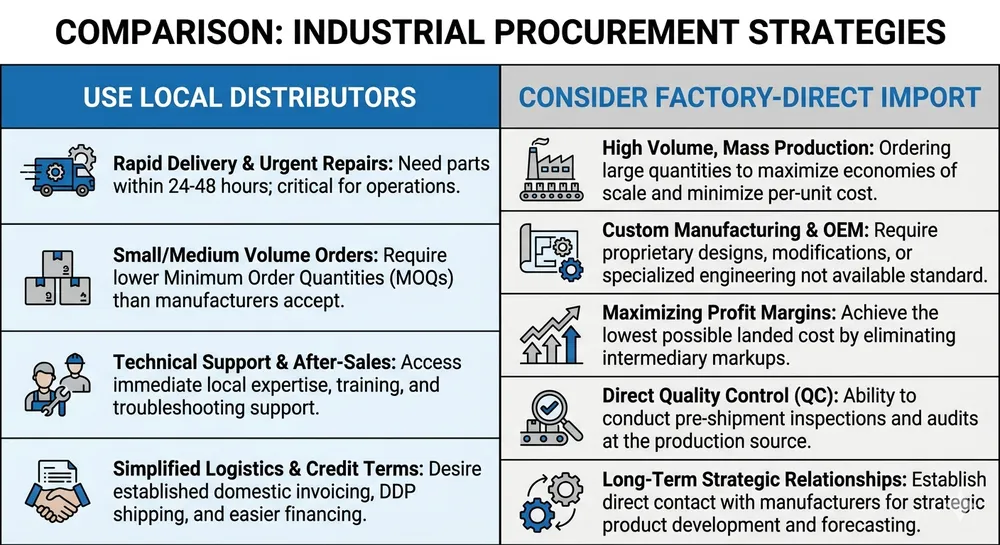
Local distributors and regional importers earn their margin by solving a real problem: you don't have to manage import logistics, customs clearance, or container-level inventory. That's worth something. The question is how much it's worth relative to your order volume and margin structure.
For a facility running 500–1,000 boxes per month on unpredictable consumption, local distributor pricing is probably the right answer. The convenience premium — typically 25–45% above factory-direct landed cost on standard industrial nitrile — is justified by the flexibility and the absence of logistics overhead.
For a facility running 3,000+ boxes per month on predictable consumption, that same convenience premium is a fixed cost you're paying every month for a problem you could solve once with a direct supplier relationship and a modest safety stock. At 3,000 boxes per month, a 30% landed cost reduction on standard industrial nitrile is a meaningful number on an annual basis.
The math changes further when you factor in spec consistency. Local distributors source from whoever is competitive at the time of their own purchasing cycle. That means your glove spec can shift between orders without your knowledge — same box, different production run, different compound. For applications where thickness and chemical resistance are safety-critical, that variability is a liability, not just an inconvenience.
We've had buyers come to us after a spec failure incident — a production run of gloves that measured 3.1 mil instead of the 4 mil they'd been ordering, which only surfaced when a worker reported breakthrough on a solvent application. The distributor had switched manufacturers without notification. That's a sourcing risk that direct factory relationships eliminate.
When Local Supply Is the Right Answer
A credible sourcing review has to say this plainly: local supply is the right answer in specific situations, and pretending otherwise doesn't help you.
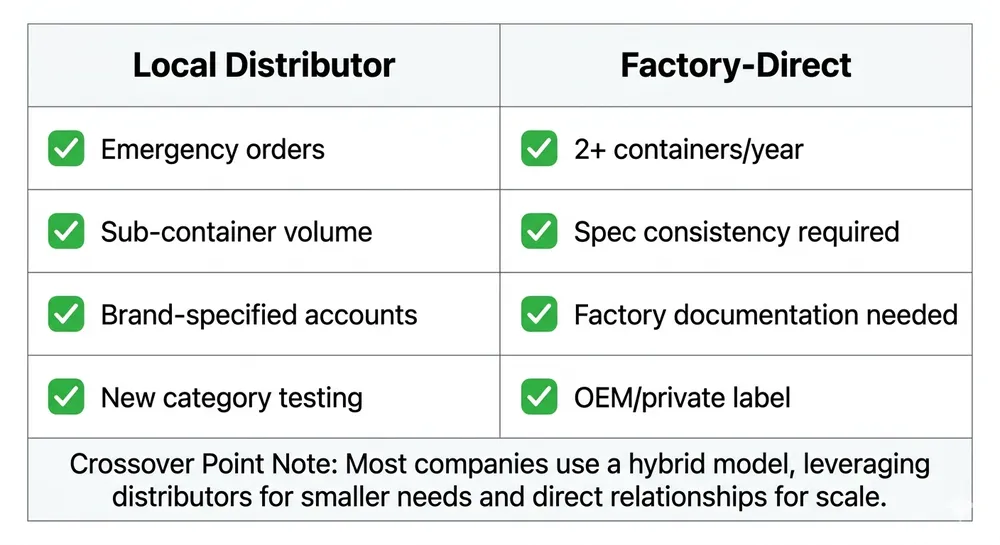
Urgent small orders — if you need 50 boxes by Thursday, no factory-direct relationship helps you. Your local distributor earns their margin on exactly this scenario.
Emergency replacement — equipment failure, unexpected consumption spike, a supplier shipment delayed at customs. Local inventory is your buffer. Most serious industrial buyers maintain a 4–6 week safety stock from their primary supplier and use local distributors as the emergency layer.
Compliance timing — if you're onboarding a new facility and need certified product on-site before your first IMSS safety audit, a local distributor with documentation on hand is faster than a new factory relationship.
Trial before commitment — if you're evaluating a new glove spec for a new application, buying a small quantity locally to test with your workers before committing to a container order is the sensible approach.
The factory-direct model works best as your primary supply channel for predictable, repeat volume — not as a replacement for every sourcing scenario.
Pricing Reference: What Industrial Nitrile Actually Costs in Mexico
Pricing in this market moves with raw nitrile butadiene rubber (NBR) commodity prices, freight rates, and currency fluctuation. These are representative ranges based on current market conditions, not fixed quotes.
| Sourcing Channel | Typical Price Range (per box of 100) | Notes |
|---|---|---|
| National distributor (branded) | MXN 280–420 | Includes 3M, Ansell, Kimberly-Clark |
| National distributor (generic) | MXN 180–260 | Variable spec consistency |
| Regional importer | MXN 150–220 | Better pricing, less spec control |
| Factory-direct (landed, container) | MXN 110–160 | Requires container MOQ, 30–45 day lead time |
(These ranges assume standard 4-mil powder-free industrial nitrile. Accelerator-free and chemical-resistant grades carry a 15–30% premium across all channels.)
The landed cost for factory-direct import includes freight, Mexican import duties, and customs brokerage. At current freight rates from Qingdao to Manzanillo or Veracruz, a 20-foot container of nitrile gloves typically runs USD 1,800–2,800 in ocean freight depending on routing and season. Your customs broker will handle the import classification — the relevant HS code for nitrile examination/industrial gloves in Mexico is typically 3926.20 or 4015.19 depending on the specific product type, and duty rates vary accordingly.
Matching Your Sourcing Route to Your Situation
The right sourcing model depends on three variables: your monthly consumption, your tolerance for logistics management, and how critical spec consistency is to your application.
If your consumption is below 500 boxes/month: Local distributor or regional importer. The container economics don't work at this volume, and the logistics overhead isn't worth it. Focus your evaluation on which local supplier has the most consistent spec documentation.
If your consumption is 500–2,000 boxes/month: This is the transition zone. Run the landed cost calculation for a direct factory relationship. If the annual savings exceed MXN 80,000–100,000, the logistics investment is worth making. Many buyers in this range use a hybrid model: factory-direct for their primary SKU, local distributor for secondary grades and emergency stock.
If your consumption is above 2,000 boxes/month: Factory-direct is almost certainly your better primary channel. At this volume, the landed cost difference compounds significantly, and the spec consistency benefit is worth the lead time management. You should be running a 6–8 week safety stock and ordering by container.
If your application is chemical-handling or high-compliance: Regardless of volume, your glove spec needs to be locked to a specific compound formulation with documented chemical resistance data. That means a direct relationship with a manufacturer who controls their own compound — not a distributor sourcing from whoever is cheapest that quarter.
For Industrial Nitrile Gloves specifications, thickness grades, and chemical resistance profiles relevant to Mexican industrial applications, that category page covers the technical selection criteria in detail.
If you're ready to run a landed cost comparison against your current supplier, the fastest path is to send us your current spec — grade, size, monthly volume, and delivery port — and we'll put together a full landed cost model. Request a quote with those details and we'll respond with a container-level price, freight estimate, and duty calculation so you have a real number to compare.